
Twin Due Date Calculator: Estimate Your Delivery Window
A Twin Due Date Calculator estimates a delivery-planning reference window for a multiple pregnancy while keeping your standard 40-week EDD as the pregnancy-dating reference. Enter your last period, ultrasound, IVF transfer, conception, or ovulation/IUI date, then select your twin type if known.
Twin pregnancies are often delivered before the standard 40-week EDD, but the recommended timing depends on the type of twin pregnancy and how the pregnancy progresses.
Chorionicity and amnionicity are important because twins who share a placenta or amniotic sac require different monitoring and may have different planned-delivery timing. Maternal health, fetal growth, surveillance findings, and pregnancy complications can also affect the final delivery plan.
Use the calculator to compare your standard EDD with a guideline-based planning range for an uncomplicated pregnancy. Your obstetric or maternal-fetal medicine team should determine your actual delivery timing.
Quick Facts
- Di/Di twins: Calculator reference window is 38w0d to 38w6d
- Mono/Di twins: Calculator reference window is 34w0d to 37w6d
- Mono/Mono twins: Calculator reference window is 32w0d to 34w0d
- Triplets or higher-order multiples: no universal calculator delivery window; specialist planning is required
- Unknown twin type: the calculator shows the standard 40-week EDD but does not assign a type-specific delivery window
- The standard 40-week EDD remains the pregnancy-dating reference even when planned delivery may occur earlier
- Updated Sep 11, 2026
- Reviewed by 100Calc Research Team
Multiple Pregnancy Calculator
Twin Due Date Calculator
Calculate your standard 40-week EDD and, when your twin type supports a general reference range, see an estimated delivery-planning window. The calculator supports LMP, conception, ovulation/IUI, IVF transfer, and ultrasound dating.
Use Last Period if you know the first day of your last menstrual cycle.
What you need to enter first
First, select your twin type and then choose the dating method that matches the information you know best. If your twin type is unknown, or you select triplets or higher-order multiples, the calculator will still show your standard EDD but will not invent a fixed delivery target.
Estimated Delivery Planning Window
Your pregnancy dating result and delivery-planning estimate will appear here.
(Used for medical charting)
Why this planning window?
An explanation of how your selected multiple type affects delivery planning will appear here.
Twin pregnancy timeline week by week
Short answer
A direct answer based on your inputs will appear here.
Are twins considered full term at 37 weeks?
Your dynamic answer about planned-delivery timing will appear here.
Is your due date earlier with twins?
Your dynamic explanation comparing the 40-week EDD with planned-delivery timing will appear here.
Explore More Calculators
Use the Chinese Gender Calculator for a traditional boy-or-girl prediction from lunar age and conception month. Enter conception date, due date, or LMP.
Try calculatorUse this fetal growth calculator to check baby weight percentile from ultrasound data in grams, kg, or cm and see what the result means…
Try calculatorEnter gestational sac measurements in mm or cm to calculate mean sac diameter, estimate early gestational age, compare week-by-week milestones, and see when follow-up…
Try calculatorMissed a birth control pill? Check pregnancy risk, protection status, backup contraception needs, and what to do next with our missed pill calculator.
Try calculatorUse our Pregnancy Chance Calculator to estimate your odds. Enter your cycle day, age, and method. Find out if you are in the high-risk…
Try calculatorUse our pregnancy due date calculator to find your exact Baby Due date. IVF, conception, ovulation, and ultrasound methods with weeks and timeline.
Try calculator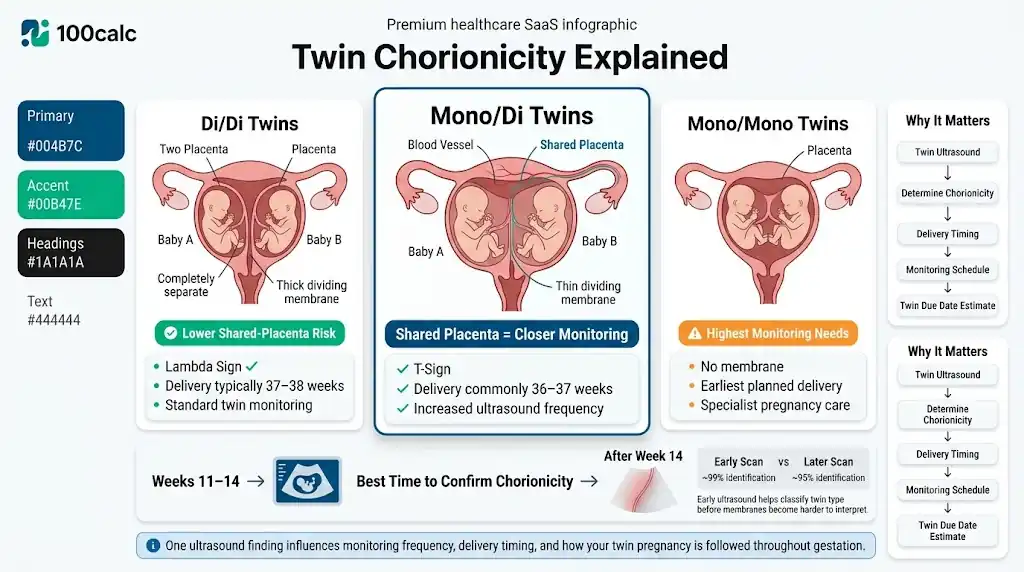
Micro Insight
Chorionicity can significantly affect monitoring and delivery planning in a twin pregnancy. Mono/Di twins share a placenta, so they generally need closer surveillance than Di/Di twins. Ask your care team whether chorionicity and amnionicity were identified on your ultrasound.
If your twin type is still unknown, the calculator can show your standard EDD but will not assign a type-specific delivery-planning window.
What Is Chorionicity in a Twin Pregnancy?
Chorionicity describes whether twins have separate or shared placentas. Di/Di twins each have their own chorion and usually separate placentas, Mono/Di twins share a placenta but have separate amniotic sacs, and Mono/Mono twins share both a placenta and an amniotic sac. Chorionicity is an important factor in pregnancy monitoring and delivery planning, but it is not the only factor that determines when delivery should occur.
Doctors check chorionicity with an ultrasound between weeks 11 and 14. They look for the number of placental masses and the shape of the membrane where it meets the placenta.
A thick membrane forms a lambda sign. That means separate placentas, or Di/Di twins. A thin membrane forms a T-sign. That means one shared placenta, or Mono/Di twins.
This scan is done early on purpose. After 14 weeks, the membranes start to thin and merge. The lambda sign can disappear by week 20 in some Di/Di pregnancies, making later scans less reliable. A first-trimester scan gets it right in about 99% of cases. A later scan drops to around 95%.
Once chorionicity and amnionicity are established, they become important parts of your pregnancy record and help guide monitoring and delivery planning. The final plan also depends on fetal growth, maternal health, complications, and findings during ongoing surveillance.
What Your Delivery-Planning Reference Window Means
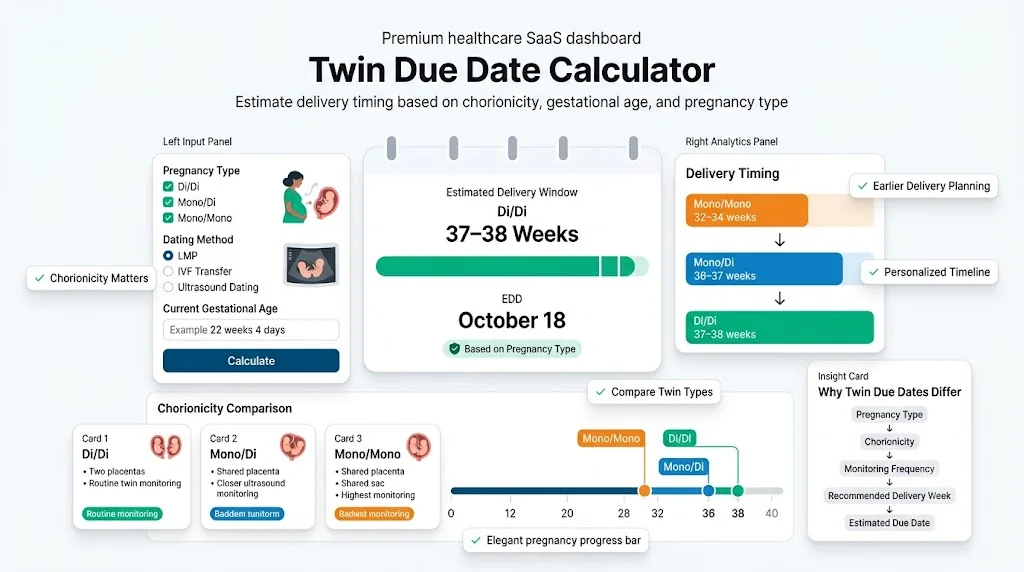
Your result can show two different pregnancy dates that answer different questions. The standard 40-week EDD is the pregnancy-dating reference used to establish gestational age. When your twin type has a defined calculator range, the delivery-planning reference window shows a general timing range for an uncomplicated pregnancy. It is not a prediction of the exact birth date or a replacement for your care team’s individualized plan.
Understanding Your Result
The standard 40-week EDD anchors gestational age throughout the pregnancy. Clinicians use gestational age to time prenatal care, interpret fetal growth and testing, and make pregnancy-management decisions. Twin pregnancy does not automatically replace this EDD with an earlier due date.
The delivery-planning reference window is different from the standard EDD. For twin types with a defined calculator range, it reflects guideline-based timing used as a reference for an uncomplicated pregnancy. Shared placentas or amniotic sacs can change pregnancy risks and therefore affect monitoring and planned-delivery timing. Your actual delivery plan may move earlier or differ from the calculated range if complications develop.
The two outputs serve different purposes: the standard EDD dates the pregnancy, while the type-specific reference window helps explain when planned delivery may be considered in an uncomplicated twin pregnancy.
Is Your Result Good or Bad?
A delivery-planning result is not a good-or-bad score. It is a reference range based on the twin type you selected.
For an uncomplicated Di/Di pregnancy, the calculator shows the Di/Di reference range. Mono/Di and Mono/Mono pregnancies have different reference ranges because shared placental or amniotic structures can require different monitoring and delivery planning.
An earlier reference window does not by itself mean that something is wrong. It reflects differences in how multiple pregnancies may be managed. At the same time, a pregnancy reaching the calculated range does not guarantee a low-risk delivery.
Your obstetric or maternal-fetal medicine team may recommend delivery before, within, or occasionally outside the calculator’s displayed range depending on maternal health, fetal growth, surveillance results, labor, membrane rupture, or other clinical factors.
What You Should Do Next
If you selected “Unknown,” check your ultrasound report or ask your care team whether chorionicity and amnionicity have been identified. The calculator will keep showing your standard EDD but will not assign a type-specific delivery-planning window until a twin type is selected.
Treat 32 weeks as a pregnancy milestone, not a universal “safe zone.” Babies born before 37 weeks are still considered preterm, and risks generally increase at earlier gestational ages.
Use your delivery-planning reference window to help organize practical preparations, but remember that labor may begin earlier and your care team may recommend different timing if clinical circumstances change.
Bring your standard EDD and calculator result to your next appointment and ask how the displayed reference range compares with your individualized delivery plan.
Quick Example to Test
Enter a conception date of April 10, 2026, with Mono/Di selected as your twin type.
The standard 40-week EDD is January 1, 2027. Using this calculator’s U.S.-oriented reference model for an uncomplicated Mono/Di pregnancy, the delivery-planning reference window runs from November 20 to December 17, 2026, corresponding to 34w0d through 37w6d.
On the example date of July 11, 2026, the pregnancy is about 15 weeks 1 day, in the second trimester. The delivery-planning window is only a reference range. Your care team may recommend different timing based on growth, surveillance findings, or pregnancy complications.
How to Use the Twin Due Date Calculator
This tool first estimates your standard 40-week EDD from the dating method you select. For eligible twin types, it then shows a guideline-based delivery-planning reference window for an uncomplicated pregnancy. The calculated range is educational and does not replace the individualized delivery plan made by your obstetric or maternal-fetal medicine team.
Select Your Twin Type
Choose Di/Di, Mono/Di, Mono/Mono, Triplets or Higher-Order Multiples, or Unknown. The calculator uses a type-specific delivery-planning reference window only for Di/Di, Mono/Di, and Mono/Mono twins. If you select Triplets/Higher-Order or Unknown, it still calculates the standard EDD but does not invent a universal delivery window.
Pick Your Dating Method
Five methods are available: last period, conception, ovulation or IUI, IVF transfer, or ultrasound. Each one feeds the calculator a different starting point for your standard EDD. Pick whichever date you know with the most confidence.
Enter Your Date and Extra Details
Type in the date tied to your chosen method. LMP needs a cycle length too, since cycles longer or shorter than 28 days shift the math. IVF transfer needs embryo age, since Day 3 and Day 5 embryos aren't the same gestational age on transfer day.
Tap Calculate to Build Your EDD and Planning Result
The tool calculates your standard 40-week EDD first. For Di/Di, Mono/Di, and Mono/Mono twins, it then converts the calculator's locked gestational reference range into calendar dates. Triplets/Higher-Order and Unknown do not receive a fixed type-specific delivery-planning window.
Review Your Delivery-Planning Result and Timeline
Your standard EDD appears alongside the delivery-planning reference window when one is available. The timeline also shows pregnancy milestones and current gestational progress. These dates are reference points for understanding the pregnancy timeline, not guarantees of safety or exact delivery timing.
Quick Example to Test
Try ultrasound dating with these values: scan date July 11, 2026, gestational age 10 weeks 2 days, twin type Mono/Di.
The standard 40-week EDD is February 4, 2027. Using the calculator’s Mono/Di reference range of 34w0d through 37w6d, the delivery-planning reference window is December 24, 2026 to January 20, 2027.
On the example scan date of July 11, 2026, the pregnancy is 10 weeks 2 days and remains in the first trimester.
How the Twin Due Date Calculator Stays Accurate
The calculator separates pregnancy dating from delivery planning. It first estimates the standard 40-week EDD using the dating method you select. For Di/Di, Mono/Di, and Mono/Mono twins, it then converts the locked U.S.-oriented reference gestational range into calendar dates. Triplets and pregnancies with unknown twin type do not receive a universal type-specific delivery window. The result is a planning reference for an uncomplicated pregnancy, not a prediction of the date your clinician will recommend delivery.
Key Features & Benefits
- Supports five dating methods, including LMP, conception, ovulation/IUI, IVF transfer, and ultrasound dating
- Uses the selected twin type to show a type-specific delivery-planning reference range when the calculator model supports one
- Shows the standard 40-week EDD alongside the delivery-planning reference window for Di/Di, Mono/Di, and Mono/Mono twins
- Tracks gestational age, trimester, and time remaining until the reference window begins when applicable
- Handles Triplets/Higher-Order and Unknown selections without assigning an unsupported universal delivery window
Technical Process
Base Dating
Builds your standard 40-week EDD from your chosen method, using period, scan, transfer, or conception date as the anchor point.
Delivery-Planning Reference Range
Checks today's date against the pregnancy-dating result and, when a type-specific window is available, shows current weeks pregnant, trimester, and days until the delivery-planning reference window begins.
Live Tracking
Checks today's date against your target window to show current weeks pregnant, trimester, and days remaining until delivery.
How the Twin Due Date Formula Works (Complete Breakdown)
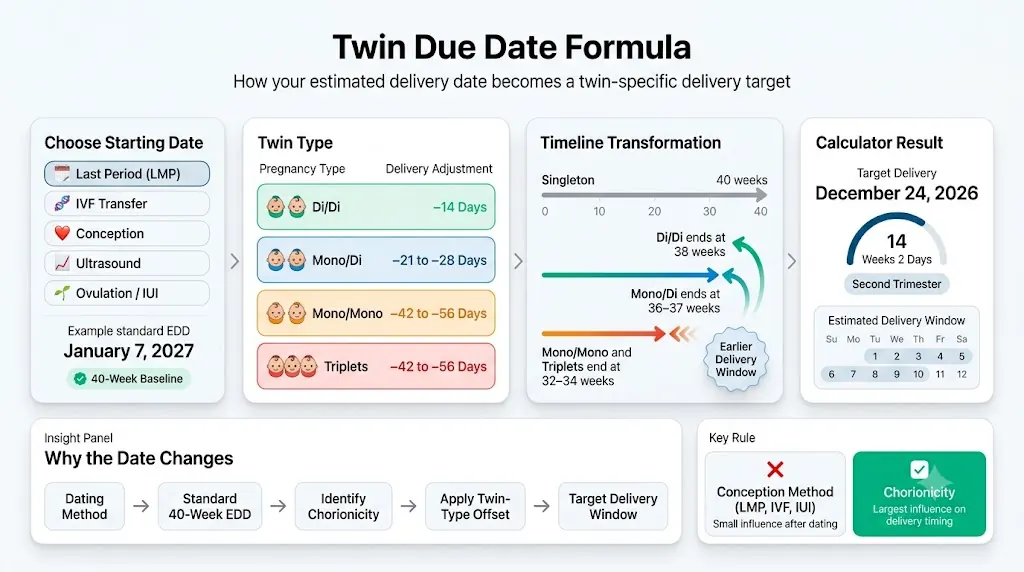
A Twin Due Date Calculator first establishes the standard 40-week EDD using the selected dating method. For Di/Di, Mono/Di, and Mono/Mono twins, it then converts the calculator’s type-specific gestational reference range into calendar dates. The standard EDD remains the pregnancy-dating reference; the second result is an estimated delivery-planning range.
Formula:
					Standard EDD = Pregnancy Dating Method Formula

Di/Di Reference Window = 38w0d to 38w6d
Mono/Di Reference Window = 34w0d to 37w6d
Mono/Mono Reference Window = 32w0d to 34w0d

Triplets / Higher-Order Multiples = No Universal Calculator Delivery Window
Unknown Twin Type = Standard EDD Only Until Twin Type Is Known
How the Formula Works
The first line works exactly like a regular pregnancy calculator. It takes your starting date and adds 280 days, then nudges that number based on your cycle length or embryo age if you used LMP or IVF dating.
The second step creates a delivery-planning reference range for twin types that have a defined calculator model. The number of days between the standard EDD and the displayed window depends on the selected twin type. Triplets and pregnancies with unknown twin type are handled separately because a single universal delivery window is not appropriate for those selections.
Understanding the Formula Variables
Standard EDD
Your 40-week reference date. It’s built the same way for twins as it would be for one baby, using LMP, conception, ovulation, IVF transfer, or ultrasound as the starting point.
Twin-Type Reference Range
For Di/Di, Mono/Di, and Mono/Mono twins, the calculator converts a locked gestational reference range into calendar dates based on the standard EDD. Triplets/Higher-Order and Unknown do not use a fixed chorionicity offset or receive a universal type-specific delivery window.
Cycle Length
Corrects LMP-based dating for cycles that run longer or shorter than 28 days. A 32-day cycle pushes ovulation later, so the calculator shifts your EDD forward to match.
Embryo Age
Day 3, 5, or 6, used to work backward from your transfer date to an estimated conception date. A Day 5 embryo is already five days along on transfer day, so the formula accounts for that head start.
Another Example Calculation (Step-by-Step)
This example uses ovulation dating instead of LMP, so you can see how the formula handles a different input path.
Given:
- Ovulation date: August 20, 2026
- Twin type: Mono/Di
Calculation:
					Standard EDD = Ovulation Date + 266 Days
Standard EDD = August 20, 2026 + 266 Days
Standard EDD = May 13, 2027

Mono/Di reference window = 34w0d to 37w6d
Window Start = Standard EDD − 42 Days
Window End = Standard EDD − 15 Days

Delivery-Planning Reference Window =
April 1, 2027 to April 28, 2027
Result:
- Standard 40-Week EDD: May 13, 2027
- Delivery-Planning Reference Window: April 1 to April 28, 2027
- Reference Gestational Range: 34w0d to 37w6d
Meaning:
This example uses ovulation dating, so it does not need the cycle-length adjustment used with LMP dating. The calculator first establishes the standard 40-week EDD, then applies the Mono/Di delivery-planning reference range. The resulting April 1 to April 28 window is an estimate for an uncomplicated pregnancy, not a scheduled delivery date. Actual timing depends on your care team’s assessment.
How do you calculate a twin due date?
A Twin Due Date Calculator first estimates the standard 40-week EDD from LMP, conception, ovulation/IUI, IVF transfer, or ultrasound dating. For Di/Di, Mono/Di, and Mono/Mono twins, it then converts a type-specific gestational reference range into calendar dates. The result is an estimated delivery-planning window for an uncomplicated pregnancy, while the standard EDD remains the reference for gestational age.
How early is delivery scheduled for Di/Di twins conceived via IUI?
A common question from moms who tracked ovulation or had an insemination procedure instead of a natural cycle.
Input
- Dating method: Ovulation / IUI
- IUI date: April 15, 2026
- Twin type: Di/Di
Process
The standard 40-week EDD is January 6, 2027, using the conception-based 266-day formula. Under this calculator’s U.S.-oriented reference model, an uncomplicated Di/Di pregnancy uses a delivery-planning reference window of 38w0d through 38w6d. That corresponds to December 23 through December 29, 2026.
Result
- Standard 40-Week EDD: January 6, 2027
- Delivery-Planning Reference Window: December 23 to December 29, 2026
- Pregnancy Progress on Example Date: 14 weeks 3 days
- Example Date: July 11, 2026
Meaning
Conception method does not determine the delivery-planning range here. The calculator first establishes gestational dating from the IUI date, then applies the reference range associated with the selected twin type. Actual delivery timing can differ if maternal or fetal factors require a different plan.
When do triplets typically get delivered?
One of the most searched questions from parents expecting three or more babies.
Input
- Dating method: Ultrasound
- Scan date: July 11, 2026
- Gestational age at scan: 7 weeks 0 days
- Twin type: Triplets
Process
The ultrasound dating calculation gives a standard 40-week EDD of February 27, 2027. The calculator does not assign a universal delivery-planning window for triplets because timing depends on chorionicity, amnionicity, fetal growth, complications, and the specialist care plan.
Result
- Standard 40-Week EDD: February 27, 2027
- Delivery-Planning Reference Window: Individual specialist assessment required
- Pregnancy Progress on Example Date: 7 weeks 0 days
- Example Date: July 11, 2026
Meaning
The standard EDD can still be calculated, but a single generic delivery window should not be applied to all triplet pregnancies. Your maternal-fetal medicine team will determine planned delivery timing based on the specific type of triplet pregnancy and how the pregnancy progresses.
What if I don't know my twin type yet?
A frequent situation for anyone who just found out they’re having twins and hasn’t had a dating scan.
Input
- Dating method: Last Period
- LMP date: May 1, 2026
- Cycle length: 30 days
- Twin type: Unknown
Process
The 30-day cycle adds 2 days to the standard LMP formula, giving a standard 40-week EDD of February 7, 2027. Because the twin type is unknown, the calculator does not assign a type-specific delivery-planning window.
Result
- Standard 40-Week EDD: February 7, 2027
- Delivery-Planning Reference Window: Twin type needed
- Pregnancy Progress on Example Date: 9 weeks 6 days
- Example Date: July 11, 2026
Meaning
You can still estimate the standard EDD before chorionicity and amnionicity are known. However, the calculator will not assume Di/Di or assign a delivery-planning range until the twin type is confirmed. Check your ultrasound report or ask your care team for the chorionicity and amnionicity result.
How far along am I with Mono/Di twins right now?
The question most Mono/Di moms ask once they know their exact conception date from a fertility clinic.
Input
- Dating method: Conception
- Conception date: February 1, 2026
- Twin type: Mono/Di
Process
The standard 40-week EDD is October 25, 2026. Using the calculator’s Mono/Di reference range of 34w0d through 37w6d, the delivery-planning reference window runs from September 13 through October 10, 2026.
Result
- Standard 40-Week EDD: October 25, 2026
- Delivery-Planning Reference Window: September 13 to October 10, 2026
- Pregnancy Progress on Example Date: 24 weeks 6 days
- Example Date: July 11, 2026
Meaning
On the example date, the pregnancy is 24 weeks 6 days. Because Mono/Di twins share a placenta, monitoring is typically more frequent than in uncomplicated Di/Di pregnancies. The calculated delivery range is a planning reference, while the actual delivery plan depends on surveillance findings and clinical circumstances.
Quick Rules to Remember
The standard 40-week EDD remains the pregnancy-dating reference. Di/Di, Mono/Di, and Mono/Mono selections can produce type-specific delivery-planning reference windows, while Triplets and Unknown require individualized information before a universal window can be assigned. Chorionicity and amnionicity are important to planning, but the actual delivery date depends on your care team’s assessment of the whole pregnancy.
Twin Due Date Calculator Result Benchmarks Explained
A Twin Due Date Calculator result should be interpreted as a delivery-planning reference, not a prediction or good-or-bad score. Different twin types may have different recommended timing ranges, while the actual plan depends on whether the pregnancy remains uncomplicated and on your care team’s ongoing assessment.
| Calculator Reference Window | Pregnancy Type | 100Calc U.S.-Oriented Model | NICE Planned-Birth Context | Important Note |
|---|---|---|---|---|
| 38w0d–38w6d | Di/Di | Type-specific reference window for an uncomplicated Di/Di twin pregnancy. | NICE recommends planned birth at 37 weeks for an uncomplicated Di/Di pregnancy. | Actual timing can change if maternal or fetal complications develop. |
| 34w0d–37w6d | Mono/Di | Type-specific reference window for an uncomplicated Mono/Di twin pregnancy. | NICE recommends planned birth at 36 weeks for an uncomplicated Mono/Di pregnancy. | Shared placental circulation requires closer surveillance. |
| 32w0d–34w0d | Mono/Mono | Type-specific reference window for an uncomplicated Mono/Mono twin pregnancy. | NICE recommends planned birth between 32w0d and 33w6d. | Specialist monitoring and individualized clinical planning are required. |
| No universal window | Triplets / Higher-Order | The calculator does not assign one fixed delivery-planning window. | NICE recommends 35 weeks for some uncomplicated triamniotic triplet pregnancies, while other triplet types require individualized timing. | Chorionicity, amnionicity, complications, growth, and specialist assessment matter. |
| No type-specific window | Unknown | The calculator shows the standard 40-week EDD only. | Chorionicity and amnionicity should be determined when possible to guide care planning. | Do not assume Di/Di when twin type is unknown. |
Important: These are planning references for uncomplicated pregnancies. The calculator's U.S.-oriented model and NICE planned-birth recommendations are not identical and should not be blended into one universal target. Your actual delivery timing depends on your care team's assessment of the pregnancy.
Interpretation
Pregnancy outcomes generally improve with advancing gestational age, but 32 weeks is still preterm and should not be treated as a universal “safe” threshold. Reaching the delivery-planning reference range also does not guarantee a low-risk birth. Use the range to understand general timing, while relying on your care team to assess fetal growth, maternal health, surveillance findings, and any complications that could change the plan.
Pro Tip
Ask your care team which delivery-planning range applies to your pregnancy once chorionicity and amnionicity are established. Knowing the current plan can help you prepare for leave, childcare, transportation, and hospital arrangements while remembering that the timing may change if new clinical findings appear.
What to Do After Using the Twin Due Date Calculator
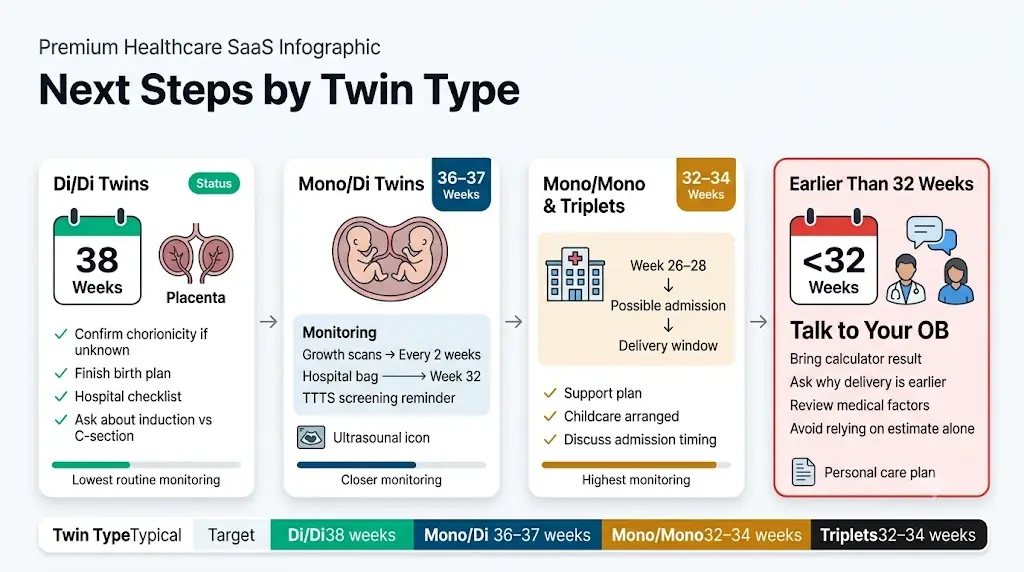
Your target window is a planning tool, not a finish line. What you do next depends on your twin type and how far along you are. Confirming a few key details early can protect both you and your babies from a rushed, last-minute scramble later in pregnancy.
For Di/Di Results (38w0d–38w6d Reference Window)
Di/Di twins generally have a later delivery-planning reference range than twins who share a placenta or amniotic sac. If you selected a confirmed Di/Di result, use the calculator range as a planning reference and discuss the actual timing and mode of birth with your care team. If your twin type has not been confirmed, check your ultrasound report or ask your clinician before relying on a type-specific range.
For Mono/Di Results (34w0d–37w6d Reference Window)
Mono/Di twins share a placenta and therefore require closer surveillance for complications specific to monochorionic pregnancy. Your care team may recommend more frequent ultrasound monitoring during pregnancy. Use the calculator’s Mono/Di window as a planning reference only, and ask your obstetric or maternal-fetal medicine team about your surveillance schedule and planned delivery timing.
For Mono/Mono or Triplet Pregnancies
Mono/Mono twin pregnancies require specialist monitoring because the twins share both a placenta and an amniotic sac. Triplet pregnancies also require specialist planning, but they should not automatically be assigned the Mono/Mono delivery range. Discuss surveillance, hospitalization if relevant, and planned delivery timing directly with your maternal-fetal medicine or obstetric team because these decisions depend on the specific pregnancy and clinical findings.
You Might Also Find These Helpful
Pregnancy & Fertility 45
Use this Pregnancy Risk Calculator to check age, BMI, health history, bleeding, and twins. See if closer prenatal monitoring may be worth asking about.
Try calculatorOne Time Pregnancy Calculator estimates pregnancy odds from one encounter, plus fertile window timing, test date, due date, and 21-day testing guidance.
Try calculatorUse the AMH Calculator to convert ng/mL or pmol/L, compare your result with age-based data, and see what it may mean for IVF, fertility,…
Try calculatorUse the Baby Eye Color Calculator with parents, grandparents, or sibling context to compare Brown, Green/Hazel, and Blue/Grey model estimates instantly.
Try calculatorBasal Body Temperature Calculator checks reading conditions and analyzes your temperature pattern for a sustained shift that may be consistent with ovulation.
Try calculatorBPD gestational age calculator: estimate fetal age from BPD, compare your week, check normal BPD ranges, and understand ahead or behind results.
Try calculatorCalculate odds with the Chance of Twins Calculator. Enter maternal age and history. Find your probability instantly. See if you will conceive multiples now.
Try calculatorFind out exactly when you conceived. Our free Conception Calculator uses your Due Date, LMP, or Ultrasound to estimate your fertilization date and fertile…
Try calculatorUse our Conception Date Due Date Calculator to find your baby's arrival date. Enter your conception or intercourse date for clinical 40-week results.
Try calculatorContraceptive effectiveness calculator to compare birth control methods, typical vs perfect use, backup protection, and 5-year pregnancy risk.
Try calculatorUse this CRL calculator to estimate gestational age and due date from crown-rump length in mm or cm. Compare CRL, LMP, and IVF dating…
Try calculatorEstimate your monthly and 12-month pregnancy odds by age, partner age, and cycle dates. See your fertile window and when to seek fertility help.
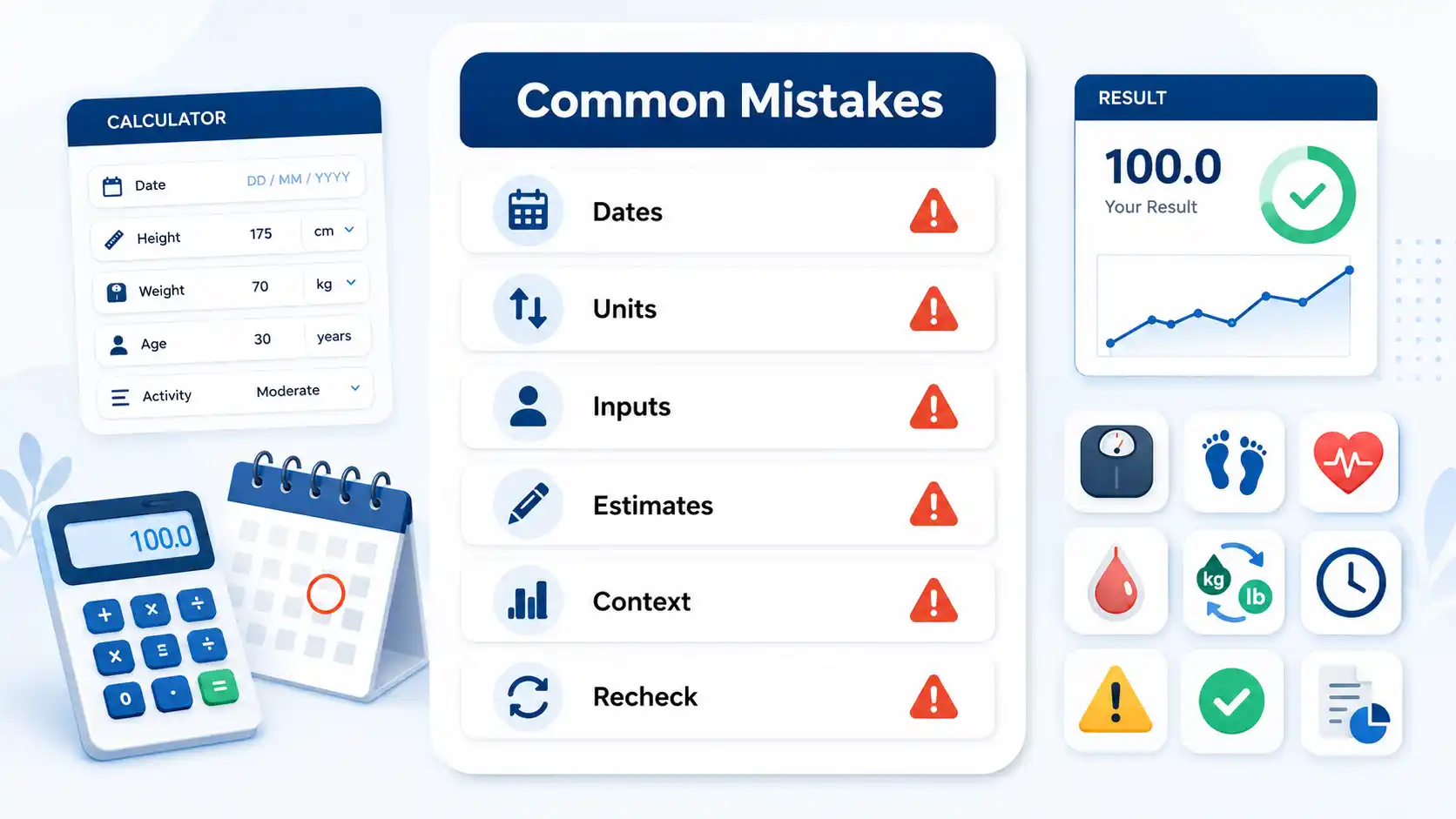
Try calculatorCommon Mistakes When Using the Twin Due Date Calculator
Small input errors throw off your target window more than most parents expect. Chorionicity, cycle length, and dating method all shift the math, and mixing them up leads to a result that doesn’t match what your OB actually plans. Here’s where most twin due date calculations go wrong.
- Assuming "identical twins" always means shared placenta, when Di/Di twins can be identical too
- Treating the standard 40-week EDD as the expected planned delivery date for a twin pregnancy
- Skipping the cycle length field on LMP dating, which skews the EDD by several days
- Sticking with an app-based date after an ultrasound has already updated your EDD
- Assuming that a type-specific delivery-planning range means birth anywhere in that range is automatically risk-free
Frequently Asked Questions (FAQs)
Does your due date actually change with twins, or just your delivery date?
Twin pregnancy does not automatically change how the standard EDD is established. The EDD remains the pregnancy-dating reference once it has been appropriately assigned. What may differ is planned delivery timing, which can be earlier depending on twin type and clinical circumstances. Changes to an established EDD should be uncommon and based on accepted pregnancy-dating criteria.
Why does my twin due date keep changing after every ultrasound?
Your EDD usually should not keep changing after every ultrasound. The first accurate ultrasound, especially in the first trimester, can establish or confirm gestational age and may revise an LMP-based estimate when the difference meets accepted dating criteria. Once the EDD is established, later changes should be uncommon. Later ultrasounds are generally used to assess fetal growth and well-being rather than repeatedly redating the pregnancy.
When will I find out I'm having twins on ultrasound?
Most twin pregnancies are confirmed around 6 to 8 weeks, once two gestational sacs or heartbeats become visible on an early scan. Chorionicity gets confirmed a few weeks later, between 11 and 14 weeks.
Can I calculate my due date before I know my twin type?
Yes. Select “Unknown” as your twin type. The calculator will still estimate your standard 40-week EDD, but it will not assume Di/Di or assign a type-specific delivery-planning window. Once chorionicity and amnionicity are known, select the confirmed twin type to see the applicable calculator reference range.
How do you calculate a due date for twin pregnancy?
Start by estimating the standard 40-week EDD from your pregnancy-dating information. For Di/Di, Mono/Di, or Mono/Mono twins, the calculator then converts the selected twin type’s delivery-planning reference range into calendar dates. The standard EDD remains the gestational-age reference, while the calculated window is an estimate for delivery planning.
Do twins usually deliver early?
Yes. Preterm birth is common in twin pregnancies, and ACOG notes that more than half of twins are born before 37 weeks. However, birth before 37 completed weeks is still considered preterm and can carry additional neonatal risks or require extra care. When delivery is planned depends on the twin type, pregnancy complications, fetal growth, and your care team’s assessment.
Can twins be born on their due date?
Yes, although many twins are born before the standard 40-week EDD. Planned delivery may also be recommended earlier depending on chorionicity, amnionicity, maternal or fetal conditions, and how the pregnancy progresses. The standard EDD still remains the pregnancy-dating reference.
In which month are most twins born?
There’s no fixed month. Timing depends on conception date and twin type, not season. Most twins arrive at 36 to 38 weeks gestation, regardless of when that falls on the calendar.
What's the difference between a twin due date calculator and a regular due date calculator?
A regular pregnancy due date calculator estimates the standard 40-week EDD. This Twin Due Date Calculator keeps that EDD and, when an eligible twin type is known, also estimates a separate delivery-planning reference window. The calculated window does not replace the EDD or your clinician’s individualized delivery plan.
Is a twin due date calculator accurate for IVF pregnancies?
Yes, if you enter your exact transfer date and embryo age, Day 3, 5, or 6. IVF dating tends to be more precise than LMP-based estimates.
Questions?
We had love to hear from you! Whether you are reporting an issue, suggesting a new calculator, or exploring collaboration opportunities — we are here to help. Every message helps us make 100calc smarter, faster, and more helpful for everyone.
Why People Trust 100calc
At 100calc.com, we focus on accuracy, speed, and trust. Every calculator we create is designed to give reliable, instant, and easy-to-understand results you can truly depend on.