
Heavy Equipment Hourly Rate Calculator: O&O Cost Engine
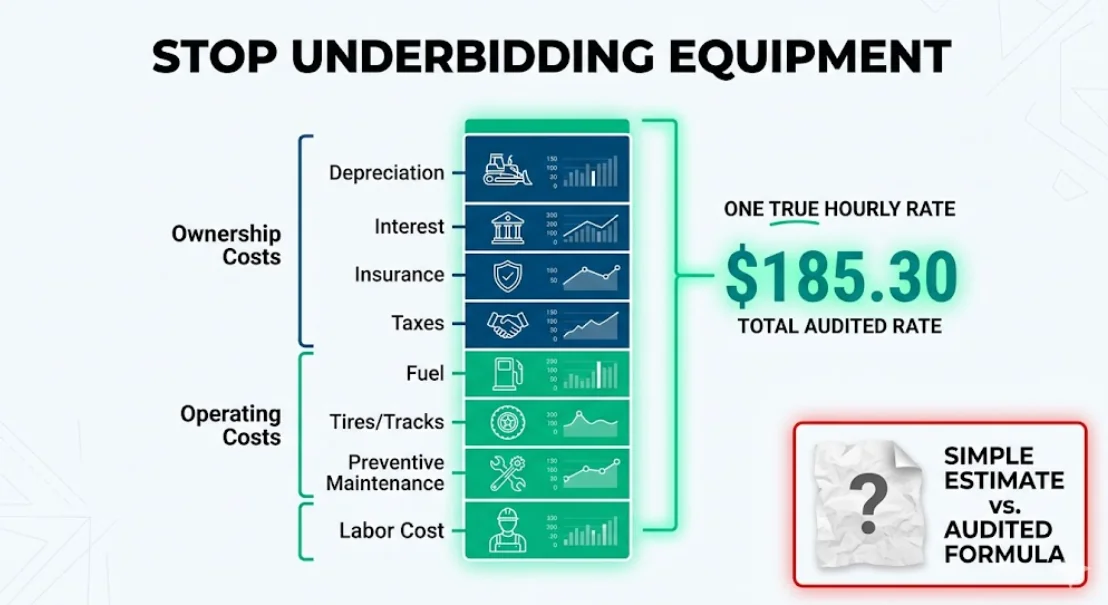
A heavy equipment hourly rate calculator determines the total cost of owning and operating machinery every sixty minutes. It combines fixed ownership expenses like depreciation and insurance with variable operating costs such as fuel and labor. This calculation gives you a sustainable billing rate. It prevents you from undercharging and losing money on long-term projects.
Most contractors guess their rates. One bad bid can destroy your profit for a whole year. Are your machines actually paying for themselves? Many owners ignore idle time costs. This hidden leak eats your cash while the engine is off.
This tool uses the professional O&O cost engine to find your exact break-even point. You will learn how utilization affects your bottom line. Set a billing rate that protects your margins and grows your business.
Quick Facts
- O&O Framework: Combines fixed ownership and variable operating costs.
- The Idle Rule: Machines sitting idle raise your hourly ownership cost.
- Margin vs Markup: Calculates profit as a percentage of total revenue.
- 2026 Benchmark: USA medium excavator rates average between $140 and $210 per hour.
- Updated Jun 17, 2026
- Reviewed by 100Calc Research Team
Ownership & Operating (O&O) Cost Engine
Equipment Hourly Rate Calculator
Calculate a bulletproof hourly billing rate. Whether you need a heavy equipment cost of ownership calculator or heavy equipment hourly rate calculator for earthmovers, or a precise machine hour rate calculation for CNC shops, this tool factors in depreciation, real-world idle time, running costs, and profit margin.
Final Hourly Billing Rate
Net Profit Margin: / hr
Hourly Cost Breakdown
People Also Ask
How to calculate machine rate per hour?
What is a heavy equipment cost of ownership calculator?
How to calculate CNC machining cost per hour?
What is the excavator per hour rate in pakistan?
Explore More Calculators
Wondering where your paycheck vanishes? Use this free Ramsey budget calculator to expose leaks, fund your Four Walls, and force your balance to exactly…
Try calculatorCalculate exact cost per minute for salaries, factory overhead, and electricity. Convert hours and minutes to money instantly with our free CPM calculator app.
Try calculatorDealerships hide massive lease rates in tiny decimals. Use this money factor calculator to convert MF to APR instantly and expose hidden markups.
Try calculatorBanks round transfers to 1,000 point blocks. Use our calculator to find exact points needed for 2026 award flights and avoid stranded airline miles.
Try calculatorExplore Related Tools
What Your Equipment Hourly Rate Means
Your result shows the exact financial weight of a single machine hour. This number reveals your sustainable billing floor. It separates actual profit from simple cash flow.
Understanding Your Result
This metric exposes your true cost of ownership. A final billing rate tells you exactly what to charge clients. The break-even number shows your absolute minimum operating cost. Any contract priced below your break-even point means you are losing money on every engine hour. Measuring costs this way prevents unexpected financial trouble at the end of the year.
Is Your Result Good or Bad?
Context depends entirely on market conditions and your equipment type. A high required billing rate often points to a growing efficiency gap. This usually happens when machine utilization drops or your overhead becomes too heavy.
A standard US billing rate for a compact skid steer lands between $85 and $115 per hour. Medium excavators typically sit around $160 to $210 per hour. Required rates climbing above local market averages signal a need for urgent production optimization. You might have excess idle time inflating your hourly depreciation.
What You Should Do Next
- Track your idle hours to stop wasting expensive machine depreciation time.
- Adjust the utilization slider to see how simple downtime destroys your profit margins.
- Use your calculated break-even rate to reject unprofitable contracts with total confidence.
- Review your loan interest terms if your fixed ownership costs look too high.
A Quick Example to Test
Imagine you run a compact track loader and need to find your target rate.
Input:
Enter a $75,000 purchase price and a $20,000 salvage value. Set useful life to 5,000 hours and utilization to 60%. Input zero for interest and insurance. Add $45 for total running costs like fuel and labor. Set a 15% margin.
Result:
The system calculates a break-even rate of $63.33 per hour.
Meaning:
Your final billing rate must be $74.51 per hour to hit your profit goal. Earning $60 an hour on a job leaves you burning cash and unable to replace the machine later.
What are heavy equipment ownership and operating costs?
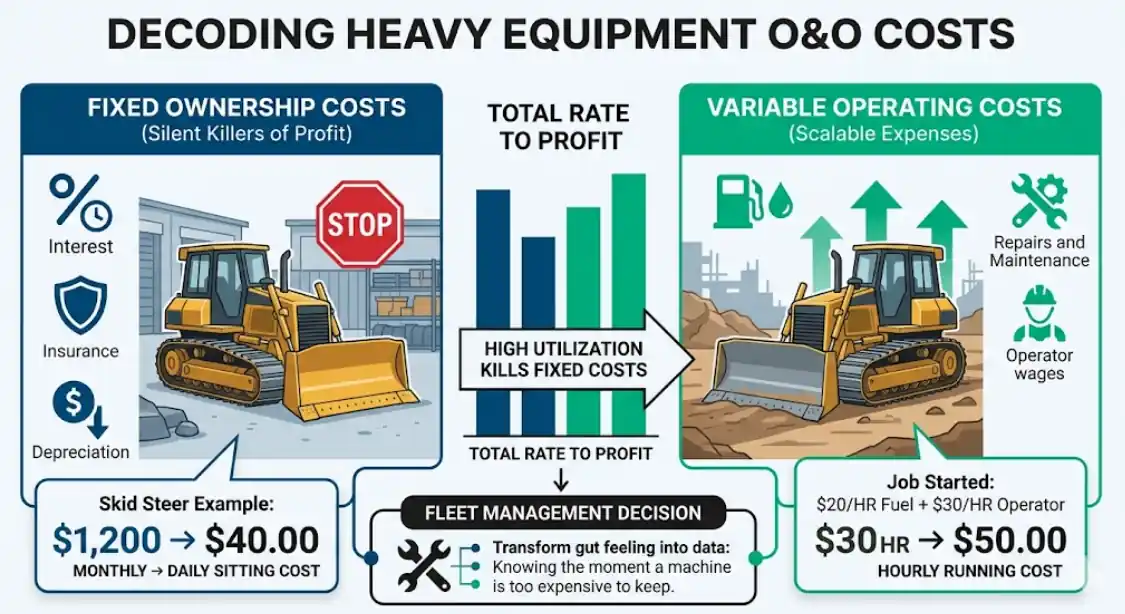
Ownership and operating (O&O) costs represent the total financial burden of a machine throughout its lifecycle. These expenses split into two categories. Fixed costs like depreciation and insurance occur regardless of use. Variable costs like fuel and repairs happen only when the engine runs. Balancing both ensures your billing rate covers every hidden expense.
Fixed ownership costs are the silent killers of profit. These include monthly loan interest and the steady drop in the machine’s resale value. Even if a bulldozer sits idle in a yard, it continues to lose value and cost money in insurance. This is why high utilization is the only way to recover these sunken investments.
Variable operating costs scale directly with work. Fuel consumption and hydraulic oil changes are primary examples. Operator wages and wear parts like bucket teeth also fall here. These expenses stop when the machine stops. Managing these costs requires tracking every gallon of diesel and every scheduled maintenance check.
Imagine a landscaping company buys a skid steer for $60,000. The monthly finance payment and insurance cost $1,200. This machine costs $40 every day just sitting in the trailer. Once the job starts, the owner adds $20 an hour for fuel and $30 an hour for the operator. The total rate must account for the $40 daily “rent” plus the hourly running costs to actually make a profit.
Micro Insight
Tracking O&O costs helps you spot the exact moment a machine becomes too expensive to keep. When repair bills and depreciation per hour exceed the revenue generated, it is time to sell. This data transforms a “gut feeling” into a professional fleet management decision.
How much do heavy equipment operators charge per hour?
Heavy equipment operators in the USA charge an average of $24 to $38 per hour in 2026. Highly skilled union workers on complex projects can command rates exceeding $45 per hour.
| Mode | Category | Primary Metric | Region Focus | Notes |
|---|---|---|---|---|
| Heavy Construction | Civil Works | Fuel & Utilization | USA / UK / PK | Best for excavators and earthmoving projects. |
| Industrial / CNC | Manufacturing | Power & Labour | Global / Europe | Focuses on precision shop floor hourly billing. |
| Fleet Management | Logistics | O&O Balance | Global | Ideal for managing mixed equipment portfolios. |
Heads-up: You must add this operator wage to your machine running costs to avoid underbidding.
How to Use the Heavy Equipment Hourly Rate Calculator
This tool converts massive capital investments into a simple hourly number. It processes fixed depreciation and variable running expenses. Follow these steps to find your exact billing rate.
Enter Purchase Data
Input the total amount paid for the machine. Add the expected resale value at the end of its use. The calculator subtracts this salvage value to find the true depreciable cost. This sets the baseline for your fixed ownership expenses.
Define Machine Life
Set the total hours the equipment will run before replacement. Adjust the utilization slider to reflect actual working time. The system uses this percentage to account for idle days. Lower utilization forces the hourly cost higher to cover lost time.
Add Running Costs
Type in your variable hourly expenses. Include diesel consumption, routine maintenance parts, and the operator wage. These numbers represent the cash burned only when the engine is running. The tool adds these directly to your baseline ownership cost.
Factor Financing
Open the advanced section to include hidden annual overhead. Enter your yearly loan interest rate and total insurance costs. The logic divides these annual numbers by your active working hours. This prevents financing fees from eating your expected profits.
Set Profit Goal
Input the targeted profit margin for your business. The system calculates this as a percentage of your total billing rate. It divides your break-even cost by the inverse of this margin. The final output is your required hourly charge.
How do you calculate the hourly rate for a heavy dozer?
Read your capital costs and estimate your annual idle time. To find your true billing rate, combine your fixed overhead with your hourly running expenses. Then apply your profit margin to the total. This is a major sticking point for earthmoving contractors who forget to account for depreciation.
This classic fleet scenario tracks a large production machine. Owners often struggle with pricing because they ignore loan interest.
Use these inputs in the calculator:
- Purchase Price: $600,000
- Salvage Value: $100,000
- Useful Life: 12,000 Hours
- Utilization: 75%
- Loan Interest: 6%
- Insurance: $6,000
- Total Running Costs: $120.00
- Target Profit Margin: 15%
Process:
The system adjusts your machine life based on the 75% utilization rate. It divides your $500,000 depreciable value by 9,000 effective hours. It adds your hourly overhead to your $120 running cost to find the break-even point. Finally, it divides that total by 0.85 to build in your profit.
Final Result:
- The final billing rate is $239.47 per hour.
Meaning:
Your dozer must earn exactly $239.47 every hour the engine runs. This rate covers massive depreciation, pays the operator, and secures a 15% business profit. Bidding lower guarantees a financial loss over the machine’s lifespan.
Accuracy and Method Behind the Heavy Equipment Hourly Rate Calculator
This system follows the industry-standard Ownership and Operating (O&O) cost model. It provides a professional-grade alternative to basic spreadsheets by factoring in the financial impact of machine downtime. Every calculation uses real-world logic to ensure your billing rate covers depreciation and overhead while securing actual profit.
Key Features & Benefits
- Adjusts hourly rates automatically based on your specific machine utilization percentage.
- Uses a professional revenue-based margin formula to protect your total business profit.
- Converts complex annual financing and insurance costs into precise 60-minute units.
- Supports global billing standards by switching between major regional currencies instantly.
- Visualizes cost distribution through an interactive ring chart for quick budget audits.
Technical Process
Data Capture
The engine gathers capital costs and operating variables to build a specific machine profile.
Logic Processing
Our algorithm normalizes annual overhead and adjusts life cycles for realistic idle time.
Result Delivery
The system outputs a sustainable billing floor with profit margins and break-even context.
How the Heavy Equipment Hourly Rate Formula Works (Complete Breakdown)
This heavy equipment hourly rate calculator uses a precise Total Cost of Ownership (TCO) formula. It calculates your required billing rate by separating fixed asset depreciation from variable running costs. Mastering this equation prevents the common mistake of underbidding jobs and losing money to hidden downtime expenses.
What is the heavy equipment hourly rate formula?
The heavy equipment hourly rate formula calculates your exact billing requirement. It divides your total fixed and variable costs by your target margin. The equation isolates depreciation and adds operating expenses like fuel. It also accounts for idle time. A lower utilization rate forces a higher hourly charge to break even.
Formula:
Hourly Rate = ( [ (Purchase - Salvage) / (Life × Utilization%) ] + [ (Insurance + (Purchase × Interest%)) / (Annual Hours × Utilization%) ] + [ Fuel + Maintenance + Labor ] ) / (1 - Margin%)
This formula calculates your true break-even point before applying a revenue-based profit margin. First, it isolates ownership costs that accumulate even when the machine is parked. Next, it adds operating expenses that occur only when the engine runs. Finally, it divides the total by the inverse of your margin. This structure stops contractors from confusing a simple cost markup with actual business profit.
Key Variables for Accurate Cost Tracking
Cost tracking variables measure the specific financial inputs needed to operate heavy machinery profitably. The core components include your initial purchase price, expected salvage value, annual utilization percentage, and daily running expenses like fuel and labor. Accurately monitoring these metrics prevents hidden downtime from destroying your project margins.
Purchase & Salvage Value
This combines your initial investment minus the expected resale amount. It represents the total capital consumed over the machine’s entire working life.
Utilization Rate
This percentage shows how often the machine actively works. Lower utilization heavily inflates your hourly ownership rate to cover the cost of idle days.
Operating Costs
These metrics include hourly fuel burn, operator wages, and routine maintenance parts. They represent the immediate cash required to run the equipment on a live job site.
Overhead & Interest
These inputs track fixed annual expenses like bank loans and insurance premiums. The system converts these yearly burdens into a specific hourly charge based on your working time.
Profit Margin
This defines your targeted financial return. The equation calculates this as a pure percentage of the final billed rate to secure true business growth.
What Each Variable Means
Each value below connects directly to your ownership and operating inputs. These numbers measure the exact financial drain of your machine per hour. Using accurate figures for fuel, labor, and expected idle time is critical. It ensures your final billing rate remains highly profitable and realistic for modern construction markets.
Another Example Calculation (Step-by-Step)
Check Your Value For Construction Machines
Let’s calculate the rate for a standard 20-ton excavator. This process shows how fixed overhead and variable costs merge into a single billing target.
Given:
- Purchase Price: $200,000
- Salvage Value: $50,000
- Life: 10,000 Hours
- Utilization: 75% (Assumes 1,500 annual hours)
- Total Running Costs: $75.00/hr
- Annual Overhead (Insurance/Interest): $12,000
- Target Profit Margin: 20%
Calculation:
					Ownership Cost = ((200000 - 50000) / (10000 × 0.75)) + (12000 / 1500) = 20.00 + 8.00 = 28.00
Break-Even = 28.00 + 75.00 = 103.00
Final Rate = 103.00 / (1 - 0.20) = 128.75
Result:
- Break-Even Rate: $103.00/hr
- Final Billing Rate: $128.75/hr
Meaning:
Your excavator costs exactly $103.00 per hour to own and operate at 75% utilization. You must bill $128.75 per hour to achieve your 20% profit target. Dropping below this rate means you are absorbing the cost of depreciation instead of passing it to the client.
How do you calculate heavy equipment hourly rates?
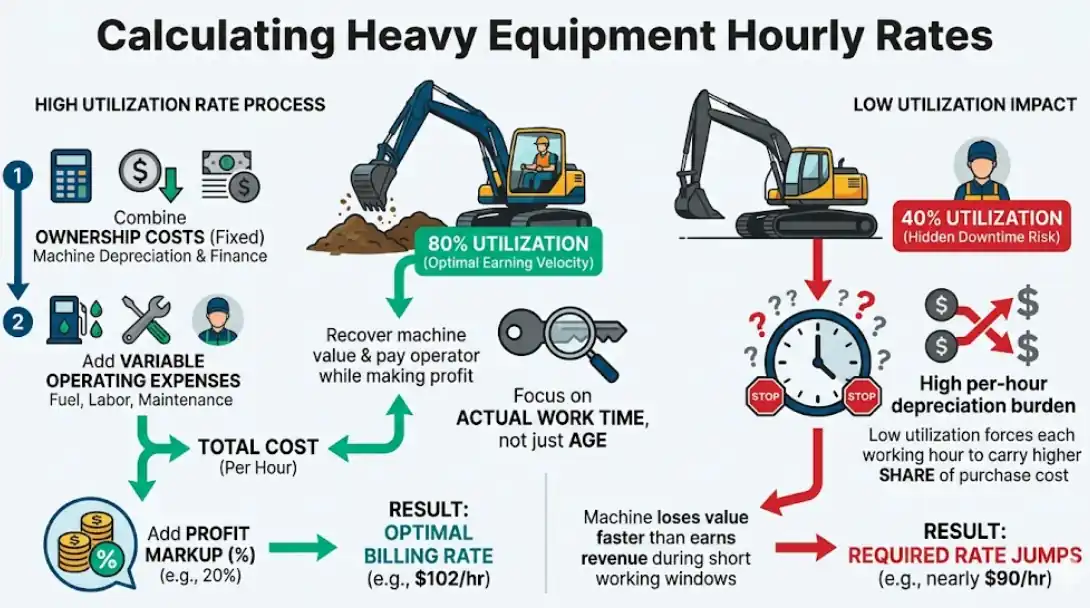
To calculate heavy equipment hourly rates, you must combine your total ownership costs with variable operating expenses. This involves adding machine depreciation and financing to hourly fuel and labor bills. The final step divides this total cost by the inverse of your profit margin. This ensures every hour billed covers the machine’s value loss and generates business profit.
What is the hourly billing rate for a mid-size excavator in the USA?
A civil contractor needs to price a machine for a long-term highway project. High fuel prices and labor shortages are currently driving these rates upward.
Use these inputs in the calculator:
$150,000 Purchase, $30,000 Salvage, 10,000 Hour Life, 80% Utilization, $60/hr Running Costs, 20% Profit Margin.
Process:
The system calculates the hourly depreciation at $15.00 and adds $6.25 for interest and insurance. This creates a total hourly cost of $81.25.
Result:
$101.56 per hour.
Meaning:
Billing $102 per hour ensures the contractor recovers the machine’s value and pays the operator while keeping $20.31 as pure profit.
What is the target rate for an excavator in Lahore, Pakistan?
Local operators in Gujranwala or Lahore often face high maintenance costs due to imported parts. Lower labor rates are usually offset by high fuel volatility and low machine utilization.
Use these inputs in the calculator:
Rs 12,000,000 Purchase, Rs 2,000,000 Salvage, 10,000 Hour Life, 50% Utilization, Rs 3,500/hr Operating Cost, 20% Profit Margin.
Process:
Low utilization doubles the hourly ownership cost. The break-even cost reaches Rs 5,000 per hour once maintenance and overhead are included.
Result:
PKR 6,250 per hour.
Meaning:
Charging less than PKR 6,250 means the owner is losing money on depreciation even if the daily cash flow looks positive.
How do you calculate the hourly rate for an industrial CNC machine?
A machine shop wants to bill a precision CNC mill. Industrial electricity costs and specialized labor are the primary drivers for this calculation.
Use these inputs in the calculator:
$100,000 Purchase, $20,000 Salvage, 20,000 Hour Life, 90% Utilization, $35/hr Running Costs, 10% Profit Margin.
Process:
High utilization spreads the purchase cost thin. The total hourly operating cost plus depreciation equals $44.44.
Result:
$49.38 per hour.
Meaning:
Because the machine runs almost constantly, the owner can offer a competitive $50/hr rate while still hitting a 10% profit margin.
What is the cost per hour for a compact track loader with high idle time?
Landscaping companies often have machines sitting on trailers or idling at job sites. This “hidden downtime” drastically changes the required billing rate.
Use these inputs in the calculator:
$80,000 Purchase, $20,000 Salvage, 6,000 Hour Life, 40% Utilization, $40/hr Running Costs, 15% Profit Margin.
Process:
The 40% utilization rate forces the machine to pay for itself in fewer working hours. This pushes the total hourly cost to $75.00.
Result:
$88.24 per hour.
Meaning:
The owner must bill nearly $90 per hour. Lower rates fail because the machine loses value faster than it earns revenue during its short working windows.
Quick rule to remember
Focus on the machine’s actual work time rather than just its age. A machine that sits idle costs significantly more per hour than one that runs all day. Once you understand your utilization, enter your specific fuel and labor numbers into the calculator to lock in your profit. Use these results to bid on projects with total financial clarity.
Heavy Equipment Hourly Rate Benchmarks Explained
Your calculated billing rate determines your bidding power. Compare your final number against these 2026 industry standards to evaluate your overhead costs. This quick check ensures you never undercharge for valuable machine time or lose out to competitors.
| Machine Type | Status | USA Rate (2026) | Pakistan Rate (2026) | Notes |
|---|---|---|---|---|
| Compact (Skid Steer) | Competitive | $85 - $110/hr | PKR 1,800 - 2,500/hr | Healthy baseline for landscaping projects. |
| Medium (130 Excavator) | Standard | $160 - $200/hr | PKR 4,500 - 6,000/hr | Core earthmoving benchmark across sites. |
| Heavy (D10 Dozer) | Premium | $450 - $650/hr | PKR 15,000+/hr | High specialization required due to fuel burn. |
Heads-up: Market rates fluctuate based on diesel prices and local labor. Always confirm regional fuel surcharges before finalizing a bid.
What These Ranges Mean
Profitable contractors keep their pricing within standard competitive zones. Falling below these marks indicates you are consuming your own depreciation instead of building capital. Rates pushing higher than premium limits usually point to severe idle time issues. You must fix those hidden leaks to stay viable in the market.
Pro Tip
Review your annual utilization percentage first if your required billing rate seems too high. Increasing your active work hours drops your hourly ownership burden fast.
What to Do After Using the Heavy Equipment Hourly Rate Calculator
Your calculated result serves as a financial map for your construction business. Use this number to spot hidden leaks in your daily operations and fleet management. The next steps involve tightening your schedule and reducing unnecessary fuel burn across your job sites. Small changes in machine usage lead to much bigger profit margins almost immediately.
For High Required Rates
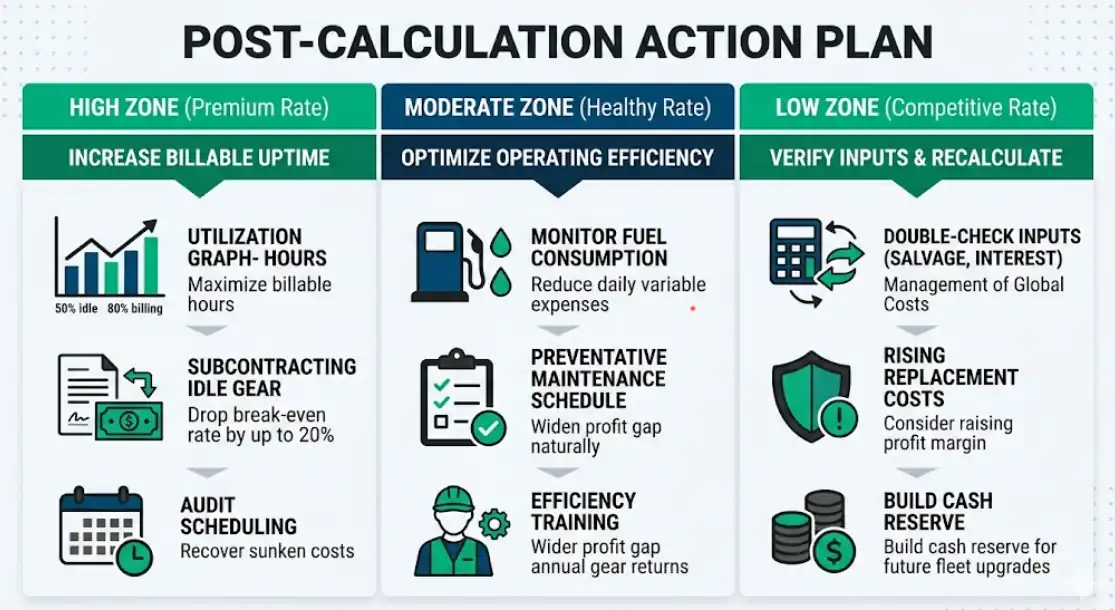
Landing in the premium zone usually means your machine sits idle too often. Low utilization forces each working hour to carry a heavier share of the purchase cost. You must increase your billable hours to lower this ownership burden fast. Aim to move from 50% usage to 80% to drop your break-even rate by up to 20%. Subcontracting your idle equipment to other firms during slow periods helps recover these sunken costs. Audit your job site scheduling to ensure machines are not waiting for materials or direction. Every hour of downtime actively drains your business capital and resale value.
For Moderate Required Rates
Moderate rates suggest your business is healthy but could benefit from better operating efficiency. Focus on reducing your daily variable expenses to widen your profit gap naturally. Monitor your fuel consumption and check for excessive engine idling at the start of each shift. High idle times on newer Tier 4 engines can inflate costs by 15% without moving any dirt. Implementing a strict preventative maintenance schedule prevents expensive emergency repairs that ruin project budgets. Small savings on wear parts or fuel add up to significant annual returns for your fleet. Operators in the USA should focus on efficiency training to maximize the work done per gallon of diesel.
For Low Required Rates
Low rates might look competitive but could signal that you are undercharging for your machine value. Double-check your salvage value and interest inputs to ensure they reflect current market prices. You might be ignoring the rising cost of replacement machinery in your local area right now. Owners in Pakistan should focus on managing parts-import costs to keep these rates sustainable. Consider raising your profit margin if your overhead stays consistently low compared to competitors. This system allows you to build a solid cash reserve for future fleet upgrades. Ensure you are not sacrificing long-term machine health just to win a short-term bid.
You Might Also Find These Helpful
Personal Finance 4
No tools published here yet.
Explore Related Tools
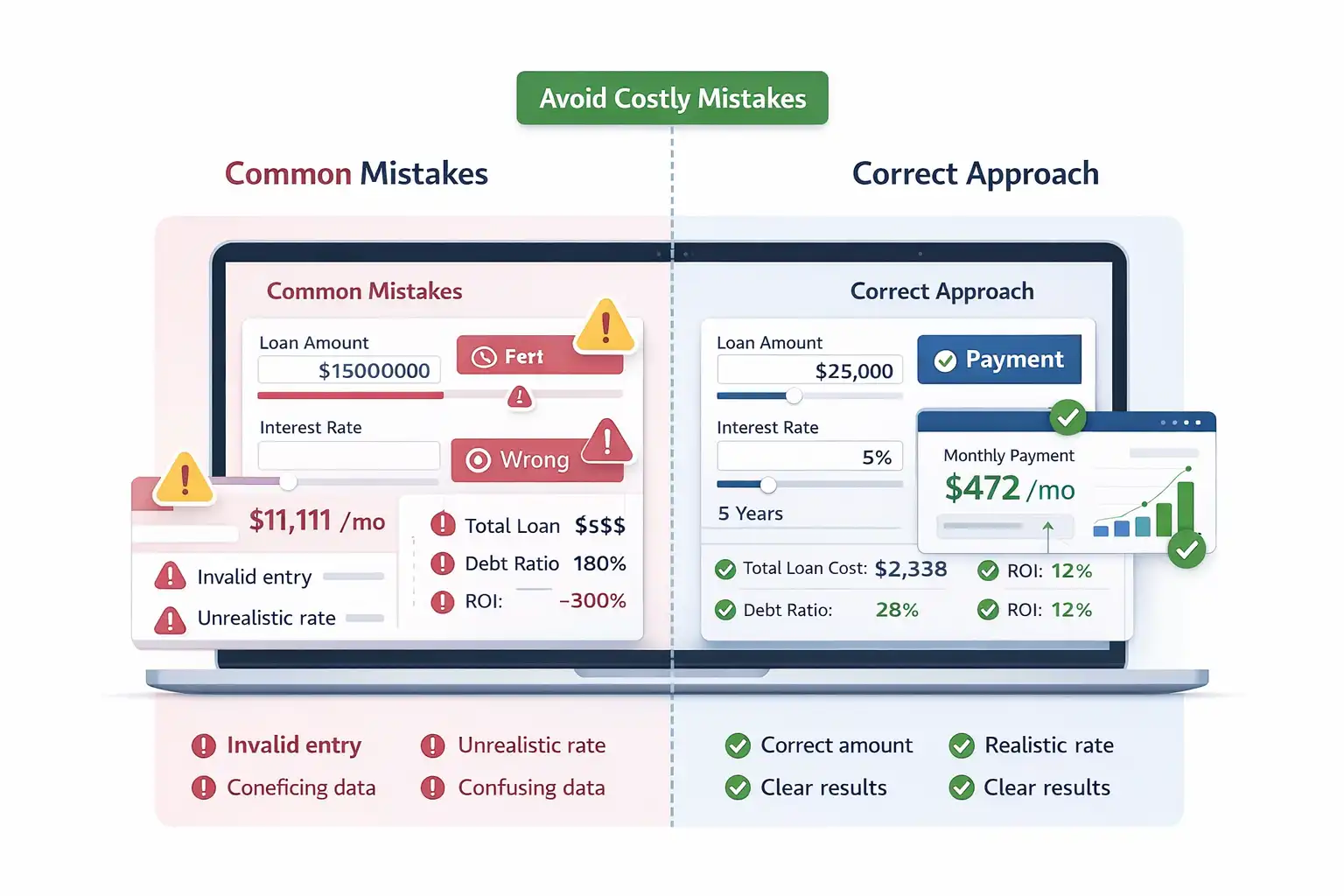
Common Mistakes When Calculating Equipment Hourly Rates
Small input errors can easily turn a profitable project bid into a financial loss. Many contractors get the wrong result because they confuse basic accounting terms or ignore hidden overhead. Avoiding these calculation mistakes ensures your final billing rate remains sustainable and accurate.
- Ignoring Interest: Forgetting to factor in the annual 5-8% loan rate on a $200k machine.
- Theoretical Life: Assuming a machine lasts 10,000 hours when site conditions limit it to 6,000.
- Markup vs. Margin: Adding 20% to cost instead of calculating for a 20% profit on revenue.
- Unburdened Labor: Entering only the base operator wage while ignoring payroll taxes and insurance.
- Perfect Utilization: Assuming 100% active work time while ignoring inevitable seasonal downtime or idle days.
Frequently Asked Questions (FAQs)
How much do heavy equipment operators charge per hour?
Heavy equipment operators in the USA charge an average of $24 to $38 per hour in 2026. Highly skilled union workers on complex projects can command rates exceeding $45 per hour.
You must add this operator wage to your machine running costs to avoid underbidding.
How do I calculate my hourly pay rate?
Calculate your true hourly pay rate by combining total ownership costs and daily operating expenses. Apply your desired profit margin using the formula: Break-even Cost divided by the inverse margin.
Relying purely on local market averages ignores your specific loan terms and daily fuel burn.
How to calculate manpower cost per hour?
Calculate manpower cost per hour by taking the base employee wage and adding the employer burden. This burden includes payroll taxes, workers compensation insurance, and health benefits. This typically adds 30 to 40 percent on top of the base salary.
Use this fully burdened rate when estimating equipment operating costs.
What is the formula for cost per hour?
The formula for cost per hour combines fixed ownership expenses and variable operating expenses. You determine ownership by dividing depreciation and interest by total working hours. Then add your hourly fuel, maintenance, and labor costs.
This combined total gives you the absolute break-even point for the machine.
How many hours is 7:30 to 4:30 PM?
A shift from 7:30 AM to 4:30 PM is exactly 9 hours. Deducting a standard 30 minute unpaid lunch break leaves 8.5 actual billable or engine hours.
Accurate shift tracking ensures you bill the client correctly for both the operator time and machine usage.
How to calculate hours for payroll?
Calculate hours for payroll by subtracting the start time from the end time. Convert any remaining minutes into decimals. Eight hours and fifteen minutes becomes 8.25 hours. Multiply this decimal by the operator hourly rate.
This prevents wage disputes and ensures accurate job site cost tracking.
What is 4:45 PM to 24h?
In the 24 hour clock format, 4:45 PM translates to 16:45. Convert any afternoon or evening time to military time by simply adding 12 to the hour.
Construction managers frequently use this format on equipment logs to avoid confusion between morning and evening shifts.
How many hours is a 7 AM to 3 PM shift?
A shift from 7 AM to 3 PM is exactly 8 hours. This timeframe represents the standard first shift in construction and industrial sectors. Taking a mandatory 30 minute lunch break drops the billable labor time to 7.5 hours.
Tracking these exact hours is critical for calculating daily operating costs.
Questions?
We had love to hear from you! Whether you are reporting an issue, suggesting a new calculator, or exploring collaboration opportunities — we are here to help. Every message helps us make 100calc smarter, faster, and more helpful for everyone.
Why People Trust 100calc
At 100calc.com, we focus on accuracy, speed, and trust. Every calculator we create is designed to give reliable, instant, and easy-to-understand results you can truly depend on.