
Corporate Calculators: Run Your Business Math Without the Spreadsheets
What are corporate calculators? They are free online tools that help founders, CFOs, and analysts evaluate company performance. You can estimate business valuation, measure your cost of debt, and calculate exact capital asset pricing. These tools turn complex balance sheet data into clear operational decisions.
Most business owners rely on fragile spreadsheet templates or expensive consultants to find their numbers. That is a risky way to run a company. You need instant, unbiased math to avoid undervaluing your agency or taking on toxic corporate debt.
Browse our complete collection of corporate finance tools below. Choose the exact calculator you need to measure sustainable growth, calculate net operating profit, and scale your operations with total financial confidence.
- Fast financial modeling
- Unbiased formulas
- No signup required
All Corporate Calculators
Pick a calculator based on your immediate financial goal. Every tool below handles a specific corporate metric or valuation model. Choose the option that matches your current business challenge. You will receive clear data to guide your next executive decision instantly.
Corporate Finance 7
Use this After-Tax Cost of Debt Calculator to find your true effective rate. Factor in corporate tax shields, estimate Bond YTM, and uncover exact…
Try calculatorAre adjusters using flawed reports to lowball your claim? Calculate your true Actual Cash Value (ACV) to expose hidden depreciation and maximize payouts.
Try calculatorStop guessing your hurdle rates. Use this Cost of Equity Calculator to run CAPM or DGM models. Expose hidden market risks and find your…
Try calculatorIs that high-yield dividend stock a trap? Use our Gordon Growth Model calculator to find its exact intrinsic value, set buy prices, and expose…
Try calculatorStandard IRR inflates your profits. Use our MIRR Calculator with WACC to calculate true project returns, safely reinvest cash, and find exact NPV instantly.
Try calculatorCalculate your true cash flow with our net operating profit after tax calculator. Strip away debt distortions from EBIT, EBITDA, or Net Income instantly.
Try calculatorAre you growing too fast? Use our sustainable growth rate calculator to find your exact revenue ceiling before a hidden cash deficit ruins your…
Try calculatorOther Finance tools you may find useful
What is Corporate Finance?
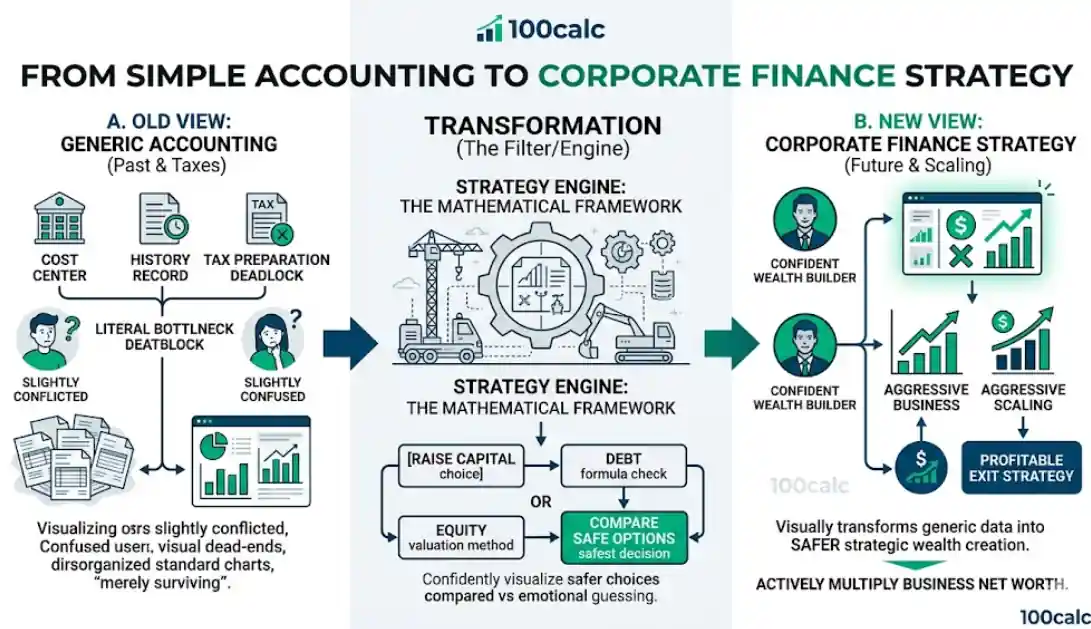
Corporate finance is the strategic direction of a company’s money and investments. This field focuses on how businesses raise capital, allocate operational funds, and maximize shareholder value. Unlike basic accounting that records past transactions, financial strategy looks entirely forward. These mathematical principles help leaders decide which projects generate the highest return.
Every growing business eventually faces massive spending choices. Executives must decide whether to take on bank debt, issue company stock, or reinvest their own profits. Corporate finance provides a strict mathematical framework to compare those options safely. Strong formulas remove emotional guesswork from your corporate strategy.
Imagine a mid-sized manufacturing company wanting to buy a new factory. The executive team cannot just guess if the expansion is a smart move. They use corporate finance models to project future cash flows. Analysts carefully weigh the cost of a commercial loan against the expected profit from increased production volume.
Deep financial analysis protects a business from unexpected bankruptcy. Such planning ensures that a company creates more value than it consumes daily. Founders and CFOs rely on these exact valuation methods to secure venture capital or plan a highly profitable exit strategy.
Micro Insight
Mastering these numbers shifts your focus from just paying yearly taxes to actively multiplying your business net worth. True corporate finance is the mathematical difference between merely surviving and aggressively scaling.
What Corporate Math Actually Exposes Before You Scale
Business formulas help you test the exact numbers behind your daily operations. You can project startup cash runway, calculate strict break-even thresholds, and find your precise company valuation. Founders and financial officers rely on this data to verify profitability and secure venture capital safely.

Key Tasks Users Perform
Value a company for acquisition
Estimate your exact exit price using standard market multiples and adjusted net profit.
Calculate exact break-even points
Find the specific sales volume needed to cover fixed overhead and stop burning cash.
Project startup cash runway
Measure exactly how many months your business can survive before requiring new funding.
Compare ROI for capital expenditures
Test whether a massive equipment purchase will actually generate a profitable long-term yield.
Core Inputs Used
EBITDA and Discretionary Earnings
The normalized profit numbers buyers use to determine your true operational cash flow.
Fixed and variable operational costs
The monthly cash required to manufacture products, pay salaries, and keep the lights on.
Customer Acquisition Cost and Churn
The total marketing dollars spent to acquire a single user and the rate they leave.
Nominal interest rates and capital
The exact percentages and initial loan amounts required to fund new corporate expansion.
Decoding Wall Street Math: How Our Corporate Calculators Process Your Data
Our corporate tools process your business numbers using strict underwriting standards. We combine time-value discounting equations with recognized accounting ratios to deliver precise valuations. This strips away the guesswork and gives founders the exact mathematical clarity needed to make safe financial decisions.
The Processing Engine: Turning Raw Revenue Into Actionable Valuation
Corporate tools map your current cash flow against future growth timelines. The system takes your baseline revenue, applies a specific discount rate, and adjusts for expected market inflation. This calculates the exact present-day value of your future business earnings.
Standard corporate finance relies on the time value of money. A dollar made today is worth more than a dollar made in the future. Our tools calculate this exact depreciation to reveal your true investment yield.
Insight: A simple one percent change in your expected discount rate can completely alter whether a project looks highly profitable or financially disastrous.
Unmasking the Formulas: Why We Reject Flawed Static Multiples
We build our logic using recognized Capital Asset Pricing Models and Net Present Value equations. This matches the exact underwriting standards used by Certified Public Accountants and investment bankers. We refuse to use generalized industry averages that ignore your specific company structure.
Basic calculators often apply a flat revenue multiple to every business. That approach hides your true operating costs. Our systems require specific margin inputs so you see the real financial health of your enterprise.
Insight: Relying on a generic industry multiple without adjusting for your unique operating expenses will severely overvalue your business during a sale.
Outdated Math is Dangerous: How We Audit Changing Tax Laws
We regularly audit our underlying calculation logic to match current Generally Accepted Accounting Principles and federal tax codes. When the IRS shifts corporate tax brackets or depreciation rules, we adjust our processing engines immediately.
Corporate finance laws constantly evolve at the federal level. We monitor these changes to ensure our tools reflect the most current regulatory realities. This prevents you from using obsolete math to make modern board-level decisions.
Insight: Using last year’s corporate tax logic to calculate this year’s net operating profit can trigger massive cash shortages during tax season.
The Forecasting Trap: When Your Projections Will Break the Math
Your final output will differ from reality if you input overly aggressive growth targets. Standard algorithms assume your revenue will grow consistently over time. If your company experiences a sudden drop in sales, the original valuation timeline breaks instantly.
Online tools also assume constant capital efficiency. If you require a sudden cash injection to stay afloat, your equity dilution changes immediately. Unpredictable hiring costs will also alter your final break-even point.
Insight: Projecting a ten percent annual growth rate without factoring in eventual market saturation almost always leads to a dangerous overvaluation.
The Hidden Market Variables That Skew Your Final ROI
Mathematical accuracy depends entirely on the financial assumptions you input. A pure formula cannot predict sudden shifts in federal interest rates or unexpected supply chain costs. Your final return on investment will fluctuate heavily based on these localized economic variables.
Corporate finance deals heavily in future probabilities. Your actual net profit will shift based on external market forces. Failing to input a realistic customer churn rate will severely skew your final cash flow results.
Insight:Underestimating your true customer acquisition cost is the primary reason startup profit margins collapse after the first year of scaling.
Important note: Results are estimates. For major decisions, verify with a qualified professional.
Are Your Business Targets Actually Safe? Standard Corporate Benchmarks
Knowing your current profit solves only part of the problem. You must also understand if your numbers represent a healthy operation or a fragile one. These standard industry benchmarks help you judge your financial safety before you pitch investors or negotiate an exit.
| Range | Metric | Meaning | What To Do |
|---|---|---|---|
| 12–18 Months | Safe Runway | Your startup has enough cash to survive without new funding. | Focus heavily on product growth rather than emergency fundraising. |
| 2.5x to 4x | Standard Multiple | Normal valuation range for a traditional small business based on SDE. | Use this baseline unless you run a high-growth tech company. |
| Under 10% | Danger Margin | Your net profit is too low to survive minor market shifts. | Audit your operating costs immediately to stop bleeding cash. |
Heads-up: These are general guidelines. Exact safety limits depend heavily on your specific industry, market conditions, and business model.
Stop Guessing: Executive Rules for Smarter Valuation
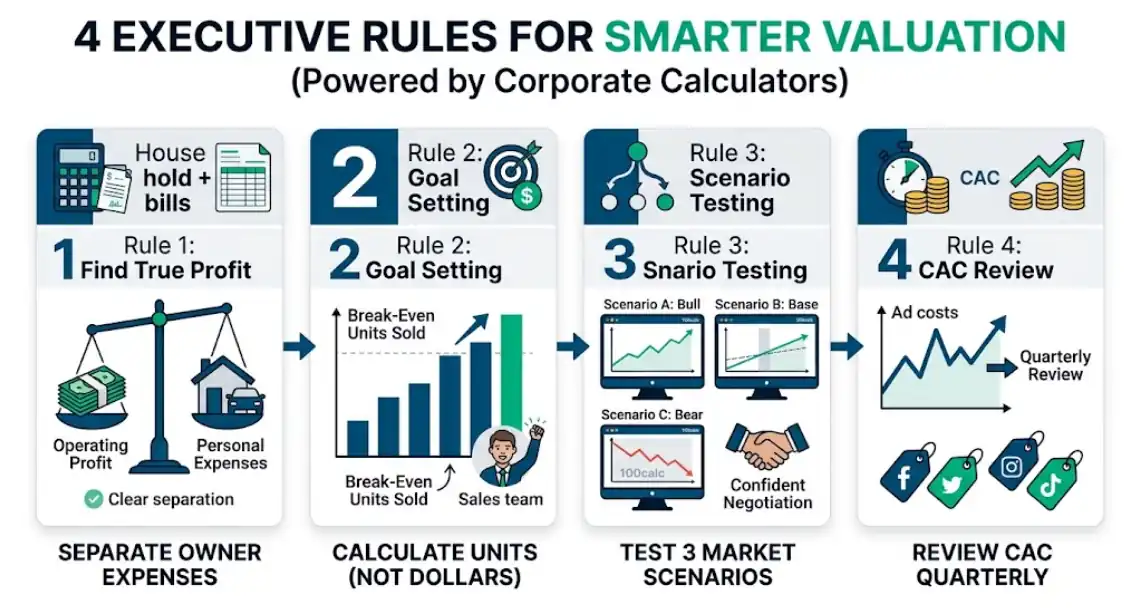
- Always separate your personal owner expenses from the official balance sheet to find true operating profit.
- Calculate your break-even point in units sold rather than just dollars to set clearer goals for your sales team.
- Test your valuation using three different market scenarios to prepare for aggressive buyer negotiations.
- Review your customer acquisition cost every quarter because advertising platforms constantly raise their prices.
The 5 Most Expensive Corporate Math Mistakes
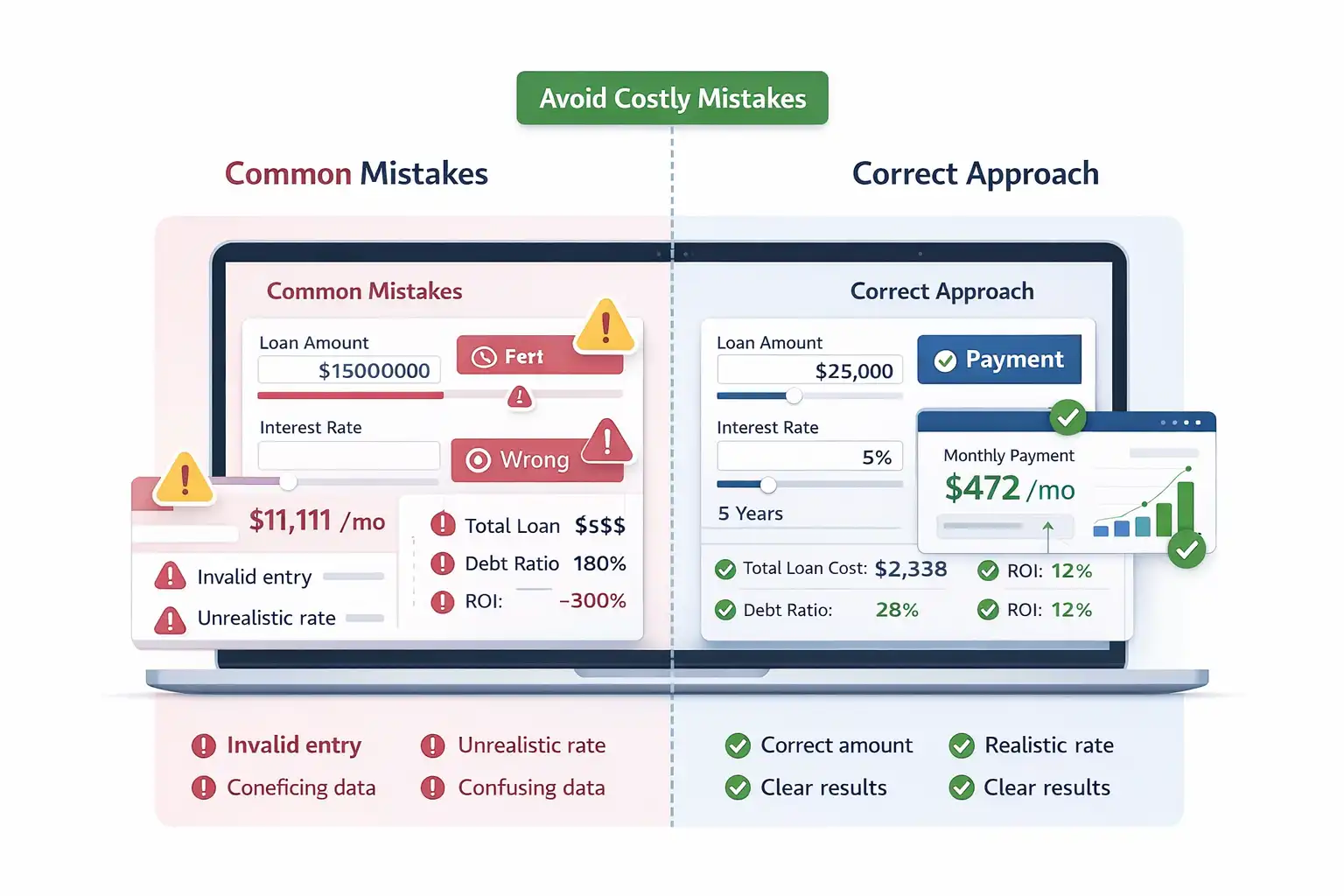
- Applying high-growth software valuation multiples to a traditional local service business.
- Forgetting to add the owner salary back into the profit when calculating Seller Discretionary Earnings.
- Using an overly optimistic discount rate that artificially inflates your Net Present Value.
- Ignoring upcoming equipment replacement costs when projecting long-term capital expenditures.
- Measuring gross revenue growth while completely ignoring a dangerously high customer churn rate.
Frequently Asked Questions (FAQs)
How much is a business worth with $100,000 in sales?
Business value depends entirely on net profit. Top-line sales alone do not dictate your company worth. Valuation typically relies on a multiple of Seller Discretionary Earnings for small companies. Software startups might use revenue multiples. Traditional businesses need strong operational cash flow to command high prices.
Is a small business actually worth three times its profit?
A three times multiple is a common industry starting point. It is rarely the final sale price. Your actual multiple depends heavily on industry risk, customer churn, and local market demand. High risk retail shops often sell for much lower multiples than stable commercial service companies.
What is the difference between EBITDA and SDE?
Seller Discretionary Earnings adds the owner salary back into the total company profit. This metric works best for valuing small businesses under five million dollars. EBITDA only adds back interest, taxes, and depreciation. Corporate buyers prefer EBITDA for larger acquisitions and mergers.
Are online business valuation calculators accurate?
They provide a strong mathematical baseline for your company. A calculator cannot measure qualitative factors like brand reputation or team experience. You should use these tools to build a structural foundation. The final sale price always depends on market demand and buyer negotiations.
What corporate calculators do financial professionals use?
Professionals rely heavily on Net Present Value and Weighted Average Cost of Capital tools. Analysts use these specific calculators to evaluate long term investments. They help executives decide if a massive new project will generate enough cash to justify the initial expense.
How do I calculate the break-even point for a new startup?
You find your break-even point by dividing total fixed costs by your gross profit margin percentage. This exact formula reveals the revenue you must generate to stop burning cash. It proves exactly when your company operations become officially profitable.
Why do corporate finance tools require a discount rate?
A discount rate accounts for the time value of money and project risk. A dollar made today is worth more than a dollar made in the future. This rate helps investors understand exactly what future business cash flows are worth right now.
Can online tools replace a BA II Plus financial calculator?
Yes. Our web-based tools handle the same complex financial equations as a physical BA II Plus device. You get the exact same amortization and cash flow results instantly without needing to memorize complicated keystrokes or read a confusing physical manual.
What is the difference between gross burn and net burn?
Gross burn is the total amount of money your startup spends every month. Net burn subtracts your monthly revenue from that total to show your actual cash loss. Investors analyze your net burn to calculate exactly how many months your company can survive before needing new funding.
What is the 1% rule in corporate finance?
The one percent rule is a quick benchmark for commercial property investments. It states that an asset should generate at least one percent of its buy price in monthly revenue. This fast calculation helps business owners quickly filter out bad commercial real estate deals.
Do these corporate calculators work for international businesses?
Yes. While specific corporate tax rates vary by country, foundational math like EBITDA multiples, Net Present Value, and cash runway are entirely currency-agnostic. You can input your local currency to get accurate operational estimates anywhere in the world.
Questions?
We had love to hear from you! Whether you are reporting an issue, suggesting a new calculator, or exploring collaboration opportunities — we are here to help. Every message helps us make 100calc smarter, faster, and more helpful for everyone.
Why People Trust 100calc
At 100calc.com, we focus on accuracy, speed, and trust. Every calculator we create is designed to give reliable, instant, and easy-to-understand results you can truly depend on.
Ready to Run Your Corporate Numbers?
Stop building fragile spreadsheets and get instant mathematical clarity for your business. You already know the required benchmarks and the critical mistakes to avoid. Now it is time to calculate your actual runway, company valuation, or specific break-even point. Choose a tool from our directory to get exact answers in seconds. Make your next executive decision with total confidence.