
Pregnancy Chance Calculator
The Pregnancy Chance Calculator estimates your odds of conception based on your cycle day and age. It also accounts for the birth control method you used. Timing is the biggest factor in pregnancy risk. The tool uses clinical fertility data to give you a percentage score. You will immediately see if you are in your fertile window.
You might have had unprotected sex recently. Maybe a condom broke unexpectedly. You need to know your risk level right now. Our calculator helps you understand the probability. It accounts for age-related changes in fertility, too. Enter your details below to get your personal assessment. The results help you decide your next steps quickly and confidently.
- Updated Jun 12, 2026
Pregnancy Chance Calculator: Check Your Odds by Cycle Day
Check how many classes you’ve attended and how many more you need to reach your target.
What Your Pregnancy Chance Result Means
Your result percentage shows your statistical risk of conception. It compares your specific situation to medical fertility data. A healthy couple typically has a 20% to 30% chance of pregnancy per month.
A result below 1 percent means you are in a safe zone. You likely used effective protection. Or perhaps you were outside your fertile window. If your result falls between 1 percent and 10 percent, there is a small risk. You might have used a barrier method like a condom.
A result above 20 percent indicates high risk. You likely had sex during your peak ovulation days. You should consider this a strong possibility of conception. The number helps you decide your next step. You might need to buy a pregnancy test or visit a doctor.
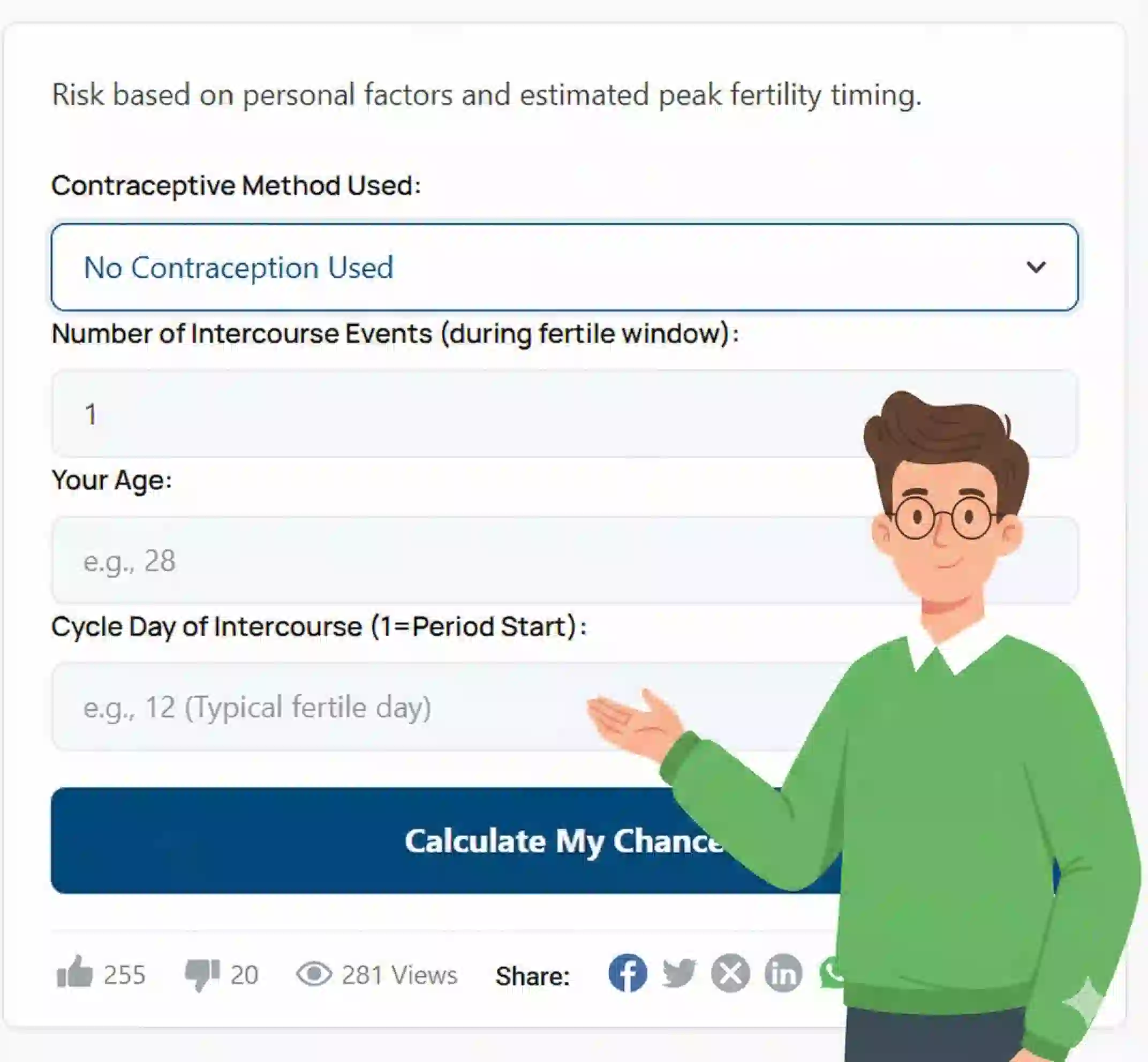
Quick example to check the math
Say you are 24 years old. You had sex on Day 14 of your cycle. You used a Male Condom for protection.
- The base risk for Day 14 is roughly 30%.
- The condom reduces that risk significantly.
- The calculation is roughly: 30% × 0.13 (Condom Factor) = 3.9%.
Your final result is 3.9%. The condom lowered your risk from High (30%) to Low-Moderate (3.9%).
Explore More Calculators
Use the Chinese Gender Calculator for a traditional boy-or-girl prediction from lunar age and conception month. Enter conception date, due date, or LMP.
Try calculatorUse this fetal growth calculator to check baby weight percentile from ultrasound data in grams, kg, or cm and see what the result means…
Try calculatorEnter gestational sac measurements in mm or cm to calculate mean sac diameter, estimate early gestational age, compare week-by-week milestones, and see when follow-up…
Try calculatorMissed a birth control pill? Check pregnancy risk, protection status, backup contraception needs, and what to do next with our missed pill calculator.
Try calculatorUse our pregnancy due date calculator to find your exact Baby Due date. IVF, conception, ovulation, and ultrasound methods with weeks and timeline.
Try calculatorUse this Pregnancy Risk Calculator to check age, BMI, health history, bleeding, and twins. See if closer prenatal monitoring may be worth asking about.
Try calculatorHow to Use the Pregnancy Chance Calculator
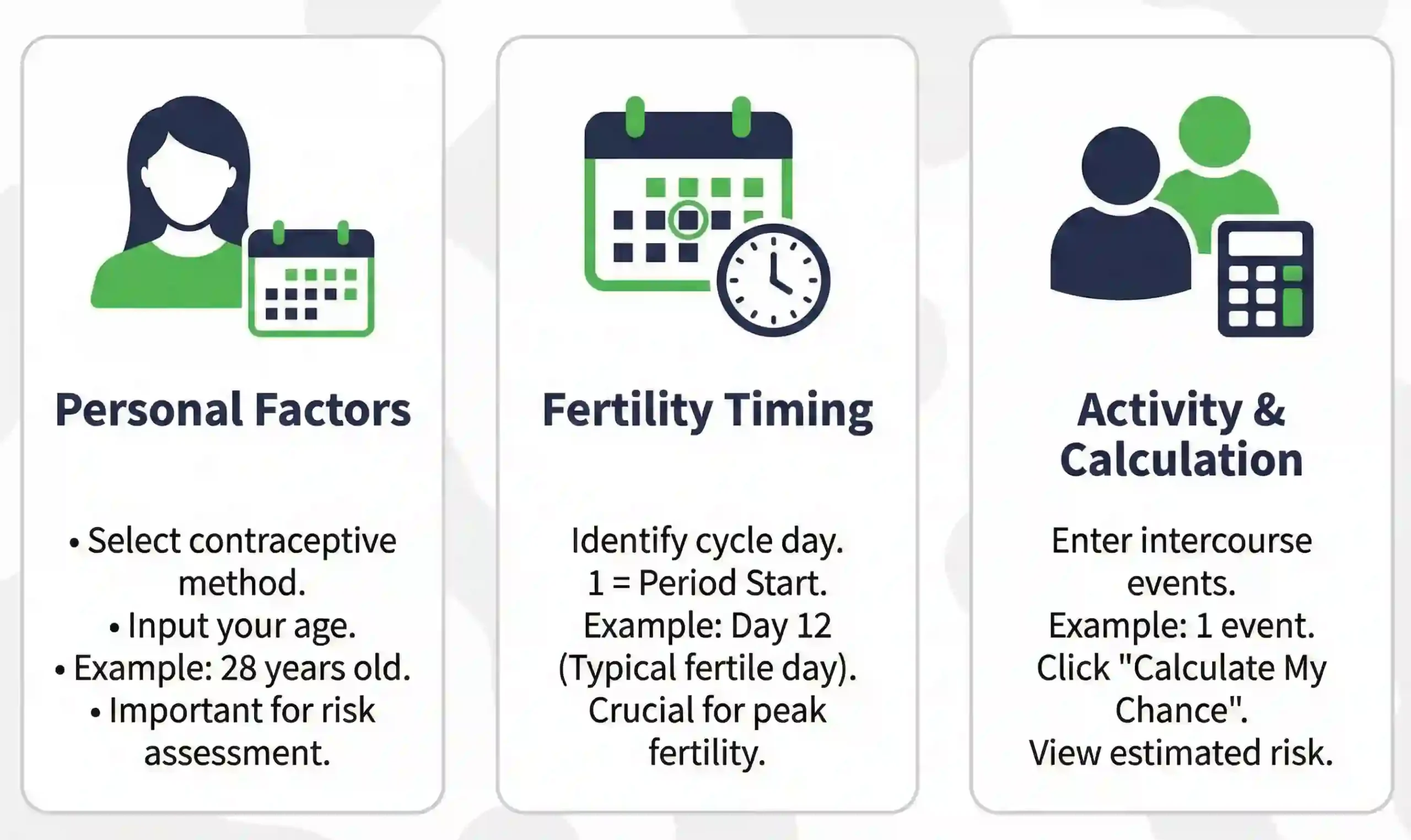
Getting your result takes less than a minute. Follow these five steps to find your estimated probability.
Select Your Contraceptive Method
Choose the birth control method you used. The list includes options like condoms, the pill, or withdrawal. Select "No Contraception" if you used nothing. The correct method significantly adjusts the risk factor.
Enter Intercourse Frequency
Type in the total number of times you had sex. Focus only on the specific window you are checking. More events increase the statistical chance.
Input Your Current Age
Enter your age in years. We need this because age affects fertility. Natural fertility rates begin to drop after age 35.
Identify Your Cycle Day
Determine the exact day of your cycle. Start counting from the first day your period began. That first day is Day 1. Count forward to the date of intercourse.
Click the Calculate Button
Press the button to run the formula. The tool processes your data instantly. You will see your percentage score and risk category below.
Example for testing
Try these sample numbers:
Your Age: 28
Cycle Day: 12
Contraceptive Method: Male Condom
Intercourse Events: 1
Result → Your estimated chance is 2.60%. The calculator shows that the condom lowered the risk significantly. Without it, the risk on Day 12 would be 20%. The protection worked to drop the score to 2.60%.
Now, enter your own numbers and check your result.
How the Pregnancy Chance Formula Works (Complete Breakdown)
Understanding your pregnancy risk helps you take control. This formula gives you a clear picture of your odds. It uses real medical data to estimate your probability. The logic combines the “Standard Days Method” with “Pearl Index” failure rates. It is accurate and practical for women of all ages.
Pregnancy Probability Formula
The pregnancy percentage shows your statistical chance of conception. It looks at your timing compared to your cycle. The formula is simple and effective.
Formula:
Chance = (Base Cycle Risk x Age Modifier x Method Failure Factor) x Events
The formula starts with the risk of your specific cycle day. It multiplies that number by your age modifier. Then it multiplies the result by the failure rate of your birth control. Finally, we multiply by 100 to get a percentage.
Example:
					If the day risk is 0.30 (Day 14) and you used no protection.

(0.30 x 1.0) x 100 = 30%
Your pregnancy chance is 30%. That is the typical peak fertility for a healthy couple.
Micro Note:
Most fertile windows last about 6 days. Sperm can live for 5 days inside the body. The egg lives for about 24 hours. The calculator accounts for this biological overlap.
Key Inputs Used in the Pregnancy Chance Calculator
Every calculation depends on three simple inputs. These inputs help us measure your personal risk. Enter real numbers to get accurate results instantly. Doctors use similar factors to assess fertility potential.
Cycle Day
Your cycle day sets the baseline risk. It counts from the start of your period. Ovulation usually occurs around Day 14. The risk is highest on this day. Being far from Day 14 significantly lowers the score. Accurate tracking ensures the best result.
Contraceptive Method
This input defines your protection level. Different methods have different failure rates. Condoms reduce the risk score greatly. Using “No Contraception” keeps the risk high. The formula applies a specific “failure factor” for each method based on clinical studies.
Your Age
Age plays a major role in fertility. Women under 35 have higher conception rates. The calculator uses an age multiplier to adjust the final score. It lowers the probability for women over 40. This ensures the result matches biological reality.
Another Example Calculation (Step-by-Step)
Let’s see how the calculator works with a real example. This helps you understand the math behind your result. The calculation follows standard medical probability rules.
Given:
- Age: 28 (Factor 1.0)
- Cycle Day: 12 (Base Risk 0.20)
- Method: Male Condom (Factor 0.13)
Calculation:
					(0.20 x 1.0 x 0.13) x 100 = 2.6%

Your calculated chance is 2.6%. The condom successfully lowered the risk from 20% down to 2.6%.
Result:
- * Base Risk: 20% (High)
- Adjusted Risk: 2.6% (Low)
- Status: Low Risk
Meaning:
Using protection made a huge difference. You were in a fertile window. However, the condom blocked most of the risk. Without the condom, the risk would have been 20%. The formula shows exactly how much protection your method provides.
Result Benchmarks and Ranges
Your percentage score falls into one of four categories. Use this table to understand your specific situation.
| Probability Range | Category | Likely Scenario |
|---|---|---|
| 0% – 1% | Very Low |
You are outside the fertile window.
Or you used highly effective protection like an IUD. |
| 1% – 5% | Low Risk |
You used condoms correctly.
Or you are only near the edge of ovulation. |
| 5% – 15% | Moderate |
You relied on the withdrawal method.
Or you missed a dose of your birth control. |
| 15% – 35%+ | High Risk |
You had unprotected sex.
It occurred during peak ovulation (Days 11–15). |
Note: Sperm survival rates vary by person. Always confirm your status with a medical test.
Interpretation
Knowing your risk percentage helps you make better decisions. A low score usually means you are safe. You likely used protection or were not fertile. A high score suggests a real possibility of pregnancy. You might need to take a pregnancy test soon.
Understanding these numbers reduces anxiety. It helps you distinguish between paranoia and actual risk. A result of 20 percent or higher is significant. It matches the natural peak fertility of a healthy couple. A result below 5 percent is generally considered low risk.
Pro Tip:
Track your menstrual cycle carefully every month. Use a dedicated app or a physical calendar. Mark the first day of your period as soon as it starts. Accurate dates lead to precise calculations. Guessing your dates significantly increases the margin of error. Consistent tracking takes the guesswork out of your fertility health.
Tips & Planning Based on Your Result
Knowing your risk is only the first step. The next step is deciding what to do. This guide helps you plan ahead. Follow the advice that matches your result category.
For Low Risk (Below 1%)
You are in a very safe zone. You likely used effective protection. Or perhaps you were far from your fertile window. Keep doing what you are doing. Maintain your current birth control method. It is working well for you. You can likely relax until your next period arrives.
For Moderate Risk (1% to 15%)
A score in this range indicates some risk. You might have used a condom. Or perhaps you relied on the withdrawal method. The chance is lower than the peak. However, it is not zero. Watch for early pregnancy signs. Wait for your next period to arrive. Take a test if it is more than a week late.
For High Risk (Above 20%)
If your result is above 20 percent, act quickly. You likely had unprotected sex during ovulation. Consider your options immediately. You might need emergency contraception if the pregnancy is unplanned. Speak to a doctor within 72 hours. Take a pregnancy test on the first day of your missed period.
You Might Also Find These Helpful
Pregnancy & Fertility 45
One Time Pregnancy Calculator estimates pregnancy odds from one encounter, plus fertile window timing, test date, due date, and 21-day testing guidance.
Try calculatorUse the AMH Calculator to convert ng/mL or pmol/L, compare your result with age-based data, and see what it may mean for IVF, fertility,…
Try calculatorUse the Baby Eye Color Calculator with parents, grandparents, or sibling context to compare Brown, Green/Hazel, and Blue/Grey model estimates instantly.
Try calculatorBasal Body Temperature Calculator checks reading conditions and analyzes your temperature pattern for a sustained shift that may be consistent with ovulation.
Try calculatorBPD gestational age calculator: estimate fetal age from BPD, compare your week, check normal BPD ranges, and understand ahead or behind results.
Try calculatorCalculate odds with the Chance of Twins Calculator. Enter maternal age and history. Find your probability instantly. See if you will conceive multiples now.
Try calculatorFind out exactly when you conceived. Our free Conception Calculator uses your Due Date, LMP, or Ultrasound to estimate your fertilization date and fertile…
Try calculatorUse our Conception Date Due Date Calculator to find your baby's arrival date. Enter your conception or intercourse date for clinical 40-week results.
Try calculatorContraceptive effectiveness calculator to compare birth control methods, typical vs perfect use, backup protection, and 5-year pregnancy risk.
Try calculatorUse this CRL calculator to estimate gestational age and due date from crown-rump length in mm or cm. Compare CRL, LMP, and IVF dating…
Try calculatorEstimate your monthly and 12-month pregnancy odds by age, partner age, and cycle dates. See your fertile window and when to seek fertility help.
Try calculatorUse this fundal height calculator to compare your cm measurement by week, check growth range, estimate baby weight, and know when to ask about…
Try calculatorCommon Mistakes to Avoid When Calculating Pregnancy
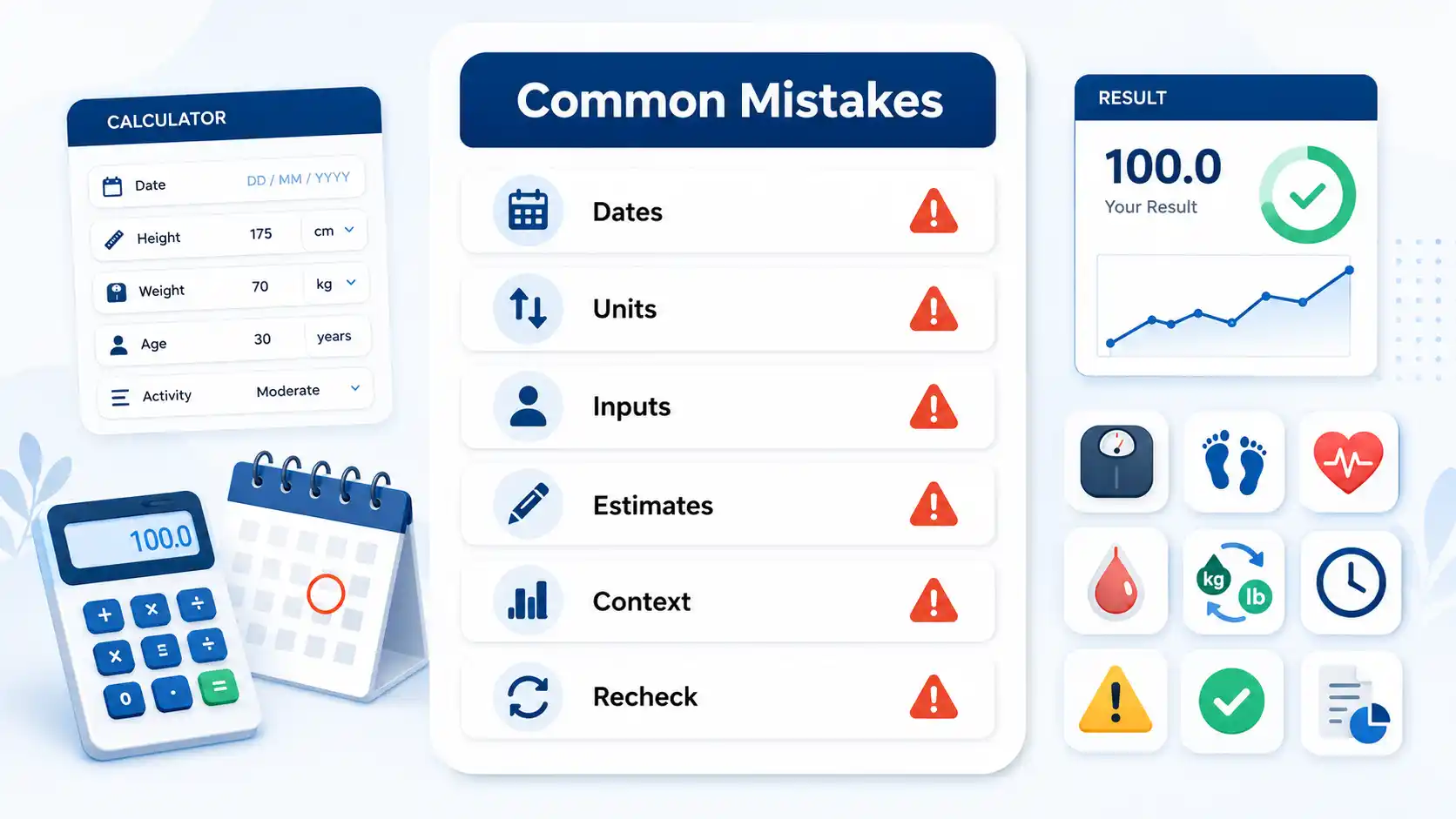
Small errors lead to wrong results. Watch out for these three common pitfalls when using the calculator.
- Guessing the Cycle Day: Do not guess your numbers. Miscounting days causes the biggest errors. Remember that Day 1 is vital. It is the day bleeding starts. Do not count from the day bleeding ends.
- Assuming "Safe Days" Are Total, you might feel safe on Day 9. However, biology works differently. Inside the body Sperm can survive for up to 5 days. Sex on Day 9 can lead to pregnancy on Day 14. Do not assume any day is completely safe without protection.
- Ignoring the Age Factor, Many people overlook their age. They think fertility drops only after age 40. That is incorrect. Natural fertility begins to decline significantly after age 35. Our calculator adjusts the math to reflect this reality.
Frequently Asked Questions (FAQs)
How to calculate the chances of getting pregnant?
You can use the calculator at the top of this page. It combines your specific cycle day with your birth control method. It also factors in your age. These three elements determine your statistical probability of conception.
When is my highest chance of getting pregnant?
Your highest chance occurs during ovulation. The ovary releases an egg around Day 13 or 14 of a typical cycle. The risk of pregnancy peaks at roughly 30% on these days.
How to calculate when to get pregnant after a period?
Start counting from the first day your bleeding began. Your fertile window usually opens around Day 10. It closes around Day 15. You should have intercourse during these specific days to increase your odds.
How can I calculate how pregnant I am?
Doctors count pregnancy weeks from the first day of your last period. They do not count from the day of intercourse. nYou can use a Due Date Calculator to see your exact timeline based on that date.
Can I get pregnant if I have irregular periods?
Yes. However, predicting your exact fertile day is harder. Your ovulation window changes every month. You might need ovulation test strips to accurately identify your peak days.
Is the pull-out method effective for preventing pregnancy?
It is not completely reliable. The typical failure rate is about 22%. Pre-ejaculate fluids often contain sperm. Our calculator adds a specific risk factor to your score if you choose this method.
Does age affect my chance of pregnancy?
Yes. Fertility is highest for women in their 20s. It begins to decline naturally after age 35. We adjust your calculation result based on the age you enter.
Questions?
We had love to hear from you! Whether you are reporting an issue, suggesting a new calculator, or exploring collaboration opportunities — we are here to help. Every message helps us make 100calc smarter, faster, and more helpful for everyone.
Why People Trust 100calc
At 100calc.com, we focus on accuracy, speed, and trust. Every calculator we create is designed to give reliable, instant, and easy-to-understand results you can truly depend on.