
Gestational Age Calculator: How Far Along Are You Today?
The Gestational Age Calculator estimates how many weeks and days pregnant you are from your last period, established due date, ultrasound-reported age, or IVF transfer. It turns your chosen dating method into an estimated due date, then places you on the 40-week pregnancy timeline. Your result shows gestational age, pregnancy stage, approximate month, and days until 40 weeks.
Your app may show one week while your scan shows another. That difference can come from the dating method, cycle length, scan timing, or IVF dates. Choose the source that matches your records. You will also see future pregnancy dates, reference fetal growth, and upcoming milestones based on your calculated timeline.
Quick Facts
- Choose from LMP, due date, ultrasound, or IVF transfer.
- LMP mode adjusts for cycle lengths from 21 to 45 days.
- Ultrasound mode uses the scan date plus reported weeks and days.
- IVF mode supports Day 3, Day 5, and Day 6 embryos.
- Results show weeks, days, EDD, stage, month, and days until 40 weeks.
- Updated Aug 27, 2026
- Reviewed by 100Calc Research Team
Pregnancy Tracking & Planning
Gestational Age Calculator
Calculate exactly how far along you are today. Whether you need a gestational age calculator from lmp, edd, ultrasound, or IVF, discover your precise current week, fetal size, and future milestones.
Use Last Period if you know the first day of your last menstrual cycle.
What you need to enter first
Select the baseline method you want to use above. You can reverse-engineer your current gestational age from a doctor's due date, a past ultrasound scan, or standard tracking dates.
Current Gestational Age
-- Weeks, -- Days
Your estimated gestational age will appear here.
Future Pregnancy Date Planner
Select a future date (like a baby shower or trip) to instantly see exactly how far along you will be.
Current Fetal Development
Upcoming Clinical Milestones
Clinical Accuracy Note
Your medical context note will appear here based on your method.
Short answer
A direct answer based on your inputs will appear here.
How accurate is calculating gestational age by this method?
Your dynamic answer regarding tracking accuracy will appear here.
What is corrected gestational age?
Corrected gestational age is a term used by pediatricians after a baby is born prematurely. For example, if a baby is born at 32 weeks (8 weeks early), their 'corrected age' at 12 weeks old would be 4 weeks. During pregnancy, we only use 'estimated gestational age' (EGA) to track progress.
Explore More Calculators
Use the Chinese Gender Calculator for a traditional boy-or-girl prediction from lunar age and conception month. Enter conception date, due date, or LMP.
Try calculatorUse this fetal growth calculator to check baby weight percentile from ultrasound data in grams, kg, or cm and see what the result means…
Try calculatorEnter gestational sac measurements in mm or cm to calculate mean sac diameter, estimate early gestational age, compare week-by-week milestones, and see when follow-up…
Try calculatorMissed a birth control pill? Check pregnancy risk, protection status, backup contraception needs, and what to do next with our missed pill calculator.
Try calculatorUse our Pregnancy Chance Calculator to estimate your odds. Enter your cycle day, age, and method. Find out if you are in the high-risk…
Try calculatorUse our pregnancy due date calculator to find your exact Baby Due date. IVF, conception, ovulation, and ultrasound methods with weeks and timeline.
Try calculator
Micro Insight
Do not subtract two weeks from your medical gestational age when planning prenatal care. Use the gestational age and due date established by your provider, especially after an early ultrasound or IVF dating has set the pregnancy timeline.
What Is Gestational Age, and Why Does It Start Before Conception?
Gestational age is the medical way to describe how far a pregnancy has progressed. It usually starts from the first day of the last menstrual period, which is often about two weeks before conception in a typical cycle.
Doctors use this earlier starting point because the exact day of conception is often unknown. A menstrual period usually gives a clearer date for creating one consistent pregnancy timeline.
This creates two different ways to describe pregnancy age:
- Gestational age: the standard pregnancy age used in medical care
- Fetal or conceptional age: roughly how long it has been since conception
- Gestational age is usually about two weeks ahead in a typical cycle
- Longer or irregular cycles can make that gap different
Imagine your last period began September 4. Ovulation and conception happened around September 18. By October 2, conception may have occurred about two weeks earlier, but the pregnancy would be dated at about 4 weeks gestational age.
This also explains a common pregnancy-test confusion. A Clearblue result showing 2 to 3 weeks since conception corresponds to about 4 to 5 weeks pregnant using standard medical dating.
Recent pregnancy discussions show that this two-week difference still causes real confusion, especially when people know their ovulation or conception date. Irregular cycles and ultrasound dates create another common source of uncertainty.
What Does Your Gestational Age Result Mean?
Your gestational age shows where you are on the pregnancy timeline. It is not a health score. A result such as 12 weeks, 4 days means 12 full weeks have passed, plus four more days.
The result also connects that timeline to your pregnancy stage, approximate month, due date, and progress toward 40 weeks. A higher week is not better or worse. It simply means the pregnancy is further along.
Read the Weeks and Days First
Pregnancy age is most precise when written as weeks plus days.
A result of 12 weeks, 4 days means you have completed 12 weeks. You are four days into week 13. Those extra days matter because pregnancy stages begin at exact week-and-day points.
Do not round 12 weeks, 6 days up to 13 weeks. The calculator keeps the completed weeks and remaining days separate.
Sample Output 1: 10 Weeks, 6 Days
This means:
- First Trimester
- About Month 3
- 76 gestational days completed
- 204 days remain until 40 weeks
- About 27% of the 280-day timeline is complete
Nothing about this result is good or bad. It only marks your current position in pregnancy.
Check Your Trimester or Term Stage
The calculator changes its stage label as gestational age moves forward.
It can show:
- First Trimester: through 13 weeks, 6 days
- Second Trimester: 14 weeks through 27 weeks, 6 days
- Third Trimester: 28 weeks through 36 weeks, 6 days
- Early Term: 37 weeks through 38 weeks, 6 days
- Full Term: 39 weeks through 40 weeks, 6 days
- Late Term: 41 weeks through 41 weeks, 6 days
- Postterm: 42 weeks or later
Trimester and term status describe different parts of the same timeline. After 37 weeks, the calculator highlights the more useful term status instead of showing only “Third Trimester.”
Sample Output 2: 39 Weeks, 2 Days
This represents:
- Full Term status
- 275 gestational days completed
- About Month 9
- 5 days until the 40-week point
- Raw timeline progress of about 98.2%
- Calculator display of 98% complete
The pregnancy is still within the third trimester, but Full Term gives more precise context at this stage.

What Does Pregnancy Percentage Complete Mean?
Pregnancy percentage complete shows progress through the calculator’s 280-day reference timeline.
The calculation is:
Gestational Days ÷ 280 × 100
A 140-day result represents about 50% of that timeline. A 252-day result represents about 90%.
This percentage is only a time-progress indicator. It is not a:
- fetal growth percentile
- pregnancy health score
- chance of giving birth today
- fetal maturity score
The progress display stops at 100% after the 40-week reference point
What Does Pregnancy Month Mean?
The pregnancy month is an approximate label. Pregnancy weeks do not divide evenly into nine calendar months.
This calculator groups completed weeks into Month 1 through Month 9. It does not divide your week number by four.
Use the month for a quick overview. Use weeks and days when timing appointments, comparing records, or checking your current gestational age.
Why Can LMP and Ultrasound Give Different Dates?
LMP dating starts from the first day of your last menstrual period. That method works best when the period date is known and cycle timing is fairly predictable.
Differences can appear when:
- the LMP date was remembered incorrectly
- cycles are longer, shorter, or irregular
- ovulation happened later than expected
- an early ultrasound gives a different dating estimate
- your provider has already established an official due date
A later scan may also measure a baby slightly ahead or behind without changing the established pregnancy date. Ultrasound becomes less reliable for dating as pregnancy advances.
If your calculator result differs from the date in your medical record, use your provider’s established due date for prenatal care. The calculator can help you understand the timeline, but it should not replace the dating used by your care team.
How to Use the Gestational Age Calculator
The Gestational Age Calculator works from one pregnancy dating source. Pick the record you trust most, enter its date and required details, then calculate. Each method creates an estimated due date. The tool uses that anchor to show your current pregnancy week, day, stage, and timeline.

Choose Your Dating Method
Select LMP, Due Date, Ultrasound, or IVF Transfer. Use the option that matches the pregnancy record you already have. LMP works from your last period. Due Date uses an established EDD. Ultrasound uses a past scan. IVF uses the recorded embryo transfer.
Enter the Anchor Date
Add the exact calendar date linked to your chosen method. Enter the first day of your last period, your established due date, ultrasound date, or embryo transfer date. This date becomes the main reference point used to build the rest of your pregnancy timeline.
Add the Required Detail
Some methods need one extra detail. LMP uses your average cycle length. Ultrasound needs the gestational weeks and days reported on the scan. IVF needs the embryo age at transfer, using Day 3, Day 5, or Day 6. Due Date mode needs nothing else.
Calculate Your Gestational Age
Press Calculate Gestational Age after checking your entries. The selected information is converted into an estimated 40-week due date when needed. That date becomes the common anchor. The calculator then finds how many gestational days have passed and converts them into completed weeks plus remaining days.
Read Your Pregnancy Timeline
Review your weeks and days, estimated due date, pregnancy stage, approximate month, and days remaining until 40 weeks. The results also include reference fetal development and upcoming milestones. Need to plan ahead? Choose a later date in the future planner to see how far along you will be then.
Quick Example to Test
Try these details in the calculator:
- Calculation Method: From Due Date (EDD)
- Estimated Due Date: December 10, 2026
- Reference Date for This Example: August 27, 2026
Result:
Your gestational age is 25 weeks, 0 days.
The calculator places you in the Second Trimester and approximately Month 6 of pregnancy.
You have 105 days until 40 weeks, with about 63% of the 280-day pregnancy timeline complete.
Here is what happened:
280 days – 105 days remaining = 175 gestational days
175 ÷ 7 = 25 weeks, 0 days
In plain words, 25 full weeks of the pregnancy timeline have passed.
Try your own established due date to see your current weeks, days, pregnancy stage, and time remaining until 40 weeks.
Note: This example is anchored to August 27, 2026. The live gestational age increases by one day each calendar day, so testing the same due date later will show a later pregnancy age.
How the Gestational Age Calculator System Works
The Gestational Age Calculator uses fixed date rules, not a prediction model. Each mode creates or accepts one estimated due date, then the same timeline logic calculates weeks and days. Identical inputs produce consistent results. Your provider’s documented due date still takes priority for medical care.
Key Features & Benefits
- Four dating methods: Supports LMP, known EDD, ultrasound-reported age, and IVF embryo transfer.
- Cycle-aware LMP dating: Adjusts the 280-day baseline when cycle length differs from 28 days.
- Week-and-day precision: Keeps completed weeks and extra days instead of rounding the result.
- Defined pregnancy stages: Applies fixed boundaries for trimesters, early term, full term, late term, and postterm.
- Future-date planning: Projects gestational weeks and days for a later appointment, trip, or event date.
Technical Process
Validate Inputs
The system checks required dates, cycle length, ultrasound age, and embryo-age selections before running the calculation.
Build EDD
The chosen dating method creates one estimated due date, or accepts the established EDD entered by the user.
Derive Timeline
That due date anchors gestational age, pregnancy stage, progress, days remaining, and future-date projections.
How Does the Gestational Age Calculator Formula Work? (Complete Breakdown)
The Gestational Age Calculator turns each supported dating method into one estimated due date. It then uses that EDD as the common anchor for calculating current gestational weeks, days, and pregnancy progress.
All four modes follow the same basic structure:
Dating Method -> Estimated Due Date -> Gestational Days -> Weeks + Days
The formulas below match the current calculator logic.
How Does the LMP Formula Work?
The LMP method starts with the first day of your last menstrual period. It adjusts the standard 280-day pregnancy reference when your cycle differs from 28 days.
EDD = LMP Date + 280 Days + (Cycle Length – 28)
A 28-day cycle keeps the standard 280-day interval unchanged. A longer cycle moves the calculated EDD later, while a shorter cycle moves it earlier.
The 280-day convention represents 40 weeks from the first day of the LMP. Traditional LMP dating also assumes a 28-day cycle with ovulation near day 14.
What Does LMP Date Mean?
LMP Date means the first calendar day of the last menstrual period. It is the starting date used by the calculator for menstrual-cycle dating.
Use the day bleeding started, not the final day of the period.
What Does Cycle Length Mean?
Cycle Length is the average number of days from one period’s first day to the next period’s first day. This calculator accepts values from 21 to 45 days.
If the field is left blank, the calculator uses 28 days internally.
Why Does the Formula Use 280 Days?
280 days equals 40 weeks, which is the standard gestational reference used for LMP-based pregnancy dating. It gives the calculator a common pregnancy timeline before cycle-length adjustment.
The 280-day value is a dating reference. It does not mean every pregnancy ends exactly on day 280.
How Does the Known Due Date Formula Work?
Known EDD mode does not estimate another due date. The date already entered becomes the pregnancy timeline anchor.
EDD = Entered Due Date
EDD means estimated due date.
No menstrual date, cycle length, or scan age is needed in this mode. The calculator works backward from the entered EDD to determine gestational age for the reference date.
How Does the Ultrasound Formula Work?
Ultrasound mode uses the gestational age already reported on the scan. It converts those reported weeks and days into total gestational days before estimating the EDD.
Scan Age in Days = (Reported Weeks x 7) + Reported Days
EDD = Scan Date + (280 – Scan Age in Days)
The variables are:
- Scan Date: calendar date when the ultrasound was performed
- Reported Weeks: completed gestational weeks shown on the scan
- Reported Days: extra gestational days from 0 to 6
- Scan Age in Days: total reported gestational age converted into days
- 280: the calculator’s 40-week reference point
If a scan reports 12 weeks, 3 days, the age used by the formula is:
Scan Age in Days = (12 x 7) + 3
Scan Age in Days = 87 Days
This calculator does not convert raw ultrasound measurements into gestational age.
It does not directly calculate from:
- BPD
- CRL
- head circumference
- abdominal circumference
- femur length
Enter the gestational weeks and days already reported on the ultrasound.
How Does the IVF Formula Work?
IVF mode uses the embryo transfer date and embryo age at transfer. That information creates an estimated due date without relying on LMP cycle timing.
EDD = Transfer Date + (266 – Embryo Age in Days)
The current calculator supports three embryo ages:
Day 3 Embryo = Transfer Date + 263 Days
Day 5 Embryo = Transfer Date + 261 Days
Day 6 Embryo = Transfer Date + 260 Days
The variables are:
- Transfer Date: date the embryo was transferred
- Embryo Age: Day 3, Day 5, or Day 6
- 266 Days: conception-based pregnancy interval used by the formula
- EDD: estimated due date produced from those values
ACOG guidance uses embryo age and transfer date for IVF dating. It gives 263 days after a Day 3 transfer and 261 days after a Day 5 transfer as examples.
The Day 6 option follows the current calculator’s programmed logic:
266 – 6 = 260 Days
How Is Current Gestational Age Calculated From the EDD?
Once an EDD exists, every dating mode enters the same calculation path. The calculator finds how many days remain until that EDD, then measures pregnancy progress against 280 days.
Days Remaining Until EDD = EDD – Reference Date
Gestational Days = 280 – Days Remaining Until EDD
The variables are:
- EDD: estimated due date created or entered earlier
- Reference Date: date used to calculate gestational age
- Days Remaining Until EDD: calendar-day gap between the reference date and EDD
- Gestational Days: total pregnancy days completed on the reference date
For the main result, the Reference Date is today.
The future-date planner uses the same logic with the selected future date as its reference.
The calculator then converts gestational days into weeks and extra days:
Completed Weeks = floor(Gestational Days / 7)
Remaining Days = Gestational Days mod 7
Here:
- Completed Weeks means full seven-day pregnancy weeks
- Remaining Days means the extra days after those completed weeks
- floor removes the unfinished part of the next week
- mod 7 returns the days left after dividing by seven
A total of 100 gestational days becomes:
Completed Weeks = floor(100 / 7)
Completed Weeks = 14
Remaining Days = 100 mod 7
Remaining Days = 2
The displayed gestational age would be:
14 Weeks, 2 Days
How Is Pregnancy Progress Percentage Calculated
Pregnancy progress compares completed gestational days with the calculator’s 280-day reference timeline. It gives a simple percentage for time passed, not fetal growth or pregnancy health.
Raw Pregnancy Progress = (Gestational Days / 280) x 100
The displayed value is rounded to a whole percentage and capped at 100%:
Displayed Progress = min(round(Raw Pregnancy Progress), 100%)
The variables are:
- Gestational Days: pregnancy days completed
- 280 Days: the 40-week reference timeline
- Raw Pregnancy Progress: unrounded percentage of the timeline completed
- Displayed Progress: rounded percentage shown in the result
At 140 gestational days:
Pregnancy Progress = (140 / 280) x 100
Pregnancy Progress = 50%
At 280 days:
Pregnancy Progress = (280 / 280) x 100
Pregnancy Progress = 100%
After 40 weeks, the displayed progress stays at:
100%
That percentage only describes time through the 280-day reference timeline. It does not represent fetal size, fetal maturity, pregnancy health, or the chance of delivery on a certain day.
How Do You Calculate Gestational Age?
Gestational age is calculated from a pregnancy dating anchor, then reported as completed weeks plus extra days. Once an estimated due date is known, gestational days = 280 minus the days remaining until EDD. LMP, known EDD, ultrasound-reported age, and IVF transfer can each provide that anchor.
Reference date for all examples below: August 27, 2026. The live calculator uses the current date, so the displayed gestational age moves forward each day.

How Far Along Are You From an LMP With a 31-Day Cycle?
A longer menstrual cycle changes the LMP-based dating slightly. Here, a 31-day cycle adds three days to the standard 280-day LMP timeline.
Input
- LMP: June 10, 2026
- Average Cycle Length: 31 days
- Reference Date: August 27, 2026
Process
The cycle is three days longer than the 28-day baseline.
Cycle Adjustment = 31 – 28
Cycle Adjustment = 3 Days
EDD = June 10, 2026 + 283 Days
EDD = March 20, 2027
Gestational Days = 280 – 205
Gestational Days = 75 Days
75 Days = 10 Weeks, 5 Days
Result
- Gestational Age: 10 weeks, 5 days
- Estimated Due Date: March 20, 2027
- Stage: First Trimester
- Approx. Pregnancy Month: Month 3
- Days Until 40 Weeks: 205
- Pregnancy Complete: 27%
Meaning
This pregnancy has completed 10 full weeks and 5 extra days. The longer cycle moves the LMP-based due date three days later than a 28-day cycle would.
How Do You Calculate Gestational Age From a Known Due Date?
If an established due date is already known, the calculator does not create a second EDD. It uses that date directly to locate the pregnancy on the 280-day timeline.
Input
- Calculation Method: From Due Date
- Estimated Due Date: September 25, 2026
- Reference Date: August 27, 2026
Process
There are 29 days between the reference date and the EDD.
Gestational Days = 280 – 29
Gestational Days = 251 Days
251 Days = 35 Weeks, 6 Days
Result
- Gestational Age: 35 weeks, 6 days
- Estimated Due Date: September 25, 2026
- Stage: Third Trimester
- Approx. Pregnancy Month: Month 8
- Days Until 40 Weeks: 29
- Pregnancy Complete: 90%
Meaning
The pregnancy has completed 35 weeks and 6 days. One more day would make the gestational age 36 weeks, 0 days.
How Do You Calculate Gestational Age From an Ultrasound Report?
Ultrasound mode starts with the pregnancy age already written on the scan report. It combines that reported age with the scan date to build the estimated due-date anchor.
Input
- Ultrasound Date: July 20, 2026
- Reported Gestational Age: 12 weeks, 4 days
- Reference Date: August 27, 2026
Process
The reported scan age equals 88 gestational days.
Scan Age = (12 x 7) + 4
Scan Age = 88 Days
Days Remaining at Scan = 280 – 88
Days Remaining at Scan = 192 Days
EDD = July 20, 2026 + 192 Days
EDD = January 28, 2027
Current Gestational Days = 126 Days
126 Days = 18 Weeks, 0 Days
Result
- Gestational Age: 18 weeks, 0 days
- Estimated Due Date: January 28, 2027
- Stage: Second Trimester
- Approx. Pregnancy Month: Month 5
- Days Until 40 Weeks: 154
- Pregnancy Complete: 45%
Meaning
The scan placed the pregnancy at 12 weeks, 4 days on July 20. By August 27, that same dating timeline reaches exactly 18 weeks.
How Is Gestational Age Calculated After a Day 6 IVF Transfer?
IVF dating uses the documented embryo transfer date and embryo age. A Day 6 embryo gives the calculator a 260-day interval from transfer to the estimated due date.
Input
- IVF Transfer Date: April 2, 2026
- Embryo Age: Day 6
- Reference Date: August 27, 2026
Process
A Day 6 embryo uses 260 days from transfer to EDD.
EDD = April 2, 2026 + 260 Days
EDD = December 18, 2026
Gestational Days = 280 – 113
Gestational Days = 167 Days
167 Days = 23 Weeks, 6 Days
Result
- Gestational Age: 23 weeks, 6 days
- Estimated Due Date: December 18, 2026
- Stage: Second Trimester
- Approx. Pregnancy Month: Month 6
- Days Until 40 Weeks: 113
- Pregnancy Complete: 60%
Meaning
This IVF pregnancy has completed 23 weeks and 6 days on the reference date. The following day marks 24 weeks, 0 days on the same dating timeline.
What Should You Remember Before Using Your Own Dates?
Choose the dating method that matches the record you have. Enter the first day of your LMP, an established EDD, the gestational age reported on an ultrasound, or the documented IVF transfer details.
Check the final weeks and days rather than relying only on pregnancy months. If your medical record uses a different established due date, follow the dating given by your prenatal care team.
Gestational Age Calculator Result Benchmarks by Pregnancy Stage
A Gestational Age Calculator result is not a score that becomes better as the number rises. It shows your position on the pregnancy timeline. These ranges help you match your weeks and days with the trimester or term label used by the calculator and in clinical pregnancy dating.
| Range | Label | USA Guideline | India Guideline | Notes |
|---|---|---|---|---|
| 0w0d–13w6d | First Trimester | First trimester continues through 13 weeks, 6 days. | Commonly treated as the first trimester in obstetric care. | Use weeks and days to track early pregnancy timing. |
| 14w0d–27w6d | Second Trimester | Second trimester begins at 14 weeks, 0 days. | The same week-based trimester range is widely used. | Month estimates are less precise than weeks and days. |
| 28w0d–36w6d | Third Trimester | Third trimester begins at 28 weeks, 0 days. | 28 weeks commonly marks the third trimester in obstetric care. | Term status has not started yet. |
| 37w0d–38w6d | Early Term | Defined as early term from 37 weeks through 38 weeks, 6 days. | This early-term range is also used in Indian obstetric practice. | The calculator switches from trimester to term-stage labeling. |
| 39w0d–40w6d | Full Term | Defined as full term from 39 weeks through 40 weeks, 6 days. | The same full-term range is commonly used in maternity care. | 40w0d is the estimated due-date reference point. |
| 41w0d–41w6d | Late Term | Defined as late term from 41 weeks through 41 weeks, 6 days. | Indian obstetric literature uses the same late-term range. | Follow the pregnancy plan set by your prenatal care team. |
| 42w0d+ | Postterm | Pregnancy at 42 weeks, 0 days or later is classified as postterm. | The same 42-week threshold is used in obstetric practice. | Contact your prenatal care team about ongoing pregnancy management. |
Heads-up: Gestational age is a timing measure, not a health score. An earlier trimester is not a poor result. Use your clinician's established due date for medical decisions.
Interpretation
Your result tells you where you are in pregnancy, not whether the pregnancy is good or bad. Before 37 weeks, the calculator uses trimester labels. From 37w0d onward, it gives the more detailed Early Term, Full Term, Late Term, or Postterm label.
The most useful value remains your completed weeks and extra days. A result of 38w6d and 39w0d differs by only one day, but the calculator moves from Early Term to Full Term at that boundary.
Pro Tip
Check the weeks and days before relying on the approximate pregnancy month. Near 37, 39, 41, and 42 weeks, even one day can change the term-stage label shown in your result.
What Should You Do After Using the Gestational Age Calculator?
Your Gestational Age Calculator result is not something to improve like a score. It tells you where you are on the pregnancy timeline. What matters next is using the correct established due date, keeping prenatal care on schedule, and knowing when your pregnancy moves into term or postterm stages.

If Your Result Is in the First or Second Trimester
Keep using the due date recorded by your prenatal care team. If your LMP result and ultrasound dating differ, do not keep switching between dates yourself. Bring the dates to your next visit so your clinician can confirm which EDD should guide the pregnancy. Early ultrasound carries the most weight when pregnancy dating needs confirmation.
Use your weeks and days when planning appointments or reviewing pregnancy milestones. The approximate month is useful for quick context, but medical care is usually timed by gestational weeks.
If Your Result Is in the Third Trimester Before 37 Weeks
Check that the calculator’s EDD matches the date in your medical record. Later ultrasound measurements should not automatically replace an EDD that was already established earlier in pregnancy.
Keep upcoming prenatal visits on your calendar. Ask your care team which hospital or office number to use if concerns arise before your next appointment. Your visit schedule may become more frequent as delivery gets closer.
If Your Result Is Early Term or Full Term
A result from 37w0d through 40w6d means pregnancy has entered the term period. Keep scheduled appointments and follow the delivery plan already discussed with your prenatal team.
Do not treat the estimated due date as a deadline. It is a reference point for pregnancy timing. If you reach your due date without labor, keep following your clinician’s plan rather than changing the date in the calculator.
If Your Result Is Late Term or Postterm
A result from 41w0d enters the late-term range, while 42w0d or later is postterm. Contact your prenatal care team if you have not already discussed what happens after your due date.
Ask about the plan for follow-up, monitoring, and delivery timing. Current ACOG guidance notes that experts commonly recommend delivery by 41 to 42 weeks when labor has not started on its own, but the timing should be decided with your clinician based on your pregnancy.
Pro Tip
Save the official EDD from your medical record and use that same date when checking future weeks. This avoids the common confusion caused by comparing several LMP, ultrasound, app, and calculator dates throughout pregnancy.
You Might Also Find These Helpful
Pregnancy & Fertility 45
Use this Pregnancy Risk Calculator to check age, BMI, health history, bleeding, and twins. See if closer prenatal monitoring may be worth asking about.
Try calculatorOne Time Pregnancy Calculator estimates pregnancy odds from one encounter, plus fertile window timing, test date, due date, and 21-day testing guidance.
Try calculatorUse the AMH Calculator to convert ng/mL or pmol/L, compare your result with age-based data, and see what it may mean for IVF, fertility,…
Try calculatorUse the Baby Eye Color Calculator with parents, grandparents, or sibling context to compare Brown, Green/Hazel, and Blue/Grey model estimates instantly.
Try calculatorBasal Body Temperature Calculator checks reading conditions and analyzes your temperature pattern for a sustained shift that may be consistent with ovulation.
Try calculatorBPD gestational age calculator: estimate fetal age from BPD, compare your week, check normal BPD ranges, and understand ahead or behind results.
Try calculatorCalculate odds with the Chance of Twins Calculator. Enter maternal age and history. Find your probability instantly. See if you will conceive multiples now.
Try calculatorFind out exactly when you conceived. Our free Conception Calculator uses your Due Date, LMP, or Ultrasound to estimate your fertilization date and fertile…
Try calculatorUse our Conception Date Due Date Calculator to find your baby's arrival date. Enter your conception or intercourse date for clinical 40-week results.
Try calculatorContraceptive effectiveness calculator to compare birth control methods, typical vs perfect use, backup protection, and 5-year pregnancy risk.
Try calculatorUse this CRL calculator to estimate gestational age and due date from crown-rump length in mm or cm. Compare CRL, LMP, and IVF dating…
Try calculatorEstimate your monthly and 12-month pregnancy odds by age, partner age, and cycle dates. See your fertile window and when to seek fertility help.
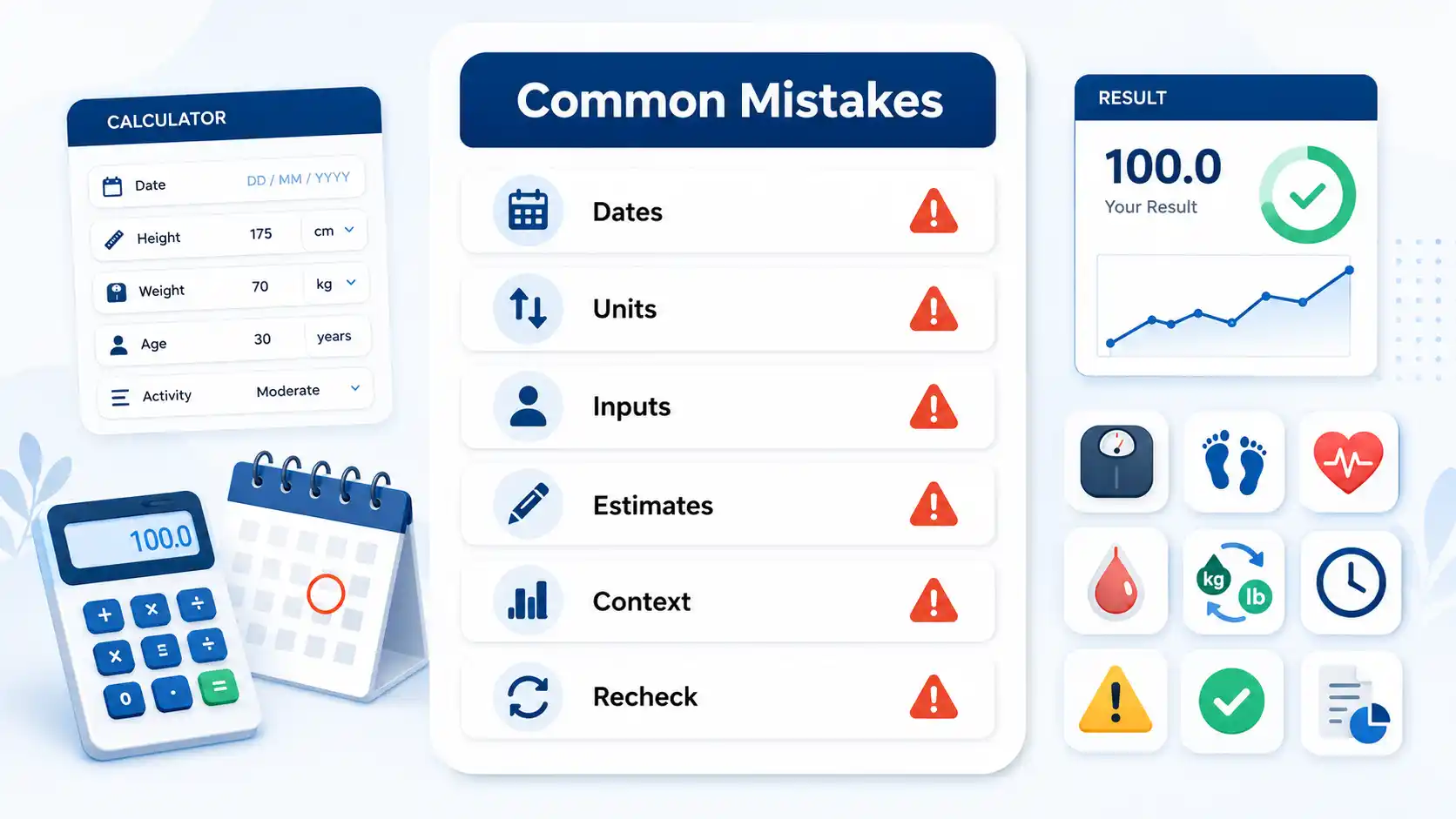
Try calculatorCommon Mistakes When Using the Gestational Age Calculator
A wrong input anywhere in the chain throws off every result after it. Most gestational age errors come from picking the wrong dating method or mixing up dates that sound similar but mean different things.
- Counting from conception instead of the last period, which sets your result about 2 weeks behind your doctor's chart
- Entering a default 28-day cycle length when your actual cycle runs longer or shorter
- Trusting a third-trimester ultrasound for dating instead of an early first-trimester scan
- Confusing gestational age with corrected age, a term that only applies to premature babies after birth
- Switching between methods each visit instead of sticking to the one date your provider uses to track your pregnancy
Frequently Asked Questions (FAQs)
How accurate is a gestational age calculator?
Accuracy depends on the dating source. A first-trimester ultrasound can establish or confirm gestational age within about 5 to 7 days, while later scans have wider uncertainty. A calculator can reproduce date math consistently, but it cannot make an uncertain LMP or scan more reliable.
Which due date should I use if my doctor changed my EDD?
Use the updated EDD that your prenatal clinician formally established and documented. Once pregnancy dating is set, later changes are usually reserved for limited situations. Enter that revised date in Due Date mode so your calculated weeks and days follow the same pregnancy timeline as your medical record.
Can I use the calculator if my periods are irregular?
Yes, but treat an LMP result with care. This calculator can adjust for cycle lengths from 21 to 45 days, yet irregular cycles can make ovulation timing harder to predict. If an early ultrasound or clinician-established EDD is available, that dating information may provide a better pregnancy anchor.
Can I use a second or third trimester ultrasound for gestational age?
Yes. Ultrasound mode accepts a past scan date with the gestational weeks and days reported on that scan. Clinical dating becomes less precise later in pregnancy, though. ACOG reports third-trimester ultrasound dating uncertainty of about 21 to 30 days, so established dates should not be casually replaced.
Why do two gestational age calculators show different results?
Small differences can come from different due-date anchors, cycle-length assumptions, reference dates, rounding rules, or local date handling. Compare the inputs before comparing the answers. 100Calc keeps completed weeks and extra days separate and uses local calendar-date handling to reduce common midnight and daylight-saving date shifts.
Can I enter my conception or ovulation date in this calculator?
Not directly. The current calculator accepts LMP, established EDD, ultrasound-reported gestational age, or IVF transfer. If conception or ovulation is the only date you know, use your clinician’s established EDD when available rather than treating an estimated conception date as an exact pregnancy-dating record.
Does the gestational age calculation work for twins?
Gestational age still describes how far the pregnancy has progressed, including twin pregnancies. This calculator can estimate that timeline from its supported dating methods, but it does not apply twin-specific growth charts, chorionicity rules, surveillance schedules, or delivery recommendations. Use your prenatal team’s established EDD for clinical decisions.
What if I do not know my LMP or due date?
Use Ultrasound mode if you have a scan date and the gestational weeks and days reported on that scan. If you have no reliable dating record, symptoms alone cannot establish gestational age well enough for clinical care. An early ultrasound can help your prenatal clinician establish pregnancy dating.
Questions?
We had love to hear from you! Whether you are reporting an issue, suggesting a new calculator, or exploring collaboration opportunities — we are here to help. Every message helps us make 100calc smarter, faster, and more helpful for everyone.
Why People Trust 100calc
At 100calc.com, we focus on accuracy, speed, and trust. Every calculator we create is designed to give reliable, instant, and easy-to-understand results you can truly depend on.