
Fundal Height Calculator by Week: Check CM Range, Growth Status & Baby Weight
A fundal height calculator in cm compares your symphysis-fundal height, or SFH measurement, with your gestational age to check whether uterine growth appears on track. Fundal height is measured from the pubic symphysis to the fundus, which is the top of the uterus. Most singleton pregnancies measure close to the pregnancy week during mid-pregnancy, but body shape, fetal position, bladder fullness, and amniotic fluid can affect the number.
A single number can cause a lot of worry. Is your baby measuring small? Is growth ahead of schedule? Does a larger measurement mean a bigger baby? Many parents leave appointments with more questions than answers.
This calculator helps you make sense of the measurement. Enter your pregnancy week and fundal height in cm. You’ll see the expected range, growth status, estimated baby weight, and whether the result falls within a normal pattern or may need further discussion with your healthcare provider.
Quick Facts
- Compares fundal height with gestational age
- Uses the common week equals centimeter growth rule
- Estimates fetal weight using Johnson's Formula
- Flags possible SGA and LGA growth patterns
- Supports NHS-style interpretation adjustments
- Updated Jul 8, 2026
- Reviewed by 100Calc Research Team
SFH & Fetal Growth Analyzer
Fundal Height Calculator
Use this fundal height calculator in cm to check your SFH measurement by week, view your growth range, and estimate fetal weight (EFW) using Johnson’s Formula. The result is a screening guide, not an official centile, percentile, or z-score diagnosis.
Growth Analysis
Checking your growth range...
PendingEstimated Fetal Weight (Johnson's Formula)
Growth Trajectory
Your Symphysis-Fundal Height relative to the expected fundal height growth range.
Clinical Context Decoder
Explanation of your specific variance will appear here.
Is my fundal height normal?
Your dynamic answer will appear here.
How accurate is this estimated fetal weight?
Your static educational answer will appear here.
Explore More Calculators
Use the Chinese Gender Calculator for a traditional boy-or-girl prediction from lunar age and conception month. Enter conception date, due date, or LMP.
Try calculatorUse this fetal growth calculator to check baby weight percentile from ultrasound data in grams, kg, or cm and see what the result means…
Try calculatorEnter gestational sac measurements in mm or cm to calculate mean sac diameter, estimate early gestational age, compare week-by-week milestones, and see when follow-up…
Try calculatorMissed a birth control pill? Check pregnancy risk, protection status, backup contraception needs, and what to do next with our missed pill calculator.
Try calculatorUse our Pregnancy Chance Calculator to estimate your odds. Enter your cycle day, age, and method. Find out if you are in the high-risk…
Try calculatorUse our pregnancy due date calculator to find your exact Baby Due date. IVF, conception, ovulation, and ultrasound methods with weeks and timeline.
Try calculator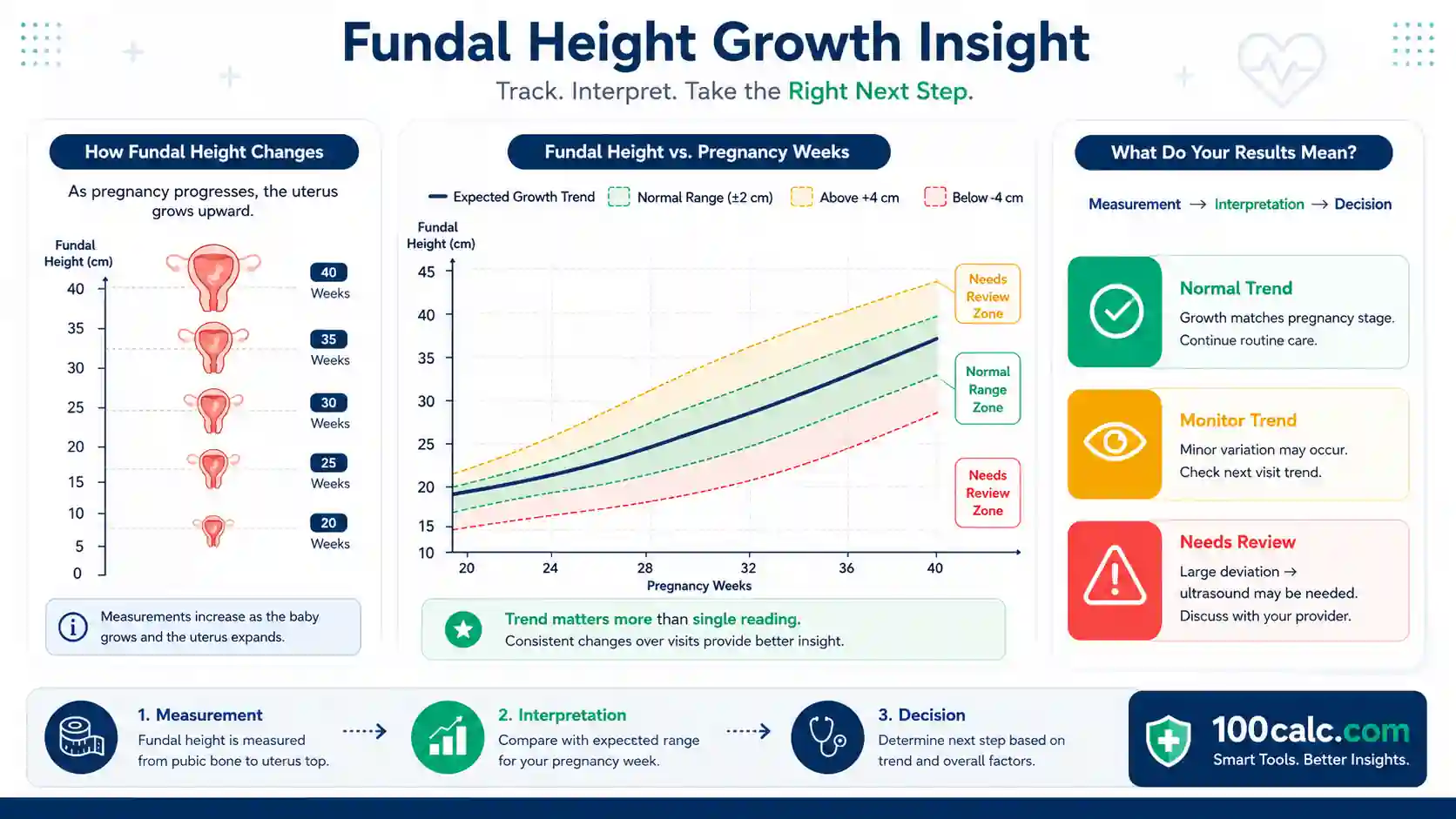
Micro Insight
Fundal height helps answer an important question. Is growth following the expected pattern? When measurements change more than expected, providers may order an ultrasound to gather more information before making any clinical decisions.
What Is Fundal Height in Pregnancy?
Fundal height gives a quick picture of how the uterus is growing over time. As the baby develops, the uterus expands upward. A measuring tape can show whether growth follows the expected pattern for that stage of pregnancy.
A measurement that differs from the expected week does not always signal a problem. Baby position, amniotic fluid levels, maternal body size, and multiple previous pregnancies can all affect the reading. A person at 32 weeks may measure 30 cm or 34 cm and still have a healthy pregnancy.
Doctors look for growth trends rather than one isolated measurement. Consistent changes over several visits often provide more useful information than a single reading taken on one day.
What Your Fundal Height Result Means
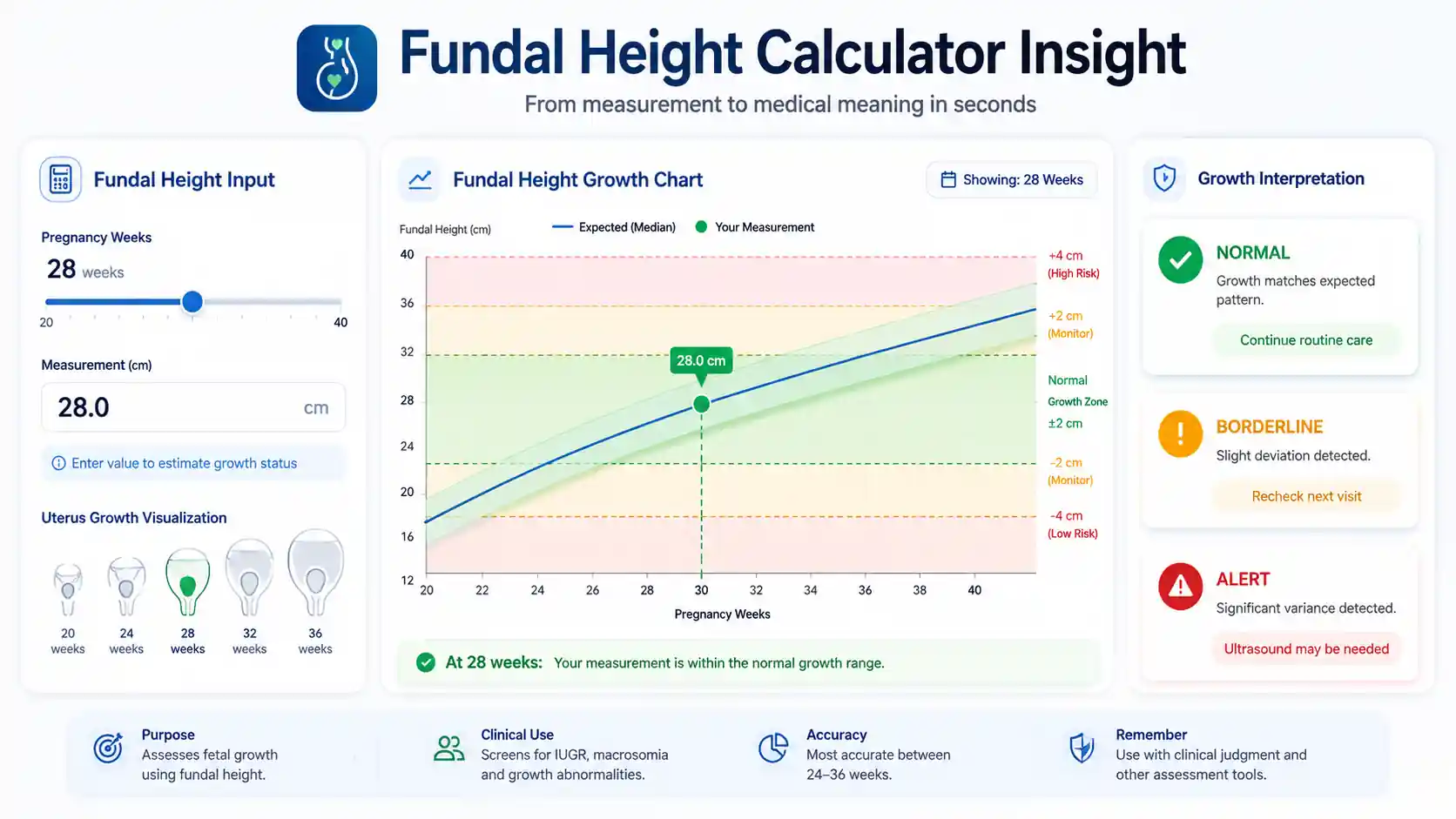
Your fundal height result shows how closely your pregnancy measurement matches your gestational age. The calculator compares your measured fundal height in centimeters with the expected value for your pregnancy week and reports the difference, called the variance.
Understanding Your Result
A positive variance means the measurement is larger than expected for that week of pregnancy.
A negative variance means the measurement is smaller than expected.
Most healthy pregnancies measure within about 2 cm above or below the gestational week. Small differences are common and often reflect baby position, body shape, or normal measurement variation.
Larger differences may lead your provider to track growth more closely or recommend an ultrasound for more information.
Is Your Result Good or Bad?
A result between -2 cm and +2 cm is usually considered within the expected range.
A result between +3 cm and +4 cm suggests the baby may be measuring larger than expected. Extra fluid, maternal body size, or a larger baby can contribute to this pattern.
A result between -3 cm and -4 cm suggests growth may be measuring behind expectations. Dating differences, baby position, and other factors can affect the reading.
Results of ±4 cm or more often trigger further assessment. These results do not diagnose a problem. They signal that growth deserves a closer look.
What You Should Do Next
Compare the result with previous measurements, not just one visit.
Discuss large changes with your healthcare provider.
Attend recommended follow-up appointments.
Consider an ultrasound if your provider suggests further growth assessment.
Quick Example to Test
Input
- Gestational Age: 34 weeks
- Fundal Height: 36 cm
Result
- Variance: +2 cm
- Growth Status: Normal Growth
Meaning
The measurement falls within the typical range for 34 weeks. Growth appears consistent with the expected pregnancy timeline. Routine monitoring is usually all that is needed unless future measurements show a larger change.
How to Use the Fundal Height Calculator
This fundal height calculator compares your fundal height measurement with your gestational age and estimates fetal weight using standard pregnancy assessment methods. It also checks whether growth appears on track, measuring large, measuring small, or falls into an SGA or LGA screening category.
Choose Your Calculation Standard
Select the calculation mode that matches your needs. Standard mode provides general pregnancy growth screening. NHS mode adds maternal BMI and parity details to refine result interpretation. These factors affect how measurements are explained but do not change the actual growth variance or fetal weight estimate.
Select Your Gestational Age
Enter your current pregnancy week between 20 and 42 weeks. The calculator uses this value as the expected fundal height reference. A pregnancy at 32 weeks is generally compared against an expected fundal height of about 32 centimeters to assess growth patterns
Enter Your Fundal Height Measurement
Add the measured fundal height in centimeters. This is the distance from the pubic bone to the top of the uterus. The calculator compares this measurement with your gestational age and determines whether growth appears within the expected range or requires closer monitoring.
Choose Fetal Head Engagement Status
Select whether the baby's head is engaged in the pelvis. This choice is used for the fetal weight estimate. Different values are applied behind the scenes based on engagement status, helping produce a more accurate screening estimate using Johnson's method.
Review Your Results
The calculator reviews your pregnancy week, fundal height, head engagement status, and optional BMI/parity context. It then shows your expected fundal height, cm difference, growth range, and rough fetal weight estimate. Use the result to understand the measurement before discussing it with your healthcare provider.
Review Growth Status, Variance, and Estimated Fetal Weight
The calculator analyzes all inputs and displays your growth variance, growth category, and estimated fetal weight. Results appear in kilograms, grams, and pounds with ounces. You may also see guidance on whether routine monitoring or further assessment could be appropriate.
Quick Example to Test
Inputs
- Gestational Age: 34 weeks
- Fundal Height: 36 cm
- Baby’s Head Engaged: No
Result
- Variance: +2 cm
- Growth Status: Normal Growth
- Estimated Fetal Weight: 3.72 kg
- Estimated Weight: 3,720 g
- Estimated Weight: 8 lb 3 oz
What Happened
The measurement was two centimeters above the expected value for 34 weeks. That still falls within the normal growth range used by the calculator. The fundal height measurement was also used to estimate fetal weight and display it in multiple units.
How the Fundal Height Calculator System Works
This fundal height calculator combines established symphysis fundal height screening practices with Johnson’s fetal weight estimation method. The system evaluates how closely your measurement matches expected pregnancy growth, then adds clinical context to help identify normal patterns, possible growth concerns, and estimated fetal weight ranges.
Key Features & Benefits
- Uses standard fundal height growth assessment methods used in prenatal care.
- Supports both Global and NHS-based interpretation pathways.
- Estimates fetal weight instantly from pregnancy measurements.
- Flags possible SGA and LGA growth patterns for review.
- Provides growth context and follow-up guidance in plain language.
Technical Process
Growth Check
Compares fundal height with gestational age to assess expected growth alignment.
Variance Analysis
Measures the difference from expected size and assigns growth categories.
Weight Estimate
Uses fundal height and head engagement status to estimate fetal weight.
What should fundal height be by week in cm?
Fundal height in cm often sits close to your pregnancy week during the middle of pregnancy. This chart gives a quick screening range, so you can compare your number before using the Fundal Height Calculator.
What is a normal fundal height chart by week?
A common screening rule is that fundal height should be close to your gestational age in weeks. Many providers use a small range around that number because baby position, bladder fullness, and measuring technique can change the reading.
| Pregnancy Week | Expected SFH | Typical Screening Range | Note |
|---|---|---|---|
| 20 weeks | 20 cm | 18 to 22 cm | Often near the belly button. |
| 21 weeks | 21 cm | 19 to 23 cm | Small shifts are common. |
| 22 weeks | 22 cm | 20 to 24 cm | Usually still early for trend tracking. |
| 23 weeks | 23 cm | 21 to 25 cm | One reading does not show the full pattern. |
| 24 weeks | 24 cm | 22 to 26 cm | Fundal height tracking is more useful from here. |
| 25 weeks | 25 cm | 23 to 27 cm | Compare with your own growth trend. |
| 26 weeks | 26 cm | 24 to 28 cm | Baby position may change the number. |
| 27 weeks | 27 cm | 25 to 29 cm | A small difference is usually expected. |
| 28 weeks | 28 cm | 26 to 30 cm | Growth checks often become more regular. |
| 29 weeks | 29 cm | 27 to 31 cm | Your provider may compare this with past visits. |
| 30 weeks | 30 cm | 28 to 32 cm | A good week for spotting growth trends. |
| 31 weeks | 31 cm | 29 to 33 cm | Fluid level and baby position can affect SFH. |
| 32 weeks | 32 cm | 30 to 34 cm | Measuring ahead or behind may need context. |
| 33 weeks | 33 cm | 31 to 35 cm | Head position can start to matter more. |
| 34 weeks | 34 cm | 32 to 36 cm | Your provider may watch the trend closely. |
| 35 weeks | 35 cm | 33 to 37 cm | A single number is less useful than the pattern. |
| 36 weeks | 36 cm | 34 to 38 cm | After this, the baby may start dropping lower. |
| 37 weeks | Around 37 cm | Less reliable | Engagement can make SFH look smaller. |
| 38 weeks | Around 38 cm | Less reliable | Baby position can change the tape reading. |
| 39 weeks | Around 39 cm | Less reliable | Your provider may rely more on exam or scan. |
| 40 weeks | Around 40 cm | Less reliable | Fundal height may stop rising clearly. |
| 41 weeks | Around 41 cm | Less reliable | Late-pregnancy readings need clinical context. |
| 42 weeks | Around 42 cm | Less reliable | Follow your provider’s monitoring plan. |
Heads-up: This chart is a screening guide, not a diagnosis. Fundal height can change with baby position, bladder fullness, body shape, fluid level, and late-pregnancy engagement.
How should I use this fundal height chart?
Use the chart as a quick screening guide, not a diagnosis. If your fundal height is more than a few centimeters above or below your pregnancy week, enter the number into the calculator and discuss the result at your next prenatal visit.
- Close to your week: usually fits expected uterine growth.
- A little ahead or behind: can happen from baby position, body shape, bladder fullness, or measuring angle.
- Far above the range: may need a check for dating, fluid level, larger baby, fibroids, or more than one baby.
- Far below the range: may need a check for fetal position, engaged head, low fluid, or slower fetal growth.
Why does the chart become less reliable after 36 weeks?
Fundal height can become less predictable near the end of pregnancy because the baby may move lower into the pelvis. When that happens, the tape measurement may look smaller even when the baby is still growing.
Use late-pregnancy fundal height as a clue, not a final answer. Your healthcare provider may use your growth trend, baby movement, physical exam, or ultrasound if the number does not match the expected pattern.
Fundal Height Formula and Calculation Method
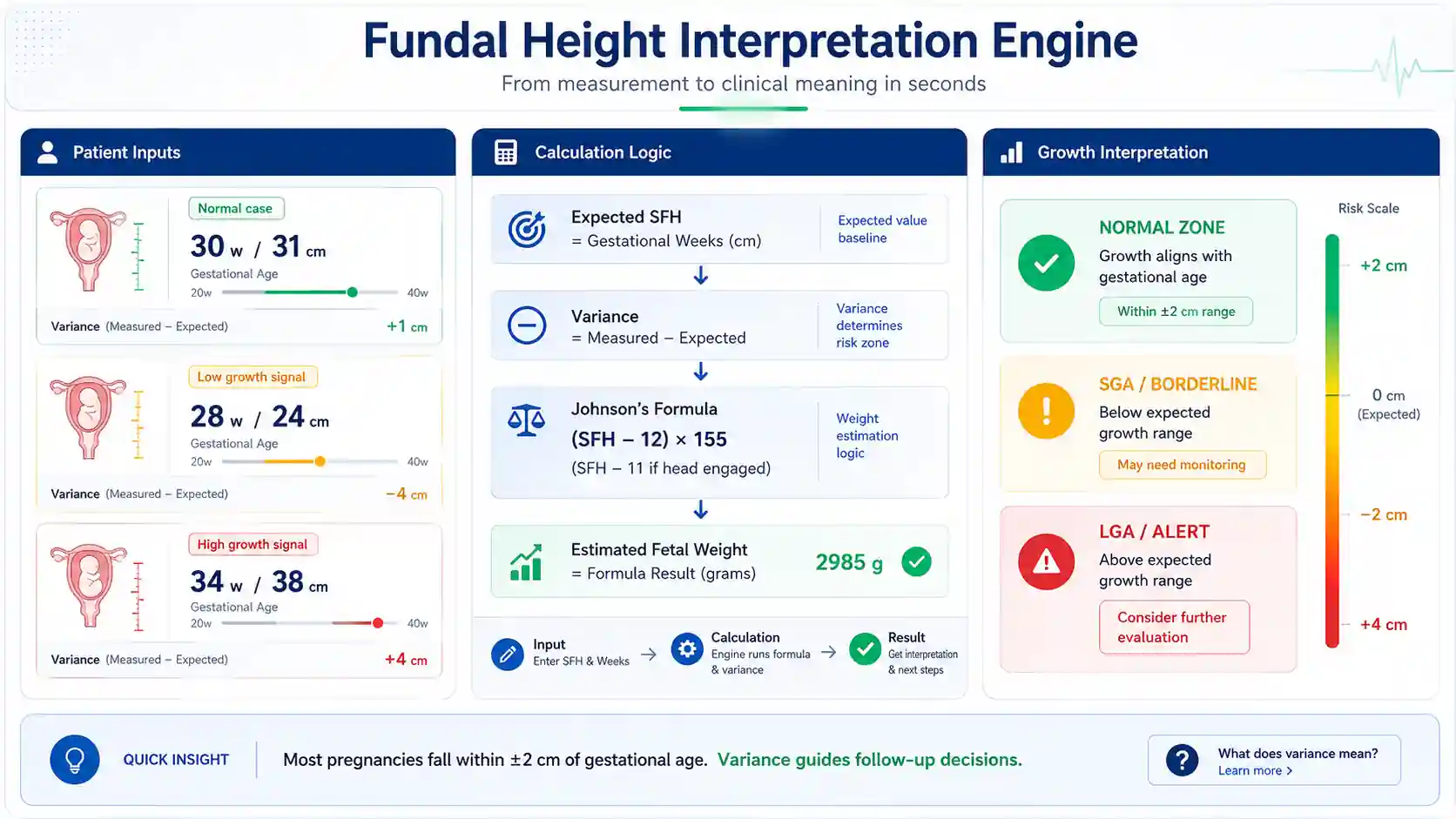
The Fundal Height Calculator uses two clinical measurements to assess pregnancy growth. It compares fundal height with gestational age and estimates fetal weight using Johnson’s Formula. This method helps screen for growth patterns, identify measurement differences, and provide a quick fetal weight estimate based on standard obstetric assessment practices.
Formula 1
Expected Fundal Height (cm) = Gestational Age (Weeks)
How the Formula Works
Fundal height usually tracks closely with the number of weeks of pregnancy after the midpoint of pregnancy. This formula creates the expected measurement used as the baseline for growth screening. The calculator compares your actual measurement against this expected value to determine whether growth appears on track.
Formula:2
Variance (cm) = Fundal Height (cm) - Gestational Age (Weeks)
How the Formula Works
Variance shows how far the measured fundal height differs from the expected size for that pregnancy week. A positive value means the measurement is larger than expected. A negative value means it is smaller. This comparison helps identify growth trends that may need closer monitoring.
Understanding the Formula Variables
SFH
This is the distance from the pubic bone to the top of the uterus, measured in centimeters. It serves as the primary growth measurement used throughout the calculator and reflects overall uterine size during pregnancy.
GA
This represents how many weeks pregnant you are. The calculator uses gestational age as the expected growth benchmark and compares actual measurements against this value to identify whether growth appears smaller, larger, or within the expected range.
Variance
Variance measures the gap between fundal height and gestational age. It helps detect patterns that may suggest normal growth, larger measurements, or smaller measurements that could benefit from further assessment.
EFW
This value is generated using Johnson’s Formula. It gives a rough estimated fetal weight based on fundal height and fetal head position.
N
The calculator uses 11 when the fetal head is engaged and 12 when it is not engaged. This small adjustment helps improve weight estimation by accounting for differences in fetal position during late pregnancy.
Another Example Calculation (Step-by-Step)
This example shows how the Fundal Height Calculator evaluates growth and estimates fetal weight using the same logic applied throughout the system.
Given:
Gestational Age = 34 weeks
Fundal Height = 36 cm
Fetal Head Engaged = No
Calculation:
					Expected Fundal Height = 34 cm

Variance = 36 - 34
= +2 cm

Estimated Fetal Weight
= (36 - 12) × 155
= 24 × 155
= 3720 g
Result:
Expected Fundal Height: 34 cm
Variance: +2 cm
Growth Status: Normal Growth
Estimated Fetal Weight: 3.72 kg
Estimated Fetal Weight: 3,720 g
Estimated Fetal Weight: 8 lb 3 oz
Meaning:
A fundal height of 36 cm at 34 weeks is still within the commonly accepted screening range. The positive variance shows the measurement is slightly ahead of the expected value but does not automatically indicate a problem. The estimated fetal weight suggests a larger baby size, though ultrasound remains the preferred method for confirming fetal growth and weight.
How Do You Calculate Fundal Height?
Fundal height is calculated by comparing the measured symphysis-fundal height (SFH) in centimeters with gestational age in weeks. A measurement close to the pregnancy week is usually considered normal. The calculator also uses Johnson’s Formula to estimate fetal weight and identify possible growth patterns such as normal growth, SGA, or LGA.
Is a Fundal Height of 31 cm Normal at 30 Weeks?
This example shows a pregnancy measuring close to the expected growth pattern.
Input
- Gestational Age: 30 weeks
- Fundal Height: 31 cm
- Fetal Head Engaged: No
Process
- Expected Fundal Height = 30 cm
- Variance = 31 − 30
- Variance = +1 cm
- Estimated Fetal Weight = (31 − 12) × 155
- Estimated Fetal Weight = 2,945 g
Result
- Variance: +1 cm
- Growth Status: Normal Growth
- Estimated Weight: 2.95 kg
- Estimated Weight: 6 lb 8 oz
Meaning
The measurement falls within the commonly accepted ±2 cm range. Growth appears consistent with pregnancy dating.
What Does a Fundal Height of 24 cm at 28 Weeks Mean?
This scenario reflects a measurement that is smaller than expected.
Input
- Gestational Age: 28 weeks
- Fundal Height: 24 cm
- Fetal Head Engaged: Yes
Process
- Expected Fundal Height = 28 cm
- Variance = 24 − 28
- Variance = −4 cm
- Estimated Fetal Weight = (24 − 11) × 155
- Estimated Fetal Weight = 2,015 g
Result
- Variance: −4 cm
- Growth Status: SGA Warning
- Estimated Weight: 2.02 kg
- Estimated Weight: 4 lb 7 oz
Meaning
A difference of four centimeters below the expected value may prompt additional growth monitoring or an ultrasound assessment.
Can a Large Fundal Height Indicate a Bigger Baby?
A larger measurement often leads parents to wonder if the baby is growing above average.
Input
- Gestational Age: 34 weeks
- Fundal Height: 38 cm
- Fetal Head Engaged: No
Process
- Expected Fundal Height = 34 cm
- Variance = 38 − 34
- Variance = +4 cm
- Estimated Fetal Weight = (38 − 12) × 155
- Estimated Fetal Weight = 4,030 g
Result
- Variance: +4 cm
- Growth Status: LGA Warning
- Estimated Weight: 4.03 kg
- Estimated Weight: 8 lb 14 oz
Meaning
A larger measurement may reflect a bigger baby, extra amniotic fluid, or normal body differences. Many pregnancies with large measurements still progress normally.
Does Head Engagement Change Estimated Fetal Weight?
Johnson’s Formula adjusts fetal weight estimates based on whether the baby’s head has entered the pelvis.
Input
- Gestational Age: 36 weeks
- Fundal Height: 35 cm
- Fetal Head Engaged: Yes
Process
- Expected Fundal Height = 36 cm
- Variance = 35 − 36
- Variance = −1 cm
- Estimated Fetal Weight = (35 − 11) × 155
- Estimated Fetal Weight = 3,720 g
Result
- Variance: −1 cm
- Growth Status: Normal Growth
- Estimated Weight: 3.72 kg
- Estimated Weight: 8 lb 3 oz
Meaning
Growth remains within the normal screening range. Head engagement slightly changes the fetal weight estimate while leaving growth classification unchanged.
Quick Rules to Remember
Fundal height is a screening measurement, not a diagnosis. Most healthy pregnancies measure within about 2 cm of gestational age. Larger or smaller differences may lead to repeat measurements or ultrasound evaluation. Enter your own pregnancy week and fundal height into the calculator to compare growth, estimate fetal weight, and understand what your measurement may mean.
Fundal Height Variance Result Benchmarks Explained
Fundal height variance helps you understand if fetal growth matches expected pregnancy progress. This benchmark range shows whether measurements fall within normal limits or signal possible growth concerns. It turns a simple centimeter difference into a clear medical insight so users can quickly judge if tracking and follow-up are needed.
| Range | Category | Meaning | Clinical Context (USA) | Clinical Context (Global/India) |
|---|---|---|---|---|
| -2 cm to +2 cm | Normal Growth | Growth matches expected gestational size | Considered within normal variation during routine prenatal checks | Seen as healthy progression in standard antenatal monitoring |
| -3 cm | Measuring Small | Baby measuring slightly smaller than expected | Often monitored with repeat scans if trend continues | Common trigger for follow-up ultrasound in prenatal care |
| +3 cm | Measuring Large | Baby measuring slightly larger than expected | May indicate gestational diabetes screening or monitoring | Usually prompts growth tracking in next visits |
| ≤ -4 cm | SGA Warning | Possible small for gestational age concern | Often requires detailed ultrasound and growth assessment | Considered high priority for fetal growth evaluation |
| ≥ +4 cm | LGA Warning | Possible large for gestational age concern | May indicate macrosomia risk or metabolic screening | Requires closer monitoring and possible glucose testing |
Heads-up: Fundal height is a screening tool, not a diagnosis. Variations depend on body type, fetal position, and measurement method.
What These Ranges Mean
Most pregnancies stay within the -2 cm to +2 cm range, which signals normal growth. Small shifts like -3 cm or +3 cm usually need monitoring, not panic. Larger deviations suggest possible growth restriction or excess growth and may require ultrasound confirmation.
Pro Tip
Track measurements over time, not just one reading. A consistent trend matters more than a single value. Regular prenatal visits give the most reliable growth picture.
What to Do After Checking Your Fundal Height Variance Result
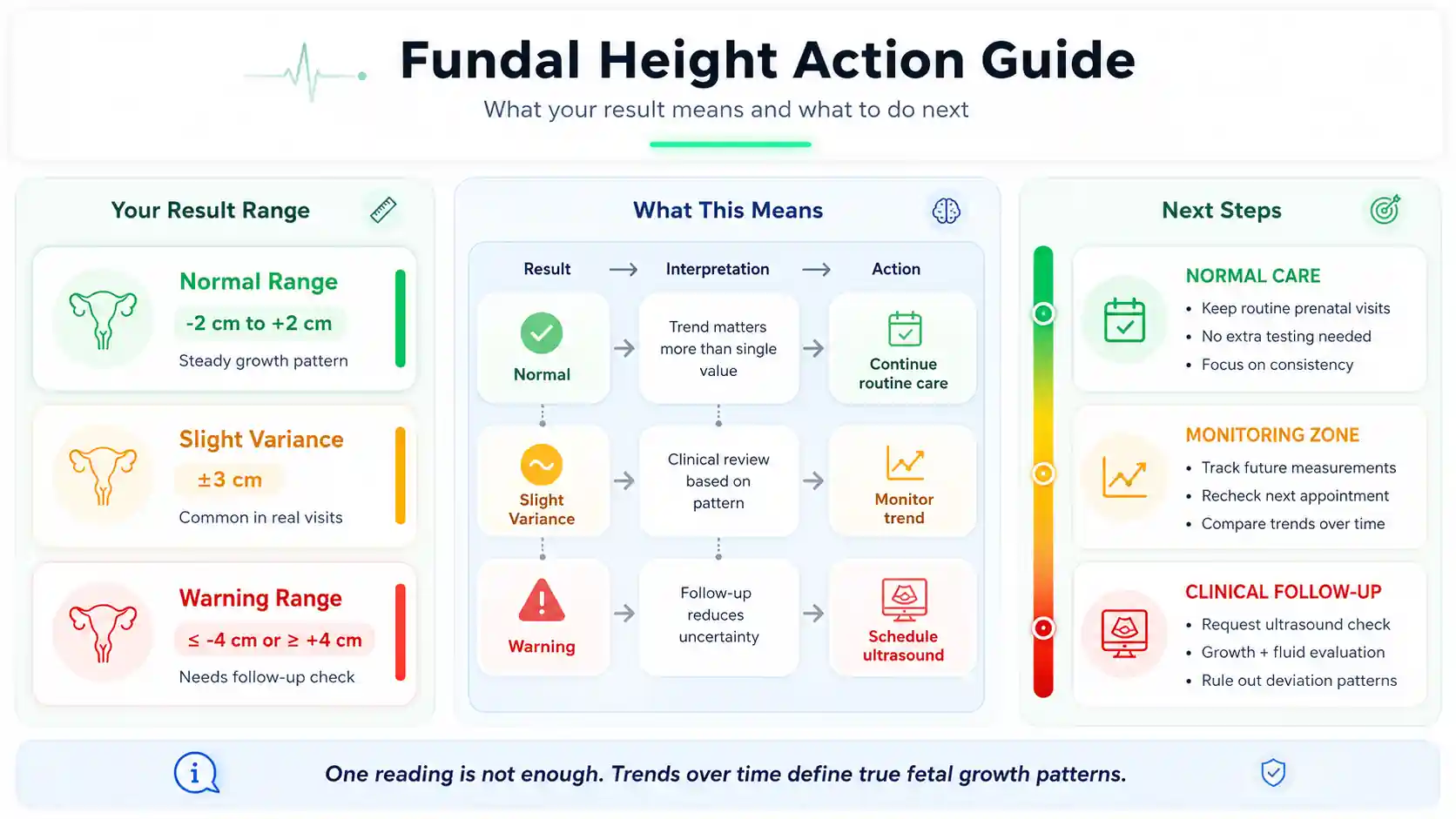
Fundal height variance results help you understand how your pregnancy growth compares with expected ranges. The real value comes from what you do next. Small differences can be normal, but trends over time matter more. These steps help you respond correctly, reduce anxiety, and know when to seek medical review.
For Normal Growth (-2 cm to +2 cm)
This range usually means growth is matching expected pregnancy progress. Most prenatal visits fall here, and it often reflects steady fetal development without concerns. The key focus now is consistency, not perfection.
Continue tracking measurements at every scheduled visit. Avoid comparing single readings. Small shifts are normal due to baby position or bladder fullness. Keep routine appointments and maintain regular prenatal care. No extra action is needed unless symptoms change.
For Slight Variance (-3 cm or +3 cm)
This range often appears in real clinic visits and usually does not signal a problem. It may reflect measurement differences, body shape, or fetal position. Doctors typically monitor trends before making decisions.
Keep a record of each reading across visits. Ask your provider to recheck measurements at the next appointment. If the pattern stays stable, it is usually considered normal variation. Only repeated variance across visits needs deeper evaluation.
For Warning Range (≤ -4 cm or ≥ +4 cm)
This level of difference needs closer attention. It may suggest the baby is smaller or larger than expected for gestational age. It does not confirm a problem, but it requires follow-up testing.
Schedule an ultrasound if not already planned. Ask your provider about growth scans and fluid checks. Focus on tracking change over time instead of a single result. Early evaluation helps rule out growth restriction or excessive growth patterns.
Pro Tip
Single measurements rarely tell the full story. The most reliable insight comes from comparing multiple fundal height readings over time. Regular prenatal visits and consistent tracking give the clearest picture of healthy fetal growth progression.
You Might Also Find These Helpful
Pregnancy & Fertility 45
Use this Pregnancy Risk Calculator to check age, BMI, health history, bleeding, and twins. See if closer prenatal monitoring may be worth asking about.
Try calculatorOne Time Pregnancy Calculator estimates pregnancy odds from one encounter, plus fertile window timing, test date, due date, and 21-day testing guidance.
Try calculatorUse the AMH Calculator to convert ng/mL or pmol/L, compare your result with age-based data, and see what it may mean for IVF, fertility,…
Try calculatorUse the Baby Eye Color Calculator with parents, grandparents, or sibling context to compare Brown, Green/Hazel, and Blue/Grey model estimates instantly.
Try calculatorBasal Body Temperature Calculator checks reading conditions and analyzes your temperature pattern for a sustained shift that may be consistent with ovulation.
Try calculatorBPD gestational age calculator: estimate fetal age from BPD, compare your week, check normal BPD ranges, and understand ahead or behind results.
Try calculatorCalculate odds with the Chance of Twins Calculator. Enter maternal age and history. Find your probability instantly. See if you will conceive multiples now.
Try calculatorFind out exactly when you conceived. Our free Conception Calculator uses your Due Date, LMP, or Ultrasound to estimate your fertilization date and fertile…
Try calculatorUse our Conception Date Due Date Calculator to find your baby's arrival date. Enter your conception or intercourse date for clinical 40-week results.
Try calculatorContraceptive effectiveness calculator to compare birth control methods, typical vs perfect use, backup protection, and 5-year pregnancy risk.
Try calculatorUse this CRL calculator to estimate gestational age and due date from crown-rump length in mm or cm. Compare CRL, LMP, and IVF dating…
Try calculatorEstimate your monthly and 12-month pregnancy odds by age, partner age, and cycle dates. See your fertile window and when to seek fertility help.
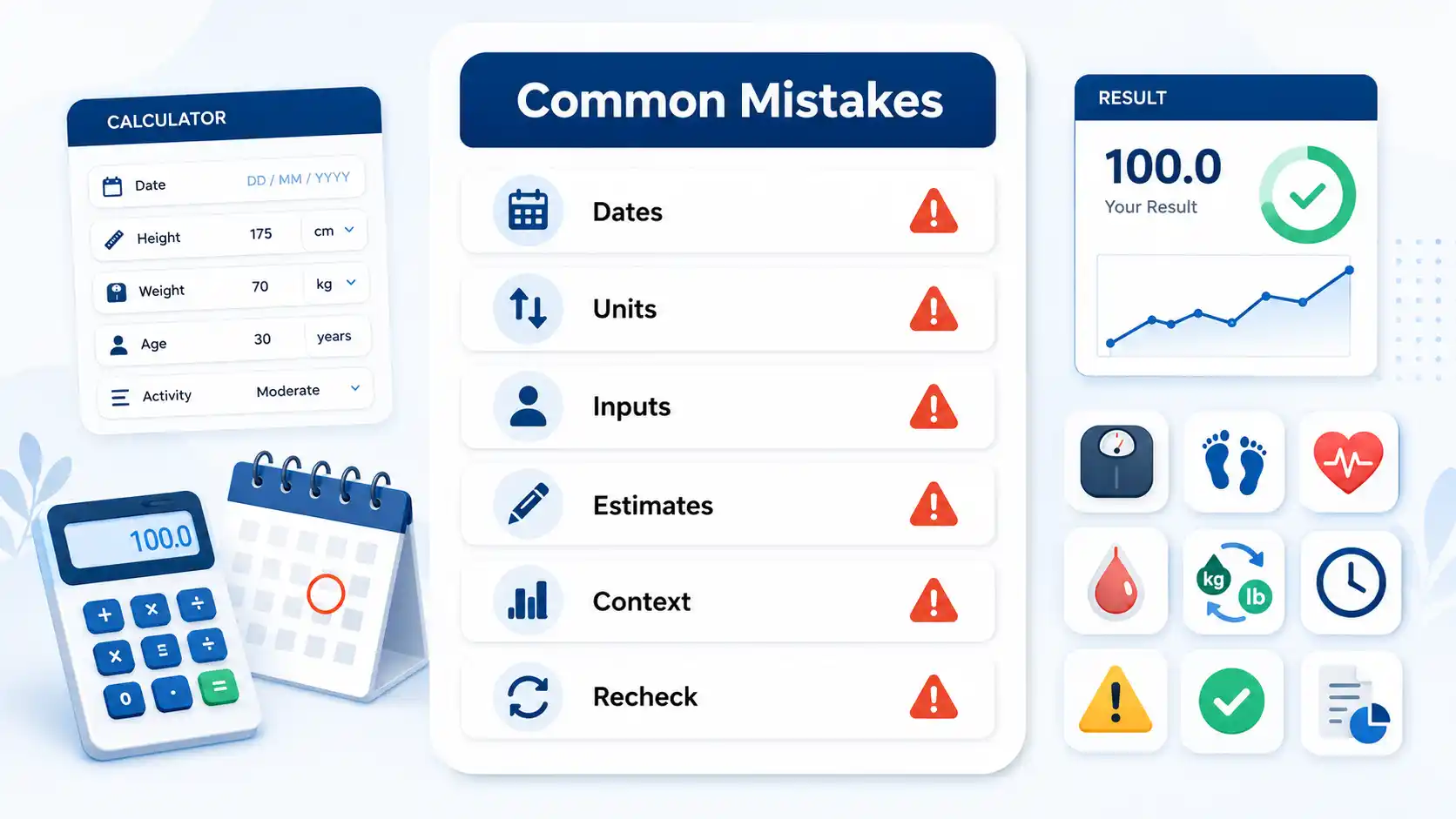
Try calculatorCommon Mistakes When Using the Fundal Height Variance Calculator
Fundal height measurement is simple, but small input errors can change the result. Many users misread the value or measure incorrectly, leading to false concern or missed signals. These mistakes often come from timing, technique, or misunderstanding what the number actually represents in pregnancy tracking.
- Measuring before 20 weeks of pregnancy when fundal height is not reliable
- Using inches instead of centimeters when entering measurements
- Taking measurements with a full bladder, which can increase height readings
- Assuming a single reading confirms growth problems without tracking trends
- Confusing fundal height with fetal weight estimation from ultrasound
Frequently Asked Questions (FAQs)
What is a normal fundal height in pregnancy?
Normal fundal height is often close to the pregnancy week in centimeters during mid-pregnancy, especially from about 24 to 36 weeks. For example, at 28 weeks, about 26 to 30 cm is commonly used as a screening range. After 36 weeks, baby position and engagement can make fundal height less reliable.
What does it mean if fundal height is ahead?
A higher-than-expected fundal height may suggest a larger baby, extra amniotic fluid, or differences in measurement. It does not confirm a problem. Doctors usually recommend monitoring trends or doing an ultrasound before drawing conclusions about fetal size.
What does fundal lag mean?
Fundal lag means the uterus measures smaller than expected for gestational age. It can suggest slower fetal growth or positioning differences. This finding usually leads to follow-up checks or ultrasound to confirm if growth is truly below expected levels.
Can BMI affect fundal height?
Yes, maternal BMI can influence fundal height readings. Higher BMI may slightly increase measurements due to abdominal thickness. This is why doctors often combine fundal height with other assessments to get a more accurate view of fetal growth.
When is fundal height no longer reliable?
Fundal height becomes less accurate late in pregnancy, especially after 36 weeks. Baby position, engagement, and fluid levels can affect readings. At this stage, ultrasound is often used for more precise growth tracking and assessment.
Why is my fundal height normal but ultrasound percentile low?
This can happen when baby position or maternal body shape affects tape measurements. Ultrasound looks directly at fetal growth, while fundal height is indirect. Doctors usually trust ultrasound more when results do not match.
Can an engaged baby make fundal height smaller?
Yes, when the baby drops into the pelvis, fundal height may measure lower than expected. This is common near the end of pregnancy. It does not always indicate poor growth and is often a normal sign of labor preparation.
Why does fundal height change between appointments?
Fundal height can change due to baby position, bladder fullness, or different measuring techniques. Small differences are normal. Doctors focus more on overall growth trends across multiple visits rather than a single measurement change.
Is fundal height the same as symphysis fundal height?
Yes, fundal height and symphysis fundal height usually mean the same measurement. It is the distance in centimeters from the pubic bone, called the pubic symphysis, to the top of the uterus.
Doctors and midwives often shorten symphysis fundal height to SFH. This measurement helps screen whether uterine growth matches the pregnancy week.
Is 36 cm fundal height normal at 33 weeks?
A fundal height of 36 cm at 33 weeks is about 3 cm ahead of the pregnancy week. It may still happen from baby position, extra fluid, body shape, or measuring differences, but your provider may want to watch the trend or order a growth scan.
One larger reading does not always mean a big baby. It becomes more useful when compared with your past measurements and other checks.
Can fundal height be wrong?
Yes, fundal height can be wrong because it is a tape-measure screening tool. Baby position, bladder fullness, maternal BMI, fibroids, fluid level, and different measuring technique can all change the number.
That is why fundal height does not confirm SGA, LGA, or fetal weight by itself. If the number looks far ahead or behind, ultrasound gives a clearer growth check.
Questions?
We had love to hear from you! Whether you are reporting an issue, suggesting a new calculator, or exploring collaboration opportunities — we are here to help. Every message helps us make 100calc smarter, faster, and more helpful for everyone.
Why People Trust 100calc
At 100calc.com, we focus on accuracy, speed, and trust. Every calculator we create is designed to give reliable, instant, and easy-to-understand results you can truly depend on.