
Conception Calculator
Track your pregnancy timeline with the Conception Calculator. It identifies the specific day fertilization occurred. The tool calculates your estimated “Conception Date.” It also finds your likely “Intercourse Window.” Doctors typically use your Last Menstrual Period to estimate the date of a pregnancy. Actual conception happens roughly two weeks later. Therefore, you need to adjust the date. Enter your details below to see your biological timeline immediately.
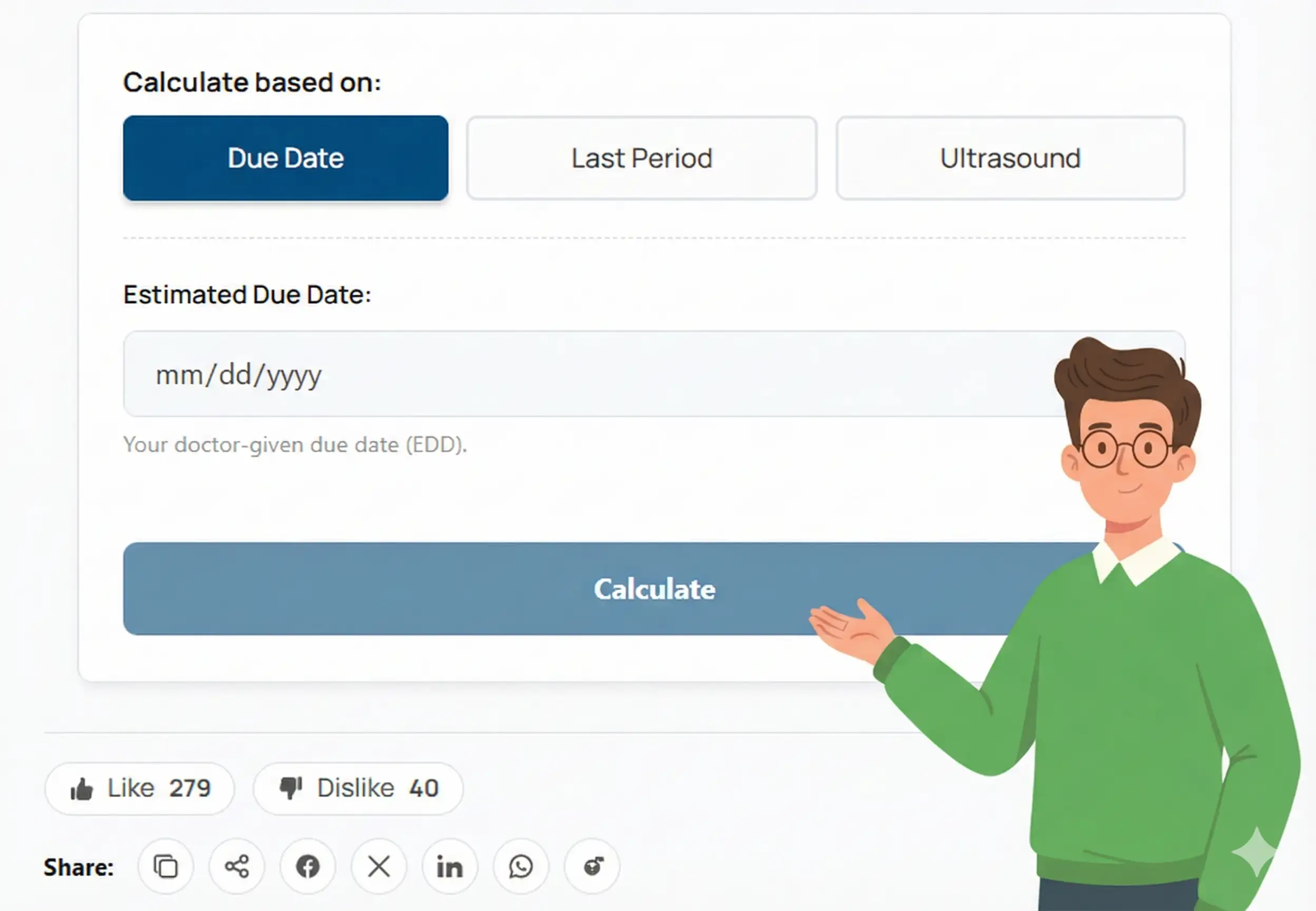
You can calculate these dates using your Due Date. Alternatively, use your Last Period or Ultrasound. The calculator adjusts for your specific cycle length. Plus, it accounts for sperm survival time. Consequently, you can pinpoint the exact days you were fertile. Use this data to understand exactly when your pregnancy began.
- Updated Jun 12, 2026
Conception Calculator: Find Your Fertilization Date
Calculate your exact Conception Date and Intercourse Window. These results represent the biological start of your pregnancy. The calculator works with your Due Date. It also accepts Last Period dates or Ultrasound measurements.
Your doctor-given due date (EDD).
Example: "8 Weeks and 3 Days".
CONCEPTION DATE
YOU ARE CURRENTLY
Sperm can survive up to 5 days. Intercourse on these days likely led to conception:
Your Pregnancy At a Glance
Calculation Details:
- Method: --
- Input Date: --
- Cycle/Stats: --
*Based on Naegele's Rule & ACOG Guidelines. Actual conception timing can vary.
What Your Conception Calculator Result Means
You must understand three key concepts when reading your report. These numbers show the complete picture of your timeline.
Understanding Conception Date
The Conception Date marks the exact moment of fertilization. It identifies the day the sperm met the egg. Consequently, this date is the biological start of the embryo. Note that the date differs from your medical start date. Doctors track pregnancy from the first day of your last period. However, conception usually happens 14 days after that period begins.
The "Intercourse Window"
You likely did not conceive on the exact day of sex. Sperm can survive inside the body for up to five days. Therefore, our result shows a specific “Risk Window.”
It highlights the five-day range where intimacy likely caused the pregnancy. For example, you may have had sex on Monday. However, you might have conceived on Thursday.
Current Pregnancy Status
The tool also calculates your current Gestational Age. Medical professionals use this standard tracking number. The report might say “12 Weeks.” However, you only conceived 10 weeks ago. Doctors add those two extra weeks to standardize the timeline. Do not worry. The number matches the numbers in your official medical charts.
Quick example to check the math
Use this quick example to verify the dates. Say your Due Date is December 25th. You enter the date into the calculator. The tool instantly subtracts 266 days. Your result shows April 4th as the Conception Date. Fertilization likely happened on that specific day.
However, your Intercourse Window will show March 30th to April 4th. Any sexual activity in that range could be the cause.
Explore More Calculators
Use the Chinese Gender Calculator for a traditional boy-or-girl prediction from lunar age and conception month. Enter conception date, due date, or LMP.
Try calculatorUse this fetal growth calculator to check baby weight percentile from ultrasound data in grams, kg, or cm and see what the result means…
Try calculatorEnter gestational sac measurements in mm or cm to calculate mean sac diameter, estimate early gestational age, compare week-by-week milestones, and see when follow-up…
Try calculatorMissed a birth control pill? Check pregnancy risk, protection status, backup contraception needs, and what to do next with our missed pill calculator.
Try calculatorUse our Pregnancy Chance Calculator to estimate your odds. Enter your cycle day, age, and method. Find out if you are in the high-risk…
Try calculatorUse our pregnancy due date calculator to find your exact Baby Due date. IVF, conception, ovulation, and ultrasound methods with weeks and timeline.
Try calculatorHow to Use the Conception Calculator
Finding your conception date takes only a minute. Follow these four steps to get an accurate estimation.
Select Your Method
Look at your available information first. Choose the "Due Date" option if you have already seen a doctor. Alternatively, select "Last Period" if you have not yet visited a clinic. You can also pick "Ultrasound" for the most precise result.
Enter the Dates
Type the specific date into the field. Enter the Estimated Due Date (EDD) your doctor provided for the first method. Otherwise, enter the first day your bleeding started for the period method. Accuracy ensures the math is correct.
Adjust Cycle Details
Select your cycle length if you use the "Last Period" method. The default setting is 28 days. However, change the number if your cycle is usually 30 or 35 days. The tool adjusts the ovulation calculation to match your body.
Click the Calculate Button
Press the button to see your whole report. The tool instantly calculates your Conception Date. You will also see your fertile window below.
Example for testing
Try these sample numbers:
Method: Due Date
Input Date: December 25, 2025
Result → Your Conception Date is April 3, 2025. The calculator shows an Intercourse Window of March 29 to April 3. That range represents the five days when sex likely led to pregnancy. You are currently in the First Trimester.
Now, enter your own numbers and check how close you are to your goal.
How the Conception Formula Works (Complete Breakdown)
Connect the dots of your pregnancy timeline. The formula provides a clear picture of when the pregnancy started. It uses standard medical math to estimate ovulation. Additionally, the logic follows Naegele’s Rule and ACOG guidelines. The method remains accurate and practical for dating a pregnancy.
Reverse Due Date Formula
The calculation works backward from the birth date. Human gestation typically lasts 266 days. We count back from the moment of conception.
Formula:
Conception Date = Due Date - 266 Days
The math starts with your Estimated Due Date. Then, it subtracts the standard gestation period of 38 weeks. The result pinpoints the exact date of fertilization.
LMP & Cycle Adjustment Formula
Alternatively, the method works forward from your period. It assumes ovulation happens 14 days before the next cycle starts.
Formula:
Conception Date = LMP + (Cycle Length - 14 Days)
Example:
					Suppose your LMP was January 1st. Your cycle is 35 days long.
January 1 + (35 - 14) = January 22.
Your conception date is January 22. The date is much later than the standard January 15th estimate.
Micro Note:
Women with long cycles often have later due dates than they expect.
Key Inputs Used in the Calculator
Nature varies slightly from person to person. However, these mathematical constants provide the best medical estimate.
Sperm Survival Time
The input defines your “Intercourse Window.” We subtract five days from the Conception Date. Sperm can wait in the fallopian tubes for this duration. Consequently, this factor creates the “Window” result on your report.
Crown-Rump Length (Ultrasound)
Ultrasound provides the “Gold Standard” input. Early scans measure the baby from head to bottom. This measurement (CRL) provides the exact age of the fetus. The calculator reverses the age to find the day life began.
Level Thresholds
The starting level matters. It sets the expectation for the result. Low levels rise fast. High levels rise slowly. Our calculator compares your result against clinical benchmarks. For example, a 90-hour doubling time is “Slow” for a starting level of 500. However, it is “Normal” to start at 4,000.
Another Example Calculation (Step-by-Step)
Let’s see how the calculator works using a real example. This breakdown helps you understand how your cycle length affects the final date. The calculation follows the same biological rules used by fertility specialists.
Given:
First Day of Period: September 1, 2025
Average Cycle Length: 32 Days
Calculation Method: Last Period (LMP)
Calculation:
We apply the ovulation adjustment formula to these numbers. The standard cycle is 28 days. However, a longer cycle delays ovulation.
Result:
Conception Date: September 19
Intercourse Window: September 14 – September 19
Status: Adjusted for Long Cycle
Meaning:
Your ovulation happened later than average. Consequently, the conception date pushed forward by four days. Standard calculators assume a 28-day cycle. Therefore, they often get this date wrong. Our tool corrects for your specific body rhythm. It confirms that sex around September 19 likely caused the pregnancy.
Result Accuracy and Benchmarks
The result serves as a mathematical estimate. It helps you understand the probability of when events occurred. Doctors consider specific methods more accurate than others. Therefore, use this breakdown to evaluate the precision of your result.
| Method Used | Accuracy Level | Best Time to Use |
|---|---|---|
| Ultrasound Scan | Highest |
First Trimester.
Before 13 weeks. |
| Due Date (EDD) | High |
Doctor Confirmed.
Based on clinical data. |
| Regular LMP | Moderate |
Standard Cycles.
Exactly 28-day loops. |
| Irregular LMP | Low |
Variable Cycles.
Hard to predict ovulation. |
Note: These are general guidelines. Every pregnancy is unique. Always discuss unusual trends with your doctor.
Interpretation
Ultrasound dates provide the most reliable benchmark. Doctors trust these scans over your period dates. Trust the Ultrasound if the result differs from your LMP. Stress or illness can sometimes delay ovulation.
Pro Tip:
Use the Ultrasound method if you have the report. Measurements taken before 12 weeks are exact. They predict the conception date within a five-day margin.
Tips & Planning Based on Your Result
Getting your date is only the first step. Next, you must understand the meaning of your pregnancy. The guide helps you interpret the timeline. Whether you have questions or need clarity, these medical facts help you stay informed. Follow these tips to plan effectively.
For Paternity Questions
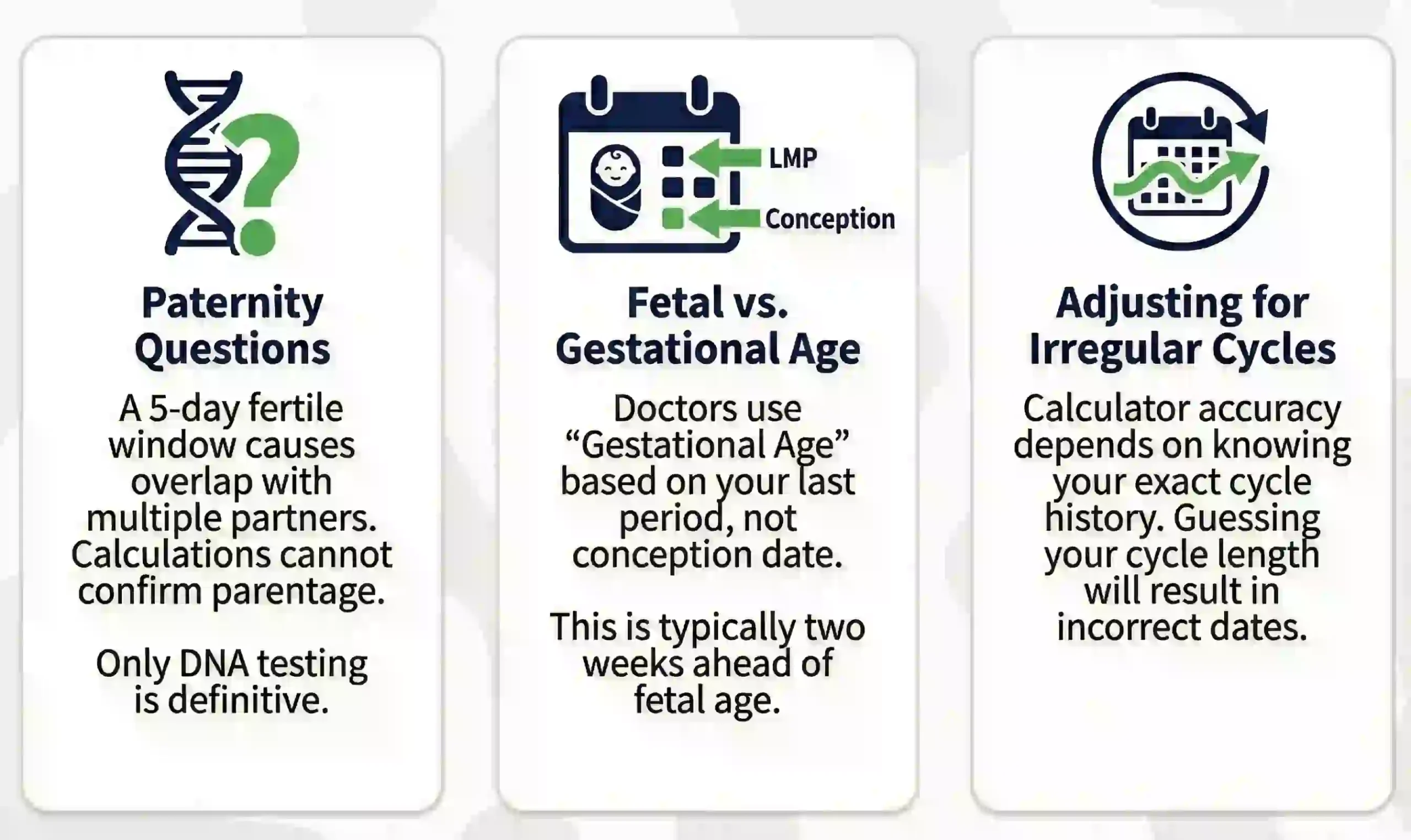
Use caution when determining parentage. The “Intercourse Window” is five days wide. Consequently, the calculator cannot distinguish between partners if you have multiple encounters in one week. Only a DNA test provides 100% proof.
Understanding "Fetal Age"
Do not get confused by the two different ages. You have a “Fetal Age” and a “Gestational Age.” Your doctor always uses Gestational Age. Tell your doctor you are “6 weeks pregnant” even if the calculator says you conceived 4 weeks ago. That distinction ensures you speak the same language.
Adjusting for Irregular Cycles
Always track your cycle length if possible. Your result will be off by four days if you guess “28 days” but actually have a 32-day cycle. Honesty about your history improves the calculator’s precision.
You Might Also Find These Helpful
Pregnancy & Fertility 45
Use this Pregnancy Risk Calculator to check age, BMI, health history, bleeding, and twins. See if closer prenatal monitoring may be worth asking about.
Try calculatorOne Time Pregnancy Calculator estimates pregnancy odds from one encounter, plus fertile window timing, test date, due date, and 21-day testing guidance.
Try calculatorUse the AMH Calculator to convert ng/mL or pmol/L, compare your result with age-based data, and see what it may mean for IVF, fertility,…
Try calculatorUse the Baby Eye Color Calculator with parents, grandparents, or sibling context to compare Brown, Green/Hazel, and Blue/Grey model estimates instantly.
Try calculatorBasal Body Temperature Calculator checks reading conditions and analyzes your temperature pattern for a sustained shift that may be consistent with ovulation.
Try calculatorBPD gestational age calculator: estimate fetal age from BPD, compare your week, check normal BPD ranges, and understand ahead or behind results.
Try calculatorCalculate odds with the Chance of Twins Calculator. Enter maternal age and history. Find your probability instantly. See if you will conceive multiples now.
Try calculatorUse our Conception Date Due Date Calculator to find your baby's arrival date. Enter your conception or intercourse date for clinical 40-week results.
Try calculatorContraceptive effectiveness calculator to compare birth control methods, typical vs perfect use, backup protection, and 5-year pregnancy risk.
Try calculatorUse this CRL calculator to estimate gestational age and due date from crown-rump length in mm or cm. Compare CRL, LMP, and IVF dating…
Try calculatorEstimate your monthly and 12-month pregnancy odds by age, partner age, and cycle dates. See your fertile window and when to seek fertility help.
Try calculatorUse this fundal height calculator to compare your cm measurement by week, check growth range, estimate baby weight, and know when to ask about…
Try calculatorCommon Mistakes to Avoid When Calculating
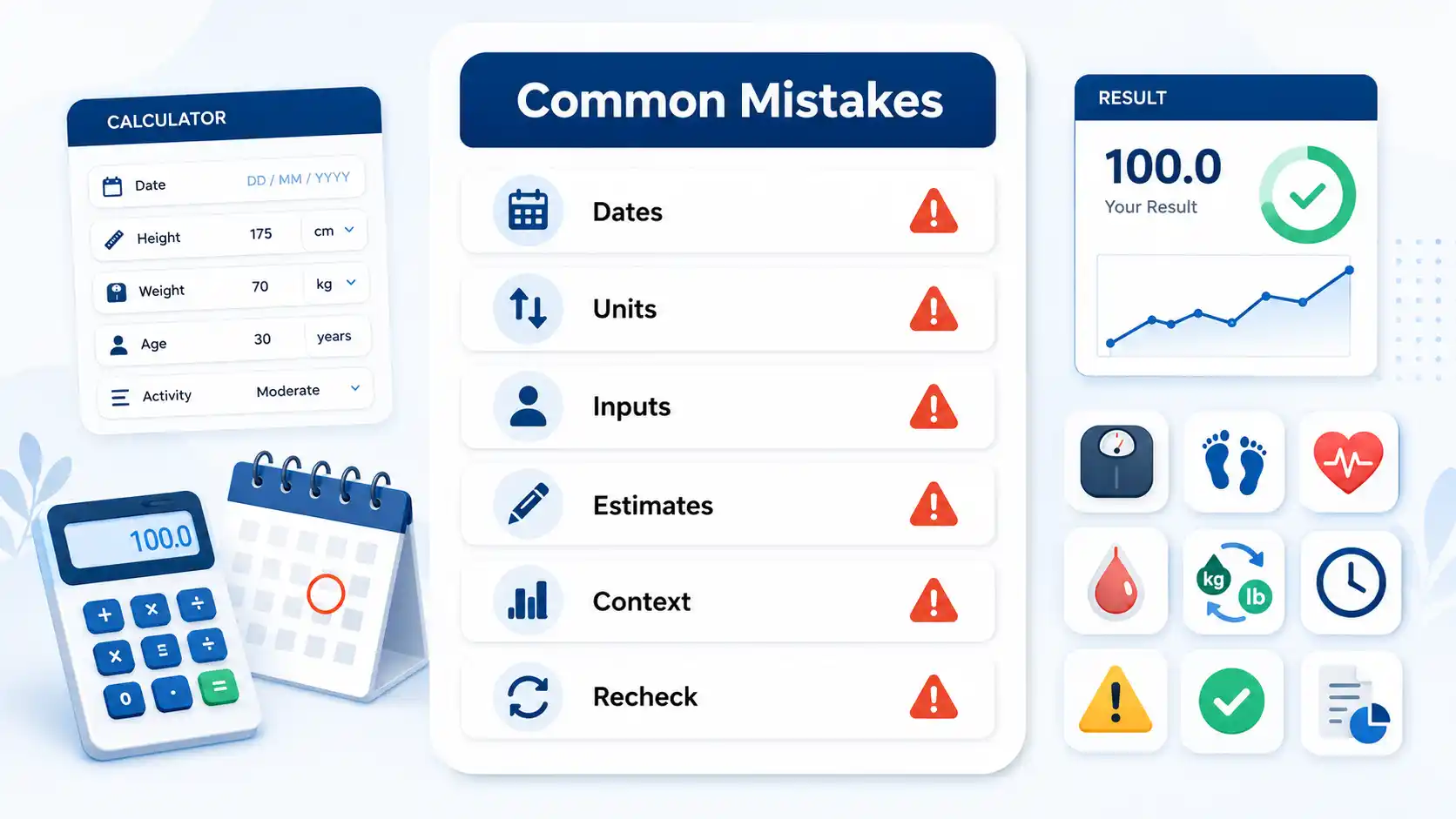
Minor errors can lead to the wrong date. Mistakes often happen when you guess cycle lengths. Additionally, errors occur if you mix up medical terms. Therefore, always double-check your calendar before you hit calculate. Staying accurate helps you solve the puzzle of your pregnancy start date.
- Confusing the Date of Sex: You likely had sex before the date of conception. The calculator accounts for this time lag.
- Entering Today's Date: Ensure you enter the past date of your last period. Do not use the current date.
- Assuming a 28-Day Cycle: Many women have cycles that are longer or shorter. Check your history first.
- Ignoring Ultrasound Updates: Always recalculate if your doctor changes your due date. Scans serve as the best source.
- Relying on Positive Tests: The day you got a positive test is not the day you conceived. It happens days later.
- Predicting Gender: Timing does not prove gender. Do not use this tool for sex selection.
Frequently Asked Questions (FAQs)
How do I calculate when I conceived?
You can use a specific mathematical formula. Simply subtract 266 days from your estimated due date. Alternatively, add 14 days to the start of your last period. Our calculator handles the math for you instantly.
How can I know the day I conceive?
Pinpointing the exact moment is impossible without medical assistance. Fertilization happens on a microscopic level. However, our tool estimates the most likely 24-hour window based on your cycle data.
How many days after your period can you get pregnant?
Ovulation typically happens about 14 days after your period begins. However, sperm can survive in the body for up to 5 days. Therefore, you can get pregnant from sex that happens as early as day 9 of your cycle.
Does 4 weeks pregnant mean you conceived 4 weeks ago?
No. Being “4 weeks pregnant” means you conceived about two weeks ago. Doctors count pregnancy from the first day of your last period. Consequently, the first two weeks of your pregnancy timeline actually occur before fertilization.
Can this calculator determine who the father is?
The tool provides an estimate. However, the fertile window lasts for five days. A calculator cannot distinguish between partners if you had multiple encounters in that week. Only a DNA test provides 100% proof.
Is an ultrasound date more accurate than my period date?
Yes. Early ultrasounds measure the embryo’s actual size. These measurements are more precise than calendar math. Trust the scan date if it differs from your period calculation.
Can I choose the gender based on the conception date?
No. The timing of sex does not guarantee a specific gender. Scientific evidence does not support the idea that “boy sperm” or “girl sperm” swim faster on certain days. Gender depends entirely on the chromosome carried by the sperm.
Questions?
We had love to hear from you! Whether you are reporting an issue, suggesting a new calculator, or exploring collaboration opportunities — we are here to help. Every message helps us make 100calc smarter, faster, and more helpful for everyone.
Why People Trust 100calc
At 100calc.com, we focus on accuracy, speed, and trust. Every calculator we create is designed to give reliable, instant, and easy-to-understand results you can truly depend on.