
hCG Gestational Age Calculator: Estimate Your Pregnancy Timeline
The hCG gestational age calculator converts your quantitative beta blood test into an estimated pregnancy week bracket.
You read your lab report and immediately panic because the numbers look completely wrong for your dates. Late ovulation often makes perfectly healthy baselines appear artificially low. A massive spike might even signal multiples instead of a calculation error.
Enter your beta result below. Our system checks your level against standard clinical ranges to verify your timeline. You will see your estimated week bracket instantly. The tool also predicts exactly what milestone should appear on your first transvaginal ultrasound.
Quick Facts
- Negative Baseline: Under 5 mIU/mL indicates you are not pregnant.
- Natural Plateau: Beta hormone production maxes out between 9 and 12 weeks.
- The Gold Standard: Transvaginal ultrasounds remain the only definitive medical dating method.
- Visual Milestones: A gestational sac should appear on an ultrasound once levels cross 1,500 mIU/mL.
- Updated Jun 12, 2026
- Reviewed by 100Calc Research Team
Pregnancy & Fertility Calculator
hCG Gestational Age Calculator
Estimate your pregnancy weeks based on your Beta hCG level, check ultrasound milestones, or verify if your numbers are normal for your known dates.
Select this if you only know your hCG number and want to estimate how far along you are.
What you need
Enter your single Beta hCG blood test result. Because hCG ranges vary widely, ultrasound is the only way to confirm exact dates, but this tool provides the standard clinical estimates.
Estimated Gestational Age
—
Your gestational age meaning will appear here.
Where your level falls
Showing the normal hCG range for your estimated weeks.
Ultrasound Expectation
Based on your hCG, your ultrasound milestone will appear here.
Dates Correlation Check
Your correlation result will appear here.
Age assessment
Your personalized assessment will appear here after calculation.
Medical note
Beta hCG levels vary drastically from woman to woman. A single hCG number cannot precisely date a pregnancy or determine viability. Ultrasound is the only definitive method for gestational dating.
Quick answer
A direct, snippet-style answer based on your inputs will appear here.
How many weeks pregnant am I based on my hCG?
Your first dynamic answer will appear here after calculation.
How can I confirm my exact weeks and check hCG doubling time?
Your second dynamic answer will appear here after calculation.
What Your Estimated Gestational Age Means
Your calculated range shows where your body currently sits on the geometric curve of early pregnancy hormone production. This value represents your relative placement inside wide medical reference brackets. Understanding this placement provides clear visibility into your embryonic timeline before your first official sonogram.
Estimating Dates for IVF and IUI Patients
If you conceived via assisted reproduction, calculating weeks using a Last Menstrual Period (LMP) is medically inaccurate. IVF patients must use the “Check Known Dates” mode because your timeline is absolute.
For example, a blood test taken 9 days past a 5-day embryo transfer (9dp5dt) is the exact biological equivalent of 14 Days Past Ovulation (DPO)—or exactly 4 weeks pregnant. At this 14 DPO milestone, a healthy serum beta hCG level typically ranges between 50 and 426 mIU/mL. Entering your exact transfer baseline allows the calculator to screen for early anomalies like a chemical pregnancy before an ultrasound can detect a gestational sac.
Understanding Your Result
The output replaces outdated assumptions about rigid daily milestone values. Because individual hormone ranges are massive, your specific number provides a broad weekly bracket rather than a single fixed date. It measures the current concentration of beta molecules to establish a biological baseline.
Your body produces this hormone at an exponential speed that remains entirely unique to your pregnancy. The calculator matches your blood data against standard clinical timelines to track development. This correlation helps you map out upcoming medical milestones.
Is Your Result Good or Bad?
A standard result lands comfortably within the average reference range for your expected weeks. Finding yourself in the low normal or high range bracket is statistically regular for single infants. These variations usually reflect late ovulation or standard structural differences in early placental cells.
A concerning result falls completely below the minimum baseline floor for your calendar dates. This slow pace requires close clinical monitoring to rule out potential embryonic complications. Exceptionally elevated numbers are often perfectly benign but can sometimes point to an early multiple pregnancy like twins.
What You Should Do Next
- Compare your estimated weeks against your Last Menstrual Period (LMP) or your exact embryo transfer date to check for correlation.
- Contact your fertility clinic or healthcare provider immediately if your numbers fall below the expected minimum boundary for your 14 DPO or transfer milestone.
- Schedule a transvaginal ultrasound appointment once your beta level crosses 1,500 mIU/mL, as measuring the fetal crown-rump length will override any blood test math.
A Quick Example to Test
Let’s say you receive your early pregnancy blood test results from the lab. Enter this value into the calculator above.
Input:
- Calculation Mode: Estimate weeks from hCG
- Beta hCG Level: 4,500 mIU/mL
The calculator checks your hormone level against standard clinical reference brackets to find your exact percentile.
Result:
Estimated Age: 5 to 6 Weeks.
Status: Average Range.
Meaning:
Your hormone levels fit cleanly inside standard clinical baselines. Your body is producing a normal amount of beta hormones for this point in time. You can confidently expect to see a gestational sac on a transvaginal ultrasound at this specific threshold.
How does hCG correlate with gestational age?
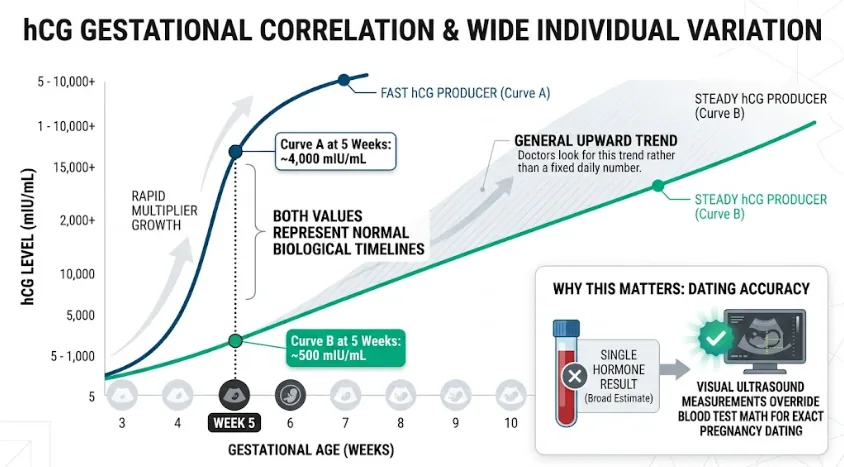
Human chorionic gonadotropin (hCG) correlates with gestational age by tracking placental development during early pregnancy. After a fertilized egg implants, hormone levels multiply rapidly. Medical professionals measure this exponential growth to estimate your pregnancy weeks before an embryo appears on an ultrasound.
Think of early pregnancy hormone production like a seed sprouting. Some seeds sprout very fast, while others take a few extra days to break the soil. Every person produces beta hCG at a slightly different speed.
If two patients are exactly five weeks pregnant, one might have a blood level of 500 mIU/mL. The other patient might have a level of 4,000 mIU/mL. Both values represent completely normal biological timelines.
This massive numerical variation means blood tests only provide broad estimates. Doctors look for a general upward trend rather than a fixed daily number to confirm early fetal development.
Why this matters
A single hormone result should never change your official due date. Visual ultrasound measurements will always override blood test math for exact pregnancy dating.
Explore More Calculators
Use the Chinese Gender Calculator for a traditional boy-or-girl prediction from lunar age and conception month. Enter conception date, due date, or LMP.
Try calculatorUse this fetal growth calculator to check baby weight percentile from ultrasound data in grams, kg, or cm and see what the result means…
Try calculatorEnter gestational sac measurements in mm or cm to calculate mean sac diameter, estimate early gestational age, compare week-by-week milestones, and see when follow-up…
Try calculatorMissed a birth control pill? Check pregnancy risk, protection status, backup contraception needs, and what to do next with our missed pill calculator.
Try calculatorUse our Pregnancy Chance Calculator to estimate your odds. Enter your cycle day, age, and method. Find out if you are in the high-risk…
Try calculatorUse our pregnancy due date calculator to find your exact Baby Due date. IVF, conception, ovulation, and ultrasound methods with weeks and timeline.
Try calculatorHow to Use the hCG Gestational Age Calculator
This tool instantly maps your early pregnancy hormone levels against standard medical brackets. It requires a single quantitative blood test number to run the comparison. Follow these five simple steps to get your personalized timeline estimate and ultrasound expectation.
Select Your Calculation Method
Choose your primary path using the interactive mode selector tabs. You can estimate your current weeks based solely on a blood level. Users may also verify if their hormone numbers match an existing calendar schedule.
Enter Your Blood Test Result
Type your exact quantitative laboratory number into the beta hCG input box. The system uses this initial value to anchor the medical comparison. Ensure your lab report uses standard mIU/mL units before typing the final amount.
Add Your Known Calendar Dates
Input your specific pregnancy weeks and days if verifying a calendar date. Skip this part if you are only estimating your current timeline. The calculator uses these exact dates to check if your hormones sit within safe baseline ranges.
Run the Exponential Matching Logic
Click the main calculate button to process your entered data. The algorithm immediately matches your blood value against clinical reference tables. It filters overlapping medical brackets to find your precise biological placement without any manual math required.
Review Your Visual Tracking Gauge
Compare your position on the visual tracking gauge against standard milestone expectations. The screen instantly displays your clinical status badge and expected weekly bracket. It also reveals exactly what structures should appear on your next transvaginal ultrasound appointment.
How do you check if your beta level is normal for your IVF transfer date?
Let’s say you are seven weeks pregnant and want to verify your numbers. Use these exact inputs to test the correlation logic.
Use these inputs in the calculator:
- Calculation Mode: Check if hCG is normal for my dates
- Beta hCG Level: 8,000 mIU/mL
- Known Age: 7 weeks, 0 days
Process:
The system checks your entered hormone level against the clinical minimum baseline established for a seven-week pregnancy.
Final Result:
Estimated Age: 7 Weeks.
Status: Average Range.
Meaning:
Your hormone level falls safely within the normal boundaries for a seven-week pregnancy. You pass the correlation check easily. A fetal pole and early heartbeat should be clearly visible on your upcoming sonogram.
How the hCG Gestational Age Formula Works (Complete Breakdown)
This calculator uses a standard percentile equation to measure your exact placement inside massive medical reference brackets. Because normal hormone production varies drastically between individuals, this math compares your personal blood test against known biological boundaries to find your true timeline position.
What is the gestational age percentile formula?
The medical formula calculates exactly where your hormone level sits between the lowest and highest expected values for your week. You subtract the minimum weekly boundary from your result, divide that number by the total size of the bracket, and multiply by 100 to get a percentage.
Percentile = ((hCG - Range_Min) / (Range_Max - Range_Min)) × 100
This mathematical equation removes the confusion of overlapping clinical ranges. Instead of just telling you if a number is “normal,” it isolates your exact biological speed. Doctors use this relative positioning to see if you are tracking in the low-normal, average, or high range before your ultrasound.
What Each Variable Means
Every value below connects directly to your laboratory results and standard clinical tables. These specific numbers determine exactly how your body compares to average development speeds.
Percentile
Your relative position inside the bracket appears as a value between zero and 100. The system uses this exact percentage to place your marker on the visual gauge and assign your clinical status badge.
hCG
The quantitative beta level comes directly from your medical laboratory printout sheet. The calculator uses this specific numerical value as the foundation for the entire mathematical comparison.
Range_Min
The clinical bottom boundary sets the minimum standard for your evaluated week. The system pulls this threshold from established medical reference tables to create the absolute floor for the calculation.
Range_Max
The clinical top boundary defines the maximum standard for your evaluated week. It acts as the mathematical ceiling. The algorithm uses this upper limit to determine the total span of normal hormone production.
Another Example Calculation (Step-by-Step)
Let’s see how the formula works using a fresh clinical scenario. This helps you understand how the system maps a single blood test inside a massive medical reference range.
Given:
- hCG Level = 2,500 mIU/mL
- Evaluated Week = 6 to 7 Weeks
- Range_Min = 1,080 mIU/mL
- Range_Max = 56,500 mIU/mL
Calculation:
					Percentile = ((2500 - 1080) / (56500 - 1080)) × 100
Percentile = (1420 / 55420) × 100 = 2.56%
Result:
- Calculated Percentile: 2.56%
- Status: Low Normal Range
Meaning:
Your hormone levels fall into the lower 2.56 percent of the normal bracket for a six-week pregnancy. While this sits firmly inside the standard medical baseline, a doctor will likely request a follow-up test to ensure the numbers are climbing steadily toward your first ultrasound milestone.
You Might Also Find These Helpful
Pregnancy & Fertility 45
Use this Pregnancy Risk Calculator to check age, BMI, health history, bleeding, and twins. See if closer prenatal monitoring may be worth asking about.
Try calculatorOne Time Pregnancy Calculator estimates pregnancy odds from one encounter, plus fertile window timing, test date, due date, and 21-day testing guidance.
Try calculatorUse the AMH Calculator to convert ng/mL or pmol/L, compare your result with age-based data, and see what it may mean for IVF, fertility,…
Try calculatorUse the Baby Eye Color Calculator with parents, grandparents, or sibling context to compare Brown, Green/Hazel, and Blue/Grey model estimates instantly.
Try calculatorBasal Body Temperature Calculator checks reading conditions and analyzes your temperature pattern for a sustained shift that may be consistent with ovulation.
Try calculatorBPD gestational age calculator: estimate fetal age from BPD, compare your week, check normal BPD ranges, and understand ahead or behind results.
Try calculatorCalculate odds with the Chance of Twins Calculator. Enter maternal age and history. Find your probability instantly. See if you will conceive multiples now.
Try calculatorFind out exactly when you conceived. Our free Conception Calculator uses your Due Date, LMP, or Ultrasound to estimate your fertilization date and fertile…
Try calculatorUse our Conception Date Due Date Calculator to find your baby's arrival date. Enter your conception or intercourse date for clinical 40-week results.
Try calculatorContraceptive effectiveness calculator to compare birth control methods, typical vs perfect use, backup protection, and 5-year pregnancy risk.
Try calculatorUse this CRL calculator to estimate gestational age and due date from crown-rump length in mm or cm. Compare CRL, LMP, and IVF dating…
Try calculatorEstimate your monthly and 12-month pregnancy odds by age, partner age, and cycle dates. See your fertile window and when to seek fertility help.
Try calculatorCommon Mistakes When Using the hCG Gestational Age Calculator
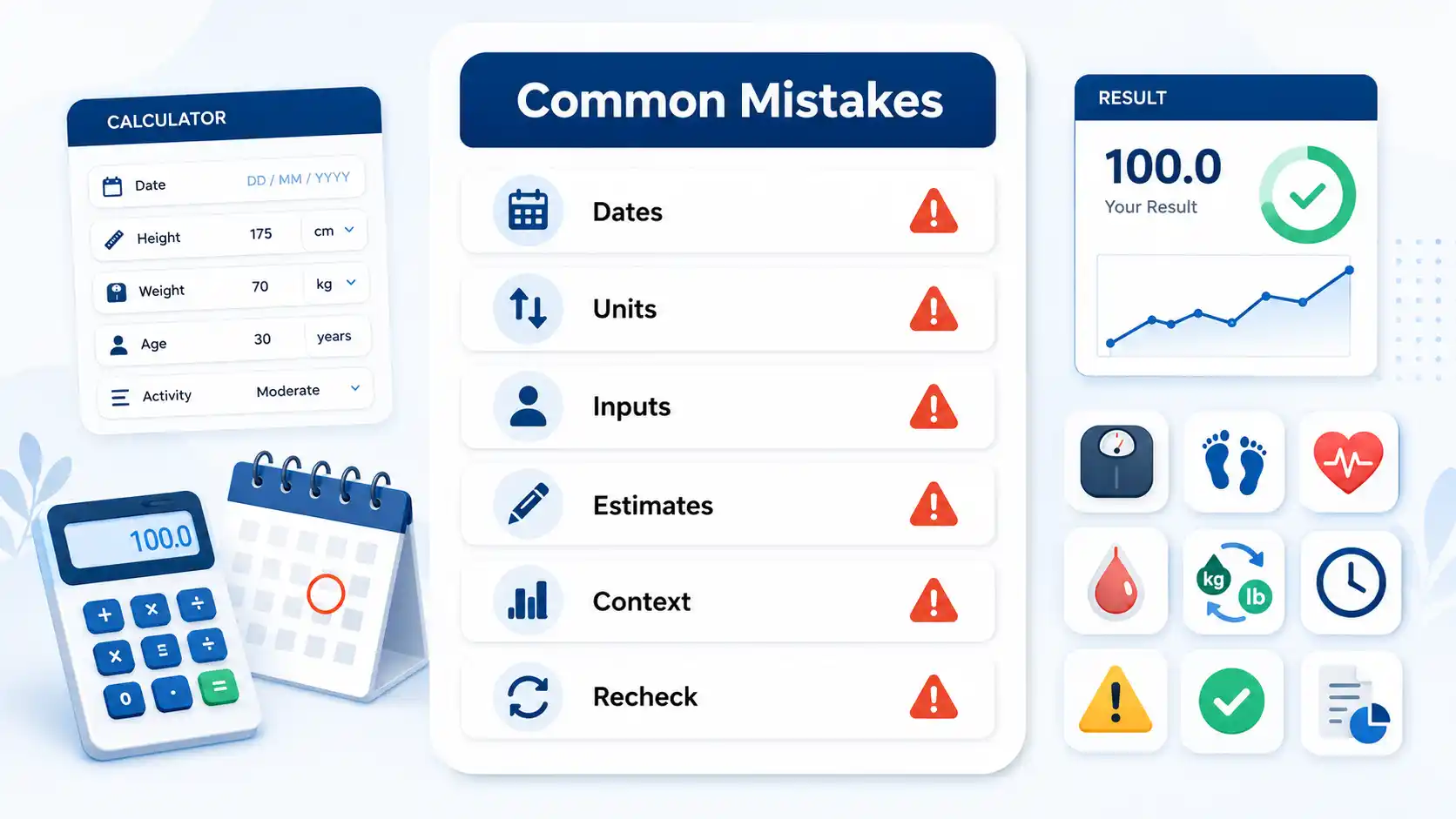
Many users enter accurate blood test numbers but still misinterpret their timeline due to simple errors in clinical logic. Because early pregnancy hormone brackets are incredibly wide, a small dating mistake often triggers unnecessary panic. Avoid these common input mistakes to ensure your estimated timeline reflects reality.
- Assuming a high hormone result automatically confirms a twin pregnancy without receiving visual confirmation via a sonogram.
- Panicking over a drop in your growth rate during weeks 9 through 12, when hormone levels naturally plateau and decline.
- Substituting cheap home urine strip darkness comparisons in place of accurate quantitative laboratory blood measurements.
- Getting confused between weeks calculated from your last menstrual period versus weeks counted from your true conception or transfer date.
- Trusting a single blood test number to define your exact due date instead of scheduling a follow-up ultrasound.
Medical Disclaimer
This tool offers educational information only. It is not a substitute for professional medical diagnosis, advice, or treatment. Always consult your doctor or a talented healthcare expert regarding any health concerns. Do not ignore or delay professional medical help based on information or results generated by this site.
Frequently Asked Questions (FAQs)
How many weeks pregnant am I based on my hCG?
Your weeks are calculated by matching your specific beta number to clinical range brackets. A value between 50 and 426 mIU/mL typically indicates you are in your fourth to fifth week of pregnancy.
Because ranges are wide, blood tests only provide an estimated timeframe.
What does it mean if my hCG is high for my gestational age?
Elevated numbers can point to a normal biological variation or a mistaken conception date. They sometimes indicate a molar pregnancy or multiples like twins.
You cannot confirm twins using blood test math alone. Only a follow-up ultrasound scan can accurately verify multiple embryos.
Can my gestational age look wrong due to late ovulation?
Yes. Ovulating later than day 14 of your cycle makes your blood levels look artificially lower than standard last-period math predicts.
This cycle mismatch is the primary reason perfectly healthy pregnancies flag as below expected ranges early on.
Why do doctors prefer ultrasound dating over hCG levels?
Individual hormone levels vary too drastically to provide precise calendar dates. A first-trimester ultrasound measures the actual physical size of the developing fetus.
This crown-rump length measurement remains the most accurate pregnancy dating method available in modern medicine.
Why do normal hCG ranges overlap so much between different weeks?
Every human body builds early placental cells at a completely unique exponential speed. This massive natural variation prevents a single blood test from determining your exact delivery date.
Doctors look for a steady upward growth trend instead of a fixed daily number.
What happens if my level sits below the normal week benchmark?
A lower-than-expected result requires your healthcare provider to order a repeat test 48 hours later. This follow-up checks whether your underlying growth trajectory meets standard viability requirements.
Slow or inconsistent rising patterns sometimes point to an ectopic pregnancy, which requires immediate medical evaluation.
Is it normal for hCG levels to drop around 10 to 11 weeks?
Yes, this is a completely normal physiological process. Hormone production peaks between 8 and 11 weeks before gradually declining and leveling off for the second and third trimesters.
A drop at this stage does not indicate a miscarriage or a failing pregnancy.
At what hCG level should an ultrasound show a gestational sac?
A gestational sac should become clearly visible on a transvaginal ultrasound once your beta hCG level reaches between 1,500 and 2,000 mIU/mL.
Diagnoses regarding early pregnancy viability should never be made by ultrasound until your hormones cross this specific threshold.
Can a home pregnancy test check my exact hCG levels?
No. Home urine tests are qualitative, meaning they only detect if the hormone is present to trigger a positive line.
You must request a quantitative beta blood test at a clinical laboratory to measure the exact numerical concentration of hormones in your system.
Questions?
We had love to hear from you! Whether you are reporting an issue, suggesting a new calculator, or exploring collaboration opportunities — we are here to help. Every message helps us make 100calc smarter, faster, and more helpful for everyone.
Why People Trust 100calc
At 100calc.com, we focus on accuracy, speed, and trust. Every calculator we create is designed to give reliable, instant, and easy-to-understand results you can truly depend on.