
Fertility Calculator by Age: Monthly and 12-Month Pregnancy Odds
A fertility calculator by age estimates your chance of getting pregnant in one well-timed cycle and across 3, 6, and 12 cycles. This tool uses your age, partner age, last period date, and cycle length to show estimated pregnancy odds, your fertile window, and your likely peak ovulation day.
A low monthly number can feel scary. It may not tell the full story.
Your 12-month estimate can look very different from one cycle. Partner age can also shift the result, which most basic fertility charts skip.
Enter your age, partner age, and cycle details. You will see your monthly estimate, longer-term odds, fertile window, peak ovulation day, and age-based guidance on when to seek help.
This calculator is a planning tool. It does not test ovarian reserve, egg quality, sperm count, sperm motility, AMH, PCOS, endometriosis, or any medical condition.
Quick Facts
- Monthly odds range from 30% in your 20s down to 2% at 43+
- Partner age can lower your odds by up to 30%
- A low monthly number can still mean strong odds over 12 months
- Specialist timing follows real guidelines: 12 months under 35, 6 months from 35 to 40, sooner after 40
- Your fertile window comes from your own cycle, not a generic 28-day guess
- Updated Jul 6, 2026
- Reviewed by 100Calc Research Team
Age & Conception Probability
Comprehensive Fertility Calculator by Age
Estimate your age-based chance of getting pregnant. Calculate your monthly conception probability, understand how your partner's age may affect your timeline, and see when specialist guidance is usually recommended.
Per-Cycle Conception Probability
--%
Your statistical chance of conceiving in a single, well-timed month will appear here.
Your Cumulative Pregnancy Trajectory
Natural conception is cumulative. If you track your fertile window actively, your statistical chances of getting pregnant grow significantly over time.
Age-Based Fertility Context
When to See a Specialist
Clinical guidelines for your specific age will appear here.
Your Immediate Action Plan
To maximize the monthly percentage shown above, you must time intercourse during this specific window of your current cycle.
Short answer
A direct answer based on your inputs will appear here.
What are my chances of getting pregnant at my current age?
Your dynamic probability answer regarding cumulative rates will appear here.
At what age are 90% of a woman's eggs gone?
Clinical studies indicate that women lose roughly 90% of their ovarian reserve by age 30, and up to 97% by age 40. However, natural conception only requires one healthy egg to release each month.
Medical note: This fertility calculator gives an age-based estimate only. It does not diagnose infertility, confirm ovulation, test ovarian reserve, measure egg quality, or check sperm health. If you are 35 or older, have irregular cycles, PCOS, endometriosis, prior pregnancy loss, or have been trying without success, speak with an OB-GYN or fertility specialist.
Explore More Calculators
Use the Chinese Gender Calculator for a traditional boy-or-girl prediction from lunar age and conception month. Enter conception date, due date, or LMP.
Try calculatorUse this fetal growth calculator to check baby weight percentile from ultrasound data in grams, kg, or cm and see what the result means…
Try calculatorEnter gestational sac measurements in mm or cm to calculate mean sac diameter, estimate early gestational age, compare week-by-week milestones, and see when follow-up…
Try calculatorMissed a birth control pill? Check pregnancy risk, protection status, backup contraception needs, and what to do next with our missed pill calculator.
Try calculatorUse our Pregnancy Chance Calculator to estimate your odds. Enter your cycle day, age, and method. Find out if you are in the high-risk…
Try calculatorUse our pregnancy due date calculator to find your exact Baby Due date. IVF, conception, ovulation, and ultrasound methods with weeks and timeline.
Try calculator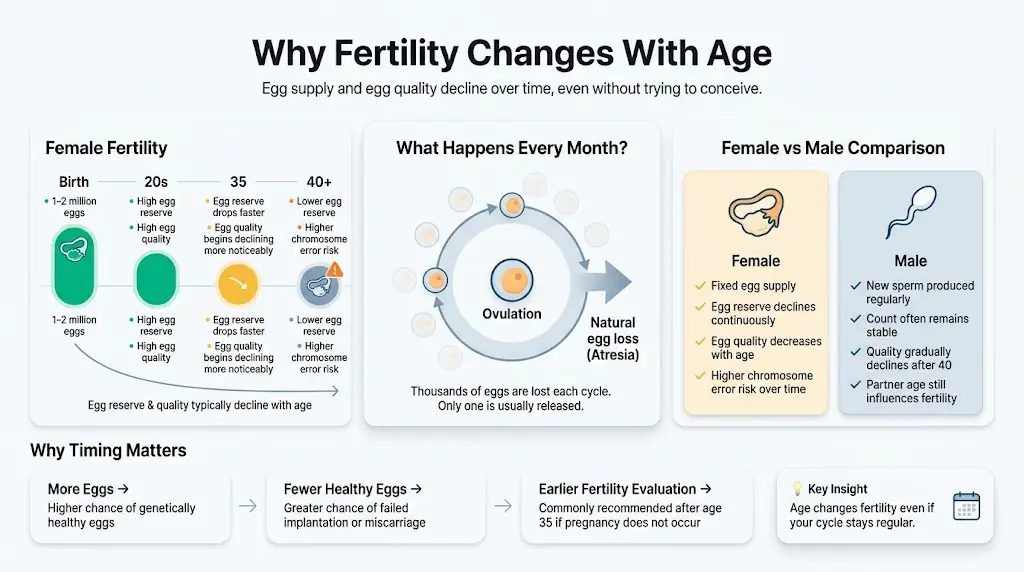
Micro Insight
This is why your odds change even when nothing else about you changes. Egg loss and quality decline happen quietly, every month, with or without trying. It explains why timing matters more as you get older, and why couples often see specialists sooner after 35.
What Is Age-Related Fertility Decline?
Age-related fertility decline is the natural drop in a woman’s chance of conceiving as she gets older. It happens because her egg supply shrinks and egg quality drops at the same time. Men experience a milder version tied to sperm quality, not sperm count.
A woman’s egg supply works like a candle that burns down every month, whether she uses it or not. She loses eggs constantly through a natural process called atresia. Ovulation only releases one egg. Thousands more disappear quietly in the background, every single cycle.
This loss speeds up with age. A woman starts with one to two million eggs before birth. By her 30s and 40s, that number drops sharply, and so does the share of eggs that are genetically normal.
Egg quality matters as much as egg count. Older eggs carry a higher risk of chromosome errors, called aneuploidy. This is why ovarian reserve, egg quantity, and egg quality are related but not identical. Ovarian reserve describes the remaining egg supply, while egg quality describes how likely an egg is to support a healthy pregnancy.
This raises the odds of a failed pregnancy or early miscarriage, even when ovulation happens on schedule.
Men age differently. Their bodies keep producing new sperm every few months. Sperm count usually stays fine into their 60s. Sperm quality still declines gradually after 40, which is why partner age still shifts the numbers.
What Your Fertility Odds Mean
Your result gives you two numbers, not one. A monthly odds number and a 12-month odds number sit side by side for a reason.
Understanding Your Result
The monthly number shows your chance in one cycle, timed well. It’s a single roll of the dice, nothing more. The 12-month number shows what happens when you roll that dice repeatedly.
Odds build up over time, even when one month looks weak on its own. A low monthly score can still lead to strong yearly odds. That gap is the real story behind your result, not the single percentage.
Is Your Result Good or Bad?
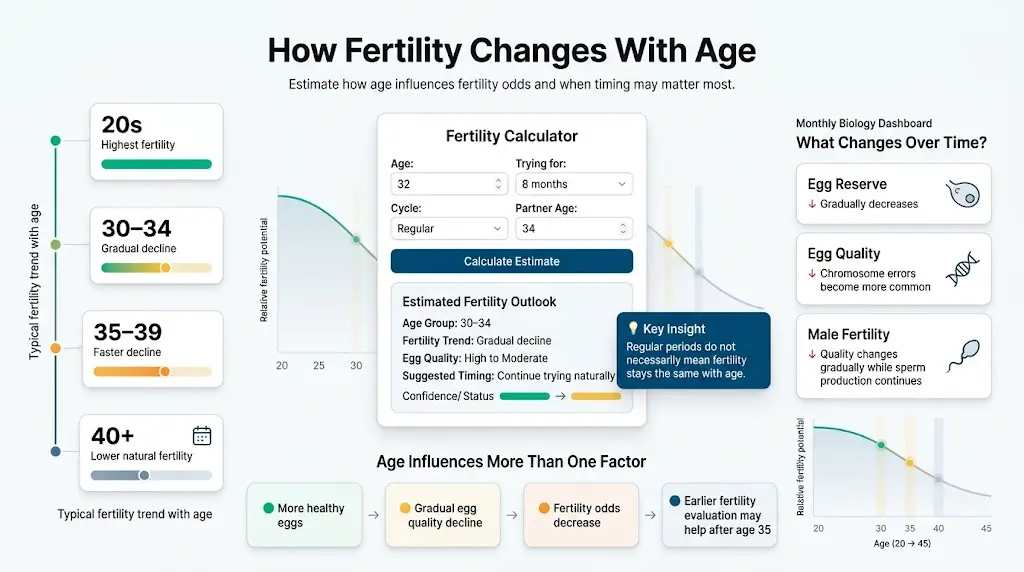
Compare your monthly number against typical ranges for your age group. Numbers above 20% usually reflect strong, expected odds for couples under 35.
Numbers between 10% and 19% still fall within a normal range for the mid-to-late 30s. This isn’t a warning sign on its own.
Anything under 10% deserves attention, but it rarely means “impossible.” Many couples in this range still conceive naturally within a year, based on the cumulative math.
Context matters more than the raw number. A 30-year-old and a 39-year-old can land on different scores and both be within normal limits for their age.
What You Should Do Next
Check your 12-month number before reacting to the monthly one. It usually tells a more useful story. Track your fertile window from your actual cycle data, not a rough guess.
Timing intercourse correctly raises your real-world odds beyond what any calculator shows.
Book a specialist visit if your result and age match the ACOG guidance shown above.
Waiting past that point rarely helps and often delays useful testing.
Revisit this calculator each cycle if your LMP or cycle length changes. Fresh inputs keep your fertile window accurate.
Quick Example to Test
- Female Age: 25 to 29
- Partner Age: 40 to 44
Calculation:
Base monthly odds for this age group start at 25%. Partner age trims that by 10%, landing at 23% monthly.
Result:
- Monthly Odds: 23%
- 12-Month Odds: roughly 96%
- Result Label: Peak Reproductive Years
How to Use the Fertility Calculator by Age
The calculator turns your age, your partner’s age, and your cycle data into two things: your real odds of conceiving and your next fertile window. Here’s what happens at each step, and why it matters.
Pick Your Age Bracket
Choose the range that matches your current age. Each bracket links to a fixed baseline odds figure, pulled from published fecundability research. This number sets your starting point before anything else gets factored in.
Add Your Partner's Age Bracket
Select the range that fits your partner, or mark donor or not applicable. The calculator applies a percentage reduction to your baseline odds based on this choice. Younger brackets apply no reduction at all.
Enter Your Last Period Date
Type in the first day of your most recent period. The tool uses this date as the anchor point for your entire cycle. It won't accept a date older than 60 days, since that stretches past a useful window.
Set Your Average Cycle Length
Enter your typical cycle length in days. The calculator adds this number to your last period date to project your next one. From there, it works backward to pinpoint ovulation and your fertile window.
Get Your Full Result
The calculator multiplies your baseline odds by your partner's adjustment, then runs that number through a compounding formula for 3, 6, and 12 months. Your fertile window appears from a separate calculation, based only on your cycle dates.
Quick Example:
Try this:
- Female age: 35 to 37
- Partner age: 50 or older
- Last period: June 5, 2026
- Cycle length: 26 days
Calculation:
Baseline odds start at 15%. Partner age trims that by 30%, landing at 11% monthly.
Result:
Over 12 months, that number climbs to 75%. The result reads “Moderate Natural Decline,” while the fertile window lands around June 12 to June 17, based on the cycle dates alone.
How the Fertility Calculator by Age System Works
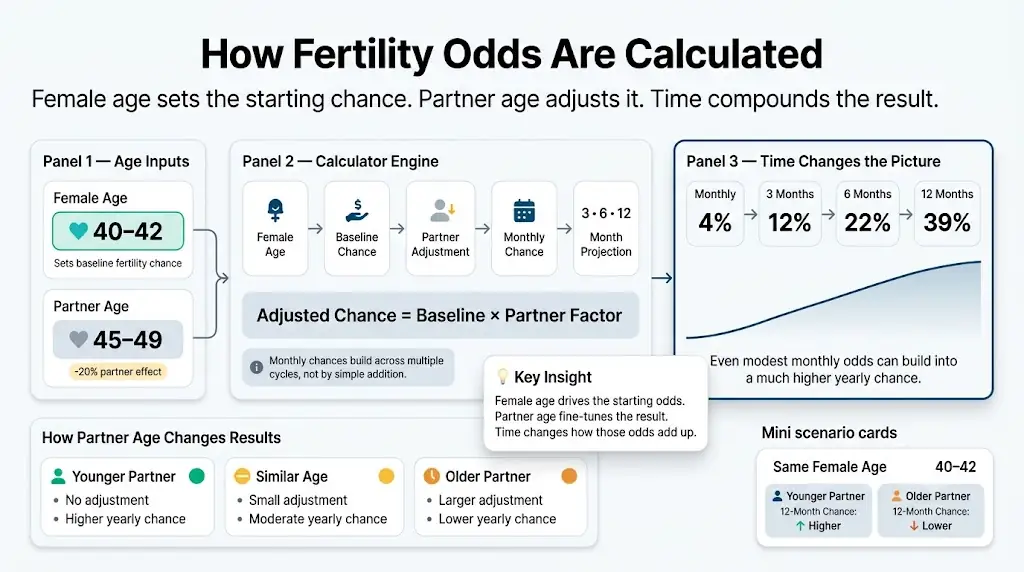
This calculator runs on published fecundability data, not a black box guess. It pulls your baseline odds from age bracket averages, then adjusts for partner age, then compounds that number across cycles using a standard probability formula. The same math researchers use to explain why doctors recommend trying for a full year before worrying.
In fertility research, fecundability means the chance of pregnancy in one cycle. Fecundity is broader and usually describes the ability to achieve pregnancy over time.
Key Features & Benefits
- Includes partner age, a factor most fertility calculators skip entirely
- Shows cumulative odds across months, not just one scary monthly number
- Flags the exact point when ACOG guidelines suggest seeing a specialist
- Calculates your real fertile window from your own cycle dates
- Built on population research, not personal guesswork dressed up as fact
Technical Process
Age Lookup
Matches your age bracket to a baseline monthly odds figure drawn from fecundability studies.
Odds Adjustment
Reduces that baseline based on partner age, since sperm quality shifts gradually after 40.
Cycle Compounding
Runs the adjusted odds through a compounding formula across 3, 6, and 12 months.
What Are the Odds of Getting Pregnant by Age?
Your odds of getting pregnant by age usually decline slowly in your early 30s, then faster after 37. This chart shows the calculator’s female-age baseline before partner-age adjustment, so you can compare your age range with the monthly and 12-cycle estimate.
| Female Age | Monthly Baseline | 12-Cycle Estimate | What It Means | Next Step |
|---|---|---|---|---|
| Under 25 | 30% | About 99% | Highest baseline range in this calculator. | Focus on fertile-window timing and cycle tracking. |
| 25 to 29 | 25% | About 97% | Strong age-based odds for natural conception. | Try well-timed intercourse across the fertile window. |
| 30 to 34 | 20% | About 93% | Still a strong baseline, but decline has started. | Track cycle length and avoid guessing ovulation. |
| 35 to 37 | 15% | About 86% | Moderate decline, but yearly odds can still look strong. | Consider medical advice after 6 months of trying. |
| 38 to 39 | 10% | About 72% | Lower monthly odds, with more pressure on timing. | Do not delay testing if cycles are irregular. |
| 40 to 42 | 5% | About 46% | Lower baseline range where early guidance matters. | Speak with a fertility specialist sooner. |
| 43+ | 2% | About 22% | Lowest age-based baseline in this calculator. | Ask about testing, IVF, donor eggs, or other options. |
Heads-up: This chart shows the female-age baseline before partner-age adjustment. Your final result may be lower if the partner-age field applies a reduction.
How Do I Read This Pregnancy Odds by Age Chart?
Read the monthly number as your estimated chance in one well-timed cycle. Read the 12-cycle number as the estimate after repeated cycles, before any partner-age adjustment is applied.
- Monthly baseline means the starting estimate from your selected female age bracket.
- 12-cycle estimate shows how repeated monthly chances build across one year.
- Partner age can reduce the final result if the selected partner age bracket is 40 or older.
- Cycle timing still matters because even a strong age range can miss the fertile window.
- Medical history can change the picture if AMH, PCOS, endometriosis, blocked tubes, or sperm test results are involved.
Why Can a Low Monthly Number Still Look Better Over 12 Cycles?
A monthly number only shows one cycle, not the full trying period. Repeated cycles build the cumulative estimate, which is why a 5% monthly baseline can become about 46% over 12 cycles.
This does not mean pregnancy is promised. It means the calculator is showing repeated chances across time, not a single isolated month.
Which Age Has the Highest Chance of Getting Pregnant?
The highest chance in this calculator appears in the under-25 and 25-to-29 age brackets. Those ranges use the strongest female-age baselines before partner age, cycle timing, or health factors change the final result.
A high baseline still needs good timing. Intercourse during the fertile window gives the monthly estimate the best chance to matter in real life.
What Should I Do If My Age Range Looks Low?
A lower age range does not mean pregnancy is impossible. It means each cycle has less room for delay, so timing, testing, and medical guidance become more important.
- If you are 35 to 39, consider help after 6 months of trying.
- If you are 40 or older, it is better to speak with a specialist sooner.
- If your cycles are irregular, do not rely on age alone.
- If partner age is 45 or older, include semen testing in the conversation.
- If you have known PCOS, endometriosis, low AMH, or past pregnancy loss, use this chart only as a starting point.
How the Fertility Calculator by Age Formula Works (Complete Breakdown)
The fertility calculator by age formula estimates your monthly pregnancy chance from female age and partner age. It then uses that monthly estimate to show your 3-cycle, 6-cycle, and 12-cycle odds. This helps explain why one monthly number can look small, while longer-term odds can look higher.
Fertility Calculator by Age Formula
Formula:
Female Age Baseline = selected female age bracket percentage Adjusted Monthly Estimate = Female Age Baseline × (1 - Partner Age Adjustment) Displayed Monthly Estimate = round(Adjusted Monthly Estimate), minimum 1% Cumulative Chance Over N Cycles = [1 - (1 - Displayed Monthly Estimate / 100)^N] × 100 Displayed Cumulative Chance = round(Cumulative Chance), maximum 99%
Fertile window date formula:
Next Period Date = LMP Date + Cycle Length Estimated Ovulation Date = Next Period Date - 14 days Fertile Window Start = Estimated Ovulation Date - 5 days If the estimated ovulation date has already passed, the calculator moves forward by one full cycle until the next ovulation date is upcoming.
What These Formulas Do
The first formula starts with the female age baseline. It then lowers that number if the selected partner age bracket has an adjustment.
Younger partner-age brackets apply no reduction. Older partner-age brackets apply a relative reduction to the starting estimate.
The second formula shows how the monthly estimate builds across repeated cycles. The odds do not add up in a straight line. Each new cycle uses the chance left over from the cycles before it.
The date formula works separately. It uses your last period date and average cycle length to estimate your next fertile window.
This calculator gives population-level estimates. It does not measure ovarian reserve, egg quality, AMH, PCOS, endometriosis, sperm count, sperm motility, or sperm DNA quality.
Formula Variables Explained in Plain English
Female Base Chance
This is the starting monthly estimate from the selected female age bracket. The calculator uses fixed age ranges, such as under 25, 25 to 29, 30 to 34, and older brackets. This number is an age-based estimate, not a personal fertility test.
Partner Age Adjustment
This is the relative reduction applied from the selected partner age bracket. Donor or not applicable and under 40 apply no reduction. Ages 40 to 44, 45 to 49, and 50+ apply higher adjustments.
Adjusted Monthly Chance
This is the monthly estimate after partner age is applied. For example, a 10% baseline with a 20% partner adjustment becomes 8%. This is the number that feeds into the longer-term odds.
Displayed Monthly Estimate
This is the rounded monthly number shown in the result. The calculator rounds the adjusted estimate to a whole percentage and keeps the result at a minimum of 1%, so the output never shows 0%.
N Number of Cycles
N means the number of cycles used in the cumulative formula. This calculator uses 3, 6, and 12 cycles, so users can compare short-term odds with a one-year estimate.
Cumulative Chance
This shows the chance across repeated cycles using the same monthly estimate. It is capped at 99%, because no fertility calculator can promise a 100% chance of pregnancy.
LMP Date
LMP means the first day of your last menstrual period. The calculator uses this date to estimate your next period, ovulation day, and fertile window.
Cycle Length
Cycle length is your average number of days from one period to the next. The calculator accepts cycle lengths from 21 to 45 days and uses this number only for date timing.
Estimated Ovulation Date
This is the estimated day of ovulation. The calculator finds it by subtracting 14 days from the next period date. It is a calendar estimate, not an ovulation test.
Fertile Window Start
This is the first estimated fertile day in the current cycle. The calculator counts back 5 days from the estimated ovulation date. If that window has passed, it moves the dates forward to the next cycle.
Another Example Calculation (Step-by-Step)
Let’s run a new example through the fertility calculator by age formula. This shows how partner age can lower the monthly estimate and how repeated cycles change the longer-term result.
Given:
- Female Age: 38 to 39
- Female Age Baseline: 10%
- Partner Age: 45 to 49
- Partner Age Adjustment: 20%
- 3, 6, and 12
Calculation:
Adjusted Monthly Estimate = 10 × (1 - 0.20) = 8% Cumulative 3-Cycle Chance = [1 - (1 - 0.08)^3] × 100 = 22% Cumulative 6-Cycle Chance = [1 - (1 - 0.08)^6] × 100 = 39% Cumulative 12-Cycle Chance = [1 - (1 - 0.08)^12] × 100 = 63%
Result:
- Monthly Estimate: 8%
- 3-Cycle Estimate: 22%
- 6-Cycle Estimate: 39%
- 12-Cycle Estimate: 63%
Meaning:
This example shows how a lower monthly estimate can still build over repeated cycles. A monthly estimate of 8% does not mean pregnancy is impossible. It means each cycle has a lower chance, so timing and medical guidance become more important.
The 12-cycle estimate is higher because the formula repeats the same monthly chance across many cycles. It is still an estimate, not a guarantee.
How Do You Calculate Fertility Chances by Age?
You calculate fertility chances by age using your age bracket and your partner’s age bracket together. The calculator applies a partner age penalty to your baseline odds, then compounds that number across 3, 6, and 12 cycles to show your realistic long term chances.
What Are the Chances of Getting Pregnant at 40 Using a Donor?
Many women trying to conceive solo or with donor sperm ask this exact question.
Input
- Female Age: 40 to 42
- Male Age: Donor / Not Applicable
Process
Baseline odds for this age bracket sit at 5%. Donor selection applies no penalty, so the adjusted monthly chance stays at 5%.
Result
- Monthly Odds: 5%
- 3-Month Odds: 14%
- 6-Month Odds: 26%
- 12-Month Odds: 46%
Meaning
A donor removes partner age from the equation entirely. The 12-month number still climbs past 45%, which reframes a scary looking monthly figure into something far more workable.
What Are the Chances of Getting Pregnant at 44 With an Older Husband?
This is one of the most searched scenarios among couples in their 40s trying for a first or second child.
Input
- Female Age: 43+
- Male Age: 50+
Process
Baseline odds start at 2%. A 30% partner penalty trims that down to roughly 1%, which is the calculator’s built in floor.
Result
- Monthly Odds: 1%
- 3-Month Odds: 3%
- 6-Month Odds: 6%
- 12-Month Odds: 11%
Meaning
This combination lands at the lowest end of the scale. Natural conception stays mathematically possible, but the numbers usually point couples toward a specialist conversation sooner rather than later.
What Are the Odds of a Natural Pregnancy at 43 With a Younger Partner?
Some women search this after remarrying a younger partner and wondering if that changes their outlook.
Input
- Female Age: 43+
- Male Age: Under 40
Process
Baseline odds for this bracket sit at 2%. A younger partner applies zero penalty, so the adjusted chance stays at 2%.
Result
- Monthly Odds: 2%
- 3-Month Odds: 6%
- 6-Month Odds: 11%
- 12-Month Odds: 22%
Meaning
A younger partner helps, but female age still drives most of the outcome here. The 12-month number more than doubles compared to the older partner scenario above, showing exactly how much partner age can shift the picture.
Can You Have a Second Baby After 40 With a Husband in His Mid-40s?
This question comes up often among couples spacing children further apart.
Input
- Female Age: 40 to 42
- Male Age: 45 to 49
Process
Baseline odds start at 5%. A 20% partner penalty brings the adjusted monthly chance down to 4%.
Result
- Monthly Odds: 4%
- 3-Month Odds: 12%
- 6-Month Odds: 22%
- 12-Month Odds: 39%
Meaning
Nearly 4 in 10 odds after a year still make natural conception realistic for many couples in this bracket. It’s a good example of why the monthly number alone rarely tells the full story.
Quick Rules to Remember
Female age sets your starting point. Partner age either leaves that number untouched or trims it down. Every result compounds across months, since one weak monthly figure rarely reflects your real yearly odds. Enter your own age brackets and cycle details above to get a result that matches your exact situation.
Fertility Calculator by Age Result Benchmarks Explained
Your monthly odds number means little without context. This table shows where your result lands compared to real fecundability data, so you know if your fertility calculator by age result reflects normal decline or a signal to act sooner.
| Monthly Odds | Label | USA Guideline (ACOG) | UK Guideline (NHS) | Notes |
|---|---|---|---|---|
| 20%+ | Peak Reproductive Years | Try naturally for 12 months before seeking a specialist. | NHS recommends trying for 1 year before a fertility referral. | Typical range for healthy couples under 35. |
| 10–19% | Moderate Natural Decline | Seek evaluation after 6 months if trying and over 35. | NHS shortens the wait to 6 months for women over 36. | Normal for mid to late 30s, still favorable long term. |
| Under 10% | Significant Decline | Consult a specialist right away or after 3 months of trying. | NHS advises earlier referral, often without a waiting period. | Common past 40, faster specialist consult usually recommended. |
Heads-up: These ranges reflect population averages from ACOG and ASRM research, not a personal diagnosis. Your own history, cycle regularity, and health can shift your real odds above or below these figures.
Interpretation
Landing above 20% puts your result in a strong, expected range for your age group. Falling between 10% and 19% still counts as normal territory, especially past your mid 30s. Anything under 10% deserves a closer look, though plenty of couples in that range still conceive naturally within a year once the cumulative math kicks in.
Pro Tip
Pair your monthly result with your 12-month cumulative number before deciding your next step. A low monthly score paired with a strong yearly number usually means patience and good timing matter more than immediate concern.
How to Improve Your Fertility Calculator by Age Result
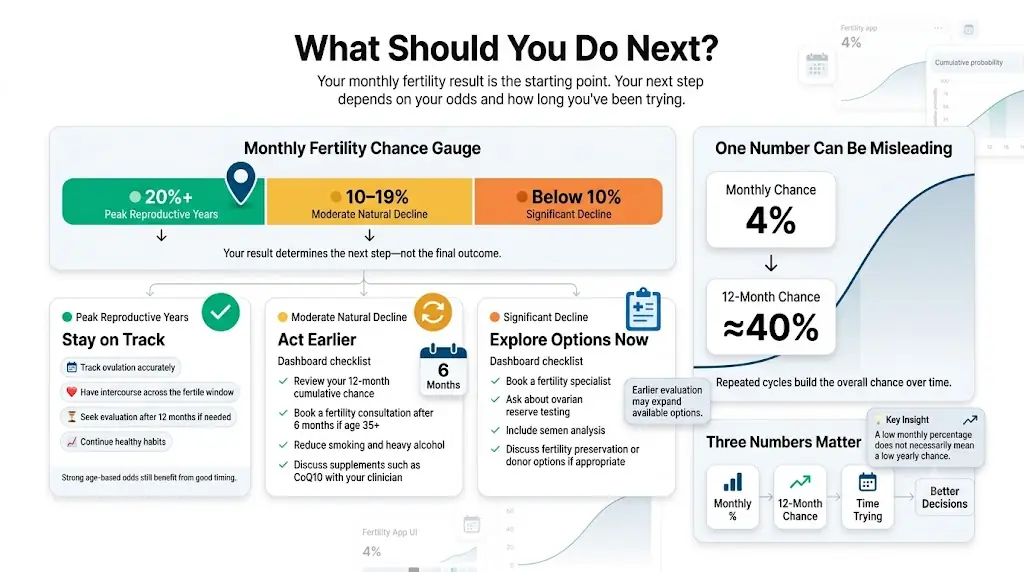
Your result points to a starting place, not a fixed outcome. What you do next depends on which category your monthly number landed in and how much time you have already spent trying.
For Peak Reproductive Years (20%+)
A strong result still benefits from good timing. Track ovulation with an app, OPK strips, LH surge tracking, cervical mucus, or basal body temperature instead of guessing at a 28-day cycle.
Keep having regular intercourse across your fertile window rather than only on the predicted peak day, since sperm can survive several days inside the body. If a full year passes without success, a specialist visit still makes sense, since strong age based odds don’t rule out other fertility factors.
For Moderate Natural Decline (10 to 19%)
This range rewards action without urgency. Check your 12 month cumulative number before feeling discouraged by the monthly figure alone, since odds stack up with repeated tries. Book a specialist consult after 6 months of trying rather than waiting the full year, since ACOG guidelines shift earlier once you pass 35.
Cut back on smoking and heavy alcohol use if either applies, since both are consistently linked to lower conception odds at any age. A CoQ10 supplement may also support egg quality during this window, though it works best alongside medical guidance rather than instead of it.
For Significant Decline (Under 10%)
A low score changes the timeline, not the outlook. Don’t wait out a full year on your own, since treatment options widen the earlier they get explored. Book a fertility specialist now if your age and partner’s age both sit near the higher end of the brackets, since combined factors add up faster than either one alone. Ask about ovarian reserve testing and a semen analysis together, since both partners contribute to the full picture at this stage.
A semen analysis can check sperm count and sperm motility, while more advanced testing may review sperm DNA fragmentation when a specialist thinks it is needed. Egg freezing or donor egg options are worth discussing too, especially if natural conception has already been tried for several months without success.
A Note on Reading Your Full Result
The monthly number rarely tells the whole story on its own. A couple with a 4% monthly chance can still reach nearly 40% after a year, so pair that figure with your cumulative odds before making any decision.
Fertile window accuracy matters just as much as the odds themselves, since even strong age based numbers won’t help if timing is off. Bring your full result, not just one number, to any specialist conversation, since the complete picture shapes treatment options far better than a single percentage ever could.
You Might Also Find These Helpful
Pregnancy & Fertility 45
Use this Pregnancy Risk Calculator to check age, BMI, health history, bleeding, and twins. See if closer prenatal monitoring may be worth asking about.
Try calculatorOne Time Pregnancy Calculator estimates pregnancy odds from one encounter, plus fertile window timing, test date, due date, and 21-day testing guidance.
Try calculatorUse the AMH Calculator to convert ng/mL or pmol/L, compare your result with age-based data, and see what it may mean for IVF, fertility,…
Try calculatorUse the Baby Eye Color Calculator with parents, grandparents, or sibling context to compare Brown, Green/Hazel, and Blue/Grey model estimates instantly.
Try calculatorBasal Body Temperature Calculator checks reading conditions and analyzes your temperature pattern for a sustained shift that may be consistent with ovulation.
Try calculatorBPD gestational age calculator: estimate fetal age from BPD, compare your week, check normal BPD ranges, and understand ahead or behind results.
Try calculatorCalculate odds with the Chance of Twins Calculator. Enter maternal age and history. Find your probability instantly. See if you will conceive multiples now.
Try calculatorFind out exactly when you conceived. Our free Conception Calculator uses your Due Date, LMP, or Ultrasound to estimate your fertilization date and fertile…
Try calculatorUse our Conception Date Due Date Calculator to find your baby's arrival date. Enter your conception or intercourse date for clinical 40-week results.
Try calculatorContraceptive effectiveness calculator to compare birth control methods, typical vs perfect use, backup protection, and 5-year pregnancy risk.
Try calculatorUse this CRL calculator to estimate gestational age and due date from crown-rump length in mm or cm. Compare CRL, LMP, and IVF dating…
Try calculatorUse this fundal height calculator to compare your cm measurement by week, check growth range, estimate baby weight, and know when to ask about…
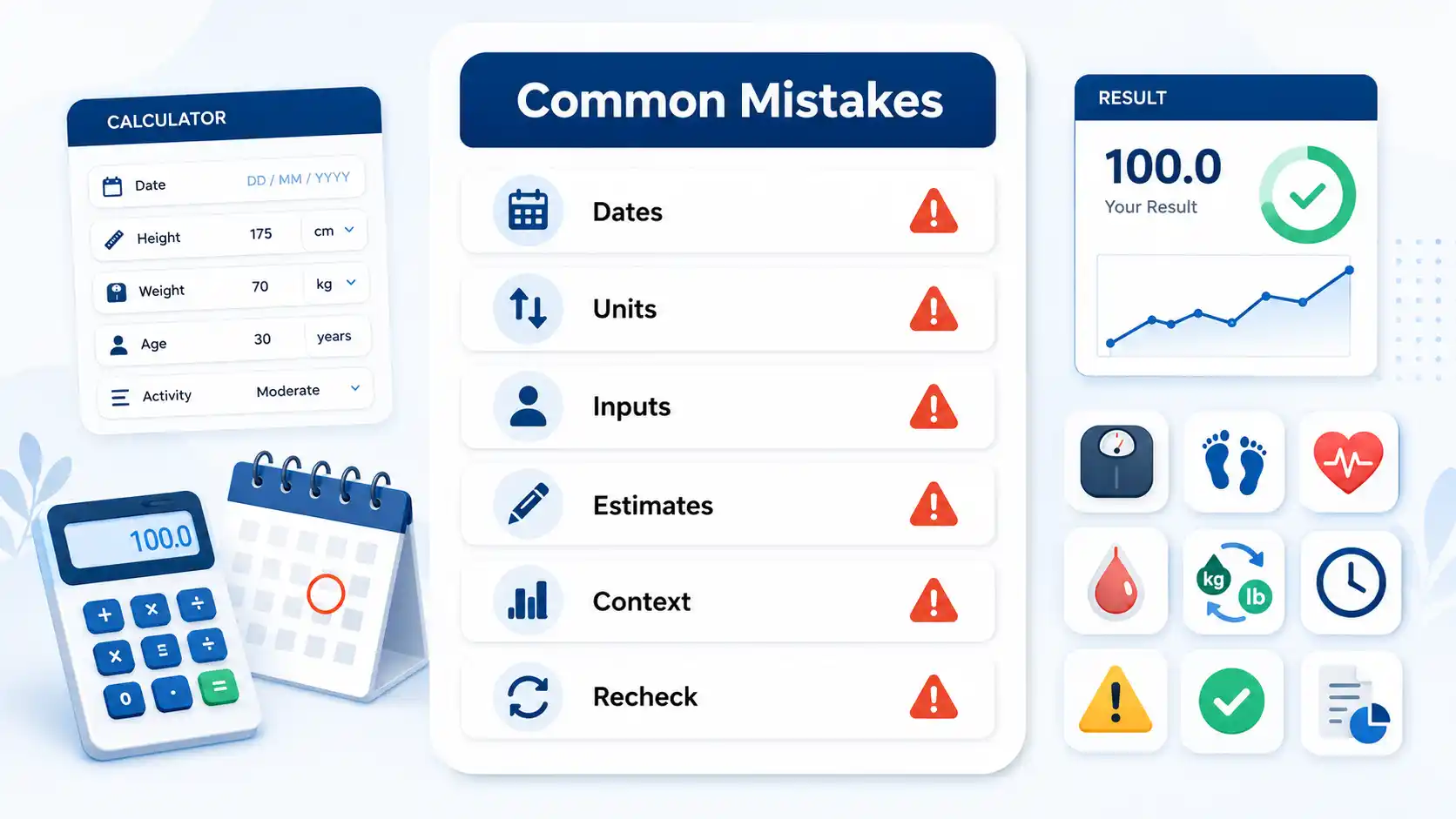
Try calculatorCommon Mistakes When Using the Fertility Calculator by Age
Small input errors and wrong assumptions throw off your fertility calculator by age result more than most people expect. These mistakes come up again and again in real user confusion around age based odds and cycle tracking.
- Reacting to the monthly odds number alone instead of checking the 12-month cumulative result
- Guessing your average cycle length instead of tracking it, which skews your fertile window dates
- Treating age 35 as a hard cutoff instead of a gradual decline that speeds up over several years
- Skipping the partner age field or assuming it won't change the result
- Treating your result as a medical diagnosis instead of a population-average estimate
Frequently Asked Questions (FAQs)
How does fertility change with age?
Monthly odds run 25 to 30% in your 20s, drop to about 15% by 35, and fall to 5 to 10% by your early 40s. The decline speeds up after 37, but it’s gradual, not a sudden drop at any single age.
Is 35 really a fertility cliff?
No. Age 35 is a screening threshold doctors use, not a biological cutoff. Your odds decline gradually through your 30s and pick up speed in your late 30s, not overnight on one birthday.
Does partner age affect fertility too?
Yes. Sperm quality and motility decline gradually after 40, which lowers a couple’s combined odds. The effect is smaller than female age, but it’s still real, especially from age 45 on.
Does AMH level predict my fertility better than age?
AMH shows how many eggs you likely have left, not their quality. Egg quality tracks closely with age, so a high AMH result doesn’t cancel out age related decline.
Does this calculator account for PCOS or irregular cycles?
No. This tool uses age based averages built for couples with regular ovulation. If you have PCOS or irregular cycles, ovulation tracking through OPKs or a doctor’s evaluation gives more accurate timing than age alone.
When should I see a fertility specialist?
ACOG guidelines recommend trying naturally for 12 months if you’re under 35, 6 months if you’re 35 to 39, and seeking help right away or after 3 months if you’re 40 or older.
Is a 1 in 4 or 1 in 10 chance normal?
Yes. Healthy couples in their 20s and early 30s often see roughly 1 in 4 odds per cycle. That commonly drops to around 1 in 10 by age 40, and both numbers match typical population data.
Can I get pregnant naturally after 40?
Yes, it happens regularly, though odds are lower and more couples need assisted options like IUI or IVF. Age alone doesn’t rule out natural conception, it just makes each individual cycle less likely to succeed.
How accurate is a fertility calculator by age?
It’s accurate at the population level, not the personal level. The numbers come from real fecundability studies, but your own health, cycle regularity, and fertility history can shift your actual odds above or below what any age bracket shows.
Is this fertility calculator by age free to use?
Yes. The calculator runs at no cost and gives instant results based on your inputs. No account, download, or payment is needed to see your monthly and cumulative odds.
How is a fertility calculator by age different from an ovulation calculator?
A fertility calculator by age estimates your odds of conceiving based on age and partner age. An ovulation calculator only predicts your fertile days from your cycle, without factoring in age related decline at all.
This calculator combines both, showing your odds and your fertile window in one place.
Can an ovulation calculator help me conceive a boy?
No ovulation calculator can reliably help you conceive a boy. Timing sex near ovulation may appear in baby-sex myths, but it cannot control whether the baby is male or female.
A baby’s sex depends on which sperm fertilizes the egg. An ovulation calculator can help estimate fertile days, but it should not be used as a baby-sex selection tool.
Can timing sex choose a baby’s sex?
No, timing sex cannot reliably choose a baby’s sex. Methods that claim “sex on ovulation day for a boy” or “sex before ovulation for a girl” are not dependable.
If your goal is pregnancy, focus on the fertile window instead of trying to time sex for a boy or girl. Limiting intercourse to one theory-based day may lower your overall chance of conceiving.
Can I get pregnant naturally at 37?
Yes, many people can get pregnant naturally at 37. Fertility is lower than it was in the 20s or early 30s, but age 37 is not a hard cutoff.
If you are 37 and have been trying for 6 months without pregnancy, it is smart to ask an OB-GYN or fertility specialist about testing. Earlier guidance can help check ovulation, ovarian reserve, tubes, and semen quality.
Can I get pregnant naturally at 40?
Yes, natural pregnancy at 40 is possible, but the monthly chance is lower. Age 40 is the point where waiting too long can cost useful time.
If you are 40 or older, speak with an OB-GYN or fertility specialist sooner instead of trying for a full year first. Testing can show whether timed intercourse, IUI, IVF, donor eggs, or another option makes more sense.
Can I get pregnant naturally at 43?
Yes, natural pregnancy at 43 can happen, but the chance per cycle is low. Egg quality and chromosome normality usually become the main limits at this age.
A low calculator result does not mean impossible. It means you should not delay medical advice, especially if you have irregular cycles, prior losses, low AMH, endometriosis, or a partner with possible sperm issues.
How can I find my highest chance of getting pregnant?
Your highest chance of getting pregnant usually comes from having sex during the fertile window, especially in the few days before ovulation. Age, partner age, cycle regularity, and ovulation timing all affect the result.
Use this calculator to estimate your age-based odds, then improve timing with cycle tracking, ovulation predictor kits, cervical mucus changes, or basal body temperature. If you are over 35, do not wait too long to ask for help.
Does partner age affect fertility?
Yes, partner age can affect fertility, especially as sperm quality changes with age. The effect is usually less predictable than female age, but it can still influence time to pregnancy.
This calculator applies a partner-age adjustment to the female age baseline. Use it as a planning estimate, not a diagnosis of male fertility.
Questions?
We had love to hear from you! Whether you are reporting an issue, suggesting a new calculator, or exploring collaboration opportunities — we are here to help. Every message helps us make 100calc smarter, faster, and more helpful for everyone.
Why People Trust 100calc
At 100calc.com, we focus on accuracy, speed, and trust. Every calculator we create is designed to give reliable, instant, and easy-to-understand results you can truly depend on.