
Basal Body Temperature Calculator — Check Your Reading & Ovulation Shift
This basal body temperature calculator does two things. It checks whether today’s BBT reading may have been affected by a different wake time or sleep disturbance, and it analyzes your 9-day temperature pattern for an ovulation-related shift.
Enter your wake times and reading, or enter nine daily temperatures, and get instant context for your BBT chart. The tool helps you identify potentially disturbed readings and check for a sustained temperature shift without changing your measured temperature.
Quick Facts
- Typical pre-ovulation BBT varies by person; many readings fall around 96–98°F (35.5–36.6°C).
- Post-ovulation rise: usually 0.4°F to 1.0°F higher
- A sustained elevated BBT can occur in pregnancy, but BBT alone cannot confirm pregnancy.
- Updated Aug 19, 2026
- Reviewed by 100Calc Research Team
Pregnancy & Fertility Calculator
Basal Body Temperature Calculator
Check whether timing or sleep disturbances may have affected today's BBT reading, or analyze your 9-day chart for a temperature shift.
Use Reading Quality Check to see whether wake-time changes, poor sleep, mouth breathing, or alcohol may have affected today's BBT reading.
Getting Started
For consistent tracking, take your basal temperature immediately after waking and before getting out of bed. Use this tool to flag conditions that may make a reading less comparable with your usual BBT measurements.
Calculation Result
BBT Coverline Chart
Short answer
How this result was determined
Explore More Calculators
Use the Chinese Gender Calculator for a traditional boy-or-girl prediction from lunar age and conception month. Enter conception date, due date, or LMP.
Try calculatorUse this fetal growth calculator to check baby weight percentile from ultrasound data in grams, kg, or cm and see what the result means…
Try calculatorEnter gestational sac measurements in mm or cm to calculate mean sac diameter, estimate early gestational age, compare week-by-week milestones, and see when follow-up…
Try calculatorMissed a birth control pill? Check pregnancy risk, protection status, backup contraception needs, and what to do next with our missed pill calculator.
Try calculatorUse our Pregnancy Chance Calculator to estimate your odds. Enter your cycle day, age, and method. Find out if you are in the high-risk…
Try calculatorUse our pregnancy due date calculator to find your exact Baby Due date. IVF, conception, ovulation, and ultrasound methods with weeks and timeline.
Try calculator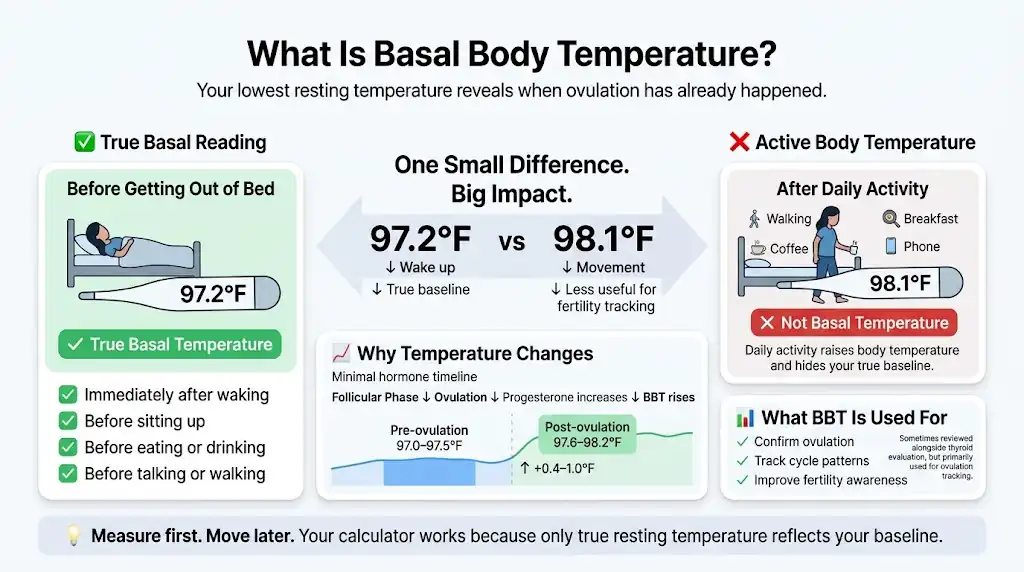
Micro Insight
the calculator above only works because this baseline shift is real and measurable. Understanding what counts as “true rest” is what makes your readings worth charting in the first place.
What Is Basal Body Temperature
Basal body temperature is your body’s lowest resting temperature, measured right after you wake up and before any movement. It shifts slightly across your menstrual cycle. A rise after ovulation is the key signal fertility trackers look for.
Your body runs at different temperatures throughout the day. Walking, eating, and even talking raise it slightly. Basal temperature strips all that away. It only counts the reading taken at true rest, straight out of sleep, before your feet touch the floor.
Think of it like checking your car’s engine before you start it. A warm engine tells you nothing useful. A cold engine reading is the real baseline. Your body works the same way. Progesterone, the hormone released after ovulation, nudges that baseline up by roughly 0.4 to 1.0 degrees Fahrenheit. That small bump is what charts are built to catch.
What Your BBT Result Means
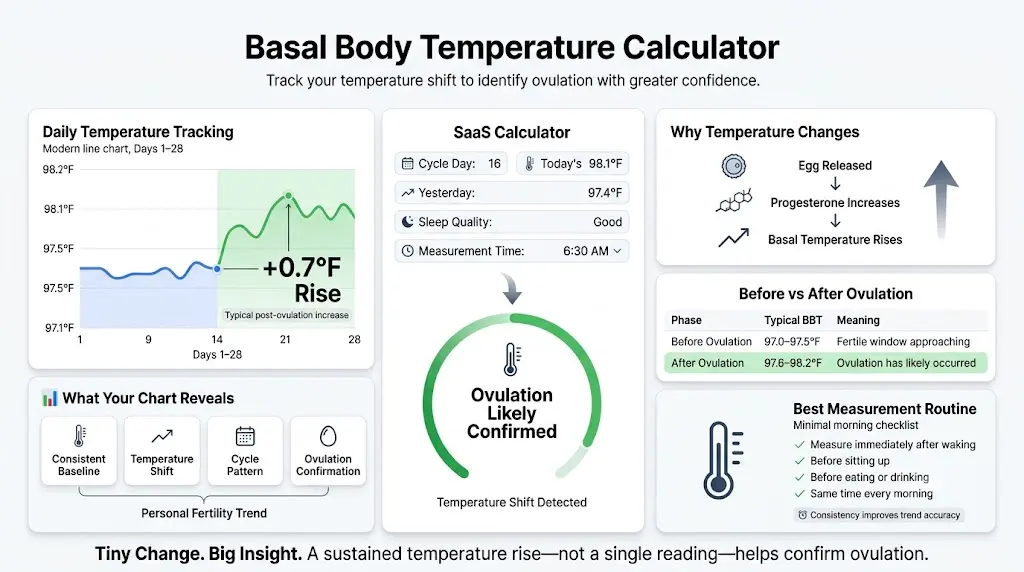
Your result tells you one of two things. It either checks the quality of a single BBT reading or checks your recent temperatures for a sustained shift. A detected shift can be consistent with ovulation having occurred, but this calculator does not prove or diagnose ovulation.
Understanding Your Result
In Reading Quality Check mode, the calculator keeps the temperature you actually measured. It compares your actual wake time with your normal wake time and checks any disturbances you report, such as interrupted sleep, mouth breathing, or alcohol. It then tells you whether that reading was taken under consistent conditions or whether you should note it as potentially less comparable with your usual BBT readings.
In Ovulation Analyzer mode, the calculator compares three recent temperatures with a coverline built from the six baseline temperatures you entered. If the readings meet the calculator’s full shift criteria, it reports a sustained temperature shift. That pattern can be consistent with ovulation having occurred, but BBT alone does not prove ovulation.
A wake-time difference or disturbance flag is not automatically a bad result. It simply gives you context when comparing that temperature with the rest of your chart. The calculator does not estimate what your temperature “should have been” at another wake time.
Is Your Result Good or Bad?
Neither result is inherently good or bad. They’re status checks, not scores.
A “Consistent Reading Conditions” result means you reported no wake-time difference or selected disturbances. “Timing Difference Noted” means you took the reading at a different time than usual. “Potentially Disturbed Reading” means one or more reported factors may make that temperature less comparable with your usual readings. None of these statuses changes your measured temperature.
For the analyzer, “Temperature Shift Detected” means your nine entered temperatures meet this calculator’s temperature-shift criteria. A sustained rise can be consistent with a post-ovulation pattern, but BBT alone cannot prove that ovulation occurred. “No Clear Shift Yet” means the entered temperatures did not meet the calculator’s full shift criteria. Keep tracking rather than assuming that ovulation did not occur.
What You Should Do Next
- Keep the temperature you actually measured rather than applying a mathematical wake-time correction.
- Note a different wake time, interrupted sleep, mouth breathing, alcohol, illness, or another disturbance alongside the reading when relevant.
- If a sustained temperature shift is detected, continue charting to see whether the elevated pattern persists.
- If no clear shift is detected, keep tracking. An unclear BBT pattern does not prove that ovulation did not occur.
Quick Example to Test
Try this in Ovulation Analyzer mode: enter 97.1, 97.3, 97.2, 97.4, 97.1, 97.3 for Days 1 to 6. Then enter 97.6, 97.5, 97.6 for Days 7 to 9.
Baseline max is 97.4°F, so the coverline sits at 97.5°F. Day 8 dips to 97.5°F, right on the line instead of clearly above it.
The tool returns “No Clear Shift Yet” because one of the three recent temperatures does not sit above the calculator’s coverline. That does not prove that ovulation did not occur. It only means these nine readings do not meet the calculator’s temperature-shift criteria yet. Keep charting to see whether a clearer pattern develops.
How to Use the Basal Body Temperature Calculator
This calculator runs two tools in one. Reading Quality Check reviews factors that may affect a single BBT reading. Ovulation Analyzer checks nine temperatures for a sustained thermal shift. The analyzer is a chart-pattern screen, not a clinical test that proves ovulation.
Pick Your Temperature Unit
Choose °F or °C before entering anything else. The calculator runs all its math in Fahrenheit behind the scenes, then converts your result back to whichever unit you picked. Switching units clears old entries, so pick your unit first to avoid re-typing.
Choose Reading Quality Check or Ovulation Analyzer
Use Reading Quality Check when you want to review one daily BBT reading for timing or sleep-related factors that may affect consistency. Use Ovulation Analyzer when you have six baseline temperatures plus three recent temperatures and want to check for a sustained temperature shift.
Enter Your Times, Reading, or Nine-Day Chart
In Reading Quality Check mode, enter your normal wake time, actual wake time, and measured temperature. In Ovulation Analyzer mode, enter six baseline temperatures followed by three recent readings. The calculator checks the entered temperature range and rejects fever-range readings from its BBT analysis.
Flag Any Sleep Disturbances
Check restless sleep, mouth breathing, or alcohol if any applied. These factors can affect BBT consistency, so the calculator flags them for context instead of changing your measured temperature.
Get Your Reading Quality or Temperature-Shift Result
Tap Calculate and the tool runs its logic instantly. In Reading Quality Check mode, the tool keeps your measured temperature unchanged and shows whether timing or reported disturbances may make the reading less reliable for pattern comparison. In Analyzer mode, it builds a coverline from your first six entries and checks whether your three recent readings meet the calculator's full temperature-shift criteria.
Quick Example to Test
Try Reading Quality Check with these values,
Input
- Normal wake time: 6:30 AM
- Actual wake time: 8:00 AM
- Measured BBT: 97.90°F
- Mouth breathing: Yes
Result
Measured BBT: 97.90°F
Wake-time difference: 90 minutes
Reading quality: Potentially disturbed
Mean:
The calculator keeps the original 97.90°F reading. Because the measurement was taken later than usual and mouth breathing was reported, mark the reading for context when reviewing the overall chart rather than applying a numerical correction.
Accuracy Behind the Basal Body Temperature Calculator
The calculator keeps your original BBT measurement unchanged. Its Reading Quality Check identifies timing and sleep-related factors that may affect temperature consistency, while the charting mode evaluates the pattern across multiple readings. Nothing here runs on guesswork. The calculator applies the same defined rules consistently to every set of inputs. Its analyzer is designed to help you identify a temperature pattern, not to replace clinical confirmation of ovulation.
Key Features & Benefits
- Flags timing and sleep-related factors without changing your measured BBT
- Flags fever temperatures automatically so bad data never skews your chart
- Checks nine BBT readings for a sustained temperature shift using its 3-over-6 screen
- Draws a visual chart with the coverline marked for you
- Works in °F or °C with no manual conversion needed
Technical Process
Input Check
Validates your temperature range and rejects fever readings before running any math.
Reading Quality Check
Reviews wake-time differences and reported disturbances without changing your measured basal body temperature.
Pattern Analysis
Compares your three recent readings with a calculated coverline to check for a sustained temperature shift.
How the Basal Body Temperature Formula Works (Complete Breakdown)
The basal body temperature calculator uses two separate processes. Reading Quality Check does not mathematically adjust your basal body temperature. It calculates the difference between your normal and actual wake times and checks the disturbances you selected. Your measured temperature remains unchanged, while the timing and disturbance information provides context for interpreting the reading.
Formula:
					Wake-Time Difference = |Actual Wake Time − Normal Wake Time|

Measured BBT = Entered Temperature

Reading Quality =
Consistent Reading Conditions, if Wake-Time Difference = 0 and no disturbances are selected

Timing Difference Noted, if Wake-Time Difference ≠ 0 and no disturbances are selected

Potentially Disturbed Reading, if any sleep, mouth-breathing, or alcohol disturbance is selected
How the Formula Works
Reading Quality Check does not calculate an adjusted temperature. It measures the difference between your normal and actual wake times, keeps your entered BBT unchanged, and assigns context based on the timing difference and any disturbances you selected. The purpose is to help you judge measurement consistency, not estimate a replacement temperature.
The Ovulation Analyzer works differently. It scans your first six entries, finds the highest temperature, and creates the calculator’s coverline above it. It then checks the final three readings against its full shift criteria. Passing this screen means a sustained temperature shift was detected, not that ovulation was clinically proven.
Understanding the Formula Variables
Time Difference
The gap between your actual wake time and your normal wake time, measured in minutes. The difference between your usual wake time and the time you took today’s BBT. Larger timing differences can make daily readings harder to compare consistently.
Measured Temp
The raw number you typed in before any correction. This is the temperature you actually measured. The calculator keeps this value unchanged.
Mouth Breathing
If you measured BBT orally and slept with your mouth open, note it as a possible disturbance. The calculator flags the factor but does not apply a fixed temperature correction.
Coverline
The threshold used by this calculator to compare your three recent temperatures. It sits 0.1°F above the highest reading from your first six entries.
Days 1 to 6
Your six baseline entries. The calculator uses the highest value from these six readings rather than their average.
Days 7 to 9
Your three recent temperature entries. The calculator compares these readings with the coverline and applies its full temperature-shift criteria.
Another Example Calculation (Step-by-Step)
This example shows how the ovulation formula plays out with slightly different numbers than what the calculator area used. It follows the exact same math the tool runs behind the scenes.
Given:
- Days 1 to 6: 96.9°F, 97.1°F, 97.0°F, 97.2°F, 97.0°F, 97.1°F
- Days 7 to 9: 97.5°F, 97.6°F, 97.4°F
Calculation:
					Baseline = Highest of Days 1-6
Baseline = 97.2°F

Coverline = Baseline + 0.1°F
Coverline = 97.3°F

Check Days 7-9 against Coverline:
Day 7: 97.5°F > 97.3°F → Above
Day 8: 97.6°F > 97.3°F → Above
Day 9: 97.4°F > 97.3°F → Above

Result: Temperature Shift Detected
Result:
- Coverline: 97.30°F
- Latest Reading: 97.40°F
- Shift Variance: +0.10°F
Meaning:
The three recent temperatures meet this calculator’s shift criteria, so it reports “Temperature Shift Detected.” This pattern can be consistent with a post-ovulation thermal rise, but it does not prove that ovulation occurred. Continue charting to see whether the elevated pattern remains consistent.
How Does a Basal Body Temperature Calculator Check Reading Quality and Ovulation Shifts?
This basal body temperature calculator uses two checks. Reading Quality Check keeps your measured BBT unchanged and reviews wake-time differences and reported disturbances for context. Ovulation Analyzer compares three recent temperatures with a coverline based on six earlier readings to look for a sustained thermal shift. A detected shift may be consistent with ovulation having occurred, but it does not clinically confirm ovulation.
What happens if I sleep in on the weekend?
A common problem for anyone tracking BBT around a work week.
Input
- Normal wake time: 6:00 AM
- Actual wake time: 8:30 AM
- Measured temperature: 97.85°F
- No disturbances checked
Process
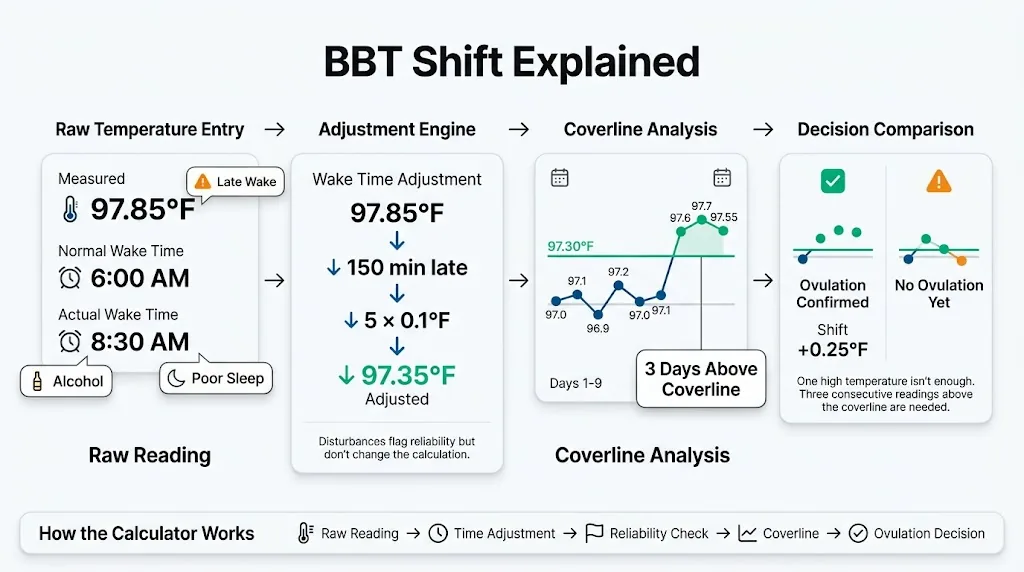
- The wake-time difference is 150 minutes. Reading Quality Check records that timing difference but does not subtract temperature from the measured BBT.
Result
- Measured Temperature: 97.85°F
- Wake-Time Difference: 150 minutes
- Status: Timing Difference Noted
Meaning
Keep the measured 97.85°F unchanged. Because it was taken 150 minutes later than your normal wake time, note the timing difference when reviewing the chart. A different measurement time can make the reading less comparable with temperatures taken under your usual conditions.
Does a night out with drinks ruin my chart?
Alcohol is one of the top disturbances people ask about in TTC forums.
Input
- Normal wake time: 7:00 AM
- Actual wake time: 7:15 AM
- Measured temperature: 98.10°F
- Alcohol checked
Process
- The wake-time difference is only 15 minutes, but alcohol was selected as a possible disturbance. The calculator flags that context without applying a numerical temperature correction.
Result
- Measured Temperature: 98.10°F
- Wake-Time Difference: 15 minutes
- Status: Potentially Disturbed Reading
Meaning
Keep the measured 98.10°F unchanged and note the alcohol exposure on your chart. Alcohol can affect BBT consistency, so interpret this reading in the context of the surrounding days rather than treating it as an equivalent clean measurement.
How do I know ovulation actually happened this cycle?
The question most people are really trying to answer when they start BBT charting.
Input
- Days 1–6: 97.0°F, 97.1°F, 96.9°F, 97.2°F, 97.0°F, 97.1°F
- Days 7–9: 97.6°F, 97.7°F, 97.55°F
Process
- Baseline max from the first six days is 97.2°F, so the coverline sits at 97.3°F. All three post-ovulation days clear that line, and Day 9 meets the calculator’s additional shift requirement. Together, these readings meet this calculator’s temperature-shift criteria.
Result
- Coverline: 97.30°F
- Latest Reading: 97.55°F
- Status: Temperature Shift Detected
- Shift Variance: +0.25°F
Meaning
The nine entered temperatures meet this calculator’s criteria for a sustained thermal shift. A biphasic BBT pattern can be consistent with ovulation having occurred, but BBT alone cannot prove the exact day of ovulation or guarantee that ovulation occurred.
Why does my chart say “No Clear Shift Yet” even after my temperatures rose?
A frustrating pattern for anyone whose temperatures hover right at the line instead of clearing it.
Input
- Days 1–6: 97.3°F, 97.2°F, 97.4°F, 97.3°F, 97.2°F, 97.3°F
- Days 7–9: 97.5°F, 97.6°F, 97.4°F
Process
- Baseline max is 97.4°F, setting the coverline at 97.5°F. Day 7 lands exactly on the coverline instead of above it, and Day 9 drops back below it entirely.
Result
- Coverline: 97.50°F
- Status: No Clear Shift Yet
Meaning
A temperature on or below the calculator’s coverline does not satisfy its sustained-shift screen. This does not prove that you did not ovulate. Keep charting because BBT patterns can be unclear or develop later.
Quick Rules to Remember
Different wake times, interrupted sleep, alcohol, and mouth breathing during oral measurement may affect how comparable a BBT reading is with the rest of your chart. Reading Quality Check does not mathematically correct these factors or replace your measured temperature. It records the wake-time difference and flags reported disturbances for context. Ovulation Analyzer then looks for a sustained rise across three recent temperatures rather than relying on one high reading. A detected temperature shift can be consistent with ovulation having occurred, but BBT alone does not prove the exact day of ovulation.
Basal Body Temperature Patterns and What They May Mean
Your basal body temperature calculator result only means something once you compare it to real ranges. These benchmarks show where your reading sits in a normal cycle, and when a number crosses into fever territory or signals a possible early pregnancy pattern.
| BBT Pattern | General Context | What It May Mean | Important Limitation |
|---|---|---|---|
|
About 96–98°F (35.5–36.6°C) before ovulation | Common pre-ovulation temperature range | May represent your lower follicular-phase baseline before the post-ovulation temperature rise | Your personal baseline may naturally be higher or lower |
|
About 0.4–1.0°F (0.2–0.6°C) sustained rise | Common post-ovulation temperature pattern | May reflect the progesterone-related thermal rise that occurs after ovulation | Look for a sustained pattern across several readings rather than one high temperature |
| Three recent higher readings | Sustained temperature-shift pattern | May support a pattern consistent with ovulation having already occurred | A BBT pattern alone cannot clinically confirm the exact day of ovulation |
| Temperature remains elevated after the expected period | Possible pregnancy-related pattern | BBT can remain elevated after ovulation during a pregnancy cycle | BBT cannot confirm pregnancy. Use a pregnancy test for confirmation |
| 100.4°F (38°C) or higher | Fever-range temperature | Illness or fever may be affecting your basal temperature | Fever readings can interfere with BBT chart interpretation and should not be treated as an ovulation shift |
Important: Basal body temperature varies from person to person. Your own repeated temperature pattern is usually more useful than comparing one reading with a universal number. Look for consistent measurements and a sustained change across several days.
Interpretation
Many ovulatory cycles show a lower-temperature phase before ovulation and a higher-temperature phase afterward. However, not every ovulatory cycle produces a perfectly clear biphasic BBT chart. Sleep, illness, measurement timing, medications, travel, and individual variation can make the pattern harder to interpret.
Pro Tip
Don’t judge one day’s reading against these ranges alone. Chart at least a full cycle before deciding if your pattern looks normal, since a single low or high day rarely tells the full story.
How to Improve Your Basal Body Temperature Chart Results
A single BBT reading rarely tells the whole story. Small habits around sleep timing, thermometer use, and tracking consistency shape how reliable your chart becomes over time. What you do after seeing your result matters just as much as the number itself.
For Consistent Reading Conditions
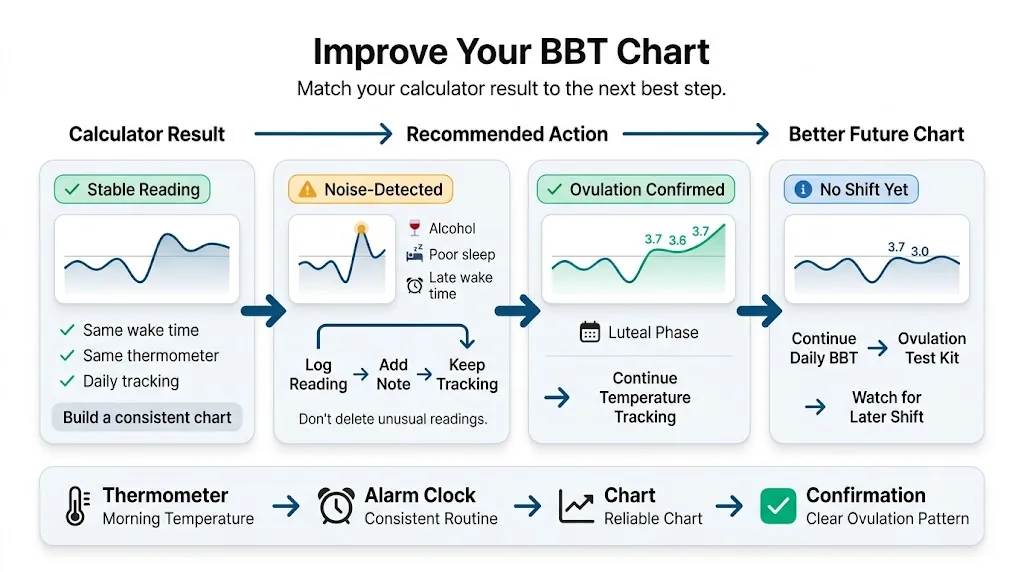
A “Consistent Reading Conditions” result means you reported no wake-time difference or selected disturbances for that measurement. Keep recording your BBT under similar conditions each day. Take your temperature immediately after waking, before getting out of bed, and try to use the same thermometer and measurement method throughout the cycle.
For Potentially Disturbed Readings
A “Potentially Disturbed Reading” result means you reported a factor such as interrupted sleep, mouth breathing during oral measurement, or alcohol that may affect BBT consistency. Keep the measured temperature unchanged and add a note explaining the disturbance. Review the reading as part of the full temperature pattern rather than interpreting that single value by itself.
For Temperature Shift Detected Results
A “Temperature Shift Detected” result means your nine entered readings met this calculator’s sustained-shift criteria. The pattern may be consistent with ovulation having occurred, but keep charting rather than treating the result as definitive proof of ovulation. If you repeatedly see fewer than 10 days of elevated temperatures after the shift, consider discussing the pattern with your healthcare professional.
For No Clear Shift Yet Results
A “No Clear Shift Yet” result means the nine entered temperatures did not meet this calculator’s sustained-shift criteria. It does not prove that ovulation failed to occur. It often just means the shift hasn’t shown up yet in your nine-day window. Keep entering daily readings past Day 9, since some cycles ovulate later than expected, especially after stress, travel, or illness. Pair your BBT chart with an ovulation predictor kit if you’re several cycles in without a clear temperature shift, since combining both methods catches patterns BBT alone can miss.
You Might Also Find These Helpful
Pregnancy & Fertility 45
Use this Pregnancy Risk Calculator to check age, BMI, health history, bleeding, and twins. See if closer prenatal monitoring may be worth asking about.
Try calculatorOne Time Pregnancy Calculator estimates pregnancy odds from one encounter, plus fertile window timing, test date, due date, and 21-day testing guidance.
Try calculatorUse the AMH Calculator to convert ng/mL or pmol/L, compare your result with age-based data, and see what it may mean for IVF, fertility,…
Try calculatorUse the Baby Eye Color Calculator with parents, grandparents, or sibling context to compare Brown, Green/Hazel, and Blue/Grey model estimates instantly.
Try calculatorBPD gestational age calculator: estimate fetal age from BPD, compare your week, check normal BPD ranges, and understand ahead or behind results.
Try calculatorCalculate odds with the Chance of Twins Calculator. Enter maternal age and history. Find your probability instantly. See if you will conceive multiples now.
Try calculatorFind out exactly when you conceived. Our free Conception Calculator uses your Due Date, LMP, or Ultrasound to estimate your fertilization date and fertile…
Try calculatorUse our Conception Date Due Date Calculator to find your baby's arrival date. Enter your conception or intercourse date for clinical 40-week results.
Try calculatorContraceptive effectiveness calculator to compare birth control methods, typical vs perfect use, backup protection, and 5-year pregnancy risk.
Try calculatorUse this CRL calculator to estimate gestational age and due date from crown-rump length in mm or cm. Compare CRL, LMP, and IVF dating…
Try calculatorEstimate your monthly and 12-month pregnancy odds by age, partner age, and cycle dates. See your fertile window and when to seek fertility help.
Try calculatorUse this fundal height calculator to compare your cm measurement by week, check growth range, estimate baby weight, and know when to ask about…
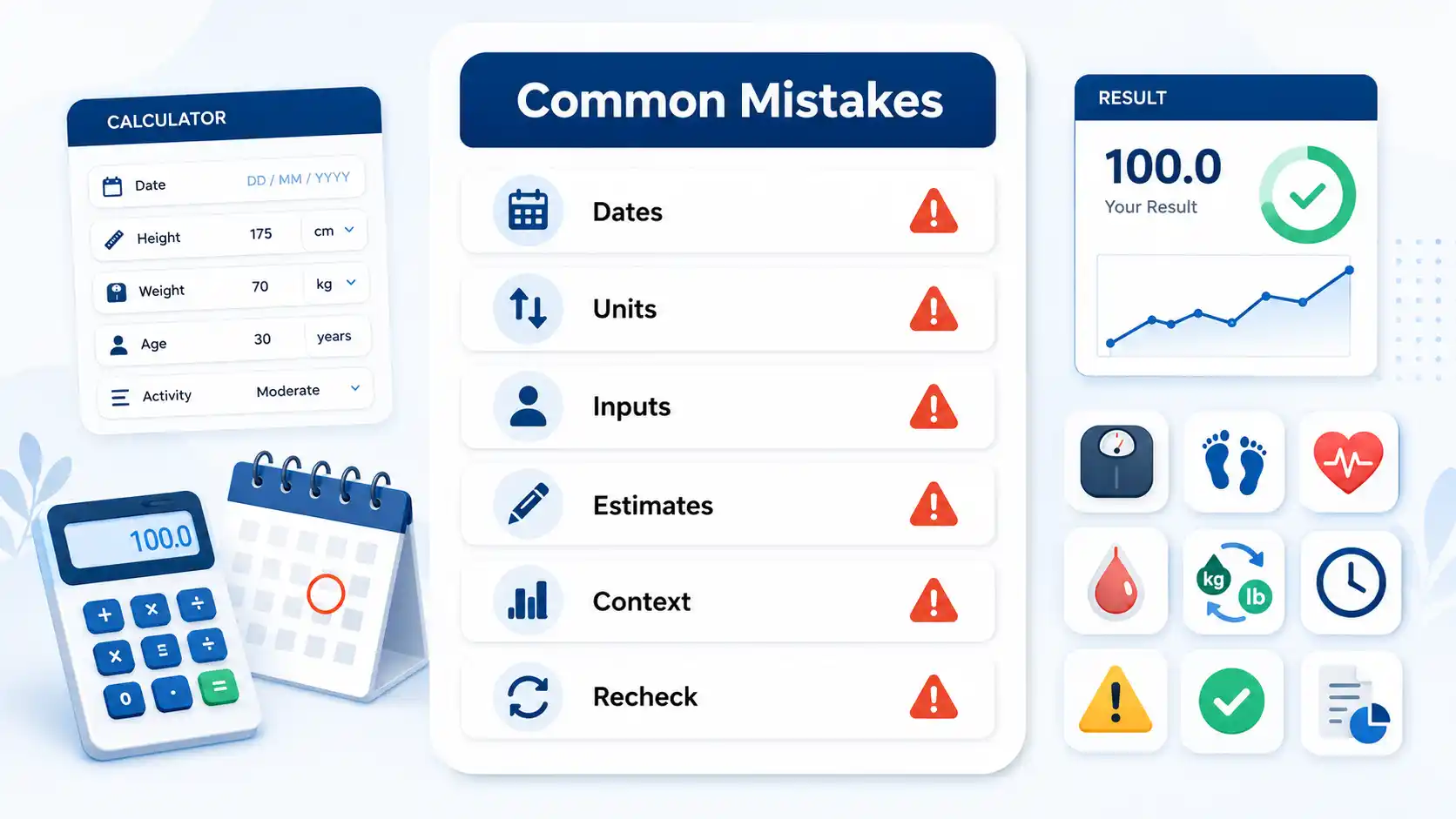
Try calculatorCommon Mistakes When Using the Basal Body Temperature Calculator
Small input errors throw off basal body temperature results more than people expect. Most confusion comes from how the reading gets taken, not the calculator itself. Here are the mistakes that most often skew a BBT chart.
- Taking your temperature after sitting up, talking, or checking your phone first
- Using a fever thermometer instead of one that reads to two decimal places
- Treating one high temperature as proof of ovulation instead of looking for a sustained pattern
- Logging a spike from illness or alcohol as a real ovulation shift
- Expecting BBT to predict fertile days ahead of time instead of using the temperature rise as a retrospective fertility sign
Frequently Asked Questions (FAQs)
What does an implantation dip look like on a BBT chart?
An implantation dip is a term sometimes used for a brief one-day drop in basal body temperature during the luteal phase. However, a temperature dip cannot confirm implantation or pregnancy because similar dips can appear in both pregnant and non-pregnant cycles. Look at the overall BBT pattern rather than using one temperature drop as evidence of implantation.
How many days after ovulation does BBT rise?
Basal body temperature usually rises after ovulation as progesterone increases. The rise is often about 0.5°F to 1.0°F above the earlier baseline, but the timing and size of the shift can vary between people and cycles. A sustained pattern across several readings is more useful than trying to identify ovulation from one temperature.
Why does my BBT stay flat with no clear pattern?
A flat or unclear BBT chart can happen because of inconsistent measurement times, disrupted sleep, illness, travel, or normal cycle-to-cycle variation. It can also occur in a cycle without ovulation, but an unclear temperature pattern alone does not prove that ovulation did not happen. Keep tracking and consider other fertility signs if the pattern remains unclear.
Does BBT drop before your period if you're not pregnant?
Yes. Without pregnancy, progesterone falls near the end of the luteal phase, and BBT usually drops a day or two before your period starts. If temperatures stay high instead of dropping, that’s the signal worth watching for.
Can I use a smartwatch or wearable instead of a basal thermometer?
Some wearables can track overnight skin-temperature trends that may help with menstrual-cycle pattern tracking. However, skin temperature is not the same measurement as oral or vaginal basal body temperature, and accuracy varies by device and algorithm. Follow your device’s instructions and avoid switching measurement methods mid-cycle if you want comparable trends.
Can I use basal body temperature tracking with PCOS or irregular cycles?
Yes. You can track BBT with PCOS or irregular cycles, but the pattern may be harder to interpret. A sustained temperature rise can be consistent with ovulation having occurred, while an unclear BBT pattern does not prove that ovulation did not happen. Combining BBT with other fertility signs may provide more context.
Does stress affect basal body temperature readings?
Stress can make a BBT chart harder to interpret, especially when it affects sleep, wake time, illness, travel, or menstrual-cycle timing. An unusual or erratic temperature pattern does not by itself show that something is wrong or that ovulation did not occur. Note unusual circumstances on your chart and focus on the pattern across several days.
Should I keep taking my temperature during my period?
Yes. Continuous daily readings, including period days, help build a complete baseline for the next cycle. Skipping days makes it harder to spot your true pre-ovulation range when the next temperature rise happens.
What happens if I forget to take my temperature one morning?
One missed day rarely breaks your chart. Just leave that day blank and continue as usual. Missing several days in a row, especially near ovulation, makes it harder to identify a sustained temperature shift with confidence.
Is basal body temperature charting accurate enough to confirm pregnancy without a test?
No. Basal body temperature cannot confirm pregnancy. An elevated BBT pattern lasting 18 days or more after ovulation can be an early pregnancy indicator, but illness and other factors can also affect temperature. Use a home pregnancy test or clinical testing to confirm pregnancy.
Questions?
We had love to hear from you! Whether you are reporting an issue, suggesting a new calculator, or exploring collaboration opportunities — we are here to help. Every message helps us make 100calc smarter, faster, and more helpful for everyone.
Why People Trust 100calc
At 100calc.com, we focus on accuracy, speed, and trust. Every calculator we create is designed to give reliable, instant, and easy-to-understand results you can truly depend on.