
Car Trade-In Tax Savings Calculator: Uncover Hidden Showroom Math
A car trade-in tax savings calculator measures the financial discount earned when trading your vehicle at a dealership. Most states tax only the net difference between your new purchase and your trade-in value. This system converts your old vehicle into an instant tax deduction. It lowers your total sales tax bill and reduces your required loan amount immediately.
Dealerships rely on you losing track of these hidden numbers. A private buyer might offer a higher raw cash price for your used vehicle. That visible profit often evaporates completely once you pay the full state sales tax on your next purchase. You must find out if the dealer offer is a genuine discount or a financial trap.
This interactive tool eliminates showroom confusion instantly. It strips away complex dealership financing rules to reveal your true out-the-door numbers. You will secure a definitive walk-away target price to protect your money before stepping onto the lot. The system also calculates the precise monthly impact of rolling over an underwater car loan.
Quick Facts
- Invisible Tax Credits: Deducts vehicle value from your new car tax base.
- Negative Equity Proof: Shows how underwater loans do not cancel your tax discount.
- Walk-Away Target: Reveals the exact offer needed to beat private buyers.
- Amortization Engine: Predicts your actual new financed monthly payment.
- Updated Jun 17, 2026
- Reviewed by 100Calc Research Team
Dealership Negotiation Tool
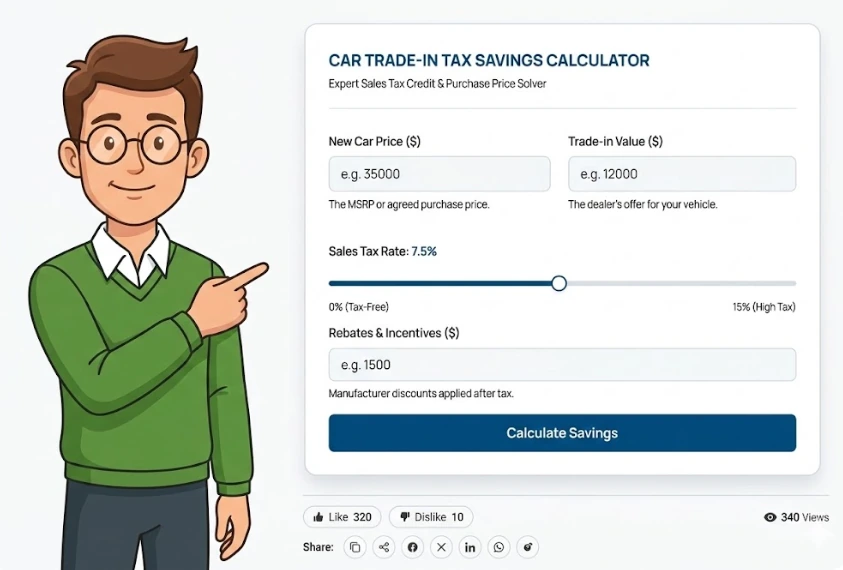
Car Trade-In Tax Savings Calculator
Calculate your exact car trade in tax savings, uncover your new out-the-door monthly payment, and generate a definitive "Walk-Away Target" to prove if trading in beats a private sale.
Total Tax Savings
Effective Trade-In Value:
The "Walk-Away" Target
To beat your private sale estimate, tell the dealer they must offer you at least:
Out-The-Door Tax Breakdown
Financing Details
Tax & Equity Impact
How to calculate tax savings on a trade-in?
Do you save on taxes when you trade-in a vehicle?
Is it better to trade-in or sell for tax purposes?
What is the $3000 rule for cars?
Does a trade-in reduce sales tax in Ohio?
Explore More Calculators
Calculate your exact strike price with our free Maximum Allowable Offer Calculator. Factor in the 70% rule, repairs, and 2026 holding costs fast.
Try calculatorBuying a family home? Calculate your exact gift of equity to bypass PMI instantly. See your new mortgage payment, tax limits, and get a…
Try calculatorNominal gains lie. Use our real estate appreciation calculator to track compound growth, subtract inflation, and reveal your true property equity.
Try calculatorExplore Related Tools
What Your Trade-In Tax Savings Result Means
Your result reveals the true financial power of your old vehicle. It shows the exact cash discount generated by local sales tax rules. You also secure a precise negotiation target to use at the dealership.
Understanding Your Result
Your Effective Trade-In Value is the most critical number on the screen. It combines the physical cash offer from the dealer with your invisible tax savings. This total represents your real buying power.
Comparing this effective value against a private market estimate reveals the true winner. A dealer might offer less raw cash than a private buyer. The massive tax credit often closes that gap completely.
Is Your Result Good or Bad?
A good result shows the dealer offer beating your private sale estimate. The result badge will display a green success message. This confirms the dealership is handing you the best financial return.
A bad result happens when the dealer lowballs you completely. Even with the tax advantage, a terrible offer means the private market wins. The system will flag a dangerous underwater status if your current auto loan exceeds the vehicle value.
What You Should Do Next
- Review your exact Walk-Away Target before visiting the showroom.
- Show the dealer this target number to force a better deal.
- Accept the dealer offer immediately if your effective trade value beats the private market.
- Delay buying a new vehicle if the calculator reveals severe negative equity that spikes your new payment.
A Quick Example to Test
Let’s say two factories make chairs and tables. Enter these values into the calculator above.
Input:
a new vehicle price of $35,000 and a 7 percent tax rate. Add a $12,000 dealer offer and a $13,500 private sale estimate. Keep your cash down and amount owed at zero.
Result:
The system calculates $840 in total tax savings. Your effective trade value reaches $12,840. The exact walk-away target becomes $12,616.
Meaning:
Because the $12,000 dealer offer falls below the $12,616 target, the private sale still wins. You must demand at least $12,617 from the dealer or sell the car yourself.
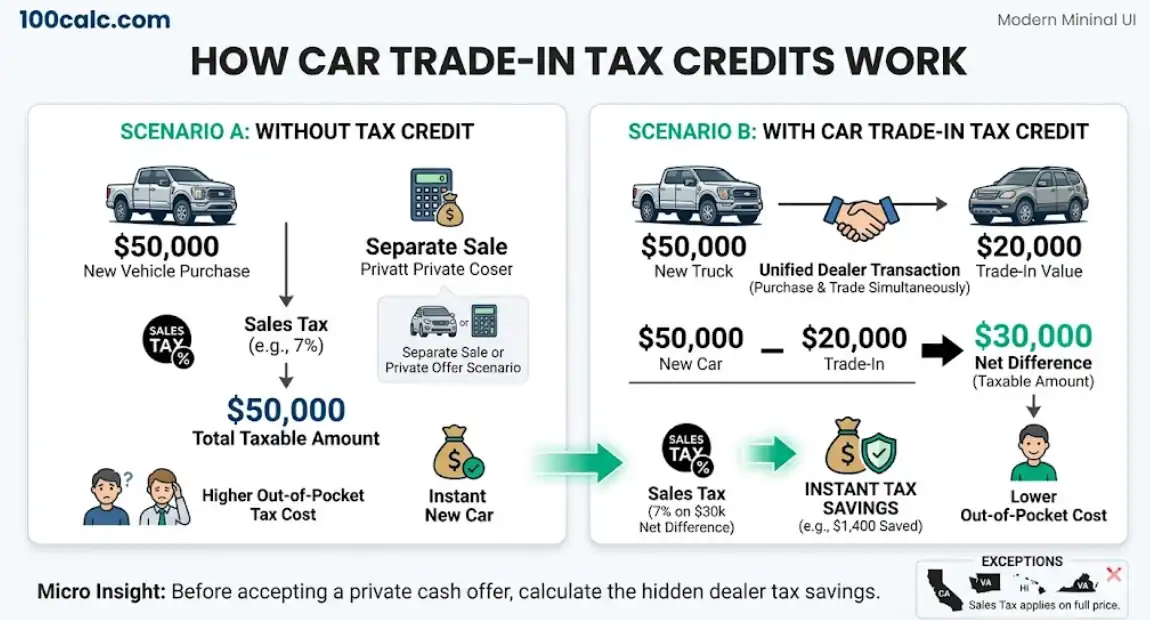
Micro Insight:
Always calculate this hidden discount before accepting a private cash offer. A private buyer might offer more raw money upfront. However, the dealer tax credit usually makes the dealership trade-in far more profitable.
How Do Car Trade In Tax Credits Work?
A car trade-in tax credit reduces your new vehicle sales tax by deducting the trade-in value from the purchase price. Instead of paying tax on the full price, you only pay tax on the net difference. This instantly lowers your out-the-door cost without requiring extra cash.
Think of your old vehicle as a massive discount voucher. Dealerships subtract its value directly from the gross price of your next car. State revenue departments then apply sales tax only to the remaining balance.
Imagine buying a $50,000 truck and trading in a $20,000 SUV. The state ignores the first $20,000. The government only taxes you on the remaining $30,000. At an average 7% tax rate, this rule keeps $1,400 in your pocket.
This benefit requires a unified transaction. Buyers must trade in and purchase at the same dealership simultaneously. A few locations do not offer this deduction. California, Hawaii, and Virginia force buyers to pay tax on the full purchase price regardless of any trade-in.
Do You Save Taxes When You Trade In A Car By Region?
Local tax codes dictate whether your vehicle trade generates a financial discount. Most North American regions subtract the old vehicle value directly from your taxable total. Certain states and international areas apply full sales tax regardless of the transaction. Review local rules below before calculating.
| Region / Area | Credit Status | Calculation Method | Financial Impact | Key Takeaway |
|---|---|---|---|---|
| Most US States | Allowed | Tax applied to the price difference. | Maximizes your overall savings. | Highly profitable to trade in. |
| CA, MI, VA, HI, DC | Not Allowed | Tax applied to full new vehicle price. | Trade acts only as a cash down payment. | Zero tax advantage for buyers. |
| Canada (ON / BC) | Allowed | Tax applied to difference (HST/PST). | Massive savings due to high tax rates. | Always compare against private sales. |
Heads-up: State tax codes update frequently. Always verify current revenue rules with your local DMV or dealership before signing paperwork.
How to Use the Car Trade-In Tax Savings Calculator
This car trade-in tax savings calculator compares trading a vehicle at a dealership versus selling it privately. It checks how much invisible tax credit your trade-in generates. The system then shows which method offers the lower out-the-door cost. The result appears instantly with a clear negotiation target and financial breakdown.
Enter the new vehicle price and your local sales tax rate
Add the gross purchase price of the new car and your local tax percentage. These values establish your maximum possible tax bill. The calculator stores these numbers to measure exactly how much the trade-in reduces your taxable amount.
Input the dealer's trade-in offer and your estimated private sale value
Now input the cash offer from the dealer and your private market estimate. Both values must use the same currency. The system checks these figures against your tax rate to calculate your effective trade-in value.
Add any amount you still owe on your current car
Enter your exact loan payoff balance. The calculator uses this to isolate your net trade equity. If you owe more than the car is worth, the system flags the negative equity to show how it inflates your new loan.
Include any extra cash down payment and your expected loan terms
Add your physical cash down payment, expected interest rate, and loan length. The system combines these financing details with your tax savings. This creates your final out-the-door auto loan amortization.
Review your total tax savings, Walk-Away Target, and monthly payment
The final result shows which selling method you should choose. One side usually wins based on the tax advantage. This split helps you negotiate efficiently and maximize your total cash return.
How do you calculate tax savings and the walk-away target?
Read the dealer offer and the private sale estimate. To find the exact tax advantage, multiply the trade-in value by your local tax rate. Then compare both selling methods. This is one of the biggest sticking points in current dealership negotiations and forum questions.
This classic car buying scenario compares two different selling routes. Buyers often struggle to calculate invisible tax credits correctly.
Use these inputs in the calculator:
- New Vehicle Purchase Price: $40,000
- Local Sales Tax Rate: 7.0%
- Dealer’s Trade-In Offer: $12,000
- Estimated Private Sale Value: $13,500
- Amount Owed on Trade-In: $0
Process:
- The formula multiplies the dealer offer by the tax rate to find the savings, then divides the private sale by the tax factor to build the target.
- Tax Savings: $12,000 * 0.07 = $840 Walk-Away Target: $13,500 / 1.07 = $12,616
Final Result:
Private Sale Wins Financially.
Meaning:
The dealer’s $12,000 offer generates $840 in tax savings, creating an effective value of $12,840. This falls short of your $13,500 private sale estimate. The dealer must offer at least $12,617 to earn your trade.
Accuracy Behind the Dealership Negotiation System
Dealership finance offices use specific formulas to calculate out-the-door pricing and negative equity rollovers. This calculator replicates that exact showroom math. It protects you from hidden dealer markups while revealing the true buying power of your trade-in before you sign any paperwork.
Key Features & Benefits
- Uncovers hidden tax savings to maximize your negotiation leverage instantly.
- Generates a strict walk-away target to confidently compare dealer versus private offers.
- Isolates negative equity penalties to show how underwater loans inflate monthly payments.
- Calculates true out-the-door auto loan amortization using standard banking formulas.
- Supports multiple global currencies for seamless cross-border vehicle finance tracking.
Technical Process
Tax Deduction Logic
Subtracts the trade-in value from the gross price to determine the exact taxable remainder.
Target Generation
Reverses the tax math against the private sale estimate to build the break-even dealer offer.
Loan Amortization
Applies the interest rate and term length against the final financed total to output monthly payments.
How the Auto Trade-In Tax Deduction Tool Calculates Formulas (Complete Breakdown)
A car trade-in tax credit reduces your new vehicle’s sales tax by deducting the trade-in value from the purchase price. Instead of taxing the full MSRP, the state only taxes the net difference, immediately lowering your out-the-door auto loan cost.
The Core Negotiation Formulas
The formulas calculate your hidden tax discount and your strict break-even negotiation target.
Formula:
					Tax Savings = Dealer Offer × (Tax Rate / 100)

Walk-Away Target = Private Sale Value / (1 + (Tax Rate / 100))
What the Formula Does
These two equations measure your true buying power in the showroom. The first multiplies your trade amount by the local tax percentage. This finds your exact cash discount. The second divides your private market estimate by the tax factor. It builds a strict break-even price to guide your negotiations.
Decoding the Dealership Variables
Each variable connects directly to your calculator inputs to measure real financial trade-offs.
Dealer Offer
This is the raw cash amount the dealership agrees to pay for your vehicle. The system uses this exact number as your baseline deduction. It directly lowers the final purchase price of your new car.
Private Sale Value
This represents the realistic cash a private buyer would pay on the open market. The calculator evaluates this higher estimate to build your comparative benchmark. It helps you expose lowball dealer offers instantly.
Tax Rate
Your local or state sales tax percentage applies to auto purchases. A higher tax rate automatically generates a larger hidden discount. This makes trading your car at a dealership much more attractive in high-tax regions.
Walk-Away Target
This is the absolute minimum dealer offer required to match private market profits. It factors the invisible tax credit into the final math. This target gives you massive leverage when finance managers try to negotiate.
Another Example Calculation (Step-by-Step)
Let us test a scenario with a high tax rate to see how aggressive tax brackets shift negotiation power. The calculation follows the exact steps used by dealership finance software.
Given:
- Total Dealer Offer = $18,000
- Private Sale Value = $21,000
- Local Tax Rate = 9%
Calculation:
					Tax Savings = 18,000 × 0.09 = 1,620
Walk-Away Target = 21,000 / 1.09 = 19,266
Result:
- Current Tax Savings: $1,620
- Target Dealer Offer: $19,266
Meaning:
A private buyer offers $3,000 more in raw cash. The massive 9 percent tax credit covers more than half of that gap. The dealership must offer at least $19,266 to match the private sale. You should demand a better offer or sell the vehicle yourself.
How do you calculate car trade-in tax savings?
Multiply the dealership cash offer by your local sales tax percentage to find your exact hidden discount. Next, divide your private market estimate by the tax factor to build your break-even target. This math reveals which selling method actually keeps more money in your bank account.
How does trade-in tax work when upgrading to a luxury SUV?
A family wants to trade their old sedan for a larger vehicle in a high-tax state.
Use these inputs in the calculator:
- New Vehicle Price: $60,000
- Tax Rate: 9%
- Dealer Offer: $25,000 P
- rivate Sale Value: $26,500
Process:
- The dealer offer generates a 9 percent discount.
- The system divides the private sale by the 1.09 tax factor.
Result:
- Tax Savings: $2,250
- Walk-Away Target: $24,311
Meaning:
The $25,000 showroom offer easily beats the $24,311 target. Trading the sedan directly to the dealership guarantees the highest financial return.
Do you get tax savings if you have negative equity on a trade-in?
A commuter owes more on their current auto loan than the car is worth.
Use these inputs in the calculator:
- New Vehicle Price: $35,000
- Tax Rate: 7%
- Dealer Offer: $15,000
- Private Sale Value: $16,500
- Amount Owed: $18,000
Process:
- The 7 percent tax credit applies to the vehicle market value.
- The $3,000 underwater balance rolls forward into the new contract.
Result:
- Tax Savings: $1,050
- Walk-Away Target: $15,420
Meaning:
Underwater loans do not erase your tax benefits. You still earn the full $1,050 deduction. Because the dealer offer falls short of the target, selling privately helps minimize the negative equity rollover.
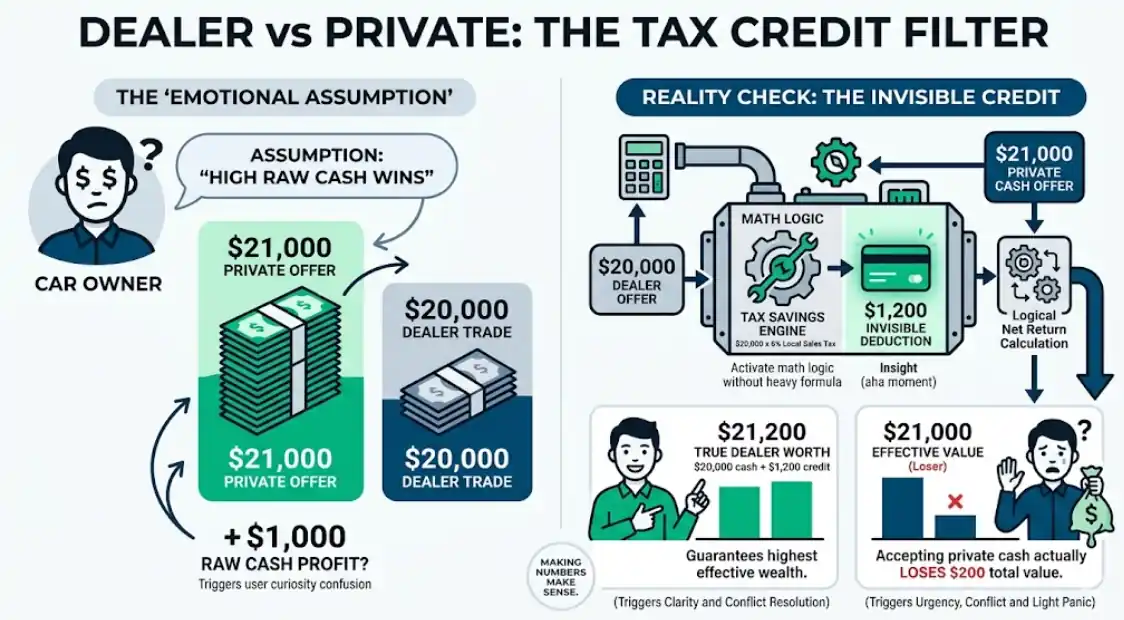
How do you compare a high private cash offer against a dealer trade?
A truck owner receives a strong private cash offer but wants to check the dealership math first.
Use these inputs in the calculator:
- New Vehicle Price: $45,000
- Tax Rate: 6%
- Dealer Offer: $20,000
- Private Sale Value: $21,000
Process:
- The 6 percent rate multiplies against the $20,000 offer.
- The $21,000 estimate divides by the 1.06 tax factor to build the benchmark.
Result:
- Tax Savings: $1,200
- Walk-Away Target: $19,811
Meaning:
The private buyer flashed $1,000 more in raw cash upfront. The invisible dealer credit is worth $1,200. Accepting the dealership deal actually puts an extra $200 in the owner’s pocket.
Quick rule to remember
Always look at the walk-away target rather than the raw cash offer. The side that provides the highest effective return wins the negotiation. Enter your own vehicle numbers below to see exactly which selling route you should choose.
What Your Car Trade-In Tax Savings Result Means
Your calculated result reveals exactly who wins the financial battle. It compares the invisible tax discount against raw private market cash. Use this quick breakdown to evaluate your showroom offer and decide your next negotiation step instantly.
| Result Scenario | Category | Mathematical Meaning | Action Required | Financial Impact |
|---|---|---|---|---|
| Dealer Target Met | Financial Win | Effective value beats private sale. | Accept the trade-in offer immediately. | Secures the best out-the-door price. |
| Dealer Offer Low | Financial Loss | Private market cash remains higher. | Demand the exact walk-away target. | Sell privately if they refuse. |
| Underwater Trade | High Risk | Current loan exceeds total trade value. | Bring extra cash to cover debt. | Rolled equity spikes monthly payments. |
Heads-up: Tax regulations vary widely by state and province. Always verify your local vehicle tax rate before negotiating.
Interpretation of Your Results
Scoring a financial win means the dealership is giving you the maximum cash return. The invisible tax credit pushes their lower physical offer past the private market baseline. A financial loss simply means the dealer is trying to keep your tax benefit for themselves to pad their profit margin.
Pro Tip
Print or screenshot your walk-away target before entering the finance office. Showing this exact math proves you understand local tax codes and forces the dealer to offer a fair baseline without relying on confusing paperwork tricks.
What to Do After Using the Car Trade-In Tax Calculator
Your result is only useful if it helps you make a better financial decision. Use this calculator to expose dealership math, maximize your total return, and avoid common showroom traps. Here is exactly what you should do next based on your specific financial output.
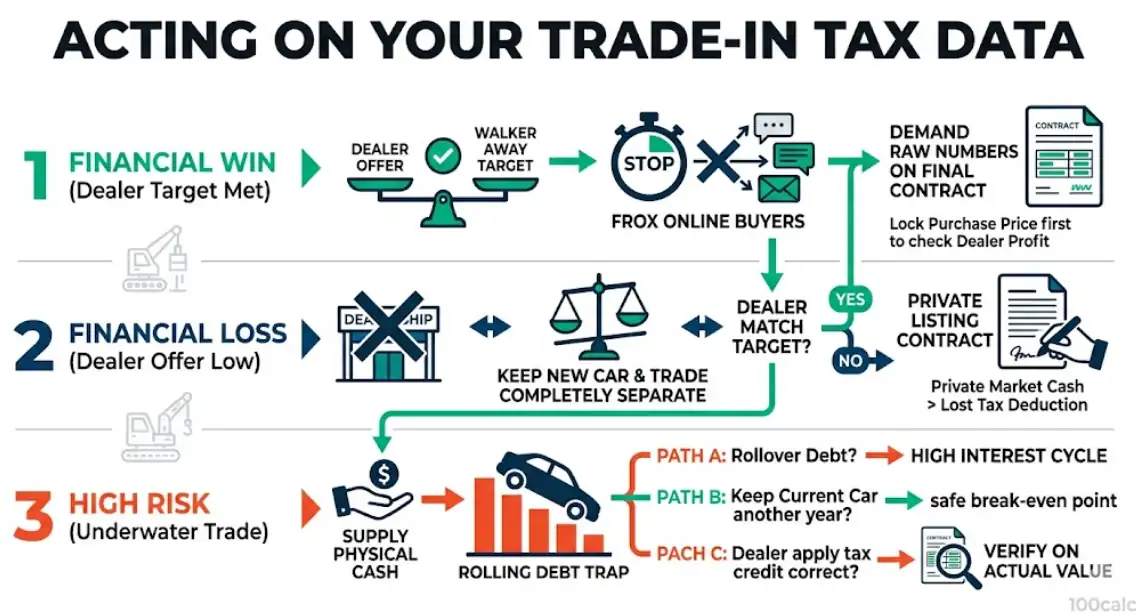
For a Financial Win (Dealer Target Met)
Lock in the purchase price of the new vehicle before officially accepting the trade-in offer. This simple step prevents the finance manager from shifting numbers to hide their profit margin.
Stop answering messages from online buyers immediately. The math proves the dealership gives you the highest total return with zero extra effort.
Demand to see the raw numbers clearly written on the final contract. Ensure the paperwork shows the actual cash value of your vehicle rather than an inflated figure that deceptively includes your state tax benefits.
For a Financial Loss (Dealer Offer Low)
Show the dealership your exact walk-away target. Tell them they must hit this specific cash number to earn your business.
Keep the new car purchase and your vehicle trade completely separate during the discussion. Never let the dealer blend both values into one confusing monthly payment.
List the car yourself if the showroom refuses to match your benchmark. The extra private market cash will easily outweigh the lost tax deductions.
For High Risk (Underwater Trades)
Bring extra physical cash to the dealership to cover your negative equity. Rolling underwater debt into a brand new loan traps you in a cycle of high interest.
Consider keeping your current vehicle for another year to aggressively pay down the principal balance. Holding the car longer helps you reach a safe break-even point as depreciation slows down.
Verify that the dealer applies your tax credit correctly. You still receive the state tax discount on the actual market value of your vehicle even when you owe the bank more than it is worth.
You Might Also Find These Helpful
Real Estate 3
No tools published here yet.
Related Tools People Use Next
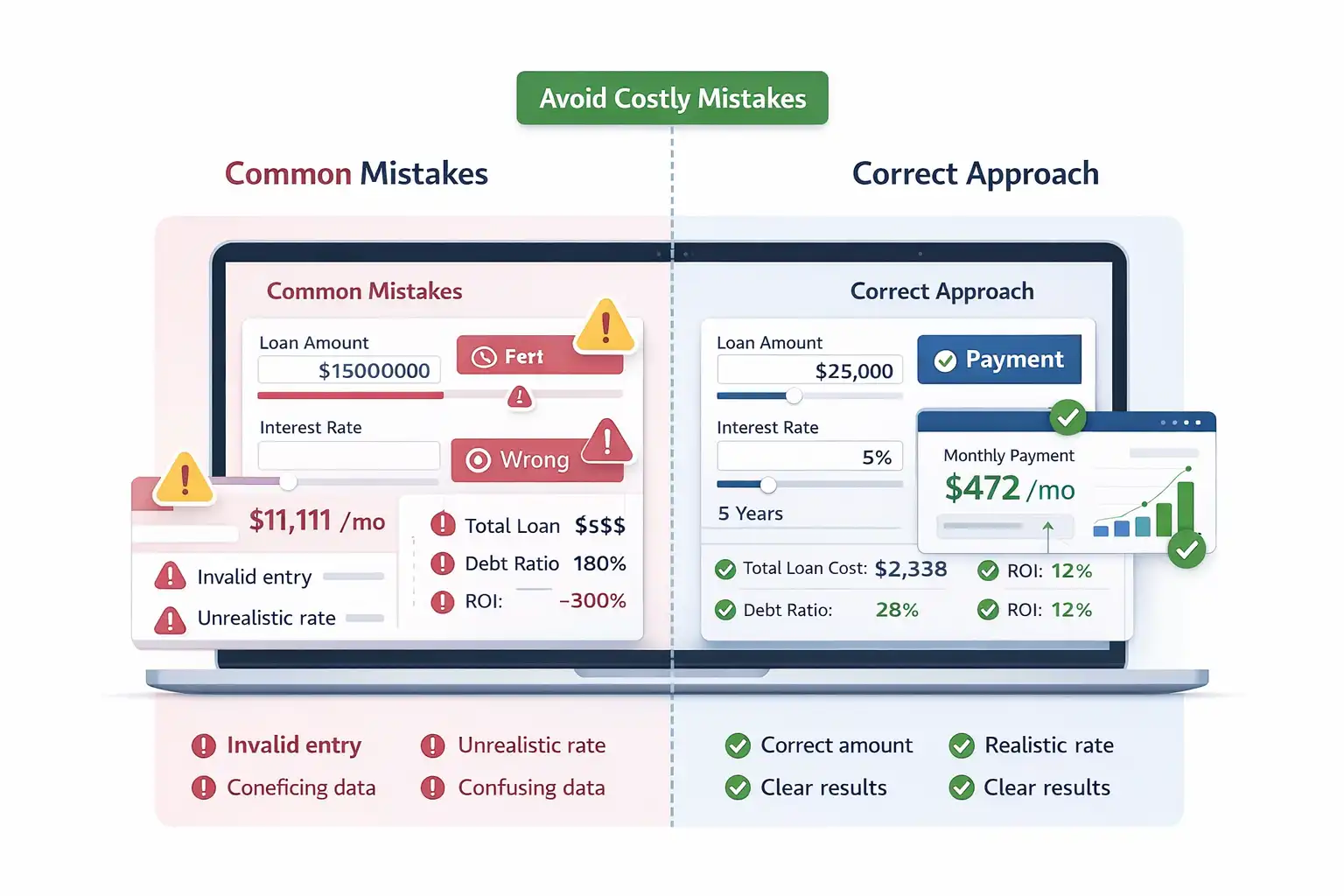
Common Mistakes When Calculating Car Trade-In Tax Savings
Many buyers lose money by misunderstanding dealership finance math and local revenue rules. Entering incorrect vehicle figures or ignoring regional tax restrictions will ruin your out-the-door price estimate. Review these frequent errors to ensure your showroom negotiation strategy remains perfectly accurate.
- Confusing your current loan payoff balance with the actual market value of the trade-in vehicle.
- Forgetting to negotiate the new car purchase price completely separate from the dealer trade offer.
- Assuming you receive a state tax deduction in non-participating locations like California or Michigan.
- Ignoring your calculated walk-away target and blindly accepting a lowball showroom cash offer.
- Rolling massive negative equity into extended eighty-four month loans to artificially lower monthly payments.
Frequently Asked Questions (FAQs)
Do I get a tax credit if my trade-in is worth more than the new car?
No, you do not receive a tax refund or a carry-forward credit for the difference. If your trade-in is worth $30,000 and you buy a $20,000 vehicle, your sales tax drops to zero. However, the state will not write you a check for the remaining tax value.
Trading down simply eliminates your sales tax liability entirely on the current transaction.
Is it a scam if a dealer quotes my trade-in value including tax savings?
It is a deceptive negotiation tactic, not necessarily an illegal scam. A dealer might verbally quote you $20,000 for your trade, but write $18,500 on the invoice, claiming the “tax savings” makes up the difference.
Always demand the raw, before-tax cash value in writing. The tax discount is a state benefit, not dealer cash.
Do you still save on sales tax if you have negative equity?
Yes. Your local tax discount applies strictly to the actual market value of your vehicle, completely ignoring your current loan balance. The dealership subtracts this full market value from the new car price before calculating any final sales tax.
Keep in mind that your underwater debt does not disappear. The finance office simply rolls that unpaid balance into your new loan contract.
Can I sell my car to one dealer and use the tax credit at another?
No. In almost every state, you must trade in your old vehicle and purchase your new vehicle on the exact same invoice to legally qualify for the tax deduction. Selling your old vehicle to a separate lot breaks this required transaction chain.
If you separate the transactions, you will pay full sales tax on the new purchase.
How does a car trade-in tax credit work if I buy out of state?
Dealerships calculate your vehicle tax based on where you legally register the car, not the state where the dealership is located. If your home state offers a trade-in credit, the out-of-state dealer applies your local tax rules to the final paperwork.
You will ultimately pay taxes to your home state’s motor vehicle department. Bring proof of residence to ensure the finance office uses the correct math.
Do I get the sales tax discount if I trade in a leased vehicle?
Generally, you do not receive a tax credit when returning a leased vehicle. You do not own the vehicle equity because the leasing company holds the actual title.
Some states offer specific exceptions if you officially buy out the lease before trading it in. Leasing laws treat ownership and trade-ins very differently than traditional auto loans.
Does the trade-in lower the price of the car or just my loan amount?
A trade-in actively lowers the taxable purchase price of the vehicle, which reduces your tax burden. Your down payment, on the other hand, only reduces your total loan amount.
This difference is why trade-ins carry a unique financial advantage. Cash down payments do not lower your sales tax liability.
Are factory rebates applied before or after my trade-in tax deduction?
Dealerships subtract your trade-in value from the negotiated purchase price first. State laws then dictate whether manufacturer cash rebates reduce the taxable amount further.
Most jurisdictions tax the gross vehicle price before applying any factory incentive cash. Understanding this calculation order prevents showroom surprises and protects your baseline deduction.
How do trade-in tax savings work with Federal EV tax credits?
When buying an electric vehicle, the dealer applies your vehicle trade-in deduction to the vehicle’s MSRP first, lowering your taxable base. Federal EV point-of-sale rebates (like the $4,000 used or $7,500 new credit) are legally treated as a cash down payment. In most states, EV rebates do not reduce your sales tax, making your trade-in the primary way to lower your tax burden.
Do out-of-state car purchases affect my trade-in tax discount?
Dealerships calculate sales tax based on your home DMV registration zip code, not the state where the dealership lot is located. If your home state allows trade-in tax credits, the out-of-state finance office will legally apply your local state rules to your final paperwork.
Does a vehicle trade-in reduce title and registration fees?
No. A vehicle trade-in only reduces your state sales tax burden. Your local DMV registration fees, title transfer costs, and dealership documentation fees are based on the vehicle’s weight, class, or fixed state laws, which remain completely unaffected by your trade-in.
What is the difference between gross trade-in allowance and net trade-in allowance?
The gross trade-in allowance is the total cash offer the dealer gives you for your vehicle before paying off your existing auto loan. State tax savings are always calculated using this gross number. The net trade-in allowance is the actual cash equity left over after the dealer pays your bank.
Does a trade-in tax credit apply to leased vehicles?
Generally, no. Because you do not own the vehicle, trading it in does not generate a sales tax deduction on your next car. However, cash applied to a lease (like a down payment) acts as a capitalized cost reduction, which lowers your monthly lease payments and the monthly use-tax you pay on those payments.
Questions?
We had love to hear from you! Whether you are reporting an issue, suggesting a new calculator, or exploring collaboration opportunities — we are here to help. Every message helps us make 100calc smarter, faster, and more helpful for everyone.
Why People Trust 100calc
At 100calc.com, we focus on accuracy, speed, and trust. Every calculator we create is designed to give reliable, instant, and easy-to-understand results you can truly depend on.