
Corrected Age Calculator for Premature Babies: See the Age Difference
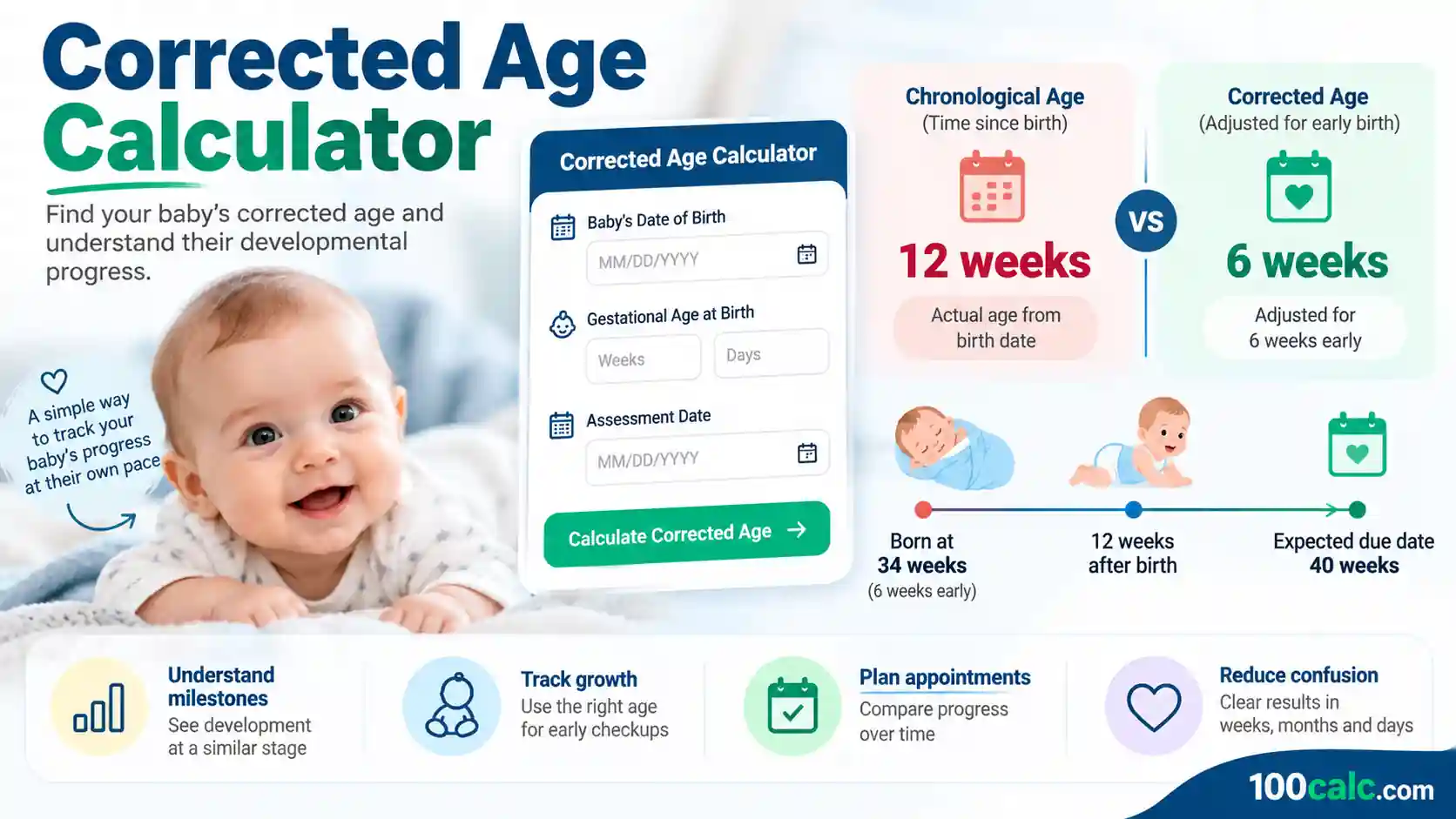
A Corrected Age Calculator estimates your premature baby’s age after accounting for how early they were born. Enter the birth date and gestational age, or use the original expected due date. The calculator shows corrected age, chronological age, postmenstrual age, and an estimated due date.
Your baby may be four months old by birth date but closer to two months old by corrected age. That difference can help you understand early developmental milestones. Calculate your baby’s age for today or another date, then use the result as a guide when discussing development with your pediatrician.
Quick Facts
- Best for: Babies born before 37 completed weeks of pregnancy.
- Three age measures: Corrected age, chronological age, and postmenstrual age.
- Flexible calculation: Enter gestational age, original due date, or weeks and days early.
- Choose any date: Calculate age today or on a past or future date.
- Important: Age estimates provide context. They do not diagnose developmental delays.
- Updated Oct 21, 2026
- Reviewed by 100Calc Research Team
Baby & Preemie Age Tools
Corrected Age Calculator
Calculate your premature baby's corrected (adjusted) age, chronological age, and postmenstrual age (PMA) in weeks and days. Start with the details you know.
—
Baby's timeline
From birth to due date and the date you selected.
Corrected-age milestone dates
Calendar dates when your baby reaches each corrected age. These aren't predictions of developmental skills.
Understand your result
How does a preemie corrected age calculator work?
A corrected age calculator for premature babies accounts for the time between a baby's actual birth and the estimated 40-week due date. It shows adjusted age alongside chronological age and postmenstrual age. The terms preemie age and adjusted age commonly refer to this corrected-age calculation.
What is the difference between corrected age and chronological age?
Chronological age is time since birth. Corrected age subtracts the time born prematurely, measured against a 40-week estimated due date.
How do I calculate corrected age in weeks?
Find the baby's chronological age in days, subtract the days born early relative to 40 weeks, and divide the remainder by 7. The calculator displays completed weeks plus days.
Is a baby born at 37 weeks considered premature?
No. The standard definition of preterm birth is before 37 completed weeks. Being born a little before the estimated due date is not by itself prematurity.
When should I stop using corrected age?
Corrected age is commonly used for developmental milestones during the first two years. Some growth-chart guidance uses correction for up to three years; follow your clinician's purpose-specific guidance.
Is corrected age the same as postmenstrual age?
No. PMA combines gestational age at birth and time since birth. Corrected age measures time after the estimated 40-week due date and may be negative before that date.
Explore More Calculators
Micro Insight
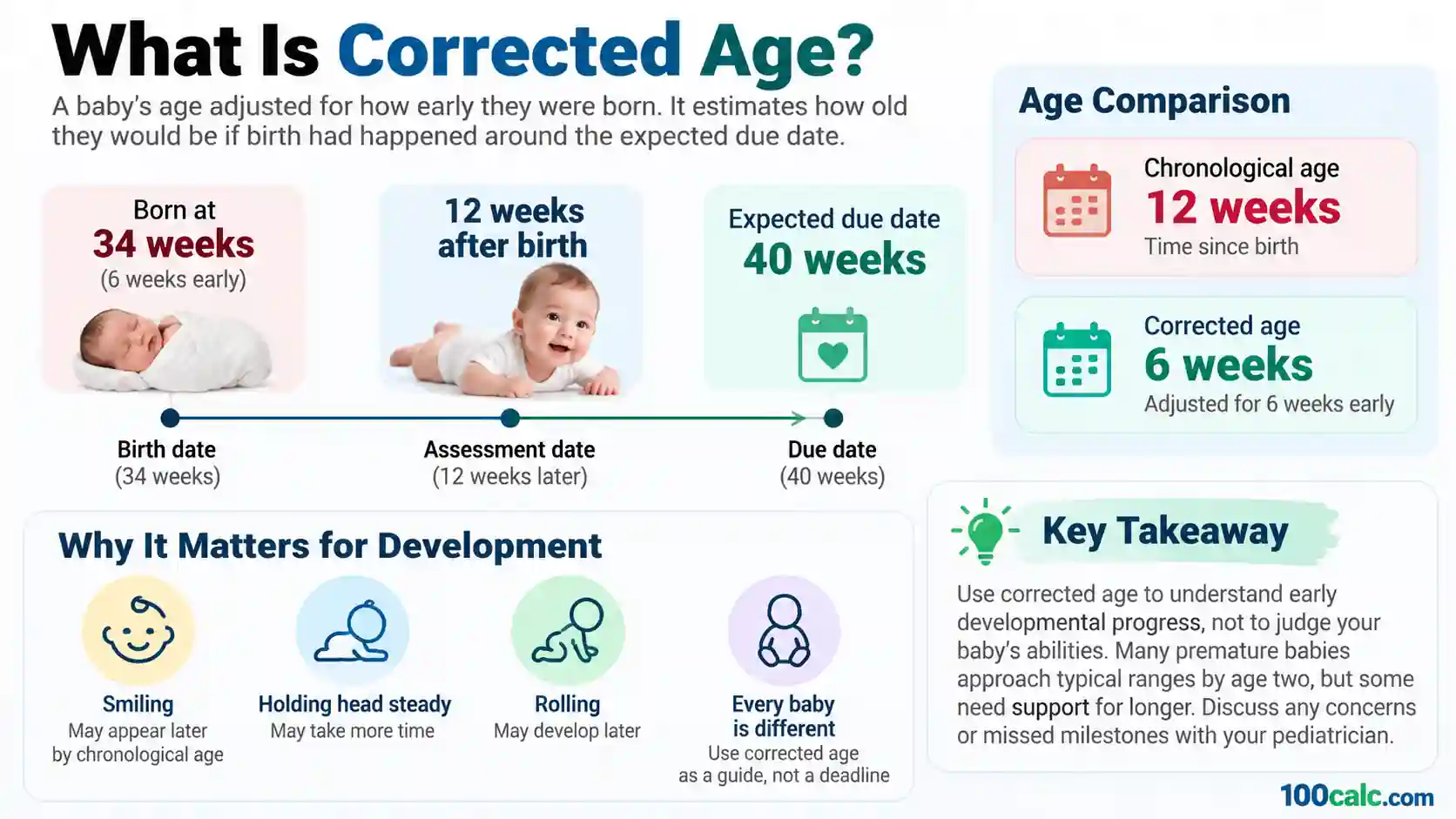
Use corrected age to understand early developmental progress, not to judge your baby’s abilities. Many premature babies approach typical developmental ranges by age two, but some need support for longer. Discuss concerns or missed milestones with your pediatrician.
What Is Corrected Age?
Corrected age is a premature baby’s age adjusted for how early they were born. It estimates how old a baby would be if birth had happened around the expected due date. Doctors often use corrected age to assess early growth and developmental milestones, especially during the first two years.
A baby born at 34 weeks arrives about six weeks before the 40-week due date. At 12 weeks after birth, that baby has a chronological age of 12 weeks but a corrected age of about six weeks.
This difference helps parents compare development with babies at a similar stage. Skills such as smiling, holding the head steady, and rolling may appear later by chronological age. Every baby develops differently, so corrected age is a guide, not a deadline.
What Does Your Baby's Corrected Age Mean?
Your corrected age shows your baby’s age after accounting for premature birth. It gives a different view from chronological age, which counts time since birth. For babies born early, corrected age can help put early developmental milestones into context.
Understanding Your Result
- Corrected age: This is your baby’s age measured from the estimated due date. It is often the more useful age for comparing early developmental milestones in premature babies.
- Chronological age: This is the time since your baby was born. It remains important for medical records, routine care, and age-based decisions.
- Postmenstrual age (PMA): This combines gestational age at birth with the time since birth. It helps describe a premature baby’s overall stage of development, including before the due date.
- Estimated due date: This is the date your pregnancy would have reached 40 weeks under the calculator’s method. It becomes the reference date for corrected age when your baby was born preterm.
- Milestone dates: These are estimated calendar dates for corrected-age milestones. They help you plan when to observe skills, but they are not deadlines for development.
Is Your Result Good or Bad?
A corrected age is not a score. A smaller corrected age does not mean something is wrong, and a larger one does not prove that development is normal.
Babies born before 37 completed weeks may reach milestones at different times. Pediatricians often consider corrected age during the first two years. Many babies develop skills between their corrected and chronological ages.
If your baby has not reached a milestone, consider their corrected age and overall progress. Contact your pediatrician if you have concerns, especially if your baby loses a skill they previously had.
What You Should Do Next
- Compare milestones by corrected age. Use age-appropriate guidance to observe your baby’s social, movement, and communication skills.
- Keep both ages available. Share the birth date, gestational age, and corrected age during medical visits.
- Follow routine care guidance. Do not change vaccination schedules or treatment plans based on corrected age alone.
- Discuss concerns early. Ask your pediatrician about developmental screening or an evaluation if progress worries you.
Example Interpretation: Test a Corrected Age Result
Suppose your baby was born on January 15, 2026, at 34 weeks of pregnancy. Select April 15, 2026, as the assessment date.
- Chronological age: 12 weeks and 6 days.
- Corrected age: 6 weeks and 6 days.
- Postmenstrual age: 46 weeks and 6 days.
- Estimated due date: February 26, 2026.
What this means: Your baby is almost three months old by birth date but under seven weeks old by corrected age. The corrected age can offer a more suitable reference for early milestones.
This result is not a developmental assessment. Use it as context when tracking progress and discussing concerns with your pediatrician.
How to Use the Corrected Age Calculator
The Corrected Age Calculator uses your baby’s birth details to estimate age measures for a selected date. Choose the method that matches the information in your baby’s medical records. The calculator then builds an age timeline using the reported gestational age or estimated due date.
Enter Your Baby's Birth Date
Select your baby's actual date of birth. This date anchors the chronological age and the rest of the timeline. Check the date against your medical records, since an incorrect birth date can affect every result.
Choose the Calculation Method
Select the method that matches the information you have. Use gestational age if you know the completed weeks and days at birth. Choose the original due date if you have the estimated delivery date from your pregnancy records. The calculator also supports entering how many weeks and days early your baby arrived.
Select the Assessment Date
The date defaults to today, but you can choose another valid date. Use a past date to review your baby's age at an earlier appointment, or a future date to plan ahead. The selected date must be on or after the birth date.
Add the Birth Information
Enter the gestational weeks and extra days, the original due date, or the time before the due date. The calculator uses this information to estimate gestational age at birth and the 40-week reference date. Gestational-age entries must fall within the tool's supported range.
Review the Results
Compare corrected age with chronological age and postmenstrual age. The calculator also displays the estimated due date, any prematurity adjustment, and milestone dates. If the selected date falls before the estimated due date, it shows the time remaining instead of a positive corrected age.
Quick Example to Test
Try this example in the calculator:
- Baby’s date of birth: January 1, 2026
- Gestational age at birth: 32 weeks, 0 days
- Calculate age on: April 23, 2026
- Expected result: Your baby’s chronological age is 16 weeks, but their corrected age is 8 weeks (about 2 months). The calculator also shows a postmenstrual age (PMA) of 48 weeks.
Your baby was born 8 weeks before the estimated 40-week due date. Subtracting those 8 weeks from their chronological age gives their corrected age.
How the Corrected Age Calculator System Works
The Corrected Age Calculator uses calendar dates and gestational-age rules to estimate your baby’s age. Its results follow the programmed 40-week reference and 37-week correction threshold. Accuracy depends on the information entered and the method used. The results support age tracking, but they cannot assess development or replace medical advice.
Key Features & Benefits
- Displays corrected age in calendar years, months, days, weeks, and remaining days.
- Compares chronological age with corrected age and postmenstrual age.
- Supports gestational age, original due date, or weeks and days early.
- Estimates the due date and displays a timeline with milestone dates.
- Lets users select an assessment date and copy or reset their results.
Technical Process
Input Capture
The system checks the birth date, assessment date, and selected method. It rejects invalid dates and gestational-age values outside its supported range.
Age Processing
The calculation uses a 280-day pregnancy reference and applies correction below 37 completed weeks. Births at 37 weeks or later receive no correction under this calculator's rules.
Result Generation
The system displays age measures, the estimated due date, and milestone dates. Calculations run in the browser under the supplied implementation, rather than requiring a server calculation.
How the Corrected Age Calculator Formula Works (Complete Breakdown)
The Corrected Age Calculator formula estimates a premature baby’s age using birth date, gestational age, and the selected assessment date. It compares chronological age with the time since the estimated due date. The calculator also finds postmenstrual age and displays age in weeks, days, and calendar units.
Formula:
					Corrected Age = Chronological Age - Days of Prematurity

Gestational Age in Days = (7 x Gestational Weeks) + Extra Days

Estimated Due Date = Birth Date + (280 - Gestational Age in Days)

Chronological Age = Days Between Birth Date and Assessment Date

Postmenstrual Age = Gestational Age in Days + Chronological Age
How the Formula Works
The first line subtracts the days your baby arrived early from their chronological age. This adjustment applies only when birth occurred before 37 completed weeks. If the assessment date falls before the estimated due date, the calculator displays the time remaining instead of a negative corrected age.
The second and third lines estimate gestational age in days and use a 280-day pregnancy reference to calculate the due date. If you enter the original due date, the calculator works backward to estimate gestational age.
The final lines calculate chronological age and postmenstrual age. Chronological age counts time since birth. Postmenstrual age combines gestational age at birth with the time elapsed since birth.
Understanding the Formula Variables
Chronological Age
This is the time between your baby’s actual birth date and the selected assessment date. It counts every day since birth without adjusting for prematurity. The calculator displays this age in weeks and days, as well as calendar units.
Days of Prematurity
This is the time between your baby’s birth date and estimated due date. The calculator subtracts these days from chronological age for babies born before 37 completed weeks. Babies born at 37 weeks or later receive no correction under the calculator’s rules.
Gestational Age
Gestational age describes how far the pregnancy had progressed when your baby was born. The calculator converts completed weeks and extra days into total days. For example, 34 weeks and 5 days equals 243 days.
Estimated Due Date
This is the calculated date when the pregnancy would reach 40 weeks. The calculator uses the birth date and gestational age to estimate it. You can also enter the original due date from your pregnancy records.
Another Example Calculation (Step-by-Step)
Let’s run a new grade through the formula to see the math in action.
Given:
- Birth Date: March 10, 2026
- Gestational Age at Birth: 32 weeks and 4 days
- Assessment Date: July 10, 2026
Calculation:
					Gestational Age = (32 x 7) + 4 = 228 days

Estimated Due Date = March 10, 2026 + (280 - 228) days
Estimated Due Date = May 1, 2026

Chronological Age = 122 days

Days of Prematurity = 52 days

Corrected Age = 122 - 52 = 70 days

Postmenstrual Age = 228 + 122 = 350 days
Result:
- Chronological Age: 17 weeks and 3 days
- Corrected Age: 10 weeks
- Postmenstrual Age: 50 weeks
- Estimated Due Date: May 1, 2026
Meaning:
Your baby is four months old by birth date, but their corrected age is about ten weeks. The difference reflects the time between birth and the estimated due date. Corrected age can help put early developmental milestones into context. It does not diagnose development or replace advice from your pediatrician.
How do you calculate corrected age?
To calculate corrected age, subtract the days a premature baby arrived early from their chronological age. First, estimate the due date using gestational age or pregnancy records. This calculator uses a 280-day pregnancy reference and applies correction only when birth occurred before 37 completed weeks.
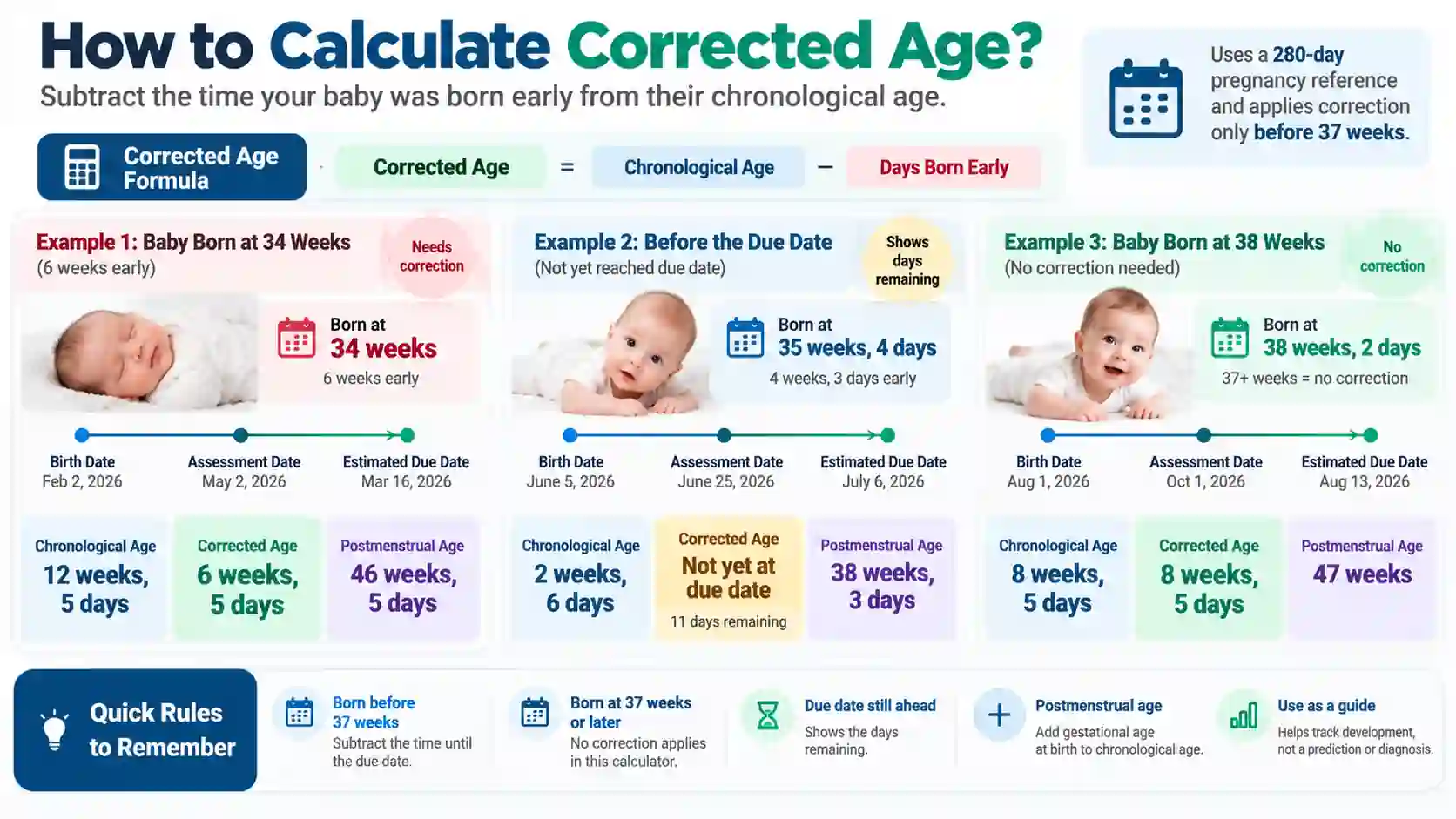
What is the corrected age of a baby born at 34 weeks?
A baby born at 34 weeks needs an adjustment for six weeks of early birth under this example.
Input:
- Birth Date: February 2, 2026
- Gestational Age at Birth: 34 weeks, 0 days
- Assessment Date: May 2, 2026
Process:
- Gestational Age = (34 x 7) + 0 = 238 days
- Days Before Due Date = 280 – 238 = 42 days
- Estimated Due Date = February 2 + 42 days
- Estimated Due Date = March 16, 2026
- Chronological Age = 89 days
- Corrected Age = 89 – 42 = 47 days
- Postmenstrual Age = 238 + 89 = 327 days
Result:
- Chronological Age: 12 weeks, 5 days
- Corrected Age: 6 weeks, 5 days
- Postmenstrual Age: 46 weeks, 5 days
- Calendar Corrected Age: 1 month, 16 days
- Estimated Due Date: March 16, 2026
Meaning:
Your baby is three months old by birth date but about six and a half weeks old by corrected age. This difference helps put early developmental milestones into context.
What is a baby's corrected age before the due date?
A baby born early may not have reached their estimated due date yet. In that case, the calculator shows the time remaining rather than a positive corrected age.
Input:
- Birth Date: June 5, 2026
- Weeks and Days Early: 4 weeks, 3 days
- Assessment Date: June 25, 2026
Process:
- Days Early = (4 x 7) + 3 = 31 days
- Estimated Due Date = June 5 + 31 days
- Estimated Due Date = July 6, 2026
- Gestational Age = 280 – 31 = 249 days
- Gestational Age = 35 weeks, 4 days
- Chronological Age = 20 days
- Assessment Date is before the estimated due date.
- Time Until Due Date = 11 days
- Postmenstrual Age = 249 + 20 = 269 days
Result:
- Chronological Age: 2 weeks, 6 days
- Corrected Age: Not yet at due date
- Postmenstrual Age: 38 weeks, 3 days
- Time Until Due Date: 11 days
- Estimated Due Date: July 6, 2026
Meaning:
Your baby has been born, but the estimated due date is still ahead. The calculator displays a countdown instead of a negative corrected age.
Does a baby born at 38 weeks need corrected age?
Under this calculator’s rules, a baby born at 37 completed weeks or later receives no prematurity correction. Corrected age and chronological age will match.
Input:
- Birth Date: August 1, 2026
- Gestational Age at Birth: 38 weeks, 2 days
- Assessment Date: October 1, 2026
Process:
- Gestational Age = (38 x 7) + 2 = 268 days
- Estimated Due Date = August 1 + (280 – 268) days
- Estimated Due Date = August 13, 2026
- Chronological Age = 61 days
- Gestational Age is at least 259 days.
- Days of Prematurity = 0
- Corrected Age = 61 – 0 = 61 days
- Postmenstrual Age = 268 + 61 = 329 days
Result:
- Chronological Age: 8 weeks, 5 days
- Corrected Age: 8 weeks, 5 days
- Postmenstrual Age: 47 weeks
- Estimated Due Date: August 13, 2026
- Prematurity Correction: None
Meaning:
The calculator uses the same age for chronological and corrected age in this case. This reflects its programmed 37-week threshold, not a full clinical assessment of your baby.
Quick Rules to Remember
- Born before 37 weeks: The calculator subtracts the time between birth and the estimated due date.
- Born at 37 weeks or later: No correction applies under this calculator’s rules.
- Due date still ahead: The result shows the days remaining until the due date.
- Postmenstrual age: Add gestational age at birth to chronological age.
- Developmental milestones: Use corrected age as a guide, not a prediction or diagnosis.
Enter your baby’s details in the Corrected Age Calculator to get results for your own dates. If you have concerns about growth or development, discuss them with your pediatrician.
How to Interpret Corrected Age Calculator Results
The Corrected Age Calculator uses gestational age at birth to determine whether a prematurity adjustment applies. These ranges explain how the calculator classifies birth timing and handles corrected age. They do not measure development or show whether your baby is meeting milestones.
| Range | Category | Gestational-Age Meaning | Calculator Treatment | Notes |
|---|---|---|---|---|
| Below 28 weeks | Extremely preterm | Birth occurred well before the estimated due date. | Applies a prematurity adjustment based on the estimated due date. | Discuss development and follow-up care with your baby's pediatrician. |
| 28 weeks to 31 weeks, 6 days | Very preterm | Birth occurred substantially before the estimated due date. | Subtracts the early interval from chronological age. | Use corrected age as one guide when discussing developmental progress. |
| 32 weeks to 36 weeks, 6 days | Moderate to late preterm | Birth occurred before 37 completed weeks of pregnancy. | Applies a prematurity adjustment under the calculator's rules. | Compare progress using corrected age when appropriate, and raise concerns with your pediatrician. |
| 37 weeks or later | No correction | The calculator does not classify the birth as preterm for its correction method. | Uses chronological age without a prematurity adjustment. | Corrected age and chronological age are the same in this calculator. |
Important: These categories describe gestational age at birth, not your baby's development. The calculator applies its own 37-week correction threshold. It cannot diagnose developmental delays or replace advice from your pediatrician.
Interpretation
These ranges explain how the calculator handles prematurity, not whether a baby’s development is good or bad. A corrected age of zero may mean the estimated due date has arrived. If the due date is still ahead, the calculator displays a countdown instead of a negative corrected age.
Pro Tip
Keep your baby’s chronological age and corrected age available for appointments. If you notice a missed milestone, loss of a previously learned skill, or another concern, contact your pediatrician rather than relying on the age category alone.
What to Do After Calculating Your Baby's Corrected Age
Your Corrected Age Calculator result can help you plan milestone tracking and prepare for pediatric visits. Your next steps depend partly on how early your baby was born and what you want to understand. Use these recommendations to organize follow-up care, avoid common age-related confusion, and know when to ask for professional guidance.
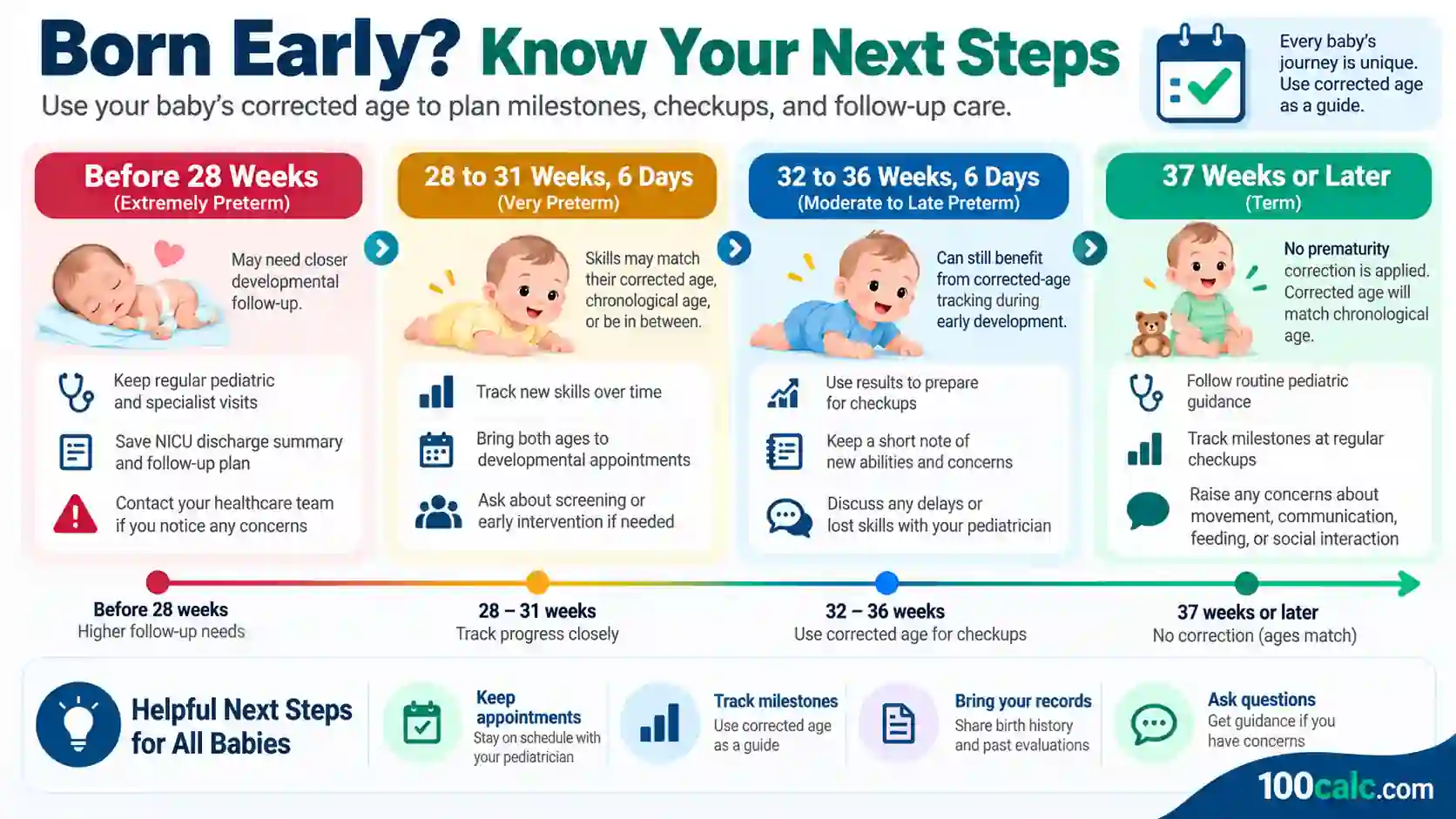
For Babies Born Before 28 Weeks
Extremely preterm babies may need closer developmental follow-up. Keep appointments with your pediatrician and any specialists involved in your baby’s care. Ask which milestones and growth measures matter most at each visit.
Save your baby’s NICU discharge summary and follow-up plan. If you notice a lost skill, feeding concern, or change in movement, contact your healthcare team promptly. Do not wait for the corrected age to reach a particular milestone.
For Babies Born at 28 to 31 Weeks, 6 Days
Very preterm babies may show skills that fit their corrected age, chronological age, or somewhere in between. Track new skills over time instead of comparing your baby with other children of the same birth age.
Bring both ages to developmental appointments. Ask whether your baby’s progress fits their individual history and whether a developmental screening or early intervention evaluation would help. Seek guidance if concerns persist, even when the corrected age seems reassuring.
For Babies Born at 32 to 36 Weeks, 6 Days
Moderate to late preterm babies can still benefit from corrected-age tracking during early development. Use your result to prepare for checkups, not to set strict deadlines for smiling, rolling, sitting, or other skills.
Keep a short note of new abilities and any concerns between appointments. Ask your pediatrician which milestones to watch next. If a skill seems delayed or your baby stops doing something they could do before, discuss it with your healthcare team.
For Babies Born at 37 Weeks or Later
This calculator applies no prematurity correction when gestational age at birth is 37 weeks or later. Its corrected age will match chronological age under these rules.
Use routine pediatric guidance to track development. If you have concerns about movement, communication, feeding, or social interaction, raise them with your child’s doctor. A calculator result cannot confirm that development is on track.
You Might Also Find These Helpful
Pregnancy & Fertility 46
Use this Pregnancy Risk Calculator to check age, BMI, health history, bleeding, and twins. See if closer prenatal monitoring may be worth asking about.
Try calculatorOne Time Pregnancy Calculator estimates pregnancy odds from one encounter, plus fertile window timing, test date, due date, and 21-day testing guidance.
Try calculatorUse the AMH Calculator to convert ng/mL or pmol/L, compare your result with age-based data, and see what it may mean for IVF, fertility,…
Try calculatorUse the Baby Eye Color Calculator with parents, grandparents, or sibling context to compare Brown, Green/Hazel, and Blue/Grey model estimates instantly.
Try calculatorBasal Body Temperature Calculator checks reading conditions and analyzes your temperature pattern for a sustained shift that may be consistent with ovulation.
Try calculatorBPD gestational age calculator: estimate fetal age from BPD, compare your week, check normal BPD ranges, and understand ahead or behind results.
Try calculatorCalculate odds with the Chance of Twins Calculator. Enter maternal age and history. Find your probability instantly. See if you will conceive multiples now.
Try calculatorFind out exactly when you conceived. Our free Conception Calculator uses your Due Date, LMP, or Ultrasound to estimate your fertilization date and fertile…
Try calculatorUse our Conception Date Due Date Calculator to find your baby's arrival date. Enter your conception or intercourse date for clinical 40-week results.
Try calculatorContraceptive effectiveness calculator to compare birth control methods, typical vs perfect use, backup protection, and 5-year pregnancy risk.
Try calculatorUse this CRL calculator to estimate gestational age and due date from crown-rump length in mm or cm. Compare CRL, LMP, and IVF dating…
Try calculatorEstimate your monthly and 12-month pregnancy odds by age, partner age, and cycle dates. See your fertile window and when to seek fertility help.
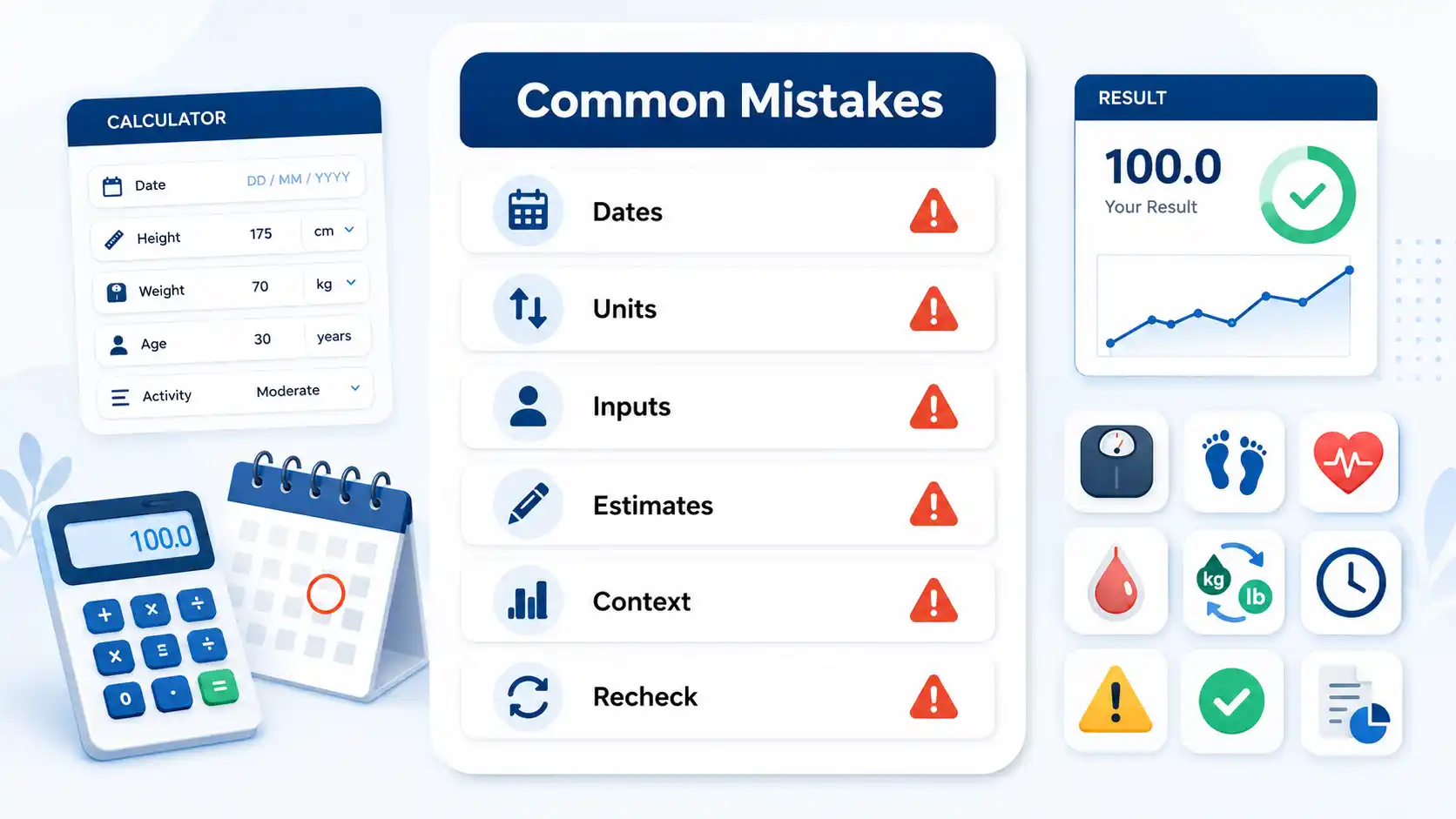
Try calculatorCommon Corrected Age Calculation Mistakes
Small input errors can change a Corrected Age Calculator result. The most common problems involve incorrect dates, rounded gestational age, and confusion between age measures. Check these details before using your result to track milestones or prepare for a pediatric appointment.
- Entering a revised appointment date or hospital discharge date instead of the original estimated due date.
- Rounding gestational age to whole weeks instead of entering the extra days, such as 32 weeks and 4 days.
- Mixing up chronological age, which starts on the actual birth date, with corrected age, which accounts for prematurity.
- Treating a milestone date as a deadline or assuming corrected age predicts exactly when a skill will appear.
- - Using corrected age alone to make medical decisions, including vaccine timing, without checking your pediatrician's guidance.
Frequently Asked Questions (FAQs)
What should I enter if I don't know my baby's gestational age at birth?
Check your birth records, hospital discharge papers, or pregnancy records for the original estimated due date. You can select the due-date method in the Corrected Age Calculator. If you cannot confirm either detail, ask your baby’s healthcare team before relying on the result.
Why does my Corrected Age Calculator show a different result from another calculator?
Different calculators may use different correction rules, date methods, or ways to display age. This calculator uses a 280-day pregnancy reference and applies prematurity correction only when gestational age at birth is below 37 weeks. Compare the input dates and calculation rules before judging the difference.
Why is my baby's corrected age shown in months instead of weeks?
Corrected age can be displayed in calendar months and days or in completed weeks and remaining days. Calendar months have different lengths, so one month does not always equal four weeks. Use the format that best suits your needs, and confirm the age format used by your healthcare provider.
Can I use corrected age to compare my baby's growth with a growth chart?
Corrected age may help healthcare professionals interpret growth in premature babies, but the appropriate chart and age measure depend on your baby’s history and clinical setting. Do not use the calculator alone to judge weight, length, or head growth. Ask your pediatrician which growth chart and age measure to use.
Should my premature baby reach every milestone at their corrected age?
No. Corrected age provides useful context, but it cannot predict the exact timing of each milestone. Some babies develop skills closer to chronological age, while others follow corrected age or fall between the two. Discuss ongoing concerns or loss of a previously learned skill with your pediatrician.
Can I calculate my baby's corrected age for a past or future date?
Yes. You can select an assessment date to estimate corrected age for a past or future day. This can help you review earlier appointments or plan ahead. Future results are estimates based on the dates and gestational-age details you enter.
What if my baby was born on the estimated due date?
If your baby was born on the estimated due date, there is no early-birth interval to subtract. Corrected age and chronological age will match. If the dates differ, use the original estimated due date recorded during pregnancy rather than an appointment or scan date.
Can corrected age be negative?
Corrected age is not shown as a negative value in this calculator. If your baby has not reached the estimated due date, the result displays a message that the due date is still ahead, along with the time remaining. This avoids presenting a negative age as if it were meaningful.
What is the difference between corrected age and adjusted age?
Corrected age and adjusted age usually refer to the same idea: accounting for how early a premature baby was born. Both terms help put early development into context. However, healthcare providers may use different terms or assessment rules, so follow the wording and guidance used by your baby’s care team.
Can I calculate corrected age if my baby was born at 35 weeks?
Yes. Enter your baby’s birth date and gestational age at birth. Under this calculator’s rules, a birth at 35 weeks qualifies for prematurity correction because it occurred before 37 completed weeks. The result estimates corrected age but does not assess whether your baby’s development is typical.
Questions?
We had love to hear from you! Whether you are reporting an issue, suggesting a new calculator, or exploring collaboration opportunities — we are here to help. Every message helps us make 100calc smarter, faster, and more helpful for everyone.
Why People Trust 100calc
At 100calc.com, we focus on accuracy, speed, and trust. Every calculator we create is designed to give reliable, instant, and easy-to-understand results you can truly depend on.