
IUI Success Rate Calculator — Estimate Your Pregnancy Chance
The IUI Success Rate Calculator estimates the chance of a positive serum hCG pregnancy test after partner-sperm IUI. In the source study, 10.9% of 1,437 IUI cycles resulted in pregnancy, but chances varied with female age, infertility diagnosis, pre-wash TPMSC, and AMH.
Enter your age, female infertility profile, and pre-wash TPMSC from the IUI day. You can also enter AMH. If AMH is provided, the calculator uses the study model that includes it; if not, it uses the model without AMH.
Your result shows an estimated per-cycle pregnancy chance and a projection across 1 to 3 cycles. The multi-cycle value assumes the same estimated chance in each cycle, so it is a mathematical projection rather than a guaranteed cumulative outcome or a recommendation about whether to continue IUI or move to IVF.
Quick Facts
- The source study analyzed 1,437 partner-sperm IUI cycles in 758 couples and reported a 10.9% pregnancy rate per cycle.
- The calculator uses female age, infertility diagnosis, pre-wash TPMSC, and optional AMH to estimate pregnancy chance.
- “Pregnancy” in this model means a positive serum hCG test 12–14 days after IUI, not clinical pregnancy, ongoing pregnancy, or live birth.
- The research cohort included women aged 18–45 using partner sperm; donor-sperm IUI and severe male-factor cases were outside the model.
- The 1–3 cycle result is a mathematical projection that assumes the same estimated chance in each cycle; it is not a guaranteed cumulative outcome.
- Updated Sep 16, 2026
- Reviewed by 100Calc Research Team
Research-based pregnancy estimate for partner-sperm IUI
Explore More Calculators
Use the Chinese Gender Calculator for a traditional boy-or-girl prediction from lunar age and conception month. Enter conception date, due date, or LMP.
Try calculatorUse this fetal growth calculator to check baby weight percentile from ultrasound data in grams, kg, or cm and see what the result means…
Try calculatorEnter gestational sac measurements in mm or cm to calculate mean sac diameter, estimate early gestational age, compare week-by-week milestones, and see when follow-up…
Try calculatorMissed a birth control pill? Check pregnancy risk, protection status, backup contraception needs, and what to do next with our missed pill calculator.
Try calculatorUse our Pregnancy Chance Calculator to estimate your odds. Enter your cycle day, age, and method. Find out if you are in the high-risk…
Try calculatorUse our pregnancy due date calculator to find your exact Baby Due date. IVF, conception, ovulation, and ultrasound methods with weeks and timeline.
Try calculator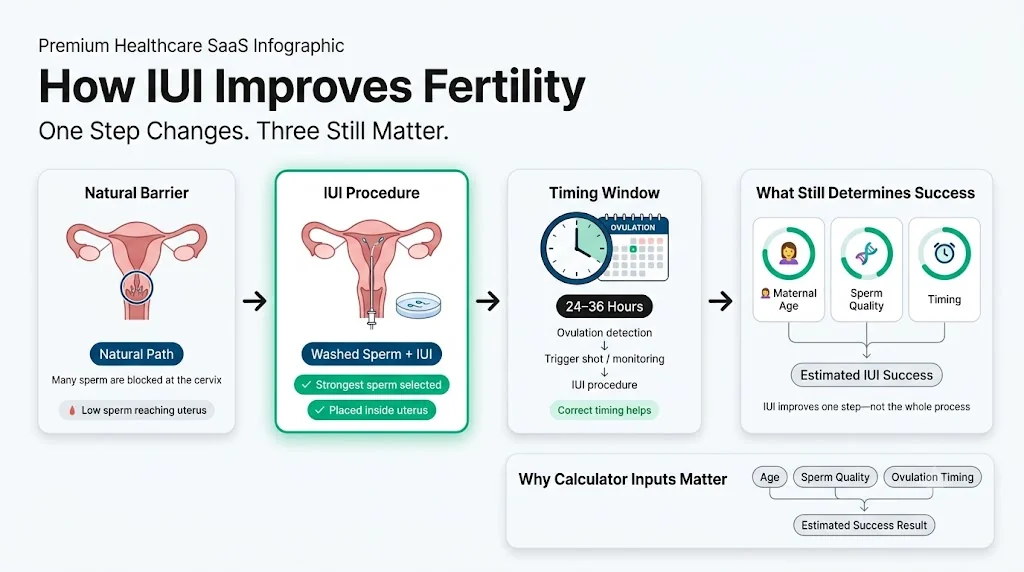
Micro Insight
IUI places prepared sperm directly into the uterus around the time of ovulation, but the procedure still depends on fertilization and implantation occurring afterward.
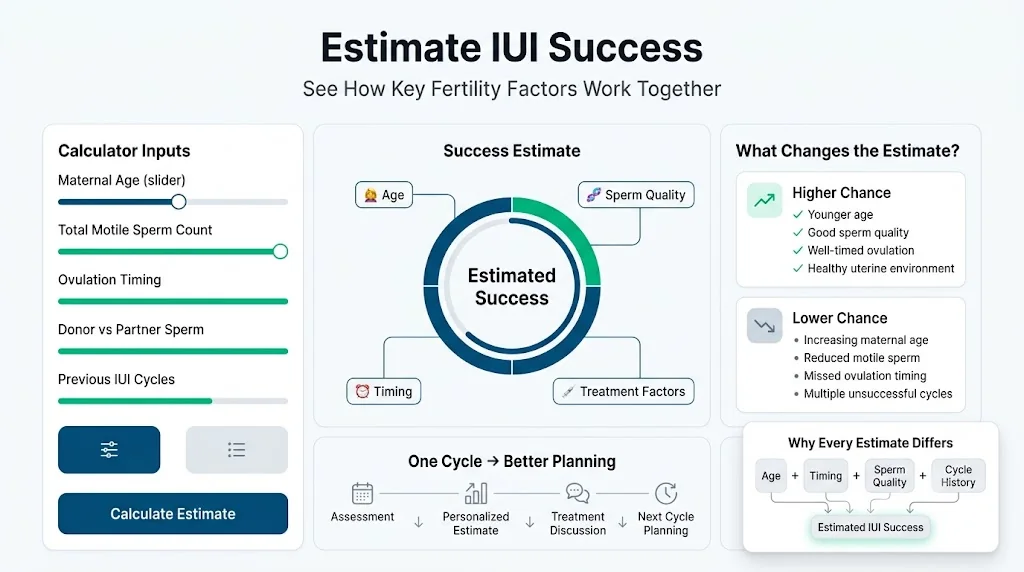
This calculator does not score ovulation timing, trigger-shot use, or generic sperm quality. Its personalized estimate is based on the factors used by the source research model: female age, female infertility profile, pre-wash TPMSC, and optional AMH.
What Is IUI?
IUI stands for intrauterine insemination. It is a fertility procedure in which a prepared sperm sample is placed directly into the uterus around the time of ovulation. Fertilization still needs to occur naturally after sperm and egg meet in the fallopian tube.
Before IUI, the semen sample is prepared in the laboratory. Sperm are separated from seminal fluid and a concentrated sample containing motile sperm is prepared for insemination. This preparation step is different from the sperm value used by this calculator: the research model uses pre-wash total progressive motile sperm count (TPMSC), measured before semen preparation.
The timing of IUI is coordinated with ovulation. Depending on the treatment protocol, a clinic may monitor a natural LH surge or use medications, including an hCG trigger, to help schedule insemination. Timing and trigger-shot use are clinically relevant to IUI care, but neither is used as a multiplier in this calculator’s prediction model.
IUI may be performed with partner sperm or donor sperm in clinical practice. However, the prediction model used by this calculator was developed from partner-sperm IUI cycles and excluded donor-sperm insemination. For that reason, selecting donor sperm does not produce a personalized research-model percentage.
What Your IUI Success Rate Result Means
Your result shows an estimated per-cycle pregnancy chance and, if you select more than one cycle, a cumulative projection. The per-cycle value comes from the research model. The multi-cycle value is a mathematical projection based on the same estimated chance in each cycle. Both refer to a positive serum hCG pregnancy test after IUI, not live birth.
Understanding Your Result
The per-cycle estimate is not a prediction that your exact IUI cycle will succeed. It is the probability produced by the study model after placing your age, female infertility profile, pre-wash TPMSC, and optional AMH into the model’s defined categories.
The cumulative projection applies the same per-cycle estimate across the number of cycles you select. For example, a 10% per-cycle estimate gives a 27.1% three-cycle projection using 1 − (1 − 0.10)³. The calculator does not automatically lower the chance in cycle two or cycle three.
Use both numbers as educational context. They do not capture every factor that may affect an IUI outcome, and they should not be treated as a clinical prognosis or treatment recommendation.
How Should You Interpret Your Estimate?
There is no universal “good,” “moderate,” or “bad” cutoff for this calculator. The source model did not define treatment thresholds such as below 7%, 7% to 12%, or above 12%, so this page should not turn those percentages into clinical labels.
A higher estimate means your entered factors fall into more favorable categories within this research model. A lower estimate means one or more factors represented by the model were associated with lower pregnancy odds in the source cohort. Neither result tells you which fertility treatment you should choose.
The model came from a retrospective, single-center partner-sperm IUI cohort and requires external validation. Your clinic may consider additional medical factors, its own outcome data, and your treatment history when estimating your chances.
What You Should Do Next
First, check that your inputs match the research model. In particular, use the pre-wash total progressive motile sperm count (TPMSC) from the IUI day. Do not substitute a post-wash TMSC value.
Use the estimate as a discussion aid with your fertility clinician. Ask how your age, infertility diagnosis, ovarian reserve, tubal status, semen results, treatment history, and your clinic’s own outcomes affect your treatment plan.
Do not change treatment because the calculator percentage looks high or low. This model does not add automatic benefits for a trigger shot, double IUI, or cycle number, and it does not contain a percentage cutoff for deciding when to move to IVF.
If donor sperm is being used, both tubes are blocked, severe male-factor infertility is present, or your diagnosis does not fit the supported categories, this calculator should not be used to generate a treatment conclusion. Those situations need clinic-specific counseling.
Quick Example to Test
Try this: age 38, no known female cause / unexplained infertility, pre-wash TPMSC of 17 million, AMH of 2.4 ng/mL, and a 3-cycle projection.
The calculator uses the model that includes AMH. Age 38 falls in the 35-or-older model band, while the infertility profile, TPMSC of at least 15 million, and AMH of at least 1 ng/mL remain in the model’s reference categories. The estimated per-cycle pregnancy chance is about 12.5%, and the three-cycle mathematical projection is about 33.0%.
The 33.0% projection is not a promise that one of three IUI cycles will work. It is the mathematical result of applying the same estimated 12.5% chance across three projected cycles.
How to Use the IUI Success Rate Calculator
This calculator uses a published IUI research model to estimate the chance of a positive serum hCG pregnancy test after partner-sperm IUI. Enter the model inputs below, then choose 1 to 3 cycles to see your estimated per-cycle pregnancy chance and a mathematical cumulative projection.
Enter Your Age
Enter your current age from 18 to 45 years. The research model uses two age categories: under 35 and 35 or older. Ages outside 18–45 were not represented in the source cohort, so the calculator will not generate an estimate for them.
Select Your Infertility Profile
Select the female infertility profile that best matches your clinical work-up. The supported options include unexplained infertility or no known female cause, anovulatory disorders, mild endometriosis, unilateral tubal factor, and uterine or anatomical factors represented in the source study.
Enter Your Pre-Wash TPMSC
Enter the pre-wash total progressive motile sperm count (TPMSC) from the IUI day in millions. Use the value measured before semen preparation. Do not substitute a post-wash TMSC value because the research model was built using pre-wash TPMSC.
Add AMH and Confirm Sperm Source
Enter your AMH result in ng/mL if you have it. When AMH is entered, the calculator uses the research model that includes AMH; if you leave it blank, it uses the model without AMH. The personalized percentage applies only to partner-sperm IUI because donor-sperm cycles were excluded from the source study.
Get Your Full Breakdown
Choose a projection of 1, 2, or 3 cycles and select Estimate Pregnancy Chance. The result shows the research-model estimate for one cycle and, when applicable, a cumulative projection using the same estimated chance in each cycle. The calculator does not automatically lower the probability in cycle two or cycle three.
Quick Example to Test
Try this: age 32, no known female cause / unexplained infertility, pre-wash TPMSC of 12 million, no AMH entered, partner sperm, and a 3-cycle projection.
Because AMH is left blank, the calculator uses the research model without AMH. Age 32 falls in the under-35 model band, and a TPMSC of 12 million falls in the 5 to under-15 million band. The result is about 11.7% per cycle and a 31.1% mathematical projection across three cycles.
The 31.1% value is a planning projection, not a prediction that pregnancy will occur within three attempts. It assumes the same estimated 11.7% probability for each projected cycle.
How the IUI Success Rate Calculator System Works
This calculator uses a published research model developed from partner-sperm IUI cycles. It starts with the model’s base odds, then applies factors for female age, infertility diagnosis, pre-wash total progressive motile sperm count (TPMSC), and AMH when an AMH value is entered. The final odds are converted into an estimated probability of a positive serum hCG pregnancy test after IUI.
Key Features & Benefits
- Uses a published IUI prediction model rather than generic age-based success percentages
- Includes female age, infertility diagnosis, and pre-wash TPMSC in every personalized estimate
- Uses the study model that includes AMH when an AMH result is entered
- Estimates positive serum hCG pregnancy after partner-sperm IUI, not clinical pregnancy or live birth
- Projects 1 to 3 cycles using the same estimated per-cycle probability instead of inventing a cycle-by-cycle decline
Technical Process
Choose the Research Model
If AMH is entered, the calculator uses the study model that includes AMH. If AMH is blank, it uses the model without AMH.
Apply Model Factors
The model applies odds-ratio factors for age, female infertility profile, pre-wash TPMSC, and AMH when applicable.
Cycle Projection
The adjusted odds are converted into a per-cycle pregnancy probability, then projected across 1 to 3 cycles using the same estimated chance in each cycle.
How the IUI Success Rate Formula Works (Complete Breakdown)
The IUI Success Rate Calculator uses two closely related research models: one without AMH and one that includes AMH. The calculator begins with the model’s base odds and multiplies those odds by the applicable factors for age, female infertility diagnosis, pre-wash TPMSC, and AMH when entered. It then converts the adjusted odds into a per-cycle probability and calculates the selected 1 to 3 cycle projection.
Formula:
					Adjusted Odds = Base Odds × Age Factor × Diagnosis Factor × TPMSC Factor × AMH Factor

Per-Cycle Probability = Adjusted Odds ÷ (1 + Adjusted Odds)

Multi-Cycle Projection = 1 − (1 − p)^n
The AMH factor is used only when an AMH value is entered. Here, p is the estimated per-cycle probability and n is the selected number of cycles from 1 to 3.
How the Formula Works
The model works with odds rather than directly adding or subtracting percentage points. It starts with base odds from the published model. Your age band, female infertility profile, pre-wash TPMSC band, and optional AMH band then apply their research-model factors. The adjusted odds are converted into a probability only after those factors have been applied.
Understanding the Formula Variables
Base Odds and Age Factor
The model starts with base odds of 0.21 when AMH is not entered and 0.22 when AMH is included. Age is then handled in two study bands: under 35 and 35 or older. Under 35 is the reference category. For age 35 or older, the calculator applies an odds ratio of 0.53 in the model without AMH or 0.65 in the model that includes AMH.
Female Infertility Profile
No known female cause or unexplained infertility and anovulatory disorders form the model’s reference group. Mild endometriosis, unilateral tubal factor, and uterine or anatomical factors represented in the study are grouped separately. That second group applies an odds ratio of 0.52 without AMH or 0.53 when AMH is included.
Pre-Wash TPMSC Factor
Pre-wash total progressive motile sperm count is divided into three model bands: under 5 million, 5 to under 15 million, and at least 15 million. A TPMSC of at least 15 million is the reference group. Lower TPMSC bands apply lower odds-ratio factors in the research model.
AMH Factor
AMH is optional because the calculator can run a model with or without it. When AMH is entered, values of at least 1 ng/mL form the reference group. An AMH value below 1 ng/mL applies an odds ratio of 0.50 in the AMH model. Leaving AMH blank does not mean the calculator assumes a normal AMH value; it switches to the model that does not use AMH.
Probability Conversion
After all applicable factors are multiplied, the calculator converts the final odds into probability using p = odds ÷ (1 + odds). There is no artificial 28% ceiling in the rebuilt model. The result comes from the research-model calculation rather than a manually imposed maximum rate.
In the model without AMH, TPMSC below 5 million uses a factor of 0.40, 5 to under 15 million uses 0.63, and at least 15 million uses 1.00. In the model with AMH, the corresponding factors are 0.38, 0.62, and 1.00.
Another Example Calculation (Step-by-Step)
Let’s run a set of inputs through the model that includes AMH so you can see how the odds-ratio factors work before the final probability is calculated.
Given:
- Age: 39
- Female infertility profile: Mild endometriosis
- Pre-wash TPMSC: 8 million
- AMH: 0.8 ng/mL
- Sperm source: Partner sperm
- Projection: 3 cycles
Calculation:
					Base Odds = 0.22

0.22 × 0.65 (Age ≥35)
     × 0.53 (Other supported female diagnosis)
     × 0.62 (TPMSC 5 to <15 million)
     × 0.50 (AMH <1 ng/mL)
     = 0.02349 adjusted odds

Per-Cycle Probability
= 0.02349 ÷ (1 + 0.02349)
≈ 2.3%

3-Cycle Projection
= 1 − (1 − 0.023)^3
≈ 6.7%
Result:
- Estimated Per-Cycle Pregnancy Chance: 2.3%
- Cycle 1 Cumulative Projection: 2.3%
- Cycle 2 Cumulative Projection: 4.5%
- Cycle 3 Cumulative Projection: 6.7%
Meaning:
This example produces a lower model estimate because several entered factors fall into categories associated with lower pregnancy odds in the source cohort. The result does not mean IUI will fail, and the 6.7% three-cycle value does not mean pregnancy will occur or not occur within three cycles. Both numbers are research-model estimates for educational context, not treatment recommendations.
Research Basis and Limitations
This calculator implements the prediction model reported by Zippl et al. (2022), which analyzed 1,437 partner-sperm IUI cycles in 758 couples at a single university reproductive medicine center. Pregnancy was defined as a positive serum hCG test 12–14 days after IUI.
The model uses female age, female infertility diagnosis, pre-wash TPMSC and, when available, AMH. It does not predict clinical pregnancy, ongoing pregnancy or live birth, and it was not developed for donor-sperm IUI. The study authors stated that external validation is needed before general clinical use.
How do you calculate IUI success rate?
This IUI Success Rate Calculator starts with the base odds from the published research model, then applies the model factors for female age, female infertility profile, pre-wash TPMSC, and AMH when an AMH value is entered. The adjusted odds are converted into an estimated per-cycle probability of a positive serum hCG pregnancy test. For 2 or 3 cycles, the calculator applies the same estimated per-cycle probability across the selected number of cycles rather than creating a different success rate for each attempt.
What does the IUI Success Rate Calculator estimate for PCOS?
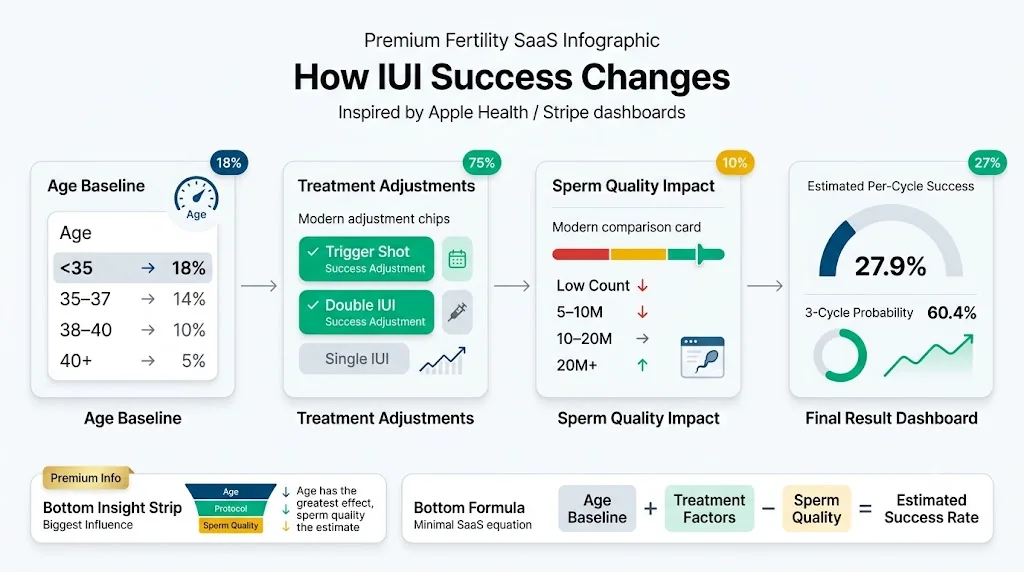
PCOS is included in this calculator under the anovulatory-disorder infertility profile. The research model does not apply a separate percentage boost for a trigger shot or double IUI, so those treatment choices are not used as calculator multipliers.
Example Input
- Age: 29
- Female infertility profile: Anovulatory disorder, including PCOS
- Pre-wash TPMSC: 18 million
- AMH: 2.4 ng/mL
- Sperm source: Partner sperm
- Projection: 3 cycles
Example Result
- Estimated per-cycle pregnancy chance: about 18.0%
- 3-cycle mathematical projection: about 44.9%
Meaning
In this example, age under 35, an anovulatory infertility profile, TPMSC of at least 15 million, and AMH of at least 1 ng/mL all fall into the reference categories of the model that includes AMH. The result estimates the chance of a positive serum hCG pregnancy test, not clinical pregnancy or live birth. It does not show that a trigger shot or any specific IUI protocol caused the estimate.
What is the IUI success rate using donor sperm?
This calculator does not provide a research-model pregnancy estimate for donor-sperm IUI. The source study evaluated homologous, or partner-sperm, IUI cycles and excluded heterologous insemination, so its prediction model should not be extended to donor-sperm cycles as though the same coefficients had been validated there.
If you select donor sperm in the calculator, treat the result state as outside the supported research population rather than converting age, AMH, or sperm characteristics into a donor-IUI success percentage. Donor-sperm outcomes should be discussed using evidence and clinic data that specifically apply to donor insemination.
What is the IUI success rate with male factor infertility?
There is no single IUI success percentage for male-factor infertility. In this calculator, the sperm-related predictor is the pre-wash total progressive motile sperm count (TPMSC) measured on the IUI day. Other semen abnormalities are not separately scored by this model.
Example Input
- Age: 37
- Female infertility profile: No known female cause / unexplained infertility
- Pre-wash TPMSC: 4 million
- AMH: Not entered
- Sperm source: Partner sperm
- Projection: 3 cycles
Example Result
- Estimated per-cycle pregnancy chance: about 4.3%
- 3-cycle mathematical projection: about 12.3%
Meaning
The lower estimate in this example reflects the model categories for age 35 or older and pre-wash TPMSC below 5 million. It does not diagnose the severity or cause of male-factor infertility, and it does not determine which fertility treatment should be used. Couples with severe male-factor infertility were not included in the source study, so this calculator should not be used to generate a treatment conclusion for those cases.
What is the IUI success rate on your third attempt?
This calculator does not assign a special success rate to the third IUI attempt. It estimates one per-cycle probability from your entered factors and uses that same probability when calculating the 1-, 2-, or 3-cycle mathematical projection.
Example Input
- Age: 33
- Female infertility profile: No known female cause / unexplained infertility
- Pre-wash TPMSC: 7 million
- AMH: Not entered
- Sperm source: Partner sperm
- Projection: 3 cycles
Example Result
- Estimated per-cycle pregnancy chance: about 11.7%
- 2-cycle mathematical projection: about 22.0%
- 3-cycle mathematical projection: about 31.1%
Meaning
The calculator continues to use the same estimated 11.7% probability in each projected cycle. The 31.1% value represents the mathematical chance of at least one positive serum hCG result across three projected cycles under that constant-probability assumption. It is not a separate “third-cycle success rate.”
If two IUI cycles have already occurred without pregnancy, do not interpret the displayed 31.1% three-cycle projection as the probability that the third attempt will succeed. The calculator does not condition its estimate on two observed previous failures or decide whether another IUI or IVF should be next.
Quick Rules to Remember
This calculator uses four research-model factors: female age, female infertility profile, pre-wash TPMSC, and optional AMH. It does not add automatic percentage boosts for trigger shots or double IUI. Use partner-sperm data that match the model, enter pre-wash TPMSC rather than post-wash TMSC, and read the 1–3 cycle result as a mathematical projection rather than a treatment recommendation.
IUI Success Rate Result Context Explained
A single IUI success rate estimate should be interpreted in the context of the factors used by the research model. This calculator does not classify results as low, moderate, or strong and does not use percentage cutoffs to recommend a treatment change. Instead, compare which of your entered factors fall into the model’s different age, infertility-profile, pre-wash TPMSC, and AMH categories.
| Model Factor | Categories Used | What It Means in This Calculator |
|---|---|---|
| Female Age | Under 35 / 35 or older | Age 35 or older was associated with lower pregnancy odds in the source cohort. The calculator uses the study's age grouping rather than separate age-by-age success-rate bands. |
| Female Infertility Profile | Unexplained or anovulatory / endometriosis, unilateral tubal factor, or anatomical factor | Unexplained and anovulatory infertility formed the more favorable reference group in the model. The other listed female-factor diagnoses were associated with lower pregnancy odds in the source cohort. |
| Pre-wash TPMSC | Under 5 million / 5 to under 15 million / 15 million or higher | The model uses total progressively motile sperm count before semen preparation on the IUI day. Lower TPMSC categories were associated with lower pregnancy odds in the study. |
| AMH, When Entered | Under 1 ng/mL / 1 ng/mL or higher | When AMH is entered, the calculator uses the study model that includes AMH. AMH below 1 ng/mL was associated with lower pregnancy odds in that model. |
| Per-Cycle Estimate | Estimated probability for one IUI cycle | The percentage estimates the chance of a positive serum hCG pregnancy test after IUI. It does not estimate clinical pregnancy, ongoing pregnancy, or live birth. |
| 2–3 Cycle Projection | Same estimated probability applied across the selected number of cycles | This is a mathematical projection using the same estimated per-cycle chance. It is not a separate predicted rate for each later cycle and is not a recommendation to continue or stop treatment. |
Research note: These categories describe inputs used by the source research model, not clinical treatment thresholds. The model was developed from a retrospective, single-center partner-sperm IUI cohort, and the authors stated that external validation is needed before general clinical use.
Interpretation
A higher calculator estimate means the combination of your entered factors falls into categories associated with higher pregnancy odds in the source cohort. A lower estimate means one or more entered factors were associated with lower odds in that model. The percentage should not be converted into a “good,” “moderate,” or “bad” treatment category, and it does not determine whether IUI should be continued or another treatment should be used.
Important Context
Check that the values you entered match the model before interpreting the percentage. In particular, use the pre-wash TPMSC from the IUI day rather than a post-wash TMSC value. Your fertility clinician can interpret the estimate alongside tubal status, ovarian reserve, semen analysis, treatment history, and other factors that this calculator does not fully capture.
What to Do After Using the IUI Success Rate Calculator
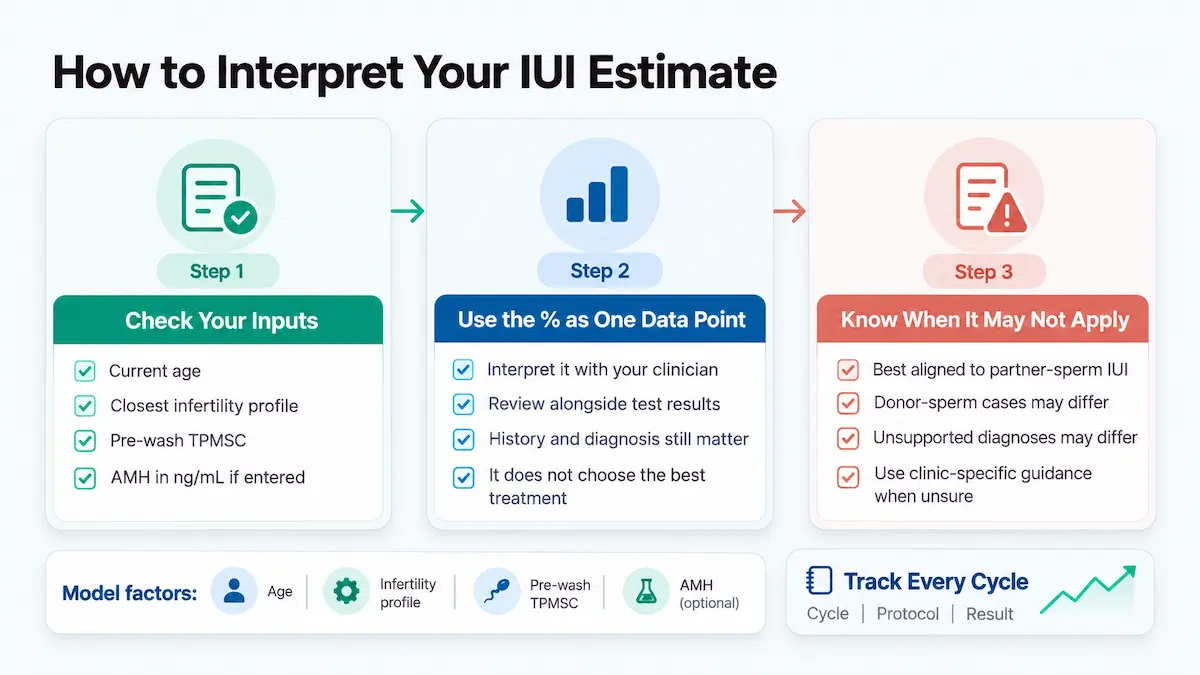
Your result is an estimate from a research model, not a treatment decision. Before interpreting it, check that your inputs match the model and then consider the percentage alongside your fertility history and clinical evaluation. The calculator does not define a percentage at which you should continue IUI, change protocols, or move to IVF.
Check That Your Inputs Match the Model
Start by confirming the information you entered. Use your current age, the closest supported female infertility profile, and the pre-wash TPMSC from the IUI day. If you enter AMH, use the value reported in ng/mL. An incorrect sperm-count type or an unsupported diagnosis can make the estimate inappropriate for your situation.
Interpret the Percentage in Clinical Context
Use the estimate as one piece of information rather than as a clinical prognosis. Your fertility clinician may also consider tubal status, ovarian reserve, semen analysis, treatment history, medications, ultrasound findings, and other factors that are not fully represented by this calculator. A higher or lower model estimate does not by itself identify the best treatment option.
Know When the Calculator May Not Apply
Do not use the percentage to make a treatment decision when your situation falls outside the research model. The source cohort involved partner-sperm IUI, and this calculator does not generate a treatment conclusion for donor sperm, unsupported infertility profiles, or other circumstances that differ substantially from the study population. In those situations, clinic-specific assessment is more appropriate than interpreting the calculator percentage on its own.
One Habit Worth Building
Keep a simple record of each cycle’s medications, monitoring results, IUI date, semen report values, and outcome. Bringing the same information to follow-up visits can make it easier to discuss how your actual treatment history compares with a research-model estimate.
You Might Also Find These Helpful
Pregnancy & Fertility 45
Use this Pregnancy Risk Calculator to check age, BMI, health history, bleeding, and twins. See if closer prenatal monitoring may be worth asking about.
Try calculatorOne Time Pregnancy Calculator estimates pregnancy odds from one encounter, plus fertile window timing, test date, due date, and 21-day testing guidance.
Try calculatorUse the AMH Calculator to convert ng/mL or pmol/L, compare your result with age-based data, and see what it may mean for IVF, fertility,…
Try calculatorUse the Baby Eye Color Calculator with parents, grandparents, or sibling context to compare Brown, Green/Hazel, and Blue/Grey model estimates instantly.
Try calculatorBasal Body Temperature Calculator checks reading conditions and analyzes your temperature pattern for a sustained shift that may be consistent with ovulation.
Try calculatorBPD gestational age calculator: estimate fetal age from BPD, compare your week, check normal BPD ranges, and understand ahead or behind results.
Try calculatorCalculate odds with the Chance of Twins Calculator. Enter maternal age and history. Find your probability instantly. See if you will conceive multiples now.
Try calculatorFind out exactly when you conceived. Our free Conception Calculator uses your Due Date, LMP, or Ultrasound to estimate your fertilization date and fertile…
Try calculatorUse our Conception Date Due Date Calculator to find your baby's arrival date. Enter your conception or intercourse date for clinical 40-week results.
Try calculatorContraceptive effectiveness calculator to compare birth control methods, typical vs perfect use, backup protection, and 5-year pregnancy risk.
Try calculatorUse this CRL calculator to estimate gestational age and due date from crown-rump length in mm or cm. Compare CRL, LMP, and IVF dating…
Try calculatorEstimate your monthly and 12-month pregnancy odds by age, partner age, and cycle dates. See your fertile window and when to seek fertility help.
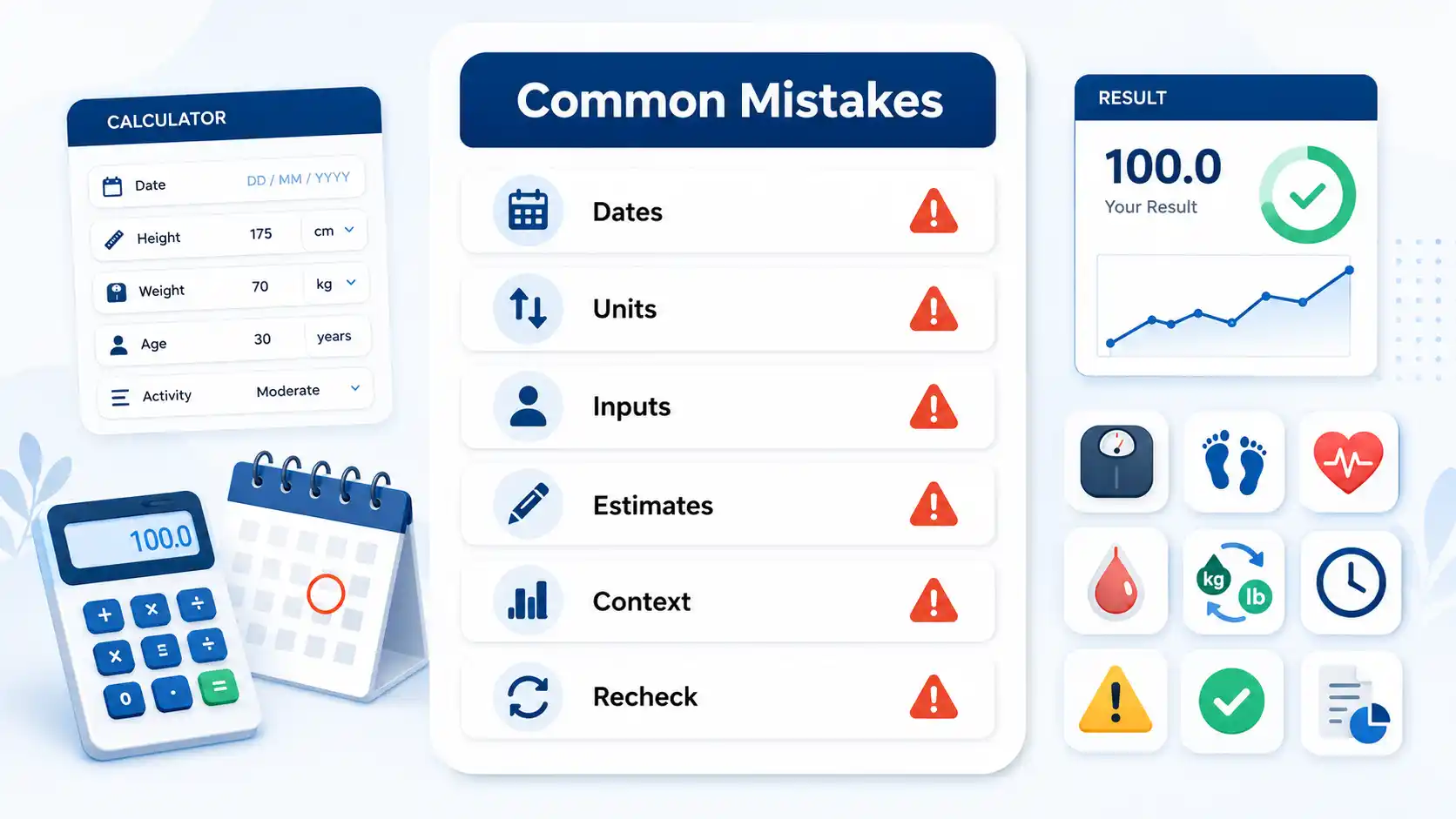
Try calculatorCommon Mistakes When Using the IUI Success Rate Calculator
The IUI Success Rate Calculator depends on using the same types of inputs used in its source model. The most common mistakes are entering the wrong sperm-count value, misunderstanding the multi-cycle projection, or treating the estimate as a treatment recommendation rather than an educational probability estimate.
- Treating the 1–3 cycle projection as a prediction that one of those cycles will result in pregnancy
- Entering the wrong sperm-count measure instead of the pre-wash total progressively motile sperm count (TPMSC) from the IUI day
- Assuming the calculator automatically lowers the pregnancy estimate in cycle two or cycle three
- Choosing an infertility profile that does not match your diagnosis instead of selecting the closest supported category
- Comparing this positive-hCG pregnancy estimate directly with IVF, live-birth, clinical-pregnancy, or ongoing-pregnancy rates that measure different outcomes
Frequently Asked Questions (FAQs)
What are the early signs of a successful IUI?
Common early signs include mild cramping, light spotting, breast tenderness, fatigue, and bloating during the two week wait. These symptoms overlap heavily with normal premenstrual signs, so they don’t confirm pregnancy on their own.
A blood or urine test after day 14 remains the only reliable way to confirm results.
When should you take a pregnancy test after IUI?
Most clinics recommend waiting at least 14 days after your IUI procedure before testing. Testing earlier risks a false negative, since hCG levels need time to rise high enough for accurate detection.
A trigger shot containing hCG can also cause a false positive if you test too soon after the injection.
Is this IUI Success Rate Calculator valid in the US, UK, or Australia?
This calculator can be used as an educational estimate when your inputs match the source research model, but it is not a national IUI success-rate model for the United States, United Kingdom, Australia, or any other country.
The prediction model was developed from partner-sperm IUI cycles at a single university reproductive medicine center in Austria. Clinic protocols, patient populations, treatment eligibility, and the way outcomes are reported can differ by country and provider. Use the estimate as research-based context and compare it with guidance and outcome data from your own fertility clinic.
Can IUI be successful on the first try?
Yes, pregnancy can occur after the first IUI cycle, but this calculator cannot predict whether a specific cycle will succeed.
In the source study behind this calculator, the researchers did not find a statistically significant change in pregnancy rate by cycle number. The calculator therefore uses the same estimated per-cycle probability when projecting across 1 to 3 cycles. The multi-cycle result is a mathematical projection, not a guarantee that pregnancy will occur within that number of attempts.
Why does IUI fail even with normal sperm and regular ovulation?
IUI can be unsuccessful even when semen results and ovulation appear favorable because pregnancy depends on multiple steps that this calculator cannot measure, including fertilization, tubal function, embryo development, and implantation.
If several cycles have been unsuccessful, your fertility clinician may reassess the diagnosis, treatment protocol, tubal status, semen findings, ovarian factors, and other clinical information. There is no single calculator percentage or cycle number that determines the correct next treatment for every patient.
What is a good IUI success rate by age?
There is no universal percentage that defines a “good” IUI success rate for each age group. Success rates vary with the population studied, infertility diagnosis, sperm factors, treatment protocol, and whether the reported outcome is a positive pregnancy test, clinical pregnancy, or live birth.
In the research behind this calculator, age was one of several predictive factors, with age 35 or older associated with lower pregnancy odds. The calculator combines age with the supported infertility profile, pre-wash TPMSC, and optional AMH rather than assigning a universal success rate from age alone.
Does a trigger shot improve IUI success?
An hCG trigger can be used to help time ovulation in some IUI protocols, but it should not be treated as a fixed percentage increase in pregnancy chance. A 2023 meta-analysis found no significant difference in pregnancy odds between IUI timed with hCG administration and IUI timed using the body’s endogenous LH surge.
Trigger-shot use is not an input in this calculator, and the calculator does not apply a trigger-shot multiplier to your estimated pregnancy chance.
How many IUI cycles should you try before IVF?
There is no single number of IUI cycles that applies to every patient. For couples with unexplained infertility, ASRM recommends a course of ovarian stimulation with oral medications plus IUI, typically 3 or 4 cycles, followed by IVF if those treatments are unsuccessful.
That recommendation is specific to unexplained infertility and should not be applied automatically to every diagnosis. Age, tubal status, semen findings, ovarian factors, previous treatment, and other clinical circumstances can change the treatment plan. The percentage from this calculator should not determine when you move from IUI to IVF.
Are there early symptoms that confirm IUI worked?
No symptom confirms success on its own. Cramping, spotting, and fatigue can appear from hormone medication whether or not the cycle worked. A blood or urine pregnancy test 14 days after IUI is the only reliable confirmation.
Does fresh sperm work better than frozen sperm for IUI?
Fresh sperm should not be assumed to produce a universally higher IUI success rate than frozen sperm. A large retrospective study comparing fresh and cryopreserved sperm in IUI found no significant overall adjusted difference in clinical pregnancy outcomes, although results differed in some treatment subgroups.
This calculator should not be used to compare fresh and frozen sperm. Its source model was developed from partner-sperm IUI cycles and excluded donor-sperm inseminations.
Questions?
We had love to hear from you! Whether you are reporting an issue, suggesting a new calculator, or exploring collaboration opportunities — we are here to help. Every message helps us make 100calc smarter, faster, and more helpful for everyone.
Why People Trust 100calc
At 100calc.com, we focus on accuracy, speed, and trust. Every calculator we create is designed to give reliable, instant, and easy-to-understand results you can truly depend on.