
Ovulation Calculator: Estimate Your Fertile Window, Test Date and Due Date
An ovulation calculator estimates when you may ovulate using the first day of your last menstrual period (LMP) and your average menstrual cycle length. It shows your predicted fertile range, next period, recommended pregnancy test date, estimated implantation dates, and due date if conception happens near ovulation. For irregular cycles, it uses your shortest and longest cycles to create a wider range.
Ovulation does not always happen on day 14. A short, long, or irregular cycle can move your fertile days earlier or later. Enter your dates to see the days that matter most. Use the result as a planning guide, not a confirmed ovulation test.
Quick Facts
- Uses the first day of your last period and cycle length.
- Shows the five days before predicted ovulation and ovulation day.
- Supports regular and irregular cycle calculations.
- Sets the pregnancy test date 14 days after predicted ovulation.
- Boy or girl timing follows the unproven Shettles Method and cannot predict a baby’s sex.
- Updated Jul 13, 2026
- Reviewed by 100Calc Research Team
Pregnancy & Fertility Calculator
Ovulation & Fertile Window Calculator
Estimate your likely ovulation day, fertile window, body signs, pregnancy test timing, and estimated due date from your LMP and cycle length.
Use Standard Cycle if your period arrives fairly consistently each month.
What you need to enter first
Pick your calculation mode above. You will need the first day of your last menstrual period (LMP) and an estimate of your cycle length to get a useful fertile window estimate.
Predicted Ovulation Date
—
Your estimated ovulation and fertile window will appear here.
Your Fertile Window
Your personalized fertile window summary will appear here after calculation.
Timing Strategy
Actionable timing instructions based on your selected mode will appear here.
Body Signs to Look For
Body signs like basal body temperature and cervical mucus changes will be explained here.
The "Two-Week Wait" Timeline
Quick Answer
A direct, snippet-style answer based on your inputs will appear here.
What are my most fertile days this cycle?
Your first dynamic answer will appear here after calculation.
When can I take a pregnancy test?
Your second dynamic answer will appear here after calculation.
Explore More Calculators
Use the Chinese Gender Calculator for a traditional boy-or-girl prediction from lunar age and conception month. Enter conception date, due date, or LMP.
Try calculatorUse this fetal growth calculator to check baby weight percentile from ultrasound data in grams, kg, or cm and see what the result means…
Try calculatorEnter gestational sac measurements in mm or cm to calculate mean sac diameter, estimate early gestational age, compare week-by-week milestones, and see when follow-up…
Try calculatorMissed a birth control pill? Check pregnancy risk, protection status, backup contraception needs, and what to do next with our missed pill calculator.
Try calculatorUse our Pregnancy Chance Calculator to estimate your odds. Enter your cycle day, age, and method. Find out if you are in the high-risk…
Try calculatorUse our pregnancy due date calculator to find your exact Baby Due date. IVF, conception, ovulation, and ultrasound methods with weeks and timeline.
Try calculator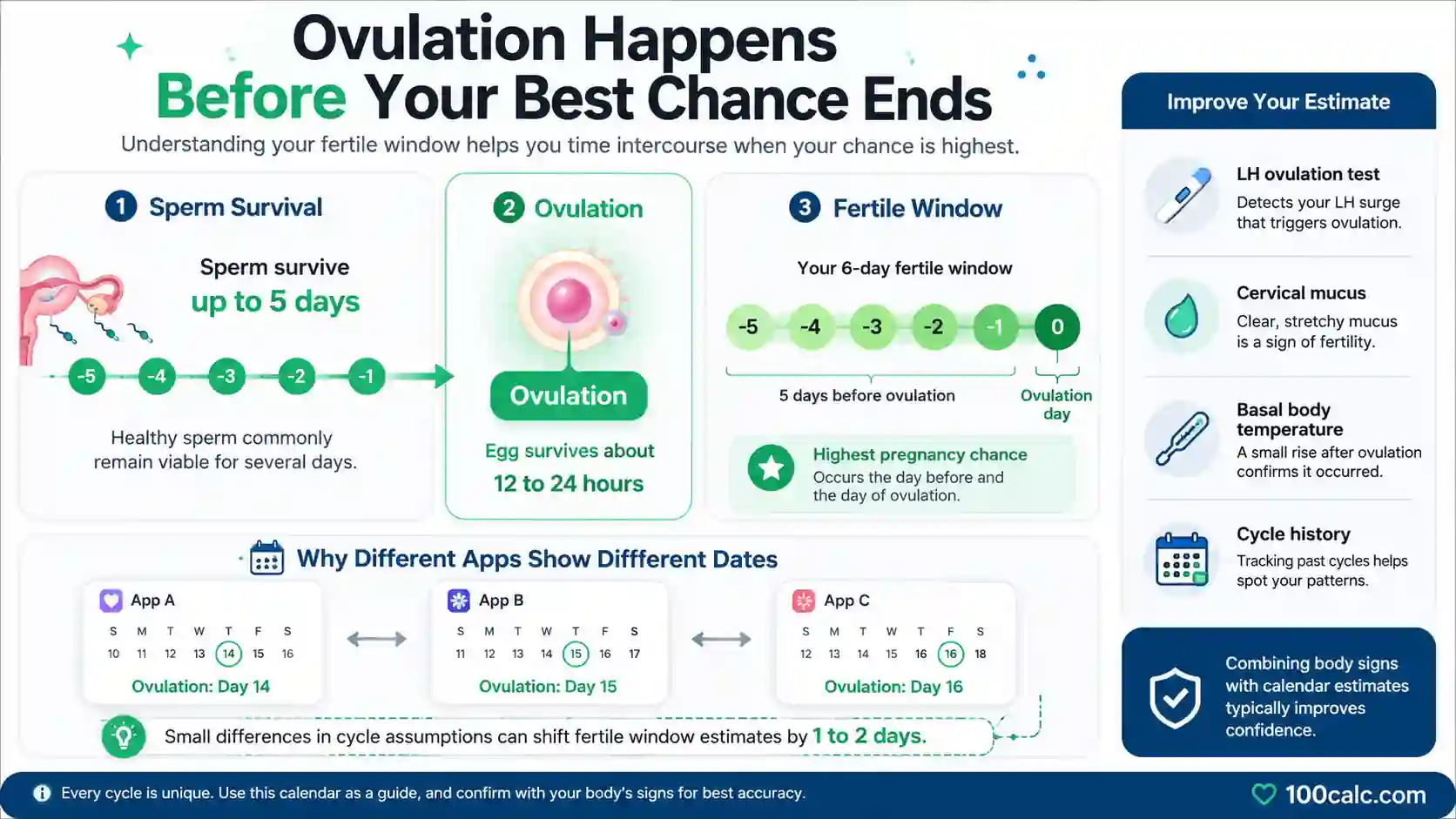
Micro Insight
Ovulation is the key event in your menstrual cycle. Understanding it helps you choose the best days to try for pregnancy, know when a pregnancy test is more likely to be accurate, and recognize when changing cycle patterns may need medical advice.
What Is Ovulation and Why Does It Matter?
The egg lives for only about 12 to 24 hours after ovulation. Sperm can survive in the female reproductive tract for up to five days. That is why your highest chance of pregnancy starts before ovulation, not only on the day it happens. This six day fertile window is why fertility calendars focus on several days instead of a single date.
Every cycle is different. Even people with regular periods may ovulate a little earlier or later each month. Stress, illness, travel, breastfeeding, coming off hormonal birth control, or conditions such as PCOS can change ovulation timing. A calendar estimate gives you a starting point, but signs like clear stretchy cervical mucus, a positive ovulation predictor kit, or changes in basal body temperature can help confirm where you are in your cycle.
A common question on pregnancy forums is why different apps show different fertile days. Most apps use slightly different assumptions about cycle length or the luteal phase. That is why estimates can vary by a day or more.
What Your Ovulation Results Mean
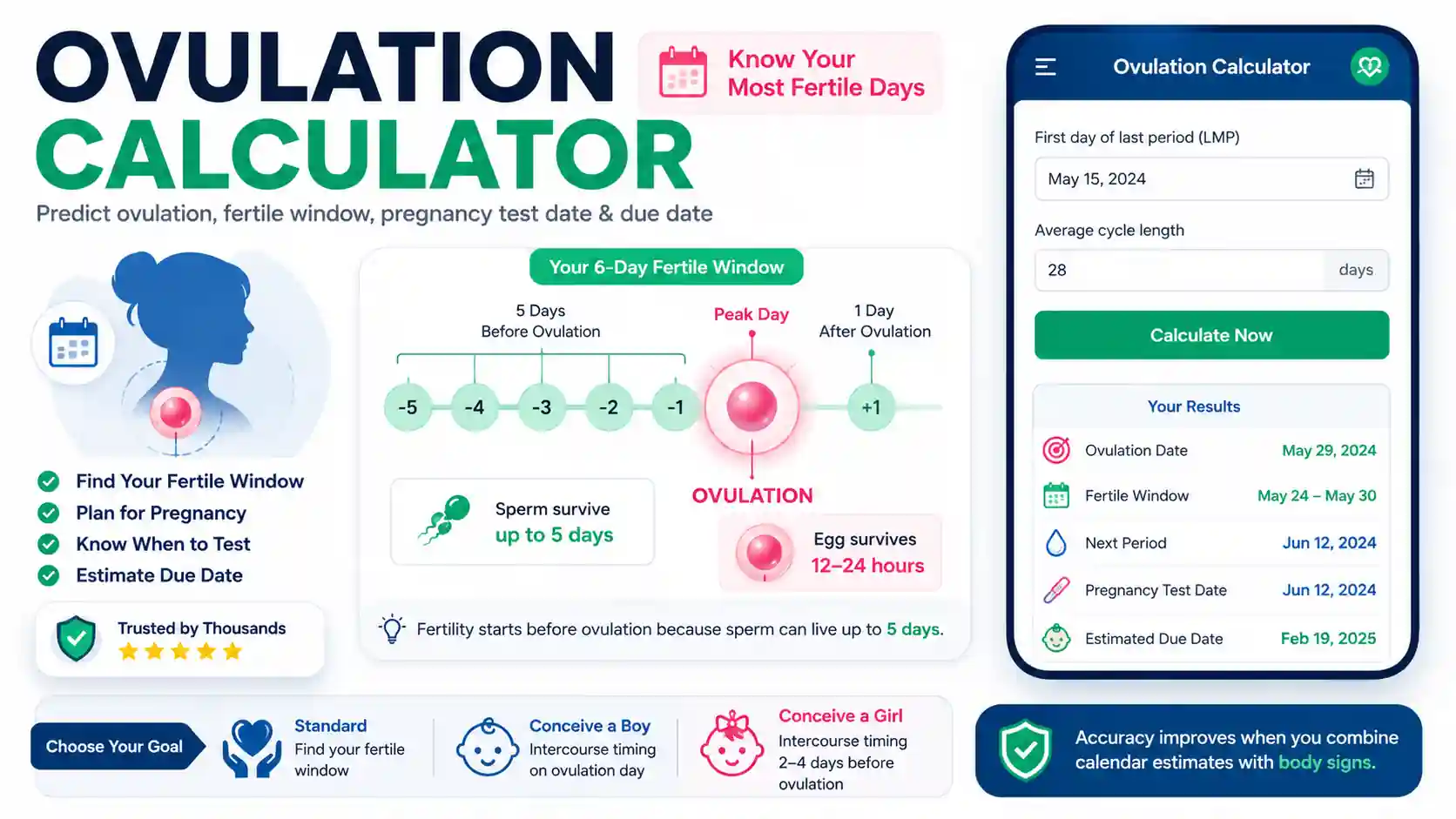
Your results estimate your likely ovulation timing based on your menstrual cycle and cycle day. They also show your fertile window, pregnancy test date, implantation window, and estimated due date if conception happens near ovulation.
Understanding Your Result
Predicted ovulation date
This is the cycle day when your body is most likely to release an egg. The calculator estimates it by using your LMP, cycle length, and a standard 14 day luteal phase. Treat this as a calendar method estimate, not confirmed ovulation.
Fertile window
Your fertile window covers the days when pregnancy is most likely. In Standard mode, it begins five days before your predicted ovulation date and ends on the predicted ovulation day. The egg may survive for about 12 to 24 hours after ovulation, but this calculator counts the main planning window through ovulation day.
Pregnancy test date
This is about 14 DPO, which means 14 days past ovulation. Testing around this time or after your missed period gives hCG more time to rise, so a home pregnancy test is more likely to be reliable.
Estimated due date
Your due date assumes conception happens near the predicted ovulation date. Most pregnancies do not end exactly on the due date. It is a planning estimate, not a guaranteed birth date.
Is Your Result Good or Bad?
There is no good or bad ovulation date.
A result that matches your usual cycle can help you plan intercourse, ovulation testing, or pregnancy testing with more confidence.
If you have regular cycles, a single ovulation date is often a useful guide.
If your cycles are irregular, a wider fertile window is normal. Ovulation may happen earlier or later than expected. Tracking cervical mucus, basal body temperature, or using ovulation predictor kits can improve timing.
If your periods are absent, highly irregular, or your predicted ovulation changes greatly each month, speak with a healthcare provider.
What You Should Do Next
- Plan intercourse throughout the fertile window instead of waiting for one day.
- Start using ovulation predictor kits a few days before the predicted ovulation date.
- Take a pregnancy test on or after the recommended test date for more reliable results.
- Track your cycle for several months if your ovulation dates vary.
- Talk with a healthcare provider if you have been trying to conceive without success or your cycles remain irregular.
Quick Example to Test
Inputs
- First day of last period: August 3
- Average cycle length: 30 days
Results
- Predicted ovulation: August 19
- Fertile window: August 14 to August 19
- Earliest pregnancy test: September 2
- Estimated next period: September 2
What this means
Your highest chance of pregnancy falls between August 14 and August 19. Ovulation is most likely around August 19. If pregnancy occurs during this cycle, testing on or after September 2 is more likely to give an accurate result.
How to Use the Ovulation Calculator
The ovulation calculator estimates your most fertile days from the first day of your last menstrual period and your cycle details. It supports regular cycles, irregular cycles, and optional timing plans based on the Shettles Method. Along with your ovulation date, it predicts your fertile window, next period, pregnancy test date, implantation window, and estimated due date.
Select Your Calculation Mode
Choose the option that matches your situation. Standard Cycle works for regular periods. Irregular Cycle uses your shortest and longest cycles to estimate a wider fertility window. Boy and Girl modes use the same ovulation estimate but suggest different intercourse timing based on the Shettles Method.
Enter Your Last Period Date
Select the first day of your last menstrual period. This date becomes the starting point for every calculation. Future dates or invalid dates are not accepted because they would produce incorrect fertility estimates.
Add Your Cycle Information
Enter your average cycle length if your periods are regular. The accepted range is 20 to 45 days. For irregular cycles, enter your shortest and longest cycle lengths between 20 and 60 days. The calculator uses these values to estimate your most likely ovulation timing.
Calculate Your Fertility Timeline
The calculator estimates ovulation by assuming a 14 day luteal phase. It then builds your fertile window, predicts your next period, estimates the best pregnancy test date, calculates a possible due date, and identifies your implantation window. Irregular cycles produce a wider fertility range instead of one ovulation day.
Review Your Fertile Window and Pregnancy Timeline
Check each result together instead of focusing on one date. Your fertile window helps plan intercourse or ovulation testing. The pregnancy test date reduces the chance of testing too early. The timeline also shows your current fertility status, making it easier to understand where you are in your cycle.
Quick Example: Implantation Window From LMP
Inputs
- Calculation mode: Standard Cycle
- First day of last menstrual period: September 5
- Average cycle length: 27 days
Results
- Predicted ovulation: September 18
- Fertile window: September 13 to September 18
- Earliest pregnancy test: October 2
- Next expected period: October 2
- Estimated due date: June 11
What Happened
The calculator counted back 14 days from your 27 day cycle to estimate ovulation. It then built your fertile window around that date and predicted the rest of your pregnancy timeline using the same cycle information.
How This Ovulation Calculator Works
This ovulation calculator uses your last menstrual period, cycle length, and selected mode to estimate your fertility timeline. It predicts your ovulation date, fertile window, next period, pregnancy test date, implantation window, and estimated due date. For irregular cycles, it creates a wider tracking window instead of relying on one fixed date.
Key Features & Benefits
- Supports standard, irregular, boy timing, and girl timing planning modes.
- Estimates ovulation using your menstrual cycle pattern and entered dates.
- Expands the fertile window when cycle lengths vary from month to month.
- Predicts pregnancy test timing, implantation window, and estimated due date.
- Shows your current fertility status based on today's date and calculated timeline.
Technical Process
Cycle Analysis
The system checks your last menstrual period and cycle details, validates the values, and selects the correct calculation method for your chosen mode.
Fertility Prediction
Cycle data is processed with a fixed 14 day luteal phase to estimate ovulation, fertile days, implantation timing, and the next expected period.
Timeline Generation
Results are organized into a clear fertility timeline that includes pregnancy testing, estimated due date, and your current fertility status based on the current date.
How the Ovulation Calculator Formula Works (Complete Breakdown)
The ovulation calculator estimates your ovulation date by counting back 14 days from your next expected period. It uses the first day of your last period and your cycle length. Irregular-cycle results use your shortest and longest cycles to create a wider estimated fertile range.
Ovulation Calculator Formula
					Predicted Ovulation Date = First Day of Last Period + (Cycle Length - 14 Days) Fertile Window Start = Predicted Ovulation Date - 5 Days
Fertile Window End = Predicted Ovulation Date Expected Period = First Day of Last Period + Cycle Length Pregnancy Test Date = Predicted Ovulation Date + 14 Days Estimated Implantation Range = Predicted Ovulation Date + 6 to 10 Days Estimated Due Date = Predicted Ovulation Date + 266 Days
The calculator assumes a fixed 14-day luteal phase. It subtracts 14 from your cycle length, then adds the remaining days to the first day of your last period.
A 30-day cycle gives a predicted ovulation date on cycle day 16. A 26-day cycle gives an estimate on cycle day 12.
Can an ovulation calculator work with irregular periods?
Average Cycle Length = Round((Shortest Cycle + Longest Cycle) / 2) Average Ovulation Date = First Day of Last Period + (Average Cycle Length - 14 Days) Earliest Ovulation Date = First Day of Last Period + (Shortest Cycle - 14 Days) Latest Ovulation Date = First Day of Last Period + (Longest Cycle - 14 Days) Wider Fertile Window Start = Earliest Ovulation Date - 5 Days Wider Fertile Window End = Latest Ovulation Date + 1 Day Pregnancy Test Date = Latest Ovulation Date + 14 Days Estimated Due Date = Average Ovulation Date + 266 Days
Irregular mode does not rely on one cycle length. It finds an average date, then uses the shortest and longest cycles to show where ovulation could happen earlier or later.
The pregnancy test date is based on the latest predicted ovulation date. Implantation and due date estimates use the average predicted ovulation date.
What Each Ovulation Formula Variable Means
Each variable plays a different role in estimating your ovulation date and fertile window. Your last period gives the starting point, while cycle length shows how many days the calculation should count. For irregular periods, the shortest and longest cycles create a wider range. Understanding these values helps you enter the right information and read your results correctly.
First Day of Last Period
This is the first day your menstrual bleeding started. It marks cycle day one and gives the calculator a starting date for every result.
Do not enter the final day of bleeding.
Cycle Length
Cycle length counts from the first day of one period to the first day of the next. Standard, boy, and girl modes accept cycle lengths from 20 to 45 days.
The number must be entered as a whole day.
Shortest Cycle
This is the fewest days in one menstrual cycle during the period you tracked. Irregular mode uses it to estimate the earliest possible ovulation date.
Accepted values range from 20 to 60 days.
Longest Cycle
This is the highest number of days between two periods. It helps estimate the latest possible ovulation date and the recommended pregnancy test date.
It must equal or exceed the shortest cycle.
Average Cycle Length
Irregular mode adds your shortest and longest cycles, divides the total by two, and rounds the result to a whole day.
This average creates the main predicted ovulation date, next period, implantation range, and estimated due date.
14-Day Luteal Phase
The calculator uses 14 days as the fixed time between predicted ovulation and the next expected period.
This value is built into the formula. It cannot be changed inside the calculator.
Predicted Ovulation Date
This is the calendar date when ovulation may occur based on the entered cycle data. It is an estimate, not proof that an egg was released.
Irregular mode shows the date based on the average cycle length.
Fertile Window
Standard mode starts the displayed range five days before predicted ovulation. It ends on the predicted ovulation day.
Irregular mode begins five days before the earliest estimate and ends one day after the latest estimate
Pregnancy Test Date
Standard mode adds 14 days to predicted ovulation. This date usually matches the next expected period because both calculations use the same 14-day assumption.
Irregular mode adds 14 days to the latest possible ovulation date.
Estimated Implantation Range
The calculator displays dates from 6 through 10 days after predicted ovulation.
In irregular mode, these dates are measured from the average predicted ovulation date.
Estimated Due Date
The calculator adds 266 days to predicted ovulation.
Standard, boy, and girl modes use the single predicted date. Irregular mode uses the average predicted ovulation date.
How Boy and Girl Timing Is Calculated
Boy Timing Start = Predicted Ovulation Date Boy Timing End = Predicted Ovulation Date + 1 Day Girl Timing Start = Predicted Ovulation Date - 4 Days Girl Timing End = Predicted Ovulation Date - 2 Days
Both modes use the same ovulation formula as Standard Cycle mode. Only the suggested timing range changes.
These dates follow the Shettles timing theory. They cannot predict or guarantee a baby’s sex.
Another Ovulation Calculation Example
Given:
- First Day of Last Period = August 3, 2026
- Average Cycle Length = 30 Days
Calculation:
					Predicted Ovulation Date = August 3, 2026 + (30 - 14 Days) = August 3, 2026 + 16 Days = August 19, 2026

Fertile Window = August 19 - 5 Days through August 19 = August 14 through August 19, 2026

Next Expected Period = August 3, 2026 + 30 Days = September 2, 2026

Pregnancy Test Date = August 19, 2026 + 14 Days = September 2, 2026

Estimated Implantation Range = August 19, 2026 + 6 to 10 Days = August 25 through August 29, 2026

Estimated Due Date = August 19, 2026 + 266 Days = May 12, 2027
Result:
- Predicted Ovulation Date: August 19, 2026
- Displayed Fertile Window: August 14 to August 19, 2026
- Next Expected Period: September 2, 2026
- Pregnancy Test Date: September 2, 2026
- Estimated Implantation Range: August 25 to August 29, 2026
- Estimated Due Date: May 12, 2027
How many days after my period would I ovulate?
You may ovulate about 7 to 21 days after your period starts, depending on your cycle length. An Ovulation Calculator estimates this by using your first period day and subtracting 14 days from your average cycle length.
This question matters because many people count from the day bleeding ends. That can be confusing. Your cycle starts on the first day of bleeding, not the last day of your period.
How do I calculate ovulation after my period?
Ovulation is usually estimated with this simple rule: cycle length minus 14 days. If your cycle is 30 days long, your predicted ovulation day is around day 16.
Use this quick formula:
Ovulation day = average cycle length – 14
Here is how it looks:
| Average Cycle Length | Estimated Ovulation Day | What It Means |
|---|---|---|
| 21 days | Day 7 | Ovulation may happen soon after bleeding ends. |
| 24 days | Day 10 | Fertile days may start early. |
| 28 days | Day 14 | Common estimate for a regular cycle. |
| 30 days | Day 16 | Ovulation may happen a little later. |
| 35 days | Day 21 | Fertile days may start much later. |
Note: These are calendar-based estimates. Ovulation can shift because of stress, illness, irregular periods, PCOS, travel, sleep changes, or hormone changes. Use this table as a planning guide, not as confirmed ovulation timing.
Do I count from the first day of bleeding or after my period ends?
Count from the first day of bleeding. That day is cycle day 1, even if your period lasts several more days.
For example, if your period starts on August 3 and your cycle is 30 days long:
- Cycle day 1: August 3
- Predicted ovulation day: August 19
- Fertile window: August 14 to August 19
If your period lasts 5 days, ovulation may happen about 11 days after bleeding ends in this example.
Can I ovulate soon after my period?
Yes, you can ovulate soon after your period if you have a short cycle or a longer period. A short cycle can move your fertile window closer to the end of bleeding.
This is why a fertile window after period is not the same for everyone. Someone with a 21-day cycle may ovulate around day 7. Someone with a 35-day cycle may ovulate around day 21.
Why does the calculator use cycle length instead of period length?
Period length only tells you how many days you bleed. Cycle length tells the calculator when your next period may start, which helps estimate ovulation.
A period and ovulation calculator works better when you know:
- First day of your last period
- Average cycle length
- Shortest and longest cycle length, if your periods are irregular
If your cycle changes often, use the irregular cycle option. It gives a wider fertile tracking window instead of one fixed ovulation date.
How do you calculate ovulation with an Ovulation Calculator?
An ovulation calculator estimates your most fertile days by using the first day of your last menstrual period (LMP) and your cycle length. It assumes a 14 day luteal phase to predict ovulation, fertile days, your next period, the best pregnancy test date, and an estimated due date if conception occurs.
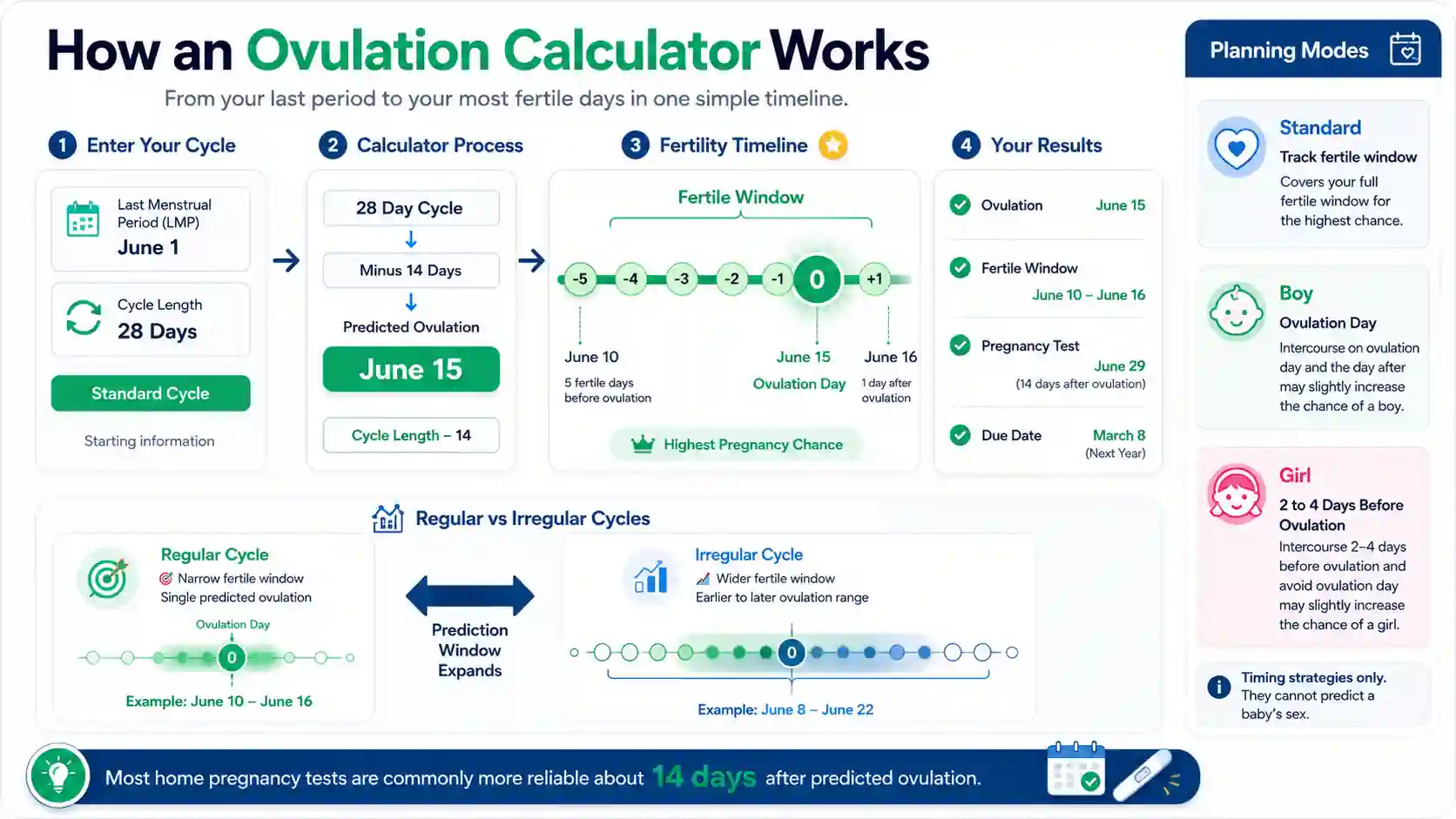
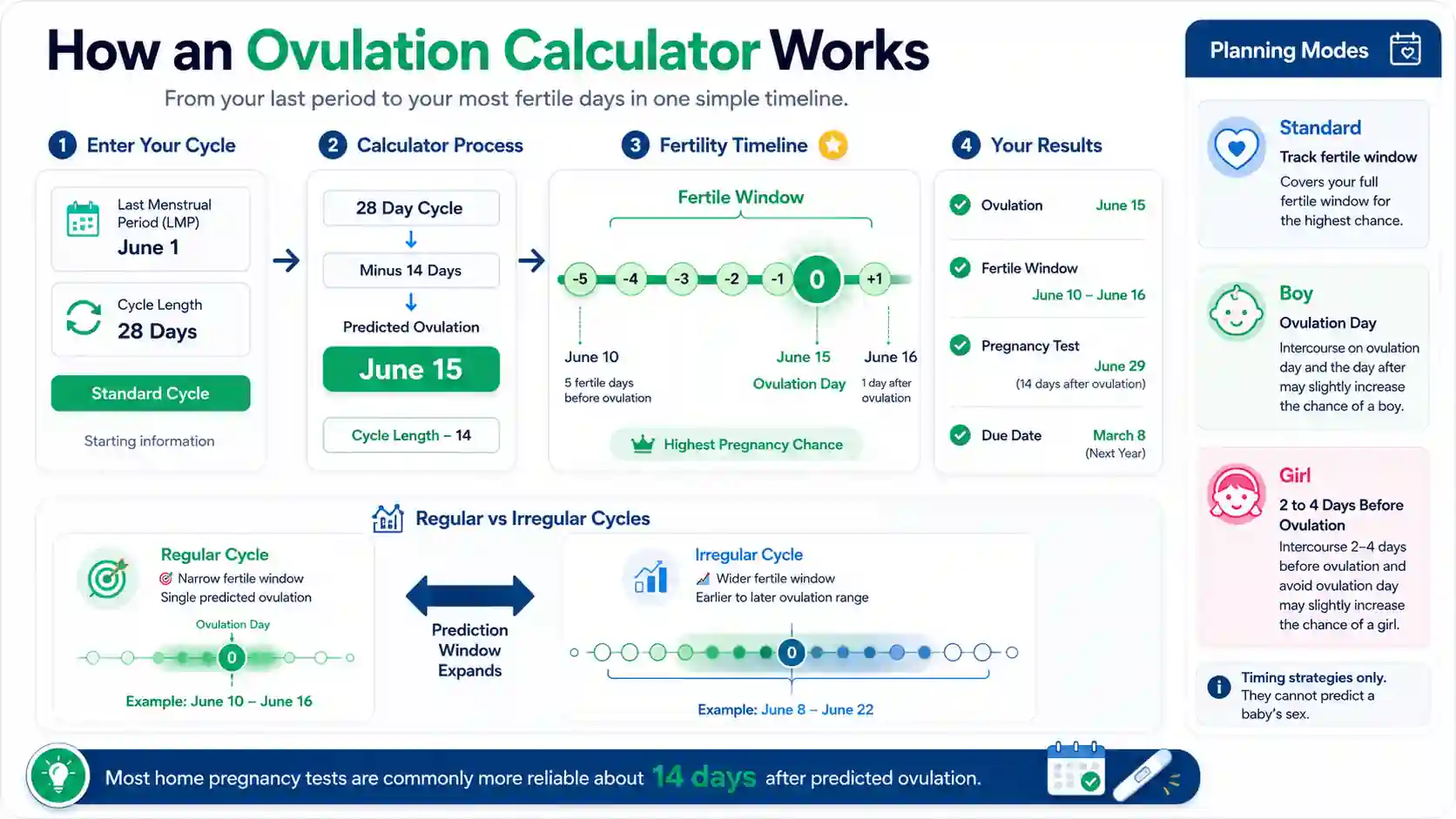
How does an ovulation calculator work for a regular 28 day cycle?
This example shows the most common situation for someone with a regular menstrual cycle.
Input
- First day of last menstrual period: June 1
- Average cycle length: 28 days
- Mode: Standard Cycle
Process
- Predicted ovulation: June 15
- Fertile window: June 10 to June 15
- Next expected period: June 29
- Earliest pregnancy test: June 29
- Estimated due date: March 8 (next year)
Result
- Ovulation: June 15
- Fertile days: June 10 to June 15
- Pregnancy test: June 29
- Due date: March 8
Meaning
This timeline highlights the highest chance of pregnancy during the fertile window and recommends testing about 14 days after ovulation.
How do irregular cycles change your fertile window?
People with changing cycle lengths often want to know why their fertile days cover a wider range.
Input
- First day of last menstrual period: June 1
- Shortest cycle: 26 days
- Longest cycle: 34 days
- Mode: Irregular Cycle
Process
- Average cycle: 30 days
- Estimated ovulation: June 17
- Earliest possible ovulation: June 13
- Latest possible ovulation: June 21
- Fertile window: June 8 to June 22
- Recommended pregnancy test: July 5
- Estimated due date: March 10 (next year)
Result
- Estimated ovulation: June 17
- Fertile window: June 8 to June 22
- Pregnancy test: July 5
- Due date: March 10
Meaning
A wider fertile window helps cover earlier or later ovulation that can happen when cycle lengths are not consistent.
How can you compare Standard, Boy, and Girl timing modes?
This example shows how each planning mode uses the same estimated ovulation date but suggests different intercourse timing.
Input
- First day of last menstrual period: August 3
- Average cycle length: 30 days
Process
- Predicted ovulation: August 19
- Standard Mode: Fertile window from August 14 to August 19
- Boy Mode: Intercourse on August 19 and August 20
- Girl Mode: Intercourse on August 15 through August 17 and avoid ovulation day
Result
- Standard: Covers the full fertile window
- Boy: Focuses on ovulation timing
- Girl: Focuses on earlier fertile days
Meaning
The Boy and Girl options follow the Shettles timing method. They are planning strategies only and cannot guarantee a baby’s sex.
How do you know when to take a pregnancy test after ovulation?
Many users search for the earliest reliable pregnancy test date after ovulation.
Input
- First day of last menstrual period: September 5
- Average cycle length: 27 days
- Mode: Standard Cycle
Process
- Predicted ovulation: September 18
- Implantation window: September 24 to September 28
- Recommended pregnancy test: October 2
Result
- Ovulation: September 18
- Implantation window: September 24 to September 28
- Pregnancy test: October 2
Meaning
Waiting until about 14 days after predicted ovulation gives home pregnancy tests the best chance of detecting pregnancy if conception occurred.
Quick Rules to Remember
These examples use the same calculation method as the ovulation calculator. Enter your own last menstrual period and cycle details to receive a personalized fertility timeline, including your predicted ovulation day, fertile window, implantation window, pregnancy test date, next expected period, and estimated due date. Keep in mind that these are estimates, and actual ovulation can shift because of stress, illness, medications, breastfeeding, or conditions such as PCOS.
Ovulation Calculator Result Benchmarks Explained
Your ovulation calculator results show where you are in your menstrual cycle and what action makes the most sense at each stage. These benchmarks help you understand your fertility status, identify your highest chance of conception, and know when pregnancy testing is most likely to give reliable results.
| Result | Label | USA Guideline | India Guideline | Notes |
|---|---|---|---|---|
| Before Fertile Window | Low Fertility | Continue cycle tracking and prepare for fertile days. | Track your cycle and watch for upcoming fertile signs. | Pregnancy is less likely during this stage. |
| Fertile Window | High Fertility | Have intercourse every 1 to 2 days for the best chance of conception. | Regular intercourse during fertile days may improve pregnancy chances. | Sperm can survive for up to 5 days before ovulation. |
| Ovulation Day | Peak Fertility | Highest chance of pregnancy if intercourse occurs today. | Peak fertility is expected around the estimated ovulation date. | The egg is usually viable for about 12 to 24 hours. |
| Two Week Wait | Post Ovulation | Wait until about 14 days after ovulation before testing. | Home pregnancy tests are usually more reliable after the expected missed period. | Implantation may occur 6 to 10 days after ovulation. |
| Irregular Cycle | Variable Timing | Use ovulation predictor kits or basal body temperature tracking. | Combine cycle tracking with LH testing for better timing. | A wider fertile window reflects less predictable ovulation. |
Heads-up: This calculator provides estimates based on menstrual cycle timing. Stress, illness, breastfeeding, medications, and conditions such as PCOS can shift your actual ovulation date.
Interpretation
A result showing Fertile Window or Ovulation Day indicates the highest chance of conception. Before Fertile Window means fertility is still low, while Two Week Wait signals that ovulation has likely passed and it is best to wait before taking a pregnancy test. If your result shows an Irregular Cycle, your ovulation may vary from month to month, so combining calendar estimates with LH tests or basal body temperature tracking can improve accuracy.
Pro Tip
Use this calculator every cycle after your period begins. Recording your results over several months can help you recognize patterns and plan intercourse, ovulation testing, or pregnancy testing with greater confidence.
What to Do After Using the Ovulation Calculator
An ovulation calculator helps estimate your fertile window, ovulation date, pregnancy test timing, and expected due date. Your next step depends on where you are in your cycle and whether your goal is pregnancy planning or tracking fertility. Pairing calendar estimates with body signs can improve accuracy because ovulation may shift from one cycle to the next.
During the Fertile Window
This is the best time to try for pregnancy. Having intercourse every one to two days during the five days before ovulation and on ovulation day gives sperm the best chance of meeting the egg. Watch for clear, stretchy cervical mucus or use an LH ovulation test to help confirm that ovulation is approaching instead of relying on calendar dates alone.
On Ovulation Day
If your result shows today is your predicted ovulation day, this is your highest fertility period. Couples using Standard mode should continue trying through ovulation day. If you selected the Boy timing mode, intercourse is recommended on ovulation day and the following day. Remember that the Shettles Method is a timing theory and cannot guarantee your baby’s sex.
During the Two Week Wait
After the fertile window ends, avoid testing for pregnancy too early. The calculator recommends testing about 14 days after ovulation because hormone levels are more likely to be high enough for accurate home pregnancy tests. Keep tracking symptoms, but remember that early pregnancy signs and premenstrual symptoms can be very similar.
If You Have Irregular Cycles
A wider fertile window means ovulation is less predictable. Using ovulation predictor kits, monitoring cervical mucus, or tracking basal body temperature alongside the calculator can help narrow down your most fertile days. If your cycles stay irregular for several months or become much longer or shorter than usual, speak with a healthcare professional for further evaluation.
You Might Also Find These Helpful
Pregnancy & Fertility 45
Use this Pregnancy Risk Calculator to check age, BMI, health history, bleeding, and twins. See if closer prenatal monitoring may be worth asking about.
Try calculatorOne Time Pregnancy Calculator estimates pregnancy odds from one encounter, plus fertile window timing, test date, due date, and 21-day testing guidance.
Try calculatorUse the AMH Calculator to convert ng/mL or pmol/L, compare your result with age-based data, and see what it may mean for IVF, fertility,…
Try calculatorUse the Baby Eye Color Calculator with parents, grandparents, or sibling context to compare Brown, Green/Hazel, and Blue/Grey model estimates instantly.
Try calculatorBasal Body Temperature Calculator checks reading conditions and analyzes your temperature pattern for a sustained shift that may be consistent with ovulation.
Try calculatorBPD gestational age calculator: estimate fetal age from BPD, compare your week, check normal BPD ranges, and understand ahead or behind results.
Try calculatorCalculate odds with the Chance of Twins Calculator. Enter maternal age and history. Find your probability instantly. See if you will conceive multiples now.
Try calculatorFind out exactly when you conceived. Our free Conception Calculator uses your Due Date, LMP, or Ultrasound to estimate your fertilization date and fertile…
Try calculatorUse our Conception Date Due Date Calculator to find your baby's arrival date. Enter your conception or intercourse date for clinical 40-week results.
Try calculatorContraceptive effectiveness calculator to compare birth control methods, typical vs perfect use, backup protection, and 5-year pregnancy risk.
Try calculatorUse this CRL calculator to estimate gestational age and due date from crown-rump length in mm or cm. Compare CRL, LMP, and IVF dating…
Try calculatorEstimate your monthly and 12-month pregnancy odds by age, partner age, and cycle dates. See your fertile window and when to seek fertility help.
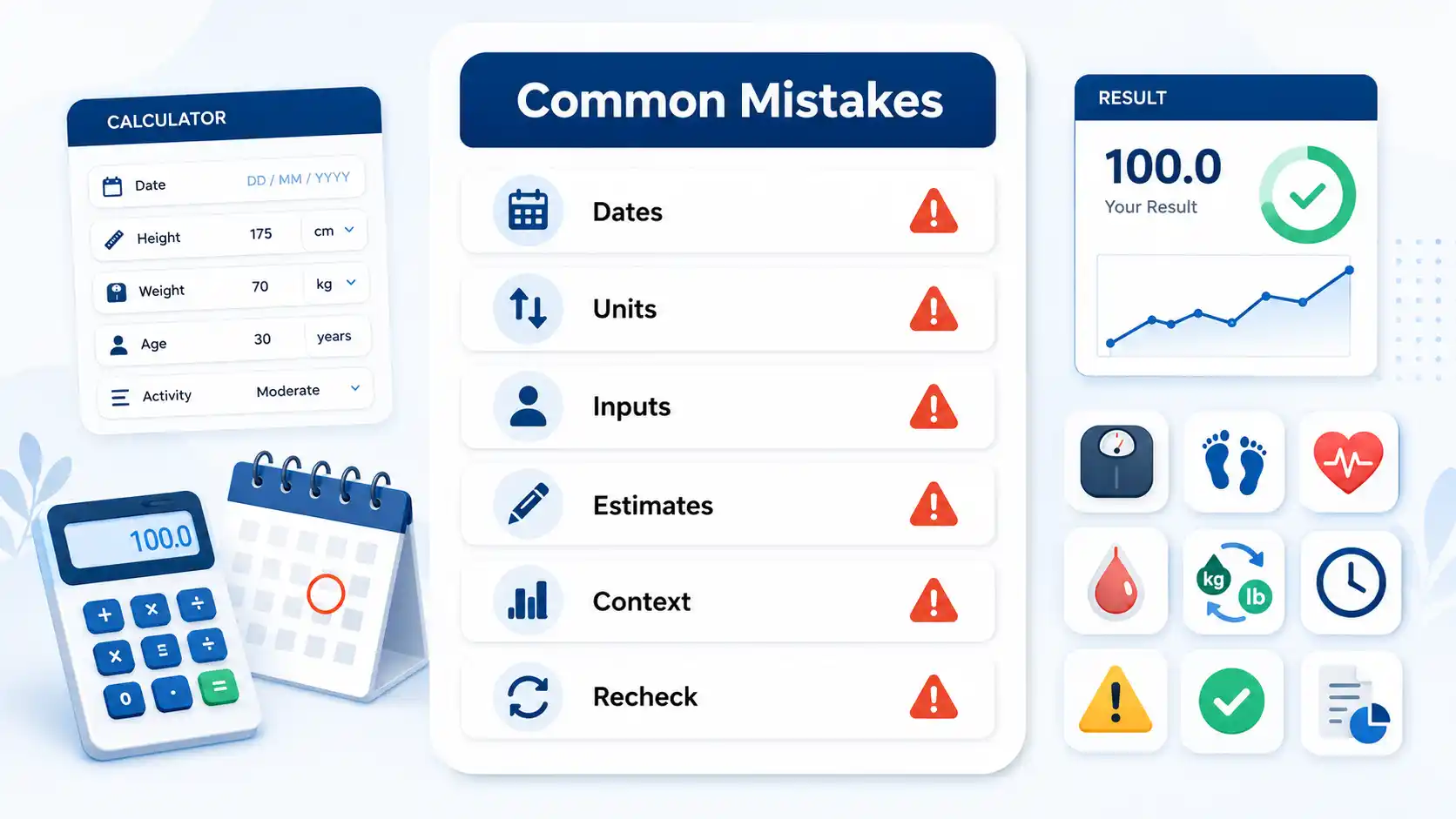
Try calculatorCommon Mistakes When Using the Ovulation Calculator
An ovulation calculator provides an estimate based on your last menstrual period and cycle length, but small input mistakes or incorrect assumptions can affect the results. Avoiding these common errors will help you get more accurate fertility predictions and make better decisions about pregnancy planning.
- Assuming ovulation always happens on day 14 regardless of your actual cycle length.
- Entering regular cycle mode even though your menstrual cycles vary from month to month.
- Entering the last day of your period instead of the first day bleeding began, which shifts every predicted date.
- Taking a pregnancy test before the recommended date of about 14 days after ovulation.
- Depending only on calendar predictions without checking LH test results, cervical mucus, or basal body temperature.
Frequently Asked Questions (FAQs)
How accurate is an ovulation calculator?
An ovulation calculator is usually most accurate for people with regular menstrual cycles because it estimates ovulation from your last menstrual period and average cycle length. It predicts your most likely fertile days but cannot confirm when ovulation actually occurs.
For better accuracy, combine your results with LH ovulation tests, cervical mucus changes, or basal body temperature tracking.
When is the best time to get pregnant?
The highest chance of pregnancy is during the five days before ovulation and on ovulation day. Since sperm can survive for several days, having intercourse every one to two days throughout this fertile window gives you the best opportunity for conception.
Missing the exact ovulation day does not always reduce your chances if intercourse occurred during the days leading up to it.
How many days does the fertile window last?
A fertile window usually lasts about six days. It includes the five days before ovulation and the day of ovulation itself. This timing reflects how long sperm can survive and how briefly an egg remains available for fertilization.
Your exact fertile window may shift from cycle to cycle, especially if your periods are irregular.
Can I use an ovulation calculator with irregular periods?
Yes. An ovulation calculator can still estimate fertility for irregular periods by using your shortest and longest cycle lengths to create a wider fertile window. This approach reflects the greater variation in ovulation timing instead of predicting one exact date.
Tracking ovulation signs alongside the calculator can improve your timing.
When should I take a pregnancy test after ovulation?
For the most reliable result, take a pregnancy test about 14 days after ovulation or after your expected missed period. Testing too early may produce a false negative because pregnancy hormone levels may still be too low to detect.
If your first test is negative and your period has not started, test again after two or three days.
Does stress delay ovulation?
Yes. Physical illness, emotional stress, major lifestyle changes, travel, and poor sleep can delay or sometimes prevent ovulation during a cycle. This may cause your fertile window and next period to occur later than the calculator predicts.
If delayed ovulation becomes common, consider discussing your symptoms with a healthcare provider.
Can an ovulation calculator predict a baby boy or girl?
No. An ovulation calculator cannot predict or guarantee a baby’s sex. Some calculators include Boy and Girl timing modes based on the Shettles Method, but scientific evidence does not support these methods as reliable for sex selection.
Use these modes as optional timing guides rather than guaranteed outcomes.
Why does my ovulation date change every month?
Ovulation can naturally shift from month to month because cycle length is not always identical. Stress, illness, medications, breastfeeding, travel, and hormonal changes can all affect when an egg is released.
Small changes of a few days are common, even in healthy cycles.
Why is my fertile window different in every app?
Different fertility apps use different prediction models. Some assume a standard 14 day luteal phase, while others learn from cycle history, ovulation tests, wearable devices, or body temperature data. This can produce different fertile window estimates.
Comparing predictions with your own ovulation signs usually provides the most confidence.
Can I still get pregnant before my calculator says my fertile window starts?
Yes. Pregnancy is possible if you ovulate earlier than expected because sperm can survive in the reproductive tract for up to five days. A calendar estimate cannot predict every cycle with complete precision.
Watching cervical mucus or using LH tests can help identify an earlier fertile window.
Can ovulation happen without noticeable symptoms?
Yes. Many people ovulate without feeling pain or noticing obvious physical changes. Mild cramps, increased cervical mucus, or breast tenderness may occur, but some experience no symptoms at all while still ovulating normally.
That is why symptom tracking alone should not replace other fertility tracking methods.
How many days after my period do I ovulate?
You may ovulate about 7 to 21 days after your period starts, depending on your cycle length. Most ovulation calculator estimates use this rule: average cycle length minus 14 days. A 28-day cycle often points to ovulation around day 14.
Count from the first day of bleeding, not the day your period ends.
Am I fertile 2–3 days before my period?
You are usually less fertile 2–3 days before your period if ovulation already happened earlier in the cycle. Pregnancy is still possible if ovulation was delayed, your cycle is irregular, or your next period date is not accurate.
Use ovulation signs or tests if your cycle shifts often.
Can I use an ovulation calculator after miscarriage or abortion?
Yes, but use the result carefully because your cycle may take time to settle after miscarriage or abortion. Ovulation can happen before your next period, so calendar dates may feel confusing during the first cycle after pregnancy loss or termination.
Ask a healthcare provider if bleeding, pain, or uncertainty continues.
What if I have PCOS or very irregular cycles?
If you have PCOS or very irregular cycles, an ovulation calculator may be less accurate because ovulation can shift, delay, or not happen in some cycles. Use the irregular cycle option as a wider tracking guide, not as a confirmed ovulation date.
Ovulation tests, cervical mucus, BBT, or medical guidance can help.
When should I see a doctor about ovulation or fertility?
See a doctor if your periods are missing, very irregular, very painful, or you think you are not ovulating. If you are under 35, ask for fertility help after 12 months of trying. If you are 35 or older, ask after 6 months.
Get help sooner with PCOS, endometriosis, miscarriage history, or known fertility issues.
Questions?
We had love to hear from you! Whether you are reporting an issue, suggesting a new calculator, or exploring collaboration opportunities — we are here to help. Every message helps us make 100calc smarter, faster, and more helpful for everyone.
Why People Trust 100calc
At 100calc.com, we focus on accuracy, speed, and trust. Every calculator we create is designed to give reliable, instant, and easy-to-understand results you can truly depend on.