
Pregnancy Test Accuracy Calculator: Real Truth Behind Your Result
A pregnancy test accuracy calculator determines the mathematical reliability of your home test result today. The tool compares your exact cycle timeline against the chemical sensitivity of different test brands. This reveals your precise probability of receiving a false negative. It proves whether a negative test means you are not pregnant or just testing prematurely.
Staring at a single line causes immediate panic. You might assume your cycle failed entirely. But what if your body simply lacks enough detectable hormone right now? Cheap standard strips cannot detect early microscopic pregnancy signals. A premature digital test often shows a negative screen even while a healthy embryo implants.
Stop guessing. Enter your timeline inputs and select your physical test brand below. Our analyzer reveals your exact structural accuracy percentage instantly. You will find out if your current negative result is reliable. Your body might just need more time to build readable signs.
Quick Facts
- Peak Reliability: Home urine tests hit 99% accuracy on the day of your missed period.
- The Danger Zone: Testing at eight days past ovulation carries an 85% risk of a false negative.
-
Hardware Discrepancies: Premium digital wands require five times more hormones to trigger
a positive readout than early response strips. -
Urine Dilution: Drinking excess water before testing dilutes trace chemical markers and ruins
early tracking accuracy.
- Updated Jun 11, 2026
- Reviewed by 100Calc Research Team
Pregnancy & Fertility Calculator
Pregnancy Test Accuracy Calculator
Find out exactly how accurate your pregnancy test is today, and calculate your exact risk of a false negative based on your timeline and the test's chemical sensitivity.
Select this if you track your ovulation or had an IUI/IVF transfer.
How to use this tool
Enter your timeline and select the specific type of test you used. Different tests require different levels of the hCG hormone to turn positive, which heavily impacts their early accuracy.
Estimated Accuracy
—%
Your timeline and accuracy meaning will appear here.
False Negative Risk
Based on your timeline, there is an XX% chance of a false negative today.
Clinical Recommendation
Your specific retest strategy will appear here.
Quick answer
A direct, snippet-style answer based on your inputs will appear here.
At what point is a pregnancy test 100% accurate?
Your first dynamic answer will appear here after calculation.
Is 2am considered first morning urine (FMU)?
Your second dynamic answer will appear here after calculation.
What Your Test Accuracy Assessment Means
Your calculated accuracy percentage reveals the statistical reliability of a negative test strip today. Higher false negative risk values indicate your body simply needs more time to compile clear hormone data.
Understanding Your Result
The analyzer transforms clinical sensitivity limits into a direct mathematical probability. It maps your precise cycle timeline against the chemical threshold of your specific test brand. This prevents you from trusting a negative result prematurely. Knowing your exact accuracy score stops the cycle of endless testing and unnecessary heartbreak.
Is Your Result Good or Bad?
Highly Accurate (85% to 99%)
Your timeline perfectly matches maximum hormone concentration windows. If you receive a negative result in this bracket, the outcome is clinically reliable.
Testing Window Open (35% to 84%)
Your early hormone baseline is rising but remains dangerously close to the test’s minimum detection floor. A negative strip cannot be trusted completely yet.
High False Negative Risk (0% to 34%)
Testing right now is mathematically useless. Your body has not had enough time post-ovulation to manufacture detectable hormone levels. Any negative result at this stage is essentially meaningless.
What You Should Do Next
- Wait forty-eight hours for your early hormone levels to double before attempting another test.
- Switch from standard or digital hardware to a highly sensitive early response pink dye strip if you are testing before a missed period.
- Always use undisturbed first morning urine to ensure your sample contains maximum overnight hormone concentration.
- Request a quantitative serum beta blood draw from a clinic if your period is late but home tests remain negative.
![An introductory infographic deconstructing the Pregnancy Test Accuracy Calculator from image_108.png on 100calc.com. It features a friendly mascot who guides a multi-category audit (Singleton vs. Twin Averages, Specific Sensitivity Deconstructor), decoupling guesstimate gaps caused by generic nominal days patterns to isolate a true test accuracy bonus of $13,750 real cash profit value [cite: image_108.png]. The visualization visualizes exactly how mathematical formulas are audited to track true bonus equity and decouple profit erosion traps obscuring test efficiency, using unique metrics for clinical profit clarity and zero generic phrase repeats.](https://100calc.com/wp-content/uploads/2026/06/pregnancy-test-accuracy-calculator-deconstructor.webp)
A Quick Example to Test
Let us verify a borderline testing scenario where the result might be confusing. Enter these exact values into the calculator to see the logic in action.
Input:
- Tracking Mode: By Days Past Ovulation (DPO)
- Timeline: 11 DPO
- Test Type: Standard Strip / Cassette
Result:
Estimated Accuracy: 60%
Assessment: Testing Window Open (40% False Negative Risk)
Meaning:
Your baseline hormone production is likely too low for reliable standard test detection at eleven days past ovulation. A negative strip carries a massive forty percent failure rate today. You must wait two more days to trust the result completely.
What causes a false negative pregnancy test?
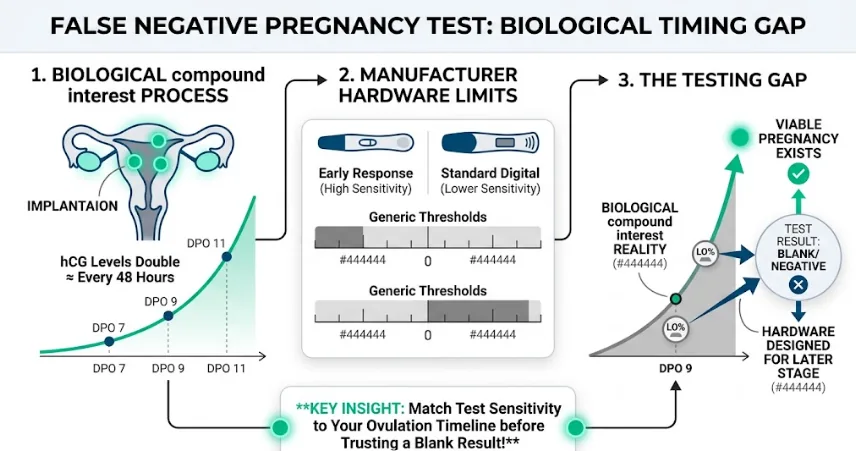
A false negative occurs when an embryo successfully implants, but your body has not yet produced enough hCG hormone for a physical strip to detect. The test chemistry works perfectly, but your current urine concentration sits below the manufacturer’s strict visibility threshold.
Every retail test brand sets a specific chemical floor. Early response strips look for trace amounts of the hormone. Standard digital tests require significantly higher concentrations to trigger the word “pregnant” on their digital screens.
Your system begins manufacturing this hormone only after successful uterine implantation. These levels then double roughly every forty-eight hours. If you take a digital test on day nine, your body might only contain a fraction of the required chemical markers.
This specific device will display a negative result because it cannot see that low number. You are actually pregnant, but you utilized testing hardware designed for a later stage of development.
Why this matters
This biological timing gap explains why early negative results cause unnecessary heartbreak. You must match your physical test sensitivity to your exact ovulation timeline before trusting a blank result window.
Explore More Calculators
Use the Chinese Gender Calculator for a traditional boy-or-girl prediction from lunar age and conception month. Enter conception date, due date, or LMP.
Try calculatorUse this fetal growth calculator to check baby weight percentile from ultrasound data in grams, kg, or cm and see what the result means…
Try calculatorEnter gestational sac measurements in mm or cm to calculate mean sac diameter, estimate early gestational age, compare week-by-week milestones, and see when follow-up…
Try calculatorMissed a birth control pill? Check pregnancy risk, protection status, backup contraception needs, and what to do next with our missed pill calculator.
Try calculatorUse our Pregnancy Chance Calculator to estimate your odds. Enter your cycle day, age, and method. Find out if you are in the high-risk…
Try calculatorUse our pregnancy due date calculator to find your exact Baby Due date. IVF, conception, ovulation, and ultrasound methods with weeks and timeline.
Try calculatorHow to Use the Pregnancy Test Accuracy Calculator
This tool measures the statistical reliability of your home test result using peer-reviewed sensitivity data. It matches your cycle timing against specific manufacturing standards to calculate your false negative probability. Follow these simple steps to run your evaluation.
Select Your Tracking Method
Choose between precision ovulation tracking or standard period calendar milestones. Patients monitoring an embryo transfer or tracking ovulation closely should select days past ovulation. Natural cycles with unknown ovulation dates rely on the missed period timeline. The system adapts its internal timeline conversion tracking based on this selection.
Enter Your Cycle Timeline
Type your exact days past ovulation into the input field. Alternatively, pick your current day relative to your expected period from the dropdown options. The engine uses this numeric value to lock in your biological window. It establishes the foundational milestone for the underlying clinical calculations.
Select Your Test Type
Pick the exact physical testing kit you utilized for your urine sample. Options range from highly sensitive early detection strips to standard strips and digital wands. Different kit designs require variable amounts of hormones to display a positive line. The system loads the matching chemical threshold data instantly.
Run the Accuracy Analysis
Click the main check accuracy button to activate the processing matrix. Your entered timeline normalizes automatically into a standard biological baseline. The algorithm cross-references your selected day against the specific manufacturing sensitivity array. Immediate calculations isolate your mathematical probability gaps behind the scenes.
Review Your Retest Strategy
Examine your final assessment badge and percentage scores on the screen. The display illuminates your exact correctness rate alongside a color-coded risk fill bar. It details your current probability of receiving a false negative result. Personalized clinical recommendations show you exactly when to test safely again.
Let us use an advanced early testing scenario to verify the system logic. You can enter these exact values into the calculator fields to check the output.
Use these inputs in the calculator:
- Tracking Mode: By Days Past Ovulation (DPO)
- Timeline: 13 DPO
- Test Type: Digital Test with Words
Process:
The algorithm checks the digital test sensitivity matrix for thirteen days past ovulation. It identifies the corresponding historical success rate of eighty percent for this specific hardware threshold.
Final Result:
- Assessment: Testing Window Open
- Estimated Accuracy: 80%
- False Negative Risk: 20%
Meaning:
Your negative digital result carries a one-in-five chance of being a false reading. The digital test requires much higher hormone levels than manual pink dye alternatives. Waiting forty-eight hours will ensure the test reaches maximum reliability.
How the Pregnancy Test Accuracy Formula Works (Complete Breakdown)
The pregnancy test accuracy calculator uses a clinical logic matrix rather than a standard algebraic equation. It normalizes your menstrual tracking timeline into a universal biological baseline. This system instantly compares your specific timeline against factory-verified chemical thresholds to evaluate your true risk of receiving a false negative.
What is the pregnancy test accuracy formula?
The logic formula calculates your exact false negative risk by cross-referencing your test strip sensitivity against your normalized biological timeline. It maps your days past ovulation to a known clinical accuracy array, then subtracts that percentage from a perfect score to reveal your error probability.
					DPO_Equivalent = 14 + Selected_Period_Days
False_Negative_Risk = 100 - Matrix_Accuracy(DPO_Equivalent, Test_Sensitivity)
This internal engine translates basic calendar dates into precise clinical data. It assigns a numerical reliability score based on the physical limits of your testing hardware. The system then processes that accuracy value to determine exactly how likely the device is to miss an early pregnancy.
Decoding the Accuracy Variables
Every parameter inside this logic engine links your selected inputs directly to clinical manufacturing guidelines. These numbers isolate your structural reliability threshold.
DPO_Equivalent
This calculated baseline represents your exact biological days past ovulation. The engine standardizes your calendar dates into this uniform metric to match clinical pregnancy development charts perfectly.
Selected_Period_Days
This input marks your specific proximity to an expected missed period. The algorithm pulls this number directly from your dropdown selection to calibrate the early timeline tracking rules.
False_Negative_Risk
This final percentage displays the mathematical probability that you are pregnant despite seeing a negative strip. It answers the deep fear of getting an incorrect blank window while testing early.
Matrix_Accuracy
This internal reference factor represents factory-verified test kit reliability data. The system automatically pulls this number from manufacturing threshold arrays matching your chosen physical hardware type.
Another Example Calculation (Step-by-Step)
Let us see how the sensitivity logic operates using a fresh clinical scenario. This helps you understand how different hardware choices directly change your final risk profile.
Given:
- Tracking Mode = By Missed Period
- Selected Proximity = 4 days before missed period (-4)
- Test Style = Digital Test with Words
Calculation:
					DPO_Equivalent = 14 + (-4) = 10
False_Negative_Risk = 100 - Matrix_Accuracy(10 DPO, Digital Test)
False_Negative_Risk = 100 - 5 = 95%
Testing four days early with a digital wand results in a massive error window. Digital screens require heavy hormone buildup to activate successfully.
Result:
- Calculated Accuracy: 5%
- False Negative Risk: 95%
- Status Badge: High False Negative Risk
Meaning:
Your negative digital result carries a ninety-five percent chance of being completely wrong today. This digital hardware cannot detect the low hormone levels typical for ten days past ovulation. You must wait closer to your missed period or switch to an early response pink dye strip.
You Might Also Find These Helpful
Pregnancy & Fertility 45
Use this Pregnancy Risk Calculator to check age, BMI, health history, bleeding, and twins. See if closer prenatal monitoring may be worth asking about.
Try calculatorOne Time Pregnancy Calculator estimates pregnancy odds from one encounter, plus fertile window timing, test date, due date, and 21-day testing guidance.
Try calculatorUse the AMH Calculator to convert ng/mL or pmol/L, compare your result with age-based data, and see what it may mean for IVF, fertility,…
Try calculatorUse the Baby Eye Color Calculator with parents, grandparents, or sibling context to compare Brown, Green/Hazel, and Blue/Grey model estimates instantly.
Try calculatorBasal Body Temperature Calculator checks reading conditions and analyzes your temperature pattern for a sustained shift that may be consistent with ovulation.
Try calculatorBPD gestational age calculator: estimate fetal age from BPD, compare your week, check normal BPD ranges, and understand ahead or behind results.
Try calculatorCalculate odds with the Chance of Twins Calculator. Enter maternal age and history. Find your probability instantly. See if you will conceive multiples now.
Try calculatorFind out exactly when you conceived. Our free Conception Calculator uses your Due Date, LMP, or Ultrasound to estimate your fertilization date and fertile…
Try calculatorUse our Conception Date Due Date Calculator to find your baby's arrival date. Enter your conception or intercourse date for clinical 40-week results.
Try calculatorContraceptive effectiveness calculator to compare birth control methods, typical vs perfect use, backup protection, and 5-year pregnancy risk.
Try calculatorUse this CRL calculator to estimate gestational age and due date from crown-rump length in mm or cm. Compare CRL, LMP, and IVF dating…
Try calculatorEstimate your monthly and 12-month pregnancy odds by age, partner age, and cycle dates. See your fertile window and when to seek fertility help.
Try calculatorWhy Your Pregnancy Test Accuracy Calculator Result May Be Wrong
Getting an incorrect mathematical assessment usually happens due to physical testing variables outside this digital tool. Your bathroom habits and calendar guesses directly alter chemical detection limits. Avoiding these standard tracking errors ensures your false negative risk assessment remains highly reliable.
- Testing your urine in the late afternoon after drinking excess water, which artificially dilutes trace hormone levels.
- Using an expensive digital test early under the false assumption that premium pricing guarantees higher chemical sensitivity.
- Reading the plastic display window after the official five-minute limit, which only reveals invalid grey evaporation lines.
- Relying on a generic mobile calendar app to guess your exact ovulation day instead of tracking your physical temperature.
- Assuming a single early negative result is absolutely definitive without waiting the recommended forty-eight hours to retest.
Medical Disclaimer
This tool offers educational information only. It is not a substitute for professional medical diagnosis, advice, or treatment. Always consult your doctor or a talented healthcare expert regarding any health concerns. Do not ignore or delay professional medical help based on information or results generated by this site.
Frequently Asked Questions (FAQs)
Is 12 DPO too early to test for pregnancy?
Testing at 12 days past ovulation is highly effective if you use an early detection brand. These sensitive options deliver roughly 95% accuracy at this stage. Standard retail strips hover around 85% accuracy because they require a higher hormone baseline.
Can a home test change from negative to positive a week later?
A valid test strip cannot change its physical status after the initial processing window closes. However, your body constantly produces more hormones during early gestation. Taking a brand new test one week later will frequently display a true positive result.
What is the most accurate pregnancy test kit in Pakistan?
Clearblue Digital and specialized early response pink dye strips are widely regarded as reliable choices across nationwide pharmacies. To confirm ambiguous retail results definitively, women often request a quantitative beta hCG blood draw at major diagnostic hubs like Aga Khan or Chughtai Lab.
Does a faint line mean the test is highly accurate?
Any visible colored line appearing within the designated testing window confirms a positive result. Line darkness does not dictate test accuracy. Faint markers simply mean your current hormone levels are sitting very close to the test kit’s minimum chemical detection floor.
Are cheap dollar store pregnancy tests accurate?
Dollar store pregnancy tests are highly accurate when taken after your missed period. They use the exact same reactive chemistry as expensive brands to detect hCG. However, they are usually less sensitive and rarely detect early pregnancies before your missed cycle.
Can medication or a UTI cause a false positive?
A standard urinary tract infection cannot cause a false positive result. However, certain fertility medications containing hCG will trigger the test strip artificially. Other standard daily medications like antibiotics or pain relievers do not affect your testing accuracy.
What is a chemical pregnancy versus a false positive?
A false positive means the test malfunctioned or reacted to medication. A chemical pregnancy is a real, extremely early miscarriage that happens shortly after implantation. The test accurately detected real pregnancy hormones, but the gestation unfortunately stopped developing shortly after.
How does the pregnancy test accuracy calculator by week (LMP) work?
Tracking your pregnancy test accuracy calculator by week based on your Last Menstrual Period (LMP) dramatically changes your reliability timeline. At exactly 3 weeks pregnant (LMP), home test accuracy is roughly 0% to 5% because the embryo is barely implanting. Once you reach 4 weeks LMP (the day of your missed period), accuracy maximizes at 99%.
What are the blood serum accuracy thresholds vs urine strips?
A quantitative blood serum test offers supreme sensitivity, detecting pregnancy hormones as low as 1 to 5 mIU/mL. This allows for clinical confirmation as early as 7 to 10 days past ovulation. Standard home urine strips require 20 to 50 mIU/mL, making them slightly slower but perfectly accurate once your period is late.
Questions?
We had love to hear from you! Whether you are reporting an issue, suggesting a new calculator, or exploring collaboration opportunities — we are here to help. Every message helps us make 100calc smarter, faster, and more helpful for everyone.
Why People Trust 100calc
At 100calc.com, we focus on accuracy, speed, and trust. Every calculator we create is designed to give reliable, instant, and easy-to-understand results you can truly depend on.