
Progesterone Calculator for Levels, Pregnancy & Ovulation
A Progesterone Calculator converts serum progesterone between ng/mL and nmol/L and helps you compare a result from your lab report with the cycle phase or pregnancy stage you select. It can also calculate a progesterone-to-estradiol (Pg:E2) ratio when you enter both hormone values.
Enter the exact progesterone value and unit shown on your lab report. For a level check, choose follicular phase, luteal phase, mid-luteal / ovulation check, a pregnancy trimester, or postmenopause. For the ratio mode, add your estradiol result in pg/mL or pmol/L.
Reference intervals differ between laboratories and assays, so use the range printed on your own report first. An appropriately timed progesterone result above 3 ng/mL can support evidence of recent ovulation, but one value cannot assess luteal-phase quality. This calculator does not diagnose a hormone imbalance or determine pregnancy viability.
Quick Facts
- Converts serum progesterone between ng/mL and nmol/L.
- Compares results with example reference intervals for menstrual phases, pregnancy trimesters, and postmenopause.
- Mid-luteal mode uses a properly timed result above 3 ng/mL as presumptive evidence of recent ovulation, not as a test of luteal-phase quality.
- Calculates a progesterone-to-estradiol (Pg:E2) mass ratio without diagnosing estrogen dominance or hormone imbalance.
- Your own laboratory's reference interval takes priority over the calculator's example ranges.
- Updated Sep 19, 2026
- Reviewed by 100Calc Research Team
Hormone & Fertility Calculator
Progesterone Calculator & Pg:E2 Ratio
Convert serum progesterone between ng/mL and nmol/L, compare a result with an example laboratory reference interval, or calculate a progesterone-to-estradiol (Pg:E2) mass ratio.
Convert units or compare a serum progesterone result with an example reference interval for the selected context.
Result
—
Your result will appear here.
Reference Range Comparison
This visual compares your value with the example interval used by the calculator.
Pregnancy Result Safety Note
A progesterone comparison cannot determine whether a pregnancy is viable or where it is located. If you are pregnant and have heavy bleeding, severe or one-sided abdominal pain, shoulder pain, dizziness, or fainting, seek urgent medical care.
Quick Answer
A direct answer based on your inputs will appear here.
Source & Limits
The source and interpretation limits will appear here.
What does this result mean?
Your first contextual answer will appear here.
Why does timing matter?
Your second contextual answer will appear here.
Explore More Calculators
Use the Chinese Gender Calculator for a traditional boy-or-girl prediction from lunar age and conception month. Enter conception date, due date, or LMP.
Try calculatorUse this fetal growth calculator to check baby weight percentile from ultrasound data in grams, kg, or cm and see what the result means…
Try calculatorEnter gestational sac measurements in mm or cm to calculate mean sac diameter, estimate early gestational age, compare week-by-week milestones, and see when follow-up…
Try calculatorMissed a birth control pill? Check pregnancy risk, protection status, backup contraception needs, and what to do next with our missed pill calculator.
Try calculatorUse our Pregnancy Chance Calculator to estimate your odds. Enter your cycle day, age, and method. Find out if you are in the high-risk…
Try calculatorUse our pregnancy due date calculator to find your exact Baby Due date. IVF, conception, ovulation, and ultrasound methods with weeks and timeline.
Try calculator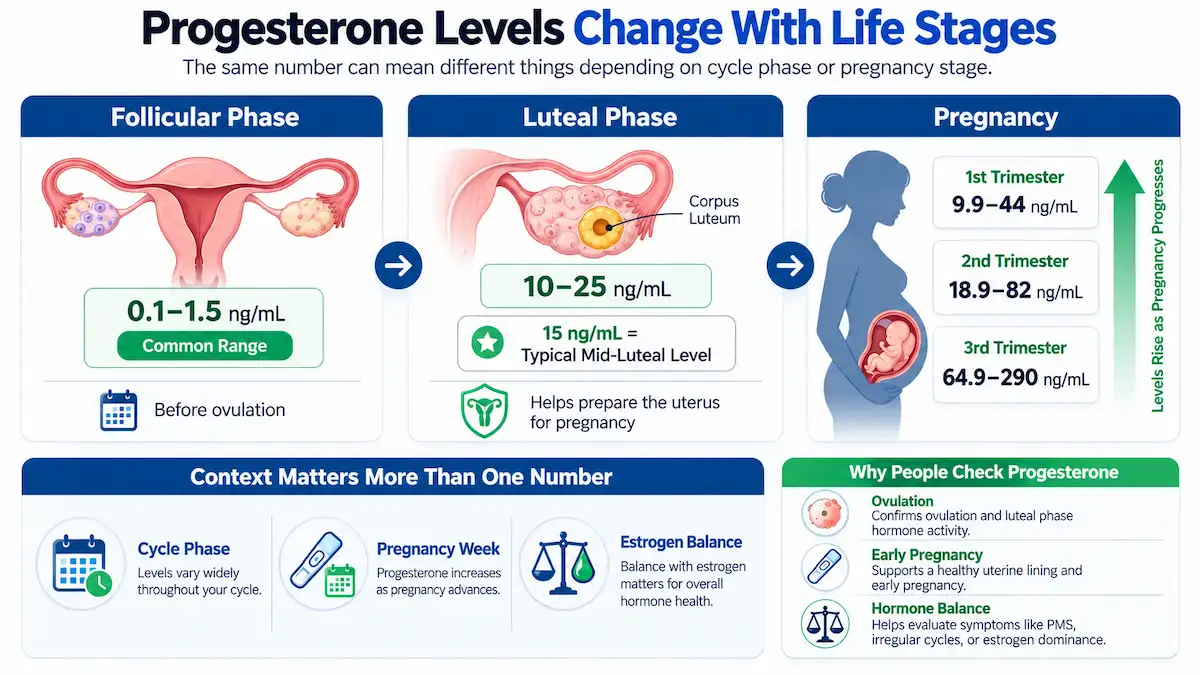
Micro Insight
Progesterone is highly time-sensitive. The same result can mean something different before ovulation, during the luteal phase, or during pregnancy. Laboratory reference intervals can also vary, so use this calculator for context and compare the result with the range shown on your own lab report.
What Is Progesterone and Why Do Its Levels Matter?
Progesterone is a hormone produced mainly by the corpus luteum after ovulation. It helps prepare and maintain the uterine lining. If pregnancy occurs, progesterone remains important, and the placenta later becomes a major source of the hormone.
A serum progesterone result cannot be interpreted from the number alone. Its meaning depends on when the blood sample was taken, whether pregnancy is present, the stage being assessed, and the reference interval used by the laboratory. This is why the calculator compares a result with the specific cycle phase or pregnancy trimester you select.
For an appropriately timed luteal-phase test, a progesterone level above 3 ng/mL can provide evidence of recent ovulation. However, one progesterone measurement cannot determine the quality of the luteal phase. The Pg:E2 mode is also a mathematical ratio only; it does not diagnose “estrogen dominance” or another hormone imbalance.
What Your Progesterone Result Means
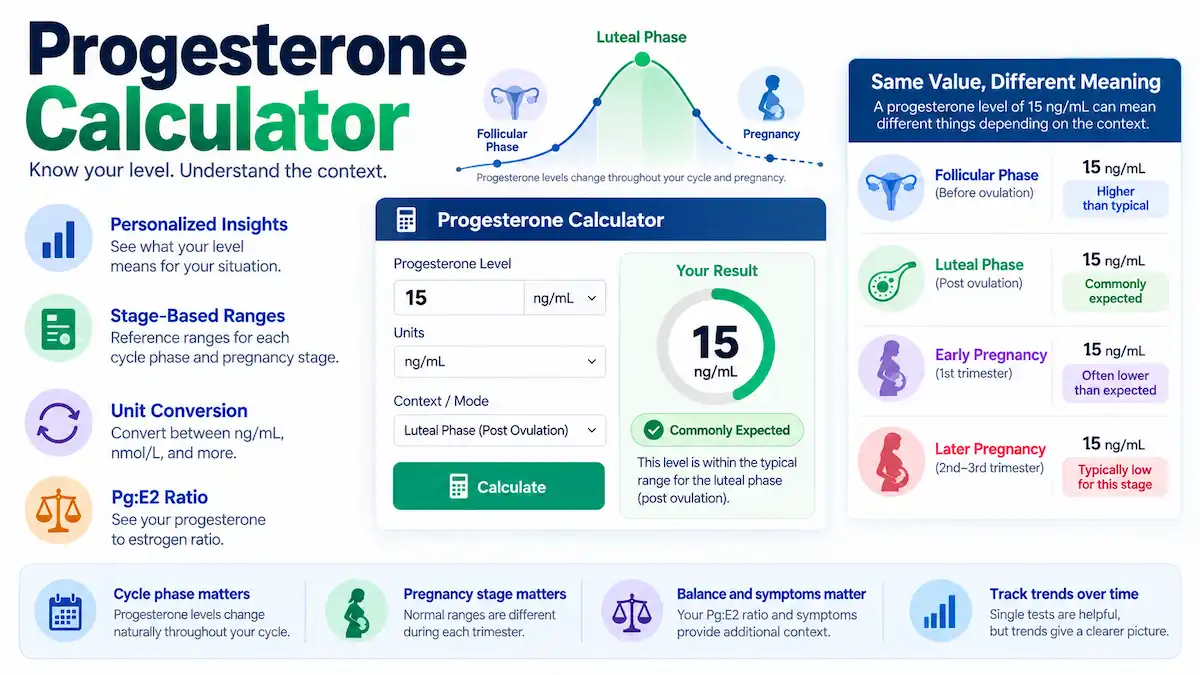
Your progesterone result shows the converted value and, when you select a human stage, how it compares with an example reference interval for that stage. The same progesterone value can have a different meaning depending on cycle timing, pregnancy stage, and laboratory method.
The calculator reports whether your result is below, within, or above its example range. These labels are comparison tools, not diagnoses. Your own laboratory’s reference interval should take priority when it differs from the calculator.
Understanding Your Result
In Human Levels mode, the calculator first converts your progesterone result and then compares it with the example interval for the stage you selected. Results are described as Below Example Range, Within Example Range, or Above Example Range rather than being labeled universally “good,” “bad,” or “optimal.”
For menstrual-cycle testing, timing matters. Progesterone is normally low before ovulation and rises afterward. If you choose the Mid-Luteal / Ovulation Check, a properly timed value above 3 ng/mL supports evidence of recent ovulation. A single result cannot measure how “strong” an ovulation was or diagnose a luteal-phase defect.
During pregnancy, progesterone generally changes as pregnancy progresses. The calculator can compare your number with an example trimester interval, but progesterone alone cannot determine whether a pregnancy is viable or where the pregnancy is located.
In Pg:E2 Ratio mode, the calculator standardizes the hormone units and calculates the progesterone-to-estradiol mass ratio. It displays the numerical ratio without classifying it as estrogen dominance, progesterone dominance, or an ideal hormone balance.
Reference intervals are not identical across laboratories. Always compare the calculator output with the interval printed on the laboratory report that produced your result.
How Should You Interpret Your Progesterone Result?
There is no single progesterone number that is “good” or “bad” in every situation. The useful comparison depends on why the test was performed and when the sample was collected.
Below Example Range: Your value is below the calculator’s example interval for the selected stage. This does not identify the cause or diagnose a medical condition.
Within Example Range: Your value falls within the calculator’s example interval for the selected stage. It does not by itself confirm normal fertility or a healthy pregnancy.
Above Example Range: Your value is above the calculator’s example interval. The calculator does not determine why it is elevated.
Supports Recent Ovulation: In Mid-Luteal / Ovulation Check mode, a properly timed progesterone result above 3 ng/mL provides presumptive evidence that ovulation recently occurred.
Timing Matters: A result that does not cross the ovulation threshold may need to be interpreted according to when the sample was taken. Progesterone testing is generally more informative about ovulation when performed about one week before the expected next menstrual period rather than automatically on cycle day 21.
Pg:E2 Ratio: The ratio is shown as a mathematical result only. There is no universal diagnostic cutoff in this calculator for “estrogen dominance” or “optimal hormone balance.”
What You Should Do Next
- Check the unit and reference interval printed on your original lab report before comparing results.
- If you are using progesterone to check ovulation, confirm that the blood sample was taken at the appropriate point in your cycle, usually about one week before the expected next period.
- If you are pregnant, do not use one progesterone result or this calculator to determine pregnancy viability or location. Discuss unexpected results or concerning symptoms with your healthcare provider.
- Treat a Pg:E2 result as a calculated ratio, not as a diagnosis of estrogen dominance or another hormone disorder.
Quick Example to Test
Input:
Mode: Human Levels & Conversion
Progesterone: 30 ng/mL
Stage: Second Trimester
Result
Converted value: 95.42 nmol/L
Status: Within Example Range
Meaning
A progesterone result of 30 ng/mL falls within this calculator’s second-trimester example interval of 25 to 83 ng/mL. This is a reference comparison only. It does not determine pregnancy viability, and the reference interval on your own laboratory report should take priority.
How to Use the Progesterone Calculator
The Progesterone Calculator has two modes. Use Levels & Conversion to convert a serum progesterone result between ng/mL and nmol/L or compare it with an example reference interval for your selected cycle or pregnancy stage. Use Progesterone : Estradiol Ratio to calculate a Pg:E2 mass ratio from your progesterone and estradiol results.
Enter Your Progesterone Level
Enter the serum progesterone value shown on your laboratory report. Use the number exactly as reported and check whether the unit is ng/mL or nmol/L before continuing.
Choose the Correct Unit
Select the unit used on your laboratory report. Choose ng/mL for a result reported in nanograms per milliliter or nmol/L for nanomoles per liter. The calculator automatically converts the result and displays both units.
Select the Right Calculation Mode
Choose Levels & Conversion if you want to convert progesterone units or compare your result with a selected human reference context. Choose Progesterone : Estradiol Ratio if you want to calculate a Pg:E2 ratio using both progesterone and estradiol results.
Choose Your Result Context or Enter Estradiol
In Levels & Conversion mode, select the context that matches your blood test, such as follicular phase, luteal phase, mid-luteal / ovulation check, pregnancy trimester, or postmenopause. In Pg:E2 Ratio mode, enter your estradiol result and select pg/mL or pmol/L.
Review Your Result and Reference Range
Review the converted progesterone value and the result message. Human reference comparisons are shown as Below Example Range, Within Example Range, or Above Example Range. The mid-luteal option may show whether the result supports recent ovulation when timed appropriately. Pg:E2 mode reports the calculated ratio without diagnosing estrogen dominance or an “optimal” hormone balance.
Quick Example: Mid-Luteal Progesterone Check
Inputs
- Progesterone: 4 ng/mL
- Mode: Levels & Conversion
- Context: Mid-Luteal / Ovulation Check
Result
- Converted value: 12.72 nmol/L
- Status: Supports Recent Ovulation
Meaning
If the blood sample was collected at the appropriate mid-luteal time, a progesterone level above 3 ng/mL provides presumptive evidence of recent ovulation. This result does not measure the quality of the luteal phase or diagnose a luteal-phase disorder.
How the Progesterone Calculator System Works
The Progesterone Calculator first standardizes your hormone values into comparable units. In Levels & Conversion mode, it can convert progesterone between ng/mL and nmol/L or compare the result with an example serum reference interval for the context you select. The mid-luteal option uses a separate ovulation-focused interpretation, while Pg:E2 mode calculates a numerical progesterone-to-estradiol ratio without diagnosing a hormone imbalance.
Key Features & Benefits
- Converts serum progesterone between ng/mL and nmol/L and displays both values for easier comparison with laboratory reports.
- Compares progesterone with example serum reference intervals for follicular phase, luteal phase, pregnancy trimesters, and postmenopause when the matching context is selected.
- Calculates a Pg:E2 mass ratio after standardizing progesterone and estradiol into the units required by the formula.
- Reports the calculated Pg:E2 ratio as a number without labeling it as estrogen dominance, progesterone dominance, or an optimal hormone balance.
- Includes a mid-luteal ovulation check for appropriately timed serum progesterone results while explaining the limits of a single measurement.
Technical Process
Unit Conversion
Progesterone is standardized between ng/mL and nmol/L. In Pg:E2 mode, estradiol is also converted when needed so the ratio can be calculated consistently.
Context Comparison
When a human context is selected, the calculator compares the progesterone result with the corresponding example laboratory interval. Your own laboratory's reference interval should take priority.
Result Interpretation
The result explains whether a value is below, within, or above the selected example interval. Mid-luteal results use ovulation-focused wording, while Pg:E2 mode reports the calculated ratio without diagnosing a hormone condition.
How the Progesterone Calculator Formula Works
The Progesterone Calculator uses standard unit conversions to express progesterone in both ng/mL and nmol/L. In Pg:E2 mode, it also standardizes estradiol before calculating a progesterone-to-estradiol mass ratio. Reference-range comparisons and the mid-luteal ovulation check are handled separately from the conversion math, so a calculated ratio is not treated as a diagnosis of hormone balance or estrogen dominance.
Progesterone Conversion and Pg:E2 Ratio Formulas
					Progesterone Conversion

nmol/L ≈ ng/mL × 3.18

ng/mL ≈ nmol/L ÷ 3.18


Estradiol Conversion

pmol/L ≈ pg/mL × 3.6713

pg/mL ≈ pmol/L ÷ 3.6713


Progesterone-to-Estradiol (Pg:E2) Mass Ratio

Pg:E2 Ratio = (Progesterone in ng/mL × 1000) ÷ Estradiol in pg/mL
What These Formulas Do
The conversion formulas express the same progesterone measurement in ng/mL and nmol/L, making it easier to compare a result with a laboratory report or reference interval that uses a different unit. Estradiol can likewise be converted between pg/mL and pmol/L when Pg:E2 mode is used.
For the Pg:E2 calculation, progesterone in ng/mL is multiplied by 1,000 so both hormone concentrations are expressed on the same mass scale before division. For example, the calculator may return a numerical ratio such as 150:1. The ratio itself does not establish whether hormone levels are normal, abnormal, balanced, or “estrogen dominant.”
Understanding the Formula Variables
Pg — Progesterone
Pg represents the serum progesterone value entered into the calculator. It can be converted between ng/mL and nmol/L, compared with the selected human reference context, used for the mid-luteal ovulation check, or included in the Pg:E2 calculation.
E2
E2 means estradiol, a form of estrogen measured in blood testing. It is required only in Pg:E2 mode. If necessary, the calculator converts the estradiol value before calculating the numerical progesterone-to-estradiol ratio.
ng/mL
ng/mL means nanograms per milliliter. It is one unit used to report serum progesterone concentrations, including by many laboratories in the United States.
nmol/L
nmol/L means nanomoles per liter. It is an SI unit used for progesterone reporting by many laboratories. The calculator converts between nmol/L and ng/mL automatically.
pg/mL
pg/mL means picograms per milliliter and is commonly used for serum estradiol measurements. In Pg:E2 mode, estradiol is expressed in pg/mL before the ratio is calculated.
Pg:E2
Pg:E2 is the numerical mass ratio between progesterone and estradiol after both values are expressed on a comparable scale. This calculator reports the arithmetic ratio only. It does not use a Pg:E2 cutoff to diagnose estrogen dominance, progesterone dominance, fertility problems, or another hormone disorder.
Another Example Calculation (Step-by-Step)
This example shows how Pg:E2 mode calculates a numerical progesterone-to-estradiol ratio after the values are expressed in compatible mass units. The calculation does not determine whether the hormone relationship is medically optimal or abnormal.
Given:
- Progesterone = 18 ng/mL
- Estradiol = 120 pg/mL
- Mode = Pg:E2 Ratio
Calculation:
					Pg:E2 Ratio = (18 ng/mL × 1000) ÷ 120 pg/mL

Pg:E2 Ratio = 150:1
Result:
- Pg:E2 Ratio: 150:1
- Result Type: Numerical Ratio
Meaning:
A Pg:E2 ratio of 150:1 means that, after converting progesterone to the same mass scale as estradiol, the progesterone concentration is 150 times the estradiol concentration. The calculator reports this mathematical relationship without classifying it as optimal, low, high, or estrogen dominant. Clinical interpretation should consider the individual hormone results, test timing, laboratory reference intervals, symptoms, medications, and the reason the tests were ordered.
How Does a Progesterone Calculator Work for Pregnancy, Ovulation, Conversion, and Pg:E2 Ratio?
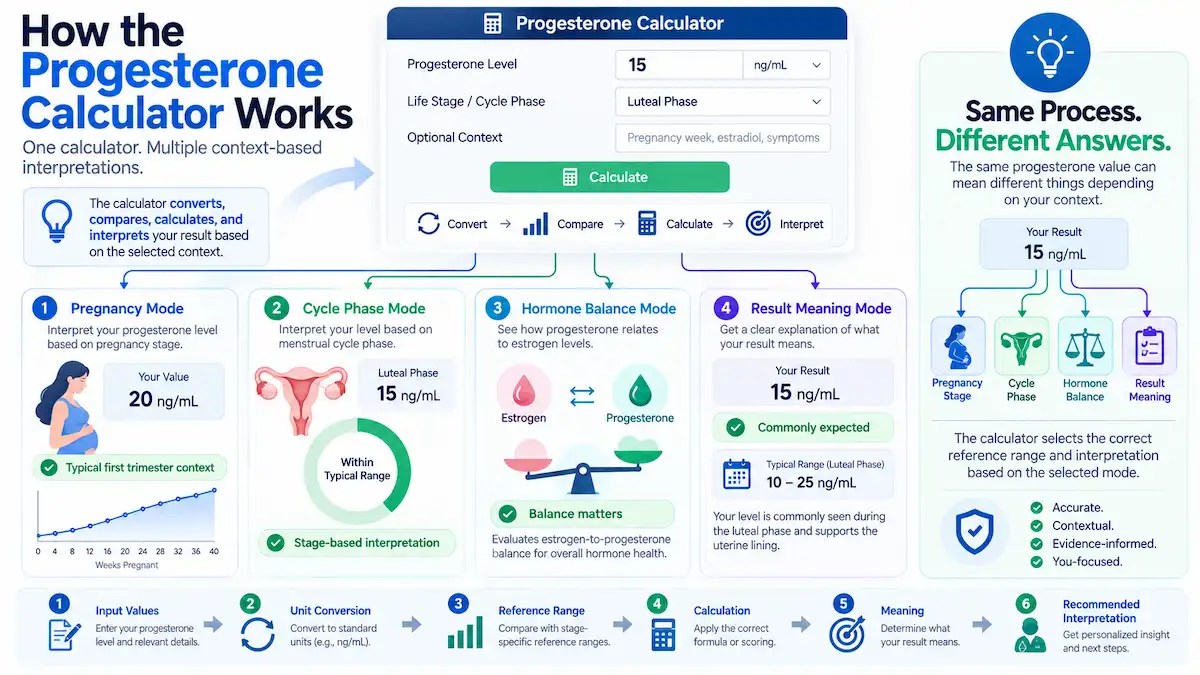
A progesterone calculator can convert a measured progesterone value between ng/mL and nmol/L, compare it with a selected reference context, provide an appropriately timed mid-luteal ovulation check, or calculate a numerical progesterone-to-estradiol (Pg:E2) ratio. The examples below show how each calculation works and what the result can and cannot tell you.
How does a pregnancy progesterone calculator work in the first trimester?
Pregnancy progesterone results should be interpreted in the context of pregnancy stage and the reference interval supplied by the laboratory that performed the test. The calculator can convert the value and provide an educational comparison, but it cannot determine pregnancy viability from a single progesterone result.
Input:
- Progesterone = 20 ng/mL
- Stage = First Trimester
Process:
The calculator converts the entered value:
20 × 3.18 = 63.6 nmol/L
It then compares 20 ng/mL with the example first-trimester reference interval.
Result:
- Progesterone: 20 ng/mL
- Converted value: 63.6 nmol/L
- Reference comparison: Within the example first-trimester range
Meaning:
A progesterone value of 20 ng/mL falls within the 11–44 ng/mL first-trimester reference interval used for this educational comparison. Laboratory intervals can differ by assay and provider, so your own lab’s range should take priority. A value inside or outside a reference interval does not by itself determine whether a pregnancy is progressing normally.
How is the progesterone-to-estradiol (Pg:E2) ratio calculated?
Pg:E2 mode calculates the numerical relationship between a progesterone result and an estradiol result. It is a mathematical ratio, not a diagnostic test for estrogen dominance or hormone balance.
Input:
- Progesterone = 15 ng/mL
- Estradiol = 150 pg/mL
Process:
The calculator expresses the values on a compatible mass scale and applies:
Pg:E2 Ratio = (15 × 1000) ÷ 150
Pg:E2 Ratio = 100:1
Result:
- Pg:E2 Ratio: 100:1
- Result type: Numerical ratio
Meaning:
A result of 100:1 means the progesterone concentration is 100 times the estradiol concentration after the unit adjustment used by the calculator. The number should not be interpreted by itself as proof of “optimal balance,” estrogen dominance, progesterone dominance, or a fertility disorder.
How do you convert progesterone from nmol/L to ng/mL?
Progesterone results may be reported in nmol/L instead of ng/mL. The calculator can convert between these units without changing the underlying hormone concentration.
Input:
- Progesterone: 63.6 nmol/L
Process:
To convert nmol/L to ng/mL:
63.6 ÷ 3.18 = 20 ng/mL
Result:
- 63.6 nmol/L = 20 ng/mL
Meaning:
These two numbers represent the same progesterone concentration in different units. Converting the unit does not change the clinical meaning of the original laboratory result. For interpretation, compare the converted value with the appropriate reference interval for the test timing and laboratory.
Can a progesterone level confirm that ovulation occurred?
A properly timed serum progesterone test can provide evidence that ovulation recently occurred, but one progesterone value cannot measure the quality of the luteal phase or overall fertility.
Input:
- Progesterone: 8 ng/mL
- Timing: About 1 week before the expected next period
Process:
The calculator converts the value if needed and applies the mid-luteal ovulation interpretation.
8 ng/mL × 3.18 = 25.44 nmol/L
Result:
- Progesterone: 8 ng/mL
- Converted value: 25.44 nmol/L
- Ovulation context: Consistent with recent ovulation
Meaning:
A properly timed luteal progesterone result above 3 ng/mL provides presumptive evidence that recent ovulation occurred. It does not show whether the luteal phase is “strong,” whether implantation will occur, or whether fertility is normal. Progesterone is released in pulses, so a single measurement can vary substantially over a short period.
Quick Rules to Remember
Use the Progesterone Calculator to convert progesterone between ng/mL and nmol/L, compare a measured value with the selected reference context, review an appropriately timed mid-luteal result for evidence of recent ovulation, or calculate a numerical Pg:E2 ratio. Reference comparisons are educational, laboratory ranges may differ, and neither a single progesterone value nor a Pg:E2 ratio should be used by itself to diagnose a hormone disorder, assess pregnancy viability, or judge overall fertility.
What Your Progesterone Calculator Result Means by Range
Progesterone levels change across the menstrual cycle, pregnancy, and menopause, so the same number can have a different meaning depending on when the sample was taken. The table below shows the serum reference intervals used by this calculator and the separate rule used for an appropriately timed ovulation check. These are educational comparison values, not universal diagnostic cutoffs. Your laboratory’s own reference interval should take priority when it is available.
| Context | Reference Value | What the Calculator Shows | Important Limit |
|---|---|---|---|
| Follicular Phase | ≤ 0.89 ng/mL |
Reference Interval
Progesterone is normally low before ovulation. | Compare with the reference interval printed on your own laboratory report when available. |
| Luteal Phase | 1.8–24 ng/mL |
Reference Interval
This is the example serum luteal-phase reference interval used by the calculator. | A single progesterone result should not be used to judge luteal-phase quality or fertility. |
| Ovulation Check | > 3 ng/mL when appropriately timed |
Recent Ovulation Evidence
A properly timed luteal result above 3 ng/mL provides presumptive evidence that ovulation recently occurred. | Test timing matters. One progesterone value cannot show whether the luteal phase is adequate or predict fertility. |
| First Trimester | 11–44 ng/mL |
Example Pregnancy Range
The calculator compares the entered value with this first-trimester serum reference interval. | A single progesterone value cannot determine pregnancy viability. Pregnancy ranges also vary by laboratory and assay. |
| Second Trimester | 25–83 ng/mL |
Example Pregnancy Range
The calculator uses this interval for an educational second-trimester comparison. | Use the range on your own laboratory report for clinical interpretation. |
| Third Trimester | 58–214 ng/mL |
Example Pregnancy Range
Progesterone is normally much higher later in pregnancy. | Results outside an example range need clinical context rather than an automatic low or high diagnosis. |
| Postmenopausal | ≤ 0.20 ng/mL |
Reference Interval
This is the example postmenopausal serum reference interval used by the calculator. | Hormone therapy and other clinical factors can affect interpretation. |
| Pg:E2 Ratio | No universal diagnostic cutoff |
Numerical Ratio
The calculator reports the mathematical relationship between progesterone and estradiol after unit adjustment. | Do not use a Pg:E2 result alone to diagnose estrogen dominance, progesterone dominance, infertility, or another hormone disorder. |
Important: These are reference comparisons, not universal country-specific treatment thresholds. Progesterone reference intervals can vary by laboratory method, test timing, pregnancy stage, and clinical setting. Use the range supplied with your own lab result when available.
Source basis: Human serum reference intervals are based on Mayo Clinic Laboratories' progesterone reference values. The ovulation interpretation follows American Society for Reproductive Medicine guidance that an appropriately timed luteal progesterone level above 3 ng/mL provides presumptive evidence of recent ovulation, while a single measurement cannot assess luteal-phase quality.
Interpretation
Your progesterone result should be interpreted according to the context in which the test was taken. Menstrual-cycle and pregnancy values can be compared with an appropriate serum reference interval, while a properly timed luteal progesterone test can provide evidence of recent ovulation. The Pg:E2 mode is different: it calculates a numerical hormone ratio and does not diagnose hormone balance or estrogen dominance.
Pro Tip
Check the unit and timing before interpreting your result. A progesterone concentration reported in ng/mL may look numerically very different after conversion to nmol/L even though it represents the same hormone level. If progesterone is being checked for ovulation, ASRM recommends timing the blood test about one week before the expected next period rather than automatically testing on cycle day 21.
What to Do After Using the Progesterone Calculator
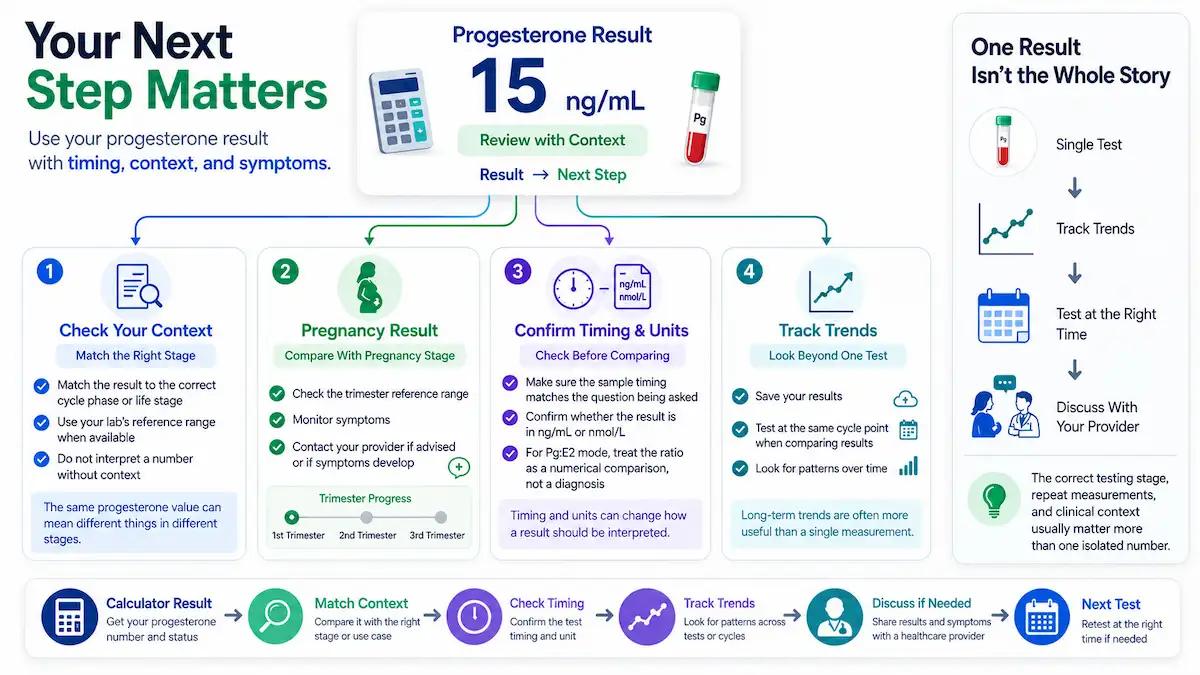
After using the Progesterone Calculator, review the result together with the test timing, selected cycle or pregnancy stage, measurement unit, and reference interval on your laboratory report. A calculator comparison can add context, but one progesterone value should not be used by itself to diagnose a fertility problem, judge luteal-phase quality, or determine whether a pregnancy is progressing normally.
For Cycle or Ovulation Results
First check when the blood sample was taken. For an ovulation assessment, serum progesterone is generally most informative when measured about one week before the expected next period rather than automatically on cycle day 21. A properly timed result above 3 ng/mL provides presumptive evidence of recent ovulation, but one value cannot show whether the luteal phase is adequate or “strong.” Compare the result with your laboratory report and discuss unexpected findings with your healthcare provider when needed.
For Pregnancy Progesterone Results
Compare the result with the correct pregnancy trimester and the reference interval supplied by the laboratory that performed the test. Pregnancy progesterone ranges change across gestation and can differ between laboratories. A result inside or outside an example range cannot by itself establish pregnancy viability, so unexpected results should be interpreted with your healthcare provider in the context of your pregnancy timing, symptoms, and other clinical information.
For Pg:E2 Ratio Results
Treat the Pg:E2 result as a numerical comparison between progesterone and estradiol, not as a diagnosis. Check that both hormone values and units were entered correctly, then review the individual progesterone and estradiol results against their own laboratory reference intervals. This calculator does not use the Pg:E2 ratio to diagnose estrogen dominance, progesterone dominance, infertility, or another hormone disorder.
For Comparing Results Over Time
If you have more than one progesterone result, record the test date, cycle timing or pregnancy stage, measurement unit, laboratory reference interval, and any relevant treatment context. When menstrual-cycle tests are being compared, similar timing can make the results easier to interpret. Look for patterns rather than assuming that one isolated measurement represents your usual progesterone level.
You Might Also Find These Helpful
Pregnancy & Fertility 45
Use this Pregnancy Risk Calculator to check age, BMI, health history, bleeding, and twins. See if closer prenatal monitoring may be worth asking about.
Try calculatorOne Time Pregnancy Calculator estimates pregnancy odds from one encounter, plus fertile window timing, test date, due date, and 21-day testing guidance.
Try calculatorUse the AMH Calculator to convert ng/mL or pmol/L, compare your result with age-based data, and see what it may mean for IVF, fertility,…
Try calculatorUse the Baby Eye Color Calculator with parents, grandparents, or sibling context to compare Brown, Green/Hazel, and Blue/Grey model estimates instantly.
Try calculatorBasal Body Temperature Calculator checks reading conditions and analyzes your temperature pattern for a sustained shift that may be consistent with ovulation.
Try calculatorBPD gestational age calculator: estimate fetal age from BPD, compare your week, check normal BPD ranges, and understand ahead or behind results.
Try calculatorCalculate odds with the Chance of Twins Calculator. Enter maternal age and history. Find your probability instantly. See if you will conceive multiples now.
Try calculatorFind out exactly when you conceived. Our free Conception Calculator uses your Due Date, LMP, or Ultrasound to estimate your fertilization date and fertile…
Try calculatorUse our Conception Date Due Date Calculator to find your baby's arrival date. Enter your conception or intercourse date for clinical 40-week results.
Try calculatorContraceptive effectiveness calculator to compare birth control methods, typical vs perfect use, backup protection, and 5-year pregnancy risk.
Try calculatorUse this CRL calculator to estimate gestational age and due date from crown-rump length in mm or cm. Compare CRL, LMP, and IVF dating…
Try calculatorEstimate your monthly and 12-month pregnancy odds by age, partner age, and cycle dates. See your fertile window and when to seek fertility help.
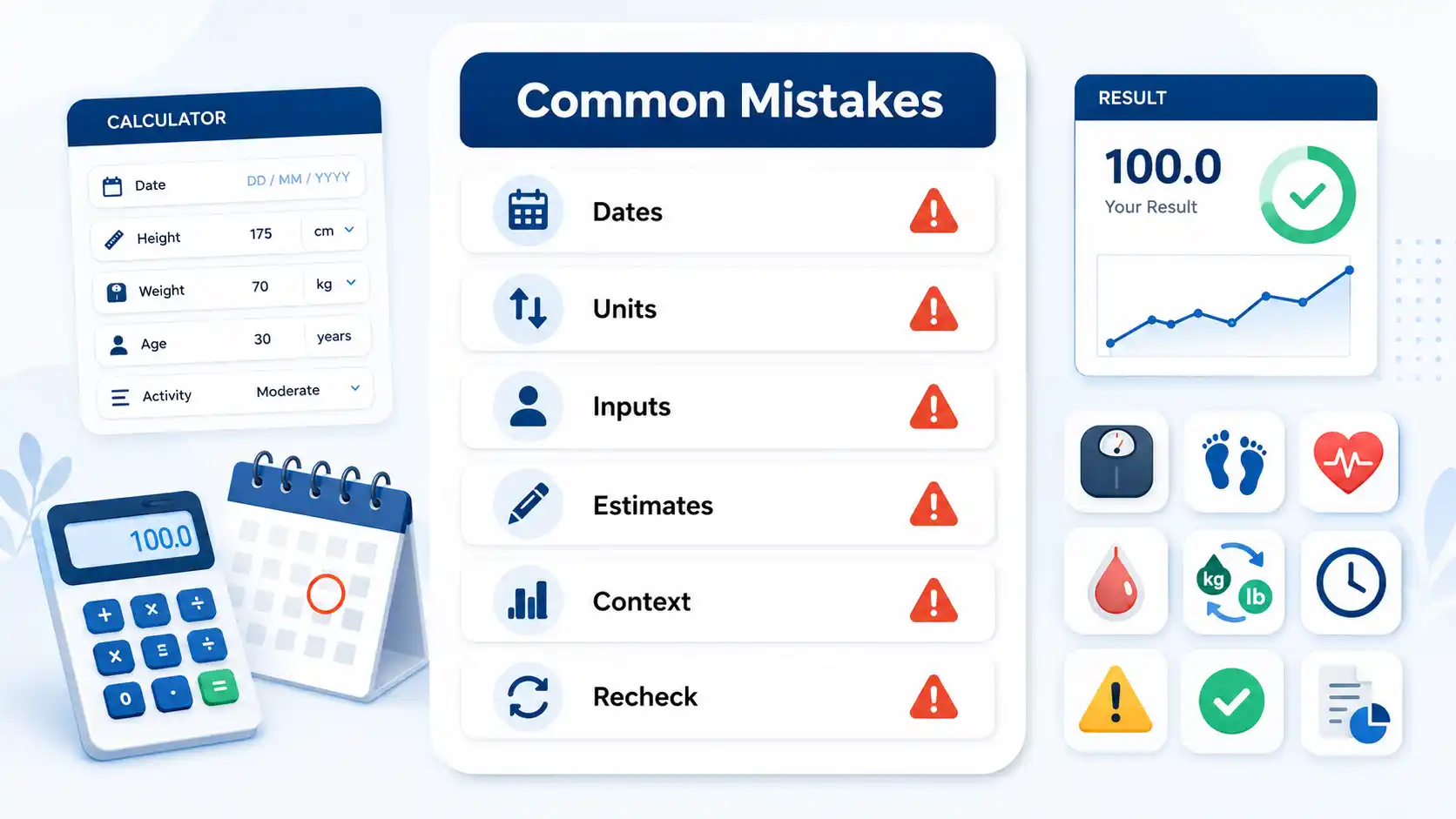
Try calculatorCommon Mistakes When Using the Progesterone Calculator
The most common progesterone calculator mistakes come from entering the wrong unit, choosing a result context that does not match the blood draw, testing at the wrong point in the cycle, or treating one hormone result as a diagnosis. Check the original laboratory report first, including its unit, collection timing, and reference interval.
- Entering the right number with the wrong unit. A progesterone result of 10 ng/mL is not the same numeric value as 10 nmol/L. Select the unit exactly as it appears on the laboratory report.
- Comparing the result with the wrong context. A follicular-phase value should not be interpreted using a luteal or pregnancy reference interval, and pregnancy results should be matched with the correct trimester.
- Assuming every ovulation progesterone test should be taken on cycle day 21. For ovulation assessment, the blood test is generally more informative when taken about one week before the expected next period, so the appropriate day depends on cycle length.
- Treating a Pg:E2 ratio as a diagnosis. The calculator reports a numerical progesterone-to-estradiol ratio, but it does not use that number to diagnose estrogen dominance, progesterone dominance, infertility, or an “optimal” hormone balance.
- Drawing a medical conclusion from one progesterone result. A properly timed result can provide evidence of recent ovulation, but progesterone can fluctuate substantially over a short period. One measurement cannot assess luteal-phase quality, overall fertility, or pregnancy viability by itself.
Frequently Asked Questions (FAQs)
What is a normal progesterone level during early pregnancy?
There is no single progesterone value that is normal for every early pregnancy. As one example, Mayo Clinic Laboratories lists a first-trimester serum reference interval of 11 to 44 ng/mL. Other laboratories may use different ranges, so the interval printed on your own lab report should take priority. A single progesterone result cannot determine pregnancy viability by itself.
Is 12 ng/mL considered low progesterone?
Whether 12 ng/mL is considered low depends on why and when the test was performed. For a properly timed luteal-phase test, 12 ng/mL is above the >3 ng/mL level that provides presumptive evidence of recent ovulation, and it also falls within the example 1.8 to 24 ng/mL luteal reference interval used by this calculator. However, one progesterone value cannot determine luteal-phase quality or overall fertility.
How is day 21 progesterone interpreted?
“Day 21 progesterone” is really a shorthand for a luteal-phase progesterone test. ASRM recommends testing about one week before the expected next period rather than automatically on cycle day 21. A properly timed progesterone result above 3 ng/mL provides presumptive evidence of recent ovulation, but a single result cannot determine luteal-phase quality.
Can progesterone levels change during the same menstrual cycle?
Yes. Progesterone is usually low before ovulation, rises after ovulation, and falls again before menstruation if pregnancy does not occur. During the luteal phase it is released in pulses, so blood levels can also change substantially over a short period. This is why test timing and clinical context matter when interpreting one result.
Can a progesterone level confirm whether a pregnancy is viable?
No. A progesterone blood test can provide useful clinical information, but one progesterone value cannot confirm whether a pregnancy is viable or determine where the pregnancy is located. Pregnancy timing, symptoms, hCG results, ultrasound findings, and other clinical information may be needed for interpretation.
How do I convert progesterone from ng/mL to nmol/L?
To convert progesterone from ng/mL to nmol/L, multiply by approximately 3.18. For example, 20 ng/mL is about 63.6 nmol/L. To convert in the opposite direction, divide nmol/L by 3.18. The two values represent the same hormone concentration in different units.
How do you calculate the progesterone to estrogen ratio?
To calculate the progesterone-to-estradiol (Pg:E2) mass ratio, multiply progesterone in ng/mL by 1,000 and divide by estradiol in pg/mL. For example, 15 ng/mL progesterone and 150 pg/mL estradiol produce a ratio of 100:1. The result is a numerical comparison only and does not diagnose hormone balance or estrogen dominance.
What is the ideal progesterone to estrogen ratio?
There is no universally validated “ideal” Pg:E2 ratio for diagnosing hormone balance from routine serum progesterone and estradiol results. This calculator can calculate the numerical ratio, but it does not classify 100:1, 500:1, or another cutoff as medically optimal. The individual hormone values, test timing, treatment context, and laboratory reference ranges are more important for clinical interpretation.
Can a Pg:E2 ratio diagnose estrogen dominance?
No. A calculated Pg:E2 ratio does not by itself diagnose “estrogen dominance” or another hormone disorder. The ratio is an arithmetic comparison between progesterone and estradiol. Clinical interpretation should consider the individual hormone results, symptoms, cycle timing, medications, and the reference ranges supplied by the laboratory.
Is a progesterone calculator accurate for fertility tracking?
A progesterone calculator can accurately perform unit conversions and the Pg:E2 arithmetic when the inputs and units are correct. Its reference-range and ovulation outputs are educational comparisons rather than a complete fertility assessment. Fertility cannot be determined from a single progesterone result, and laboratory ranges, cycle timing, medical history, and other reproductive factors still matter.
Can you have normal progesterone and still have fertility problems?
Yes. A progesterone result that is within a reference range, or a properly timed result that supports recent ovulation, does not prove that fertility is normal. Fertility also depends on factors such as age, ovarian reserve, tubal function, uterine factors, sperm, timing, and other medical conditions. Progesterone is only one part of a fertility evaluation.
Questions?
We’d love to hear from you! Whether you are reporting an issue, suggesting a new calculator, or exploring collaboration opportunities — we are here to help. Every message helps us make 100calc smarter, faster, and more helpful for everyone.
Why People Trust 100calc
At 100calc.com, we focus on accuracy, speed, and trust. Every calculator we create is designed to give reliable, instant, and easy-to-understand results you can truly depend on.