
Twin Growth Discordance Calculator: Normal Difference or Warning Sign?
A Twin Growth Discordance Calculator measures the percentage weight difference between twins using estimated fetal weight from an ultrasound report. It compares the smaller twin with the larger twin and shows whether growth falls within normal limits, mild discordance, or severe discordance based on accepted clinical thresholds.
A small size difference is common in twin pregnancies. The confusing part is knowing when that difference becomes important. Many parents see a number like 20% or 25% and wonder if it means a serious problem. The answer depends on the degree of discordance, growth trends, and whether the twins share a placenta.
Enter both twin weights and select the twin type. The calculator instantly shows the discordance percentage, explains what the result means, and helps you understand whether the difference is generally considered normal, mildly discordant, or severe.
Quick Facts
- Uses the standard twin discordance formula
- Automatically identifies the larger and smaller twin
- Supports grams and pounds/ounces
- Uses ACOG-based 20% and 25% thresholds
- Includes Di-Di and Mo-Di/Mo-Mo interpretation
- Calculates twin weight discordance instantly
- Updated Jul 2, 2026
- Reviewed by 100Calc Research Team
Twin Weight Comparison Tool
Twin Growth Discordance Calculator
Enter both twin weights to calculate the growth discordance percentage. The result explains whether the difference is below 20%, between 20% and 25%, or 25% and higher, with extra context for twin type.
Growth Discordance
Relative Size Visualizer
Result Meaning
Analysis based on American College of Obstetricians and Gynecologists criteria will appear here.
Placental Risk Factors (TTTS / sIUGR)
Dynamic medical context regarding your specific twin type will generate based on your variance percentage.
Is this growth discordance normal for twins?
Your dynamic answer will appear here.
How do doctors manage discordant twins?
Your static educational answer will appear here.
Helpful Note
Enter the estimated fetal weights from your ultrasound report. The calculator shows the discordance percentage, but your doctor will read that number with growth percentile, Doppler, fluid levels, and twin type.
Explore More Calculators
Use the Chinese Gender Calculator for a traditional boy-or-girl prediction from lunar age and conception month. Enter conception date, due date, or LMP.
Try calculatorUse this fetal growth calculator to check baby weight percentile from ultrasound data in grams, kg, or cm and see what the result means…
Try calculatorEnter gestational sac measurements in mm or cm to calculate mean sac diameter, estimate early gestational age, compare week-by-week milestones, and see when follow-up…
Try calculatorMissed a birth control pill? Check pregnancy risk, protection status, backup contraception needs, and what to do next with our missed pill calculator.
Try calculatorUse our Pregnancy Chance Calculator to estimate your odds. Enter your cycle day, age, and method. Find out if you are in the high-risk…
Try calculatorUse our pregnancy due date calculator to find your exact Baby Due date. IVF, conception, ovulation, and ultrasound methods with weeks and timeline.
Try calculator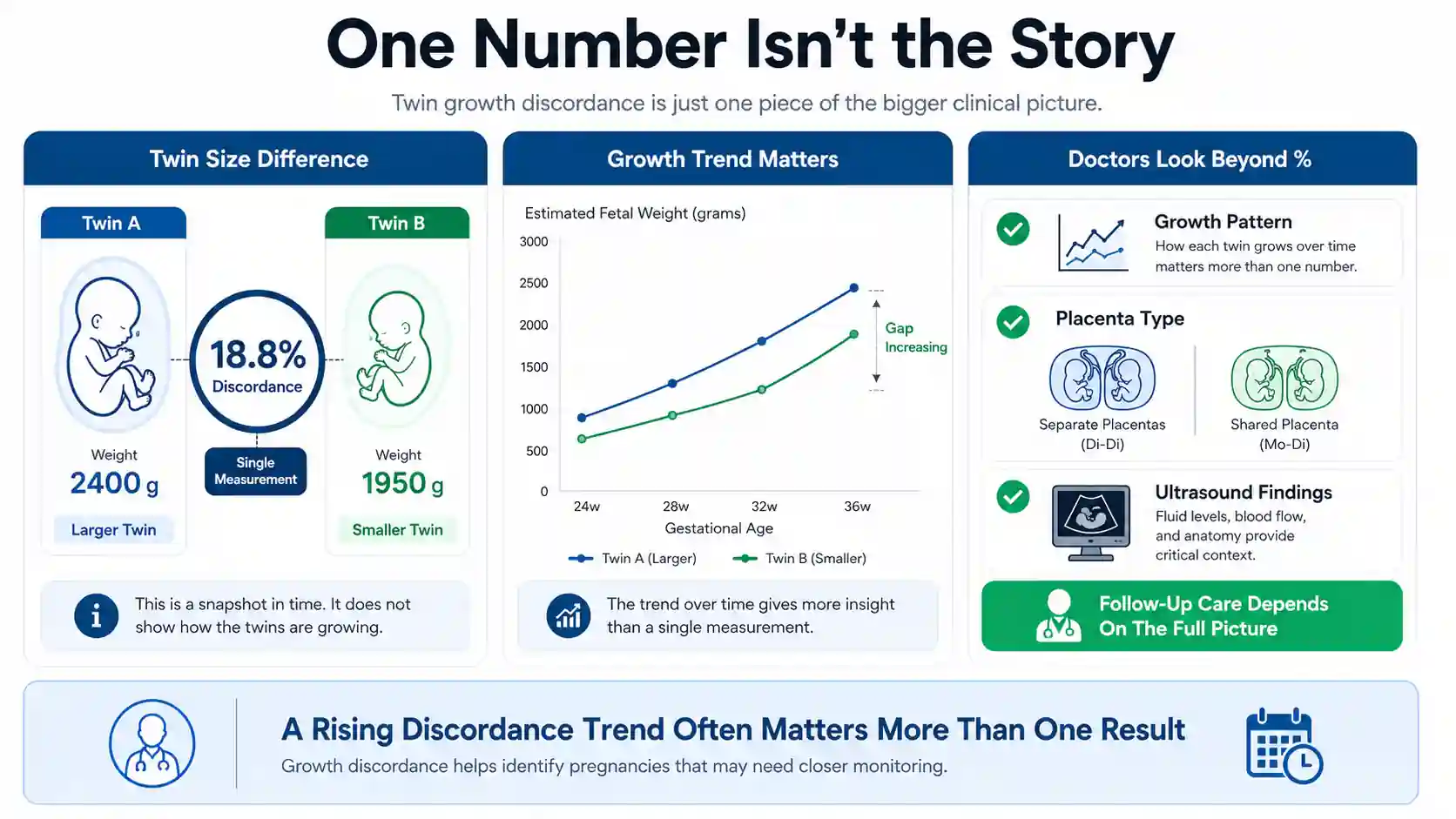
Micro Insight
The percentage matters because it helps guide follow-up care. A rising discordance trend often provides more useful information than a single measurement. Doctors look at the number alongside ultrasound findings, growth patterns, and placental type before making decisions.
What Is Twin Growth Discordance?
Twin pregnancies rarely produce two babies of exactly the same size. Small differences are common. Growth discordance becomes important when one baby starts falling noticeably behind the other over time.
Imagine twins estimated at 2,400 g and 1,950 g during a late pregnancy ultrasound. Both babies may still be growing, but the gap between them raises questions about placental function, nutrient sharing, and whether one twin is receiving enough support.
Growth discordance is not a diagnosis. It is a screening measure that helps doctors spot pregnancies needing extra attention. In monochorionic twins, where babies share a placenta, the same percentage difference often carries more concern than in twins with separate placentas.
What Your Twin Growth Discordance Result Means
Your twin growth discordance result shows the percentage size difference between the larger and smaller twin based on estimated fetal weight. The number helps identify whether both babies are growing at similar rates or whether one twin is falling behind enough to need closer monitoring.
Understanding Your Result
A low percentage means the twins are close in size. Small differences are common in twin pregnancies.
A higher percentage means one twin weighs noticeably less than the other. The result compares the smaller twin with the larger twin because the larger baby’s weight provides a stable reference point for measuring the gap.
Growth discordance measures size difference. It does not diagnose a medical condition.
Doctors also review growth trends, ultrasound findings, blood flow studies, and placental type before making decisions.
Is Your Result Good or Bad?
The result must be viewed in context.
Twin Growth Discordance Interpretation
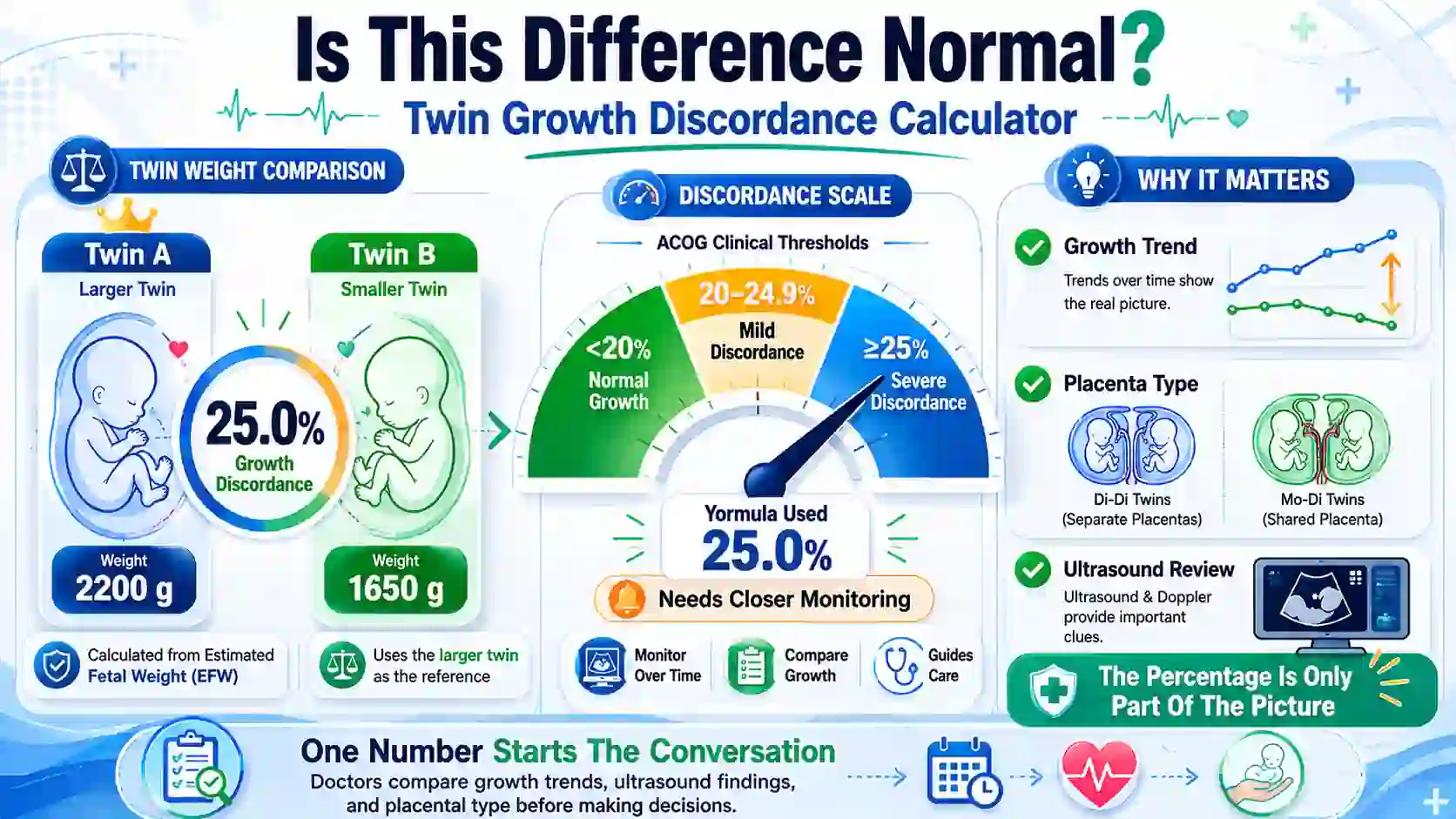
Less than 20% Normal growth. Twins are growing at similar rates.
20% to 24.9% Mild discordance. Closer follow-up may be recommended.
25% or higher Severe discordance. Further evaluation is often needed.
A higher percentage does not automatically mean the smaller twin has growth restriction.
Some twins have a size difference while both babies continue growing normally. What matters most is whether the gap stays stable or keeps increasing over time.
What You Should Do Next
Review the result alongside your latest ultrasound report.
- Compare current measurements with previous growth scans.
Discuss chorionicity with your healthcare team if it is unknown.
Follow any recommended follow-up ultrasound or Doppler appointments.
Shared-placenta twins often receive closer monitoring when discordance increases.
Quick Example to Test
- Gestational Age: 30 weeks
- Twin Type: Di-Di
- Twin A Weight: 2,000 g
- Twin B Weight: 1,600 g
Result: 20.0% Discordance
Meaning: Mild discordance.
One twin is noticeably smaller than the other. This result reaches the common clinical threshold for growth discordance. Extra growth scans may be used to monitor whether the size gap remains stable or increases during the third trimester.
How to Use the Twin Growth Discordance Calculator
This twin growth discordance calculator compares the estimated fetal weights of both twins to find the size difference between them. Enter the scan details, add both twin weights, and the calculator shows the discordance percentage with a growth category based on the size difference.
Select Your Gestational Age
Choose the current gestational age from the available options. This helps the calculator provide age-based interpretation for your result. The week does not change the discordance math. It only helps explain the finding in the right pregnancy stage.
Choose Your Twin Type
Select your twin type based on the ultrasound report. Options include Di-Di-Di, shared-placenta twins, or unsure. This information helps adjust the risk guidance because twins with a shared placenta may need closer monitoring than twins with separate placentas.
Enter Both Fetal Weights
Add the estimated fetal weight for Twin A and Twin B from the ultrasound report. You can enter weights in grams or pounds and ounces. If needed, the calculator converts the values into the same unit before comparing both twins.
Review the Twin Size Comparison
The calculator checks both weights and automatically finds the larger and smaller twin. It does not matter which twin you label as Twin A or Twin B. The system uses the correct values to calculate the size difference between the twins.
View Your Discordance Result
Your twin growth discordance percentage appears instantly with a growth category. The result shows whether the difference falls within the normal range, mild discordance range, or severe discordance range. The calculator also provides context based on your selected twin type.
Quick Example to Test
Sample Inputs
- Gestational Age: 30 weeks
- Twin Type: Di-Di
- Twin A Weight: 1,500 g
- Twin B Weight: 1,250 g
Result
- Larger Twin: 1,500 g
- Smaller Twin: 1,250 g
- Growth Discordance: 16.7%
- Category: Normal Growth
What Happened
The calculator identified Twin A as the larger twin and compared both estimated weights. The 16.7% difference stayed below the clinical discordance threshold, so the result was placed in the normal growth category.
How the Twin Growth Discordance Calculator System Works
The Twin Growth Discordance Calculator uses a clinical-style calculation method to compare twin estimated fetal weights. It standardizes weight inputs, applies the accepted discordance formula, and matches the result with growth categories. This helps users understand how the percentage is created and why the result follows a consistent process.
Key Features & Benefits
- Automatically identifies the larger and smaller twin weight
- Accepts ultrasound estimated fetal weight inputs
- Supports grams and pounds with ounce conversion
- Uses ACOG-aligned discordance thresholds
- Adds chorionicity-based guidance for result context
Technical Process
Data Input
Captures twin weights and pregnancy details before calculation
Logic Processing
Standardizes values and applies discordance calculation rules
Output Generation
Shows percentage results with growth category context
How the Twin Growth Discordance Formula Works (Complete Breakdown)
The twin discordance formula calculates the percentage difference between the larger fetus and the smaller fetus. It uses the larger fetus as the reference point, so the result shows how much smaller one twin is compared with the other.
What Is the Twin Growth Discordance Formula?
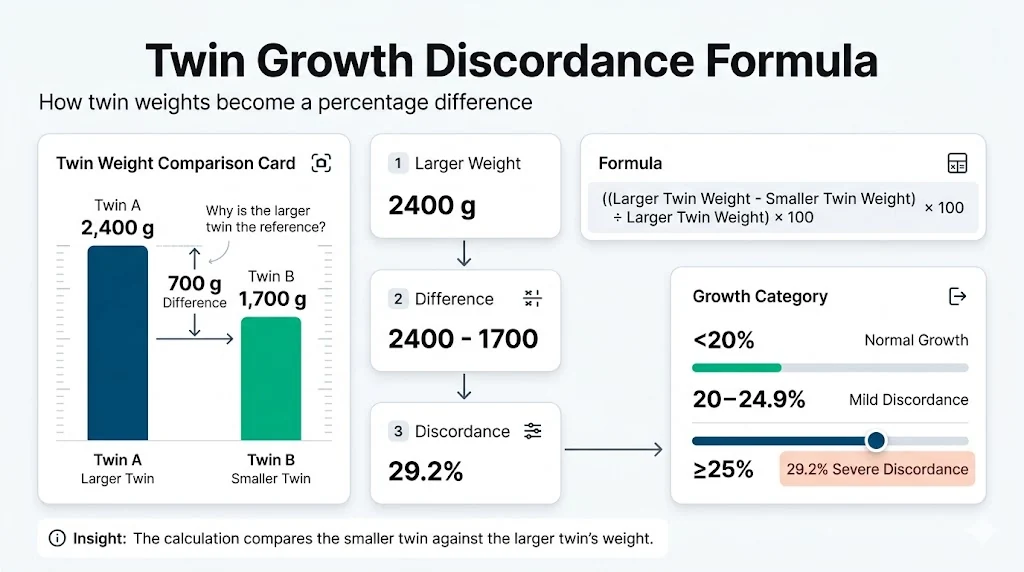
The twin growth discordance formula is: ((larger twin weight − smaller twin weight) ÷ larger twin weight) × 100. It shows how much smaller one twin is compared with the larger twin.
Formula
Discordance (%) = ((Larger Twin Weight - Smaller Twin Weight) / Larger Twin Weight) × 100
What These Formulas Do
This formula measures the relative size difference between twins. It uses the larger twin as the reference point and shows how much smaller the other twin is as a percentage.
Ultrasound fetal weights are estimates, so one scan should not be read alone. Doctors usually compare the result with previous scans to see whether the gap is stable, improving, or increasing.
The calculation does not compare both twins with an average weight. It only measures the gap between the larger and smaller twin.
Understanding the Formula Variables
Larger Twin Weight
The larger twin weight is the higher value between the two entered weights. The calculator automatically identifies this number from Twin A and Twin B inputs. It can represent an estimated fetal weight from an ultrasound or a recorded birth weight.
Smaller Twin Weight
The smaller twin weight is the lower value between the two twin measurements. The calculator finds this value automatically after comparing both inputs. It represents the twin with the lower estimated or recorded weight.
Discordance (%)
Discordance percentage shows the relative weight difference between twins. A lower percentage means the twins have similar weights. A higher percentage shows a larger difference between the two weights.
Another Example Calculation (Step-by-Step)
A simple example shows how the twin weight discordance calculator processes values. The calculation below follows the same logic used by the tool.
Given:
- Gestational Age = 34 weeks
- Twin Type = Mo-Di
- Twin A Weight = 2,100 g
- Twin B Weight = 1,680 g
Calculation:
					Larger Twin Weight = 2100 g

Smaller Twin Weight = 1680 g

Discordance (%) = ((2100 - 1680) / 2100) × 100

Discordance (%) = (420 / 2100) × 100

Discordance (%) = 20%
Result:
Discordance: 20%
Growth Category: Mild Discordance
Meaning:
The calculator found a 420 g difference between the twins and converted that gap into a percentage. The result shows the smaller twin is 20% lighter than the larger twin based on the discordance formula. This value reaches the threshold commonly used to identify increased growth difference between twins.
How Do You Calculate Twin Growth Discordance?
Twin growth discordance is calculated by comparing the weight difference between twins against the larger twin’s weight. The formula is: ((Larger Twin Weight – Smaller Twin Weight) ÷ Larger Twin Weight) × 100. The result shows the percentage size difference between twins based on fetal weight or birth weight.
What is a Normal Twin Growth Discordance Percentage?
- Twin A Weight: 1,800 g
- Twin B Weight: 1,600 g
Process
The calculator identifies Twin A as the larger twin. It compares the 200 g difference against the larger twin’s weight.
- Discordance (%) = ((1800 – 1600) / 1800) × 100
- Discordance (%) = (200 / 1800) × 100
- Discordance (%) = 11.1%
Result
- Twin Growth Discordance: 11.1%
- Growth Category: Normal Growth
Meaning
The twins have a small size difference. A result below 20% is generally considered within the normal discordance range.
What Does 20% Twin Weight Discordance Mean?
- Twin A Weight: 2,000 g
- Twin B Weight: 1,550 g
Process
The calculator selects the higher weight as the reference point. It measures how much smaller the second twin is compared with the larger twin.
- Discordance (%) = ((2000 – 1550) / 2000) × 100
- Discordance (%) = (450 / 2000) × 100
- Discordance (%) = 22.5%
Result
- Twin Growth Discordance: 22.5%
- Growth Category: Mild Discordance
Meaning
The difference reaches the mild discordance range. This type of result may lead to closer ultrasound follow-up to watch growth patterns over time.
When Is Twin Growth Discordance Considered Severe?
Twin A Weight: 2,400 g
Twin B Weight: 1,700 g
Process
The calculator compares both fetal weights and uses the larger twin as the baseline for the percentage calculation.
- Discordance (%) = ((2400 – 1700) / 2400) × 100
- Discordance (%) = (700 / 2400) × 100
- Discordance (%) = 29.2%
Result
- Twin Growth Discordance: 29.2%
- Growth Category: Severe Discordance
Meaning
The twins have a larger weight difference. Results at or above 25% fall into the severe discordance category and may require closer maternal-fetal medicine review.
Quick Rules to Remember
Twin discordance measures the size gap between twins, not the health of either baby. The calculation always uses the larger twin as the reference weight. A result below 20% usually shows similar growth, while higher percentages may need closer monitoring based on ultrasound findings and placental type.
Enter your own twin weights into the Twin Growth Discordance Calculator to see your percentage and growth category. The tool will compare both values automatically and show the result using the same calculation method.
What Do Twin Growth Discordance Ranges Mean?
Twin growth discordance benchmarks help you understand whether the size difference between twins falls within a typical range or needs closer review. The calculator compares the weight difference between twins and places the result into clinically used discordance categories based on percentage thresholds.
A discordance percentage is only one part of the scan. Doctors also check whether either twin is below the 10th percentile for gestational age. A 25% or higher discordance result may be more important when the smaller twin is also measuring small or when Doppler or fluid findings are abnormal.
| Result | Label | Meaning | What It May Lead To | Notes |
|---|---|---|---|---|
| Under 20% | Usually Reassuring | The weight gap is below the common twin discordance cutoff. | Continue the usual scan plan unless other ultrasound findings need review. | Doctors may still check growth trend, fluid levels, Doppler results, and twin type. |
| 20–24.9% | Mild Discordance | The result meets the common 20% twin growth discordance threshold. | Your provider may review repeat growth scans, fluid levels, Doppler flow, and chorionicity. | This result does not diagnose a problem by itself. Percentile and scan trend matter. |
| 25% or higher | High Discordance | The size gap is larger and may need closer clinical review. | MFM review may be discussed, especially if one twin is below the 10th percentile or Doppler results are abnormal. | Shared placenta twins may need extra attention for TTTS, sFGR, fluid changes, and blood flow. |
Heads-up: Twin growth discordance should not be judged by percentage alone. Doctors also look at fetal growth percentile, Doppler studies, amniotic fluid, chorionicity, and whether the gap is increasing over time.
Interpretation
A lower twin growth discordance percentage usually means the twins have similar estimated weights. Results around or above 20% are commonly used as a point where providers pay closer attention to growth patterns. Higher values may require more detailed review, especially when twins share a placenta or other ultrasound findings are present.
Pro Tip
Compare discordance results across multiple ultrasounds when possible. Growth trends often provide more useful information than one measurement taken at a single time point.
Does twin type change what growth discordance means?
Yes, twin type can change how a twin growth discordance result is understood. A 20% or 25% difference may feel more important when twins share one placenta because shared blood flow and placental support can affect how each baby grows.
This matters because the Twin Growth Discordance Calculator uses twin type as part of the result context. Di-Di twins, Mo-Di twins, and Mo-Mo twins can have the same discordance percentage, but doctors may review the scan in different ways.
Chorionicity means whether twins have separate placentas or share one placenta. That matters because dichorionic twins and monochorionic twins can have the same discordance percentage but different scan follow-up needs.
What does growth discordance mean in Di-Di twins?
In Di-Di twins, each baby usually has a separate placenta and separate amniotic sac. A size difference can still matter, but it may be caused by separate placental function, natural growth variation, or one twin growing slower than expected.
Di-Di twins are dichorionic twins, which means they usually have separate placentas and separate sacs.
- Di-Di means dichorionic diamniotic.
- These twins usually do not share one placenta.
- A weight gap can happen even when both babies are healthy.
- Doctors may still check:
- Estimated fetal weight
- Growth percentile
- Amniotic fluid
- Umbilical artery Doppler
- Growth trend between scans
A Di-Di result under 20% is often less worrying when both babies are growing well. A higher result, especially 25% or more, may need closer review if the smaller twin is also below the 10th percentile.
What does growth discordance mean in Mo-Di twins?
In Mo-Di twins, both babies share one placenta but have separate amniotic sacs. Because they share placental blood supply, growth discordance may need closer review for unequal placental sharing, selective fetal growth restriction, or twin-to-twin transfusion syndrome.
Mo-Di twins are monochorionic diamniotic twins, which means they share one placenta but have separate sacs.
- Mo-Di means monochorionic diamniotic.
- These twins share one placenta.
- Each baby has a separate sac.
- Doctors may look more closely at:
- Amniotic fluid difference
- Bladder visibility
- Umbilical artery Doppler
- Middle cerebral artery Doppler
- Signs of TTTS
- Signs of selective fetal growth restriction
A Mo-Di discordance result does not automatically mean TTTS. It simply means the size gap should be read with the full ultrasound report, not by percentage alone.
What does growth discordance mean in Mo-Mo twins?
In Mo-Mo twins, both babies share one placenta and one amniotic sac. A growth difference may need careful monitoring because Mo-Mo twins have shared placental support and a higher-risk pregnancy setup.
Mo-Mo twins are monochorionic monoamniotic twins, which means they share one placenta and one sac.
- Mo-Mo means monochorionic monoamniotic.
- These twins share one placenta and one sac.
- Growth discordance should be reviewed with the full scan.
- Important scan details may include:
- Fetal weight estimate
- Cord position
- Doppler blood flow
- Amniotic fluid
- Growth pattern over time
Mo-Mo pregnancies are usually followed more closely than Di-Di pregnancies. The discordance percentage is only one part of that monitoring picture.
What if I do not know whether my twins are Di-Di, Mo-Di, or Mo-Mo?
If you are not sure about your twin type, check your ultrasound report or ask your provider. Chorionicity is one of the most important details for understanding a twin growth discordance result.
For monochorionic twins, doctors may look for signs of twin-to-twin transfusion syndrome, selective fetal growth restriction, fetal growth restriction, fluid differences, and Doppler blood flow changes. Amniotic fluid may be checked with the deepest vertical pocket measurement on each side of the membrane.
Look for terms like:
- Dichorionic diamniotic
- Di-Di
- Monochorionic diamniotic
- Mo-Di
- Monochorionic monoamniotic
- Mo-Mo
- One placenta
- Two placentas
- Shared placenta
If the report says the twins share a placenta, the result may need a different level of review than a Di-Di pregnancy. Your calculator result can show the percentage, but your provider can explain what that number means with the scan findings.
What Should You Do After Checking Twin Discordance?
A twin growth discordance calculator helps estimate the size difference between twins using their fetal weights. Your result shows the percentage difference, but the next step depends on the level of discordance, whether the difference is increasing, and factors such as chorionicity, ultrasound findings, and Doppler results.
For Normal Twin Growth Discordance (Below 20%)
A result below 20% usually shows that the twins have a similar growth pattern. This does not mean the twins will have identical weights, because some size variation is common in twin pregnancies.
Continue routine ultrasound monitoring based on your provider’s schedule. Keep previous growth scans available because the pattern over time often provides more information than one measurement.
Compare your current twin discordance result with earlier scans. A stable difference may be less concerning than a gap that continues to increase between visits.
Confirm that your twin type is documented correctly. Di-Di twins and Mo-Di or Mo-Mo twins have different monitoring needs because placental sharing affects growth patterns.
For Mild Twin Growth Discordance (20% to 24.9%)
A mild discordance result means the twins have reached the range where closer observation is commonly considered. The percentage alone does not diagnose a problem, but it signals that growth trends deserve attention.
Review the result with your maternal-fetal medicine specialist or obstetric provider. They may look at repeat growth measurements, amniotic fluid levels, and blood flow patterns.
Track whether the discordance stays similar or increases over time. A stable 22% difference may be managed differently from a result that rises from 15% to 22% within a short period.
Ask whether Doppler studies are recommended. Doppler ultrasound helps evaluate placental blood flow and can provide more information about how each twin is growing.
For High Twin Growth Discordance (25% or Higher)
A severe discordance result means there is a larger size difference between the twins. This range often requires more detailed review because a significant growth gap can be linked with placental or growth concerns.
Schedule follow-up discussions with your healthcare team. Maternal-fetal medicine specialists may review growth scans, Doppler findings, and other ultrasound markers.
Pay attention to the growth direction, not only the current percentage. Increasing discordance may require closer monitoring compared with a difference that remains stable over multiple scans.
Confirm all pregnancy details are accurate, including gestational age and chorionicity. Shared placentas can require different surveillance approaches because unequal placental sharing may affect twin growth.
Why Twin Discordance Trends Matter More Than One Scan
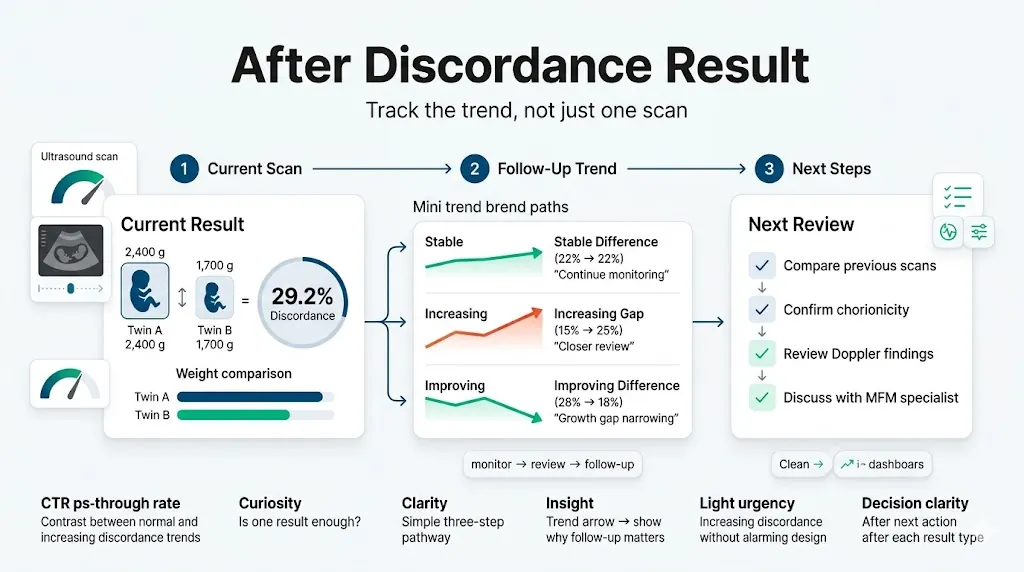
A single twin growth discordance percentage provides a snapshot of growth difference at one point in pregnancy. The change between scans often gives a clearer picture of whether the difference is stable, improving, or increasing.
Stable discordance means the size gap remains similar over time. This pattern may be managed with continued monitoring based on the pregnancy situation.
Increasing discordance means the difference between twins is becoming larger. A rising percentage may lead providers to review growth more closely and consider additional ultrasound assessments.
Improving discordance means the size difference becomes smaller on later scans. This can be a reassuring trend, but continued monitoring remains important because twin growth can change throughout pregnancy.
You Might Also Find These Helpful
Pregnancy & Fertility 45
Use this Pregnancy Risk Calculator to check age, BMI, health history, bleeding, and twins. See if closer prenatal monitoring may be worth asking about.
Try calculatorOne Time Pregnancy Calculator estimates pregnancy odds from one encounter, plus fertile window timing, test date, due date, and 21-day testing guidance.
Try calculatorUse the AMH Calculator to convert ng/mL or pmol/L, compare your result with age-based data, and see what it may mean for IVF, fertility,…
Try calculatorUse the Baby Eye Color Calculator with parents, grandparents, or sibling context to compare Brown, Green/Hazel, and Blue/Grey model estimates instantly.
Try calculatorBasal Body Temperature Calculator checks reading conditions and analyzes your temperature pattern for a sustained shift that may be consistent with ovulation.
Try calculatorBPD gestational age calculator: estimate fetal age from BPD, compare your week, check normal BPD ranges, and understand ahead or behind results.
Try calculatorCalculate odds with the Chance of Twins Calculator. Enter maternal age and history. Find your probability instantly. See if you will conceive multiples now.
Try calculatorFind out exactly when you conceived. Our free Conception Calculator uses your Due Date, LMP, or Ultrasound to estimate your fertilization date and fertile…
Try calculatorUse our Conception Date Due Date Calculator to find your baby's arrival date. Enter your conception or intercourse date for clinical 40-week results.
Try calculatorContraceptive effectiveness calculator to compare birth control methods, typical vs perfect use, backup protection, and 5-year pregnancy risk.
Try calculatorUse this CRL calculator to estimate gestational age and due date from crown-rump length in mm or cm. Compare CRL, LMP, and IVF dating…
Try calculatorEstimate your monthly and 12-month pregnancy odds by age, partner age, and cycle dates. See your fertile window and when to seek fertility help.
Try calculatorCommon Mistakes When Using the Twin Growth Discordance Calculator
A twin growth discordance calculator depends on accurate twin weights, the correct formula method, and proper pregnancy details. Many result errors happen when users enter values incorrectly or misunderstand how discordance percentages are interpreted in twin pregnancies.
- Using the smaller twin weight as the denominator instead of the larger twin weight
- Comparing twin weights with singleton fetal growth charts instead of twin-specific assessment
- Assuming twin growth discordance means the same thing as TTTS
- Ignoring chorionicity differences such as Di-Di, Mo-Di, or Mo-Mo twins
- Focusing on one ultrasound scan instead of tracking discordance changes over time
Frequently Asked Questions (FAQs)
What is normal twin growth discordance?
Twin growth discordance below 20% is commonly considered within a reassuring range, although interpretation depends on gestational age, chorionicity, and ultrasound findings. A smaller weight difference between twins can occur naturally, and doctors usually look at the overall growth pattern rather than one number alone.
How do you calculate twin growth discordance?
Twin growth discordance is calculated by subtracting the smaller twin’s estimated weight from the larger twin’s weight, then dividing that difference by the larger twin’s weight and multiplying by 100. The larger twin provides the reference value for the percentage calculation.
Is 20% discordance concerning in twins?
A 20% twin growth discordance result is often considered a level where closer monitoring may be discussed. It does not automatically mean there is a problem, but providers may review growth scans, fluid levels, Doppler studies, and other pregnancy details.
What is severe twin growth discordance?
Severe twin growth discordance is commonly classified as a difference of 25% or higher between twin weights. This larger gap may require closer follow-up because specialists often evaluate whether the difference is linked with growth restriction, placental factors, or changing trends.
Does twin discordance mean TTTS?
No, twin discordance does not mean twin-to-twin transfusion syndrome (TTTS). Discordance describes a size difference between twins, while TTTS is a specific condition related to blood flow imbalance between twins sharing a placenta. Both situations require different evaluation.
Are discordant twins always unhealthy?
No, discordant twins are not always unhealthy. Some twin pregnancies have noticeable weight differences while both babies continue to grow well. Doctors consider factors such as fetal growth percentiles, Doppler results, amniotic fluid, and pregnancy type before making decisions.
Does chorionicity affect twin discordance risk?
Yes, chorionicity affects how twin growth differences are evaluated. Twins who share a placenta may require different monitoring compared with twins who each have their own placenta. Knowing whether twins are di-di, mo-di, or mo-mo helps guide follow-up decisions.
Can twin discordance improve later in pregnancy?
Yes, twin discordance can decrease on later scans in some pregnancies. The important factor is the growth trend over time. A stable or improving difference may be interpreted differently from a gap that continues to increase between ultrasound measurements.
Why does twin growth discordance increase between scans?
Twin growth discordance may increase when one twin gains weight at a slower rate than the other. Doctors usually review repeat ultrasound measurements, placental structure, amniotic fluid, and blood flow patterns to understand whether the change needs closer attention.
Can twin growth discordance be different after birth?
Yes, birth weight discordance may differ from ultrasound estimates because fetal weight calculations are estimates. After delivery, doctors can compare actual birth weights, but pregnancy monitoring decisions rely on ultrasound findings and the complete clinical picture.
Does twin growth discordance depend on twin type?
Yes, twin type can influence how discordance is interpreted. Dichorionic twins and monochorionic twins have different placental arrangements, which can change the level of monitoring needed when a size difference appears
What do doctors check after a high twin discordance result?
After a high twin discordance result, doctors usually review the full ultrasound report, not just the percentage. They may check growth percentile, amniotic fluid, Doppler blood flow, twin type, and whether the size gap is increasing between scans.
Can you prevent size discordance in twins?
You cannot always prevent size discordance in twins. Some growth differences happen because of placenta function, cord insertion, chorionicity, genetics, or how each baby grows. The best step is to attend all scheduled twin pregnancy scans and follow your provider’s advice.
Does twin discordance mean one baby has growth restriction?
No. Twin discordance means there is a weight difference between the twins. Fetal growth restriction is a separate concern and usually depends on whether one baby is measuring small for gestational age, such as below the 10th percentile, along with Doppler, fluid, and growth trend findings.
Can twin growth discordance improve?
Yes, twin growth discordance can improve or decrease on later scans. Doctors usually care about the trend over time, not just one percentage from one ultrasound.
Questions?
We had love to hear from you! Whether you are reporting an issue, suggesting a new calculator, or exploring collaboration opportunities — we are here to help. Every message helps us make 100calc smarter, faster, and more helpful for everyone.
Why People Trust 100calc
At 100calc.com, we focus on accuracy, speed, and trust. Every calculator we create is designed to give reliable, instant, and easy-to-understand results you can truly depend on.