
Embryo Grade Success Rate Calculator
Use this Embryo Grade Success Rate Calculator to understand grades such as 4AA, 4BB and 3BC. The embryo grading chart explains the numbers and letters on your report. For supported inputs, the calculator also shows a published live-birth reference for a study group, not your personal chance of having a baby.
Enter the embryo’s development day, grade and PGT-A testing status from your clinic’s report. For an untested blastocyst, add the egg provider’s age at egg retrieval to see an age-specific reference where available.
You’ll see what your grade means, which evidence supports the result and where the data stop. If the selected study does not support a percentage for your inputs, the tool explains the grade without inventing a success rate.
Quick Facts
- An embryo grade describes its appearance and development; it does not confirm its chromosome count.
- For the untested embryo reference, use the egg provider’s age at retrieval, not their age today.
- PGT-A (preimplantation genetic testing for aneuploidy) checks sampled embryo cells for missing or extra chromosomes. A euploid result means the sample was reported to have the expected chromosome number. It does not guarantee a live birth or make age irrelevant.
- Day-3 embryos use cell count, fragmentation and cell symmetry; blastocysts use a different grading system.
- Any percentage shown is a study reference, not a personal prediction. Some inputs return a grade explanation only.
- Updated Oct 29, 2026
- Reviewed by 100Calc Research Team
IVF Embryo Grading & Live-Birth Reference
Embryo Grade & Success Rate Calculator
Decode a Day-3 embryo or Gardner blastocyst grade and, where published data support it, view a study-derived live-birth reference. This is not a personal IVF or FET prediction and does not replace your clinic's assessment.
Embryo Grade Interpretation
Your Embryo Grade Explained
Clinical Context
Short Answer
Evidence Used
Untested blastocyst age + morphology study • Euploid morphology study • ASRM Gardner grading scale • ASRM PGT-A guidance • Day-7 systematic review
Explore More Calculators
Use the Chinese Gender Calculator for a traditional boy-or-girl prediction from lunar age and conception month. Enter conception date, due date, or LMP.
Try calculatorFind out exactly when you conceived. Our free Conception Calculator uses your Due Date, LMP, or Ultrasound to estimate your fertilization date and fertile…
Try calculatorContraceptive effectiveness calculator to compare birth control methods, typical vs perfect use, backup protection, and 5-year pregnancy risk.
Try calculatorUse this fetal growth calculator to check baby weight percentile from ultrasound data in grams, kg, or cm and see what the result means…
Try calculatorCalculate hCG doubling time instantly. Enter two test results. See if your levels are rising normally. Check pregnancy progress now in the hCG Calculator.
Try calculatorCalculate implantation window instantly. Enter last period date. Find peak probability. See when to take a pregnancy test in the Implantation Calculator.
Try calculatorEmbryo Grading Chart: What the Numbers and Letters Mean
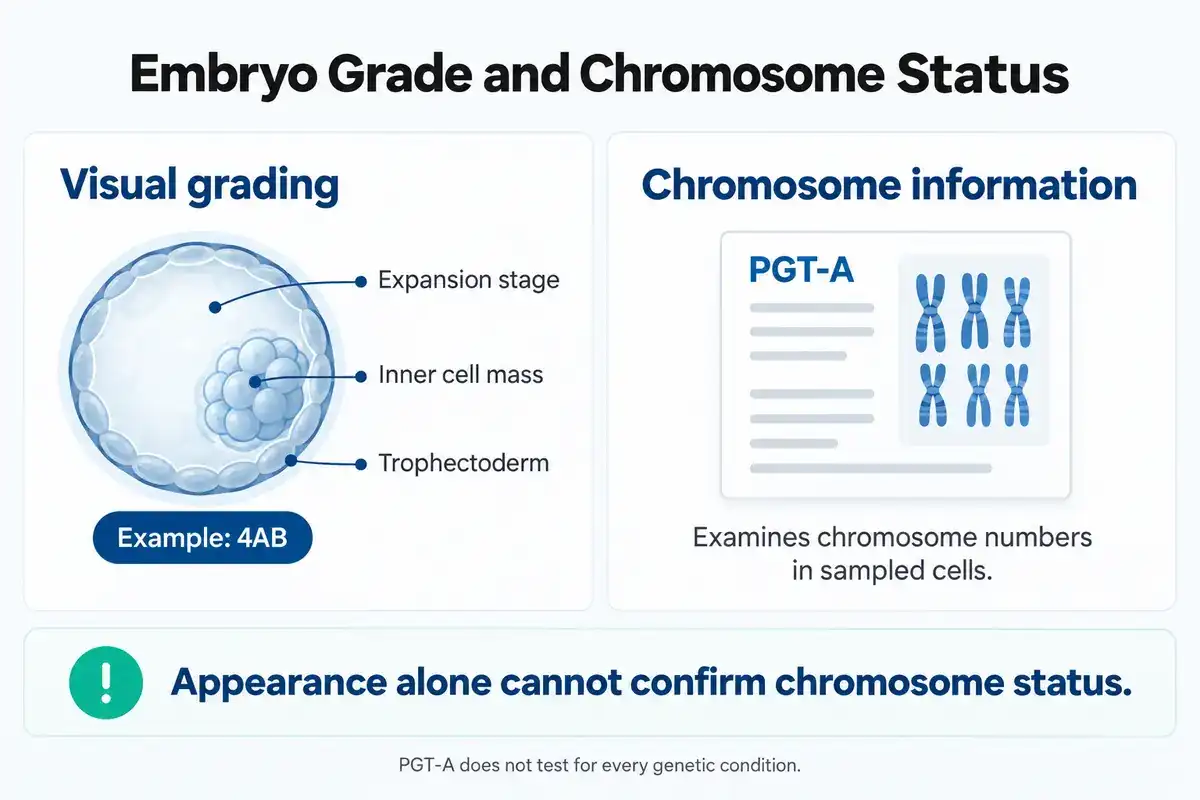
An embryo grading chart explains the numbers and letters on an embryology report. In the common Gardner blastocyst system, the number from 1–6 describes expansion and hatching. The first letter grades the inner cell mass (ICM), and the second grades the trophectoderm (TE).
For example, 4AB means an expanded blastocyst with an A-rated inner cell mass and B-rated trophectoderm. The tables below explain each part. They describe appearance and development, not a fixed success percentage.
Blastocyst Expansion: Numbers 1–6
| Number | Stage | What it means |
|---|---|---|
| 1 | Early blastocyst | The fluid-filled cavity occupies less than half of the embryo. |
| 2 | Blastocyst | The cavity occupies at least half of the embryo but does not yet fill it completely. |
| 3 | Full blastocyst | The cavity fills the embryo. |
| 4 | Expanded blastocyst | The cavity has enlarged beyond the embryo’s original volume, and the outer shell is thinner. |
| 5 | Hatching blastocyst | The embryo is beginning to emerge through its outer shell. |
| 6 | Hatched blastocyst | The embryo has completely left its outer shell. |
The number describes expansion and hatching, not the embryo’s age in days. A Day-5 embryo can have a grade such as 3BB or 4AA.
Source: ESHRE Atlas of Human Embryology: degree of expansion.
Blastocyst Letters: Inner Cell Mass and Trophectoderm
The first letter describes the inner cell mass (ICM), the inner group of cells that gives rise to the fetus. The second describes the trophectoderm (TE), the outer cell layer that contributes to the placenta.
| Letter | First letter: ICM | Second letter: TE |
|---|---|---|
| A | Numerous cells clustered closely together. | Numerous cells joined into a continuous layer. |
| B | A smaller cluster with looser spacing between cells. | Fewer cells making a less closely connected layer. |
| C | Only a small number of cells are visible. | Sparse, often larger cells with gaps in the layer. |
This table uses the common Gardner A–C scale. Some laboratories use modified scales or additional letters. Check your clinic’s definitions before comparing reports.
Sources: ESHRE Atlas of Human Embryology: inner cell mass and trophectoderm.
Does Embryo Grade Show Chromosome Status?
No. An embryo grade describes visible features; it cannot confirm whether the embryo has the expected number of chromosomes. Two embryos with the same grade can have different chromosome results.
PGT-A examines chromosome numbers in cells sampled from an embryo. It provides different information from visual grading, but it does not test for every genetic condition or guarantee a healthy baby.
What Your Embryo Grade Calculator Result Means
Your result explains your embryo’s grade and, where the selected research supports it, shows a published live-birth reference. This percentage comes from a study group. It does not predict whether your embryo will lead to a baby.
Understanding the Percentage
The outcome measured is live birth, rather than implantation or a positive pregnancy test.
For untested blastocysts, the reference comes from published estimates grouped by age at egg retrieval and embryo appearance. For euploid blastocysts, it comes from observed outcomes in a separate study of frozen embryo transfers.
These studies involved different patients and treatment settings. Comparing their percentages does not show how much PGT-A would change your own chance of success.
Read the evidence note beside your result to see which study applies and what its limits are. If a source interval appears, it describes uncertainty in the study’s estimate—not the range your personal chance must fall within.
Is a Higher Result Better?
Within the same study and outcome measure, a higher percentage means a higher estimated or observed live-birth rate for that group. It does not guarantee success, and a lower percentage does not mean failure.
This calculator does not use universal “good,” “fair” or “poor” percentage cutoffs to recommend treatment. Your clinic can interpret the reference alongside your medical history and treatment plan.
What Does “No Rate Shown” Mean?
It means the calculator’s selected evidence does not support a percentage for your inputs. It does not mean a 0% chance.
You can still read the grade explanation and the reason a rate is unavailable.
What You Should Do Next
Bring your embryology report and calculator result to your fertility clinic. Ask:
- Does my report use the grading system shown here?
- How closely does the study behind this result match my situation?
- What does your clinic’s own data suggest for patients with a similar history?
- What other factors matter when planning my transfer?
Use the result to prepare these questions. The percentage alone cannot tell you whether to test an embryo, collect more eggs or change your transfer plan.
How to Use the Embryo Grade Success Rate Calculator
Use your embryology report to enter the embryo’s development stage and grading details. The calculator explains those features and, for supported inputs, shows a published live-birth reference. You don’t need to choose a transfer type or enter an embryo count.
Enter Age at Egg Retrieval
Enter the age of the person whose eggs were used when the eggs were collected. If you used donor eggs, enter the donor’s age at retrieval. The reference studies used patients’ own eggs, so any percentage shown is not a donor-egg-specific estimate. You can leave age blank to read the grade explanation. The calculator needs an age from 25 to 44 to show its age-based reference for an untested blastocyst.
Select the Development Stage
Choose Day 3 Cleavage, Day 5 Blastocyst, Day 6 Blastocyst or Day 7 Blastocyst, matching your report. On mobile, tap Continue to Embryo Details to reach the remaining fields.
Select the PGT-A Result for a Blastocyst
Choose the category recorded on your report: Not Tested, Euploid, Mosaic, Aneuploid or No Result / Inconclusive. If testing was performed but the result is unclear to you, ask your clinic which category applies. Don’t guess or select “Not Tested” simply because you haven’t received the result.
Enter the Grading Details
For a blastocyst, select the expansion number. At stages 3–6, also enter the first letter for the inner cell mass and the second letter for the trophectoderm. For example, enter 4, A and B for a 4AB embryo. At stages 1–2, the calculator hides the letter fields.For a Day-3 embryo, select its cell count, fragmentation level and cell symmetry. Choose Not Reported if symmetry is missing from your report. If cell count or fragmentation is missing, check with your clinic before completing those fields.
View Your Grade and Evidence
Select View Grade & Evidence. Read the grade explanation, clinical context and linked sources alongside any percentage shown.A displayed percentage is a study-derived reference, not your personal chance of success. Some inputs return an explanation without a percentage; this does not mean a 0% chance.
Use Edit Inputs to correct an entry, then Recalculate to update the result
Quick Example to Test
Select Day 3 Cleavage, 7–8 Cells, Low (0–10%) fragmentation and Mostly Even symmetry. Then select View Grade & Evidence.
The calculator explains these Day-3 features without assigning a live-birth percentage.
How the Embryo Grade Success Rate Calculator Works
The Embryo Grade Success Rate Calculator first explains the features recorded on your embryology report. It then checks whether its selected research sources provide a live-birth reference for your inputs. Where a suitable reference is available, it displays that figure with its source and limitations.
How Your Grade Is Interpreted
For blastocysts, the calculator explains the expansion number, inner cell mass grade and trophectoderm grade. For Day-3 embryos, it explains cell count, fragmentation and symmetry instead.
These descriptions help you read your report. The calculator does not examine embryo images or assign a new laboratory grade.
Where the Live-Birth Reference Comes From
Untested blastocysts: For supported inputs, the calculator looks up a published reference using age at egg retrieval and the study’s morphology groups. This pathway uses the age-and-morphology table from Awadalla and colleagues’ 2021 study.
Euploid blastocysts: For supported inputs, it uses morphology-group live-birth rates from Zhang and colleagues’ 2022 study of 610 natural-cycle frozen transfers using patients’ own eggs.
These are separate research populations. Switching the PGT-A input changes the reference source; the difference between the displayed figures does not measure how much testing would improve an embryo’s chances.
The calculator does not apply an extra age or development-day multiplier to the euploid reference. Development-day information appears separately in the clinical context.
Why Some Results Have No Percentage
The calculator provides an explanation without a live-birth percentage for:
- Day-3 embryos.
- Day-7 blastocysts.
- Expansion stages 1–2.
- Mosaic, aneuploid or inconclusive PGT-A results.
- Untested blastocysts when retrieval age is missing or outside 25–44.
- Untested AC or CA grades, which do not have an assigned subgroup rate in the selected table.
A missing percentage marks a limit of this calculator’s evidence. It does not mean a 0% chance of live birth.
What the Result Can Help You Do
Use the result to understand your grade, identify the research behind any displayed figure and prepare questions for your clinic. The calculator does not account for your full treatment history, uterine factors or clinic-specific outcomes, and it does not select an embryo for transfer.
How the Embryo Grade Success Rate Calculator Gets Its Numbers
This calculator uses published reference tables rather than a base-score formula. For supported untested blastocysts, it selects a reference using retrieval age and morphology group. For supported euploid blastocysts, it selects a morphology-group rate from a separate study. It checks whether your inputs are supported before displaying a percentage.
Reference lookup:
					For supported inputs:

Untested blastocyst reference (%)
= Published table[retrieval age][morphology group]

Euploid blastocyst reference (%)
= Published table[morphology group]

If no supported reference is available:
Show the grade explanation without a percentage.
What Determines the Table Lookup?
Retrieval age
For an untested blastocyst, the calculator selects the matching age row in its reference table. Ages 25–32 share one row, ages 33–39 have individual rows, and ages 40–44 share one row.
Morphology group
The two letters determine which study group the calculator uses. The untested and euploid tables use different groupings, so their categories are not interchangeable.
PGT-A result
This selects the relevant evidence pathway. It does not add bonus points to an embryo grade.
Development day and expansion stage
These help determine whether the calculator can display a reference. They do not act as numerical multipliers.
The displayed percentage comes from the selected table entry. This version does not calculate cumulative odds across several embryos or transfers.
Worked Example: An Untested 5BB Blastocyst at Age 34
Enter age 34 at egg retrieval, Day 5 Blastocyst, Not Tested, expansion stage 5, ICM B and trophectoderm B.
The calculator places BB in the selected untested study’s fair morphology group, then reads the age-34 entry.
Calculation:
					Age at egg retrieval: 34
Development stage: Day 5
PGT-A result: Not Tested
Embryo grade: 5BB

BB -> Fair morphology group
Age row -> 34

Published reference[34][Fair] = 34%

Displayed study-derived reference: 34%
The 34% figure is the study-derived reference for that age and morphology group. It is not a rate measured specifically for every Day-5 5BB embryo, and it is not a personal prediction.
The expansion number is explained in the grade breakdown but does not change this table value. The calculator also does not apply a separate Day-5 multiplier.
Source: Awadalla et al. (2021), age-and-morphology reference table
How Do You Calculate Embryo Grade Success Rate?
Embryo grade alone cannot give you a personal success rate. This calculator uses your development stage, PGT-A result and grading details to select a supported research reference. For untested blastocysts, it also uses age at egg retrieval. The percentage refers to live birth, not implantation or a positive pregnancy test.
The examples below show what the calculator displays and how to interpret it. They are hypothetical inputs, not individual patient outcomes.
What Are the Odds of a 3BC Embryo Working at Age 42?
For an untested Day-5 3BC embryo with an egg-retrieval age of 42, this calculator displays an 8% study-derived live-birth reference.
Enter these details:
- Age at egg retrieval: 42
- Development stage: Day 5 Blastocyst
- PGT-A result: Not Tested
- Expansion stage: 3
- Inner cell mass: B
- Trophectoderm: C
How the result is selected: BC belongs to the selected study’s poor morphology group. Age 42 falls within its 40–44 age group. The calculator reads the 8% reference from that table entry.
What it means: This figure covers an age band and morphology group. It is not a measured success rate specifically for every 42-year-old with a 3BC embryo, and it does not determine whether testing or transfer is appropriate.
Source: Awadalla et al., 2021.
What Does the Calculator Show for a Euploid 4BB Embryo?
For a Day-5 4BB embryo reported as euploid, this calculator displays a 56.5% study-derived live-birth reference.
Enter these details:
- Development stage: Day 5 Blastocyst
- PGT-A result: Euploid
- Expansion stage: 4
- Inner cell mass: B
- Trophectoderm: B
How the result is selected: The calculator uses the BB morphology group from a study of 610 natural-cycle frozen transfers of euploid embryos created using patients’ own eggs.
What it means: The figure describes the study group. It is not an age-adjusted personal prediction or a rate specific to every 4BB embryo. Comparing it with an untested reference from another study does not show how much PGT-A would improve your chances.
Source: Zhang et al., 2022.
Should I Transfer an Embryo That Came Back Aneuploid?
This calculator cannot decide whether an embryo with an aneuploid PGT-A result should be transferred. Review the exact finding with your fertility specialist and a genetic counselor.
Example inputs: Age 39 at retrieval, Day 5 Blastocyst, grade 4AA and an Aneuploid PGT-A result.
Calculator output: A grade explanation and clinical context, with no live-birth percentage assigned.
What it means: A strong visual grade does not cancel an abnormal chromosome-screening result. The missing percentage is a limit of this tool, not reassurance that transfer is appropriate. Your team needs to interpret the report, explain the risks and discuss the available options.
Source: ASRM guidance on PGT-A.
Can the Calculator Estimate Success for Day-3 Embryos?
This calculator explains Day-3 grading features but does not assign a Day-3 live-birth percentage or calculate how many embryos you should bank.
Enter these details:
- Age at egg retrieval: 42
- Development stage: Day 3 Cleavage
- Number of cells: 9+ Cells
- Fragmentation level: Moderate (11–25%)
- Blastomere symmetry: Not Reported, if your report does not include it
Calculator output: An explanation of the entered features, with no live-birth percentage assigned.
What it means: You cannot use this result to estimate a combined chance across four embryos. Decisions about further retrievals require your clinic’s assessment of your treatment history, embryo development and family-building goals.
Does a Higher Expansion Number Always Mean Better Odds?
A higher expansion number describes a later expansion or hatching stage. It does not, by itself, establish a higher personal chance of live birth.
Compare these inputs:
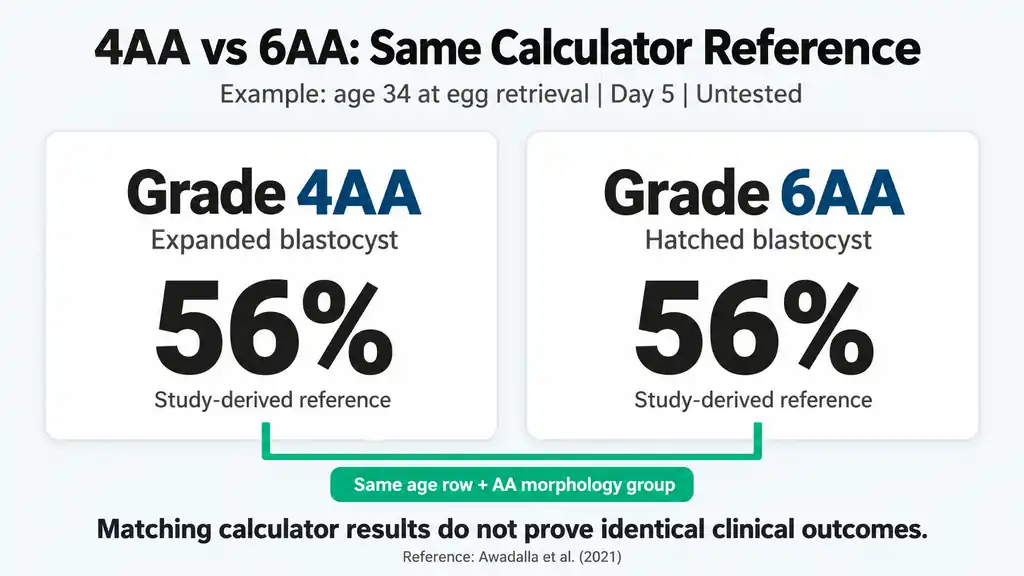
- Example A: Age 34 at retrieval, Day 5, Not Tested, grade 4AA.
- Example B: Age 34 at retrieval, Day 5, Not Tested, grade 6AA.
Calculator output: Both display the same 56% study-derived reference because they use the same age row and AA morphology group.
What it means: The matching figures reflect how this calculator looks up its reference. They do not prove that 4AA and 6AA embryos have identical clinical outcomes. The calculator explains expansion stage separately and does not use it as a numerical adjustment.
Source: Awadalla et al., 2021.
Quick Rules to Remember
- Use age at egg retrieval, including the donor’s age if donor eggs were used.
- Match the development stage and PGT-A category to your report.
- Treat a displayed percentage as a research reference, not your personal odds.
- A missing percentage does not mean 0%.
- Use your clinic’s assessment when discussing testing, embryo banking or transfer.
Embryo Grade Success Rates by Age and PGT-A Status
These tables show the published live-birth references used by this calculator. Choose the table that matches your embryo’s PGT-A status. The studies used different patient groups and methods, so their percentages should not be treated as a direct comparison of testing versus no testing.
Untested Blastocyst Success Rates by Retrieval Age
These model-derived estimates come from one study of 448 unbiopsied blastocysts transferred across 244 fresh and frozen transfers using patients' own eggs. Each cell shows the estimated live-birth rate per blastocyst, followed by its 95% confidence interval.
| Age at Egg Retrieval | AA / AB / BA | BB / CB | BC / CC |
|---|---|---|---|
| 25–32 | 51% 27–74% | 39% 23–56% | 25% 0–55% |
| 33 | 58% 40–75% | 34% 23–45% | 26% 6–48% |
| 34 | 56% 38–73% | 34% 24–44% | 29% 11–47% |
| 35 | 54% 37–70% | 32% 22–42% | 26% 11–44% |
| 36 | 54% 36–70% | 33% 23–42% | 23% 9–38% |
| 37 | 55% 36–74% | 31% 21–41% | 21% 9–35% |
| 38 | 40% 19–62% | 28% 18–39% | 12% 2–22% |
| 39 | 35% 12–60% | 25% 15–37% | 8% 0–18% |
| 40–44 | 22% 0–67% | 14% 3–28% | 8% 0–20% |
Reading the ranges: The confidence intervals describe uncertainty in the study estimates, not a personal probability range.
Age grouping: Rows 33–39 use overlapping seven-year age groups from the study, not samples limited to each exact age. Ages 25–32 and 40–44 use fixed groups.
Coverage: AC and CA were not assigned a subgroup reference in this table. These figures are not specific to an individual expansion number or development day.
Source: Awadalla et al. (2021), Table 5.
Euploid Blastocyst Success Rates by Morphology
These observed live-birth rates come from a separate study of 610 natural-cycle frozen transfers of euploid blastocysts created using patients' own eggs. They combine ages within each morphology group and are not personal age-adjusted predictions.
| ICM / Trophectoderm Grade | Study Live-Birth Rate |
|---|---|
| AA | 64.5% |
| AB | 66.9% |
| BA | 55.6% |
| BB | 56.5% |
| Any C: AC, BC, CA, CB or CC | 40.8% |
Group results: The “any C” percentage pools embryos with at least one C grade; it is not a separate measured rate for every listed combination. Small differences between groups do not establish which embryo should be transferred.
Source: Zhang et al. (2022), Table 2.
How to use these references: These are study-specific results, not national clinic benchmarks or universal “excellent,” “good” and “poor” probability bands. The difference between the two tables does not measure the benefit of PGT-A for an individual patient.
Calculator limits: This tool does not assign percentages to Day-3 embryos, Day-7 blastocysts, expansion stages 1–2, or mosaic, aneuploid and inconclusive PGT-A results. A missing percentage does not mean 0%.
Discuss your result with your fertility team alongside your treatment history and the clinic's own outcome data.
Discussing PGT-A and Your Transfer Plan
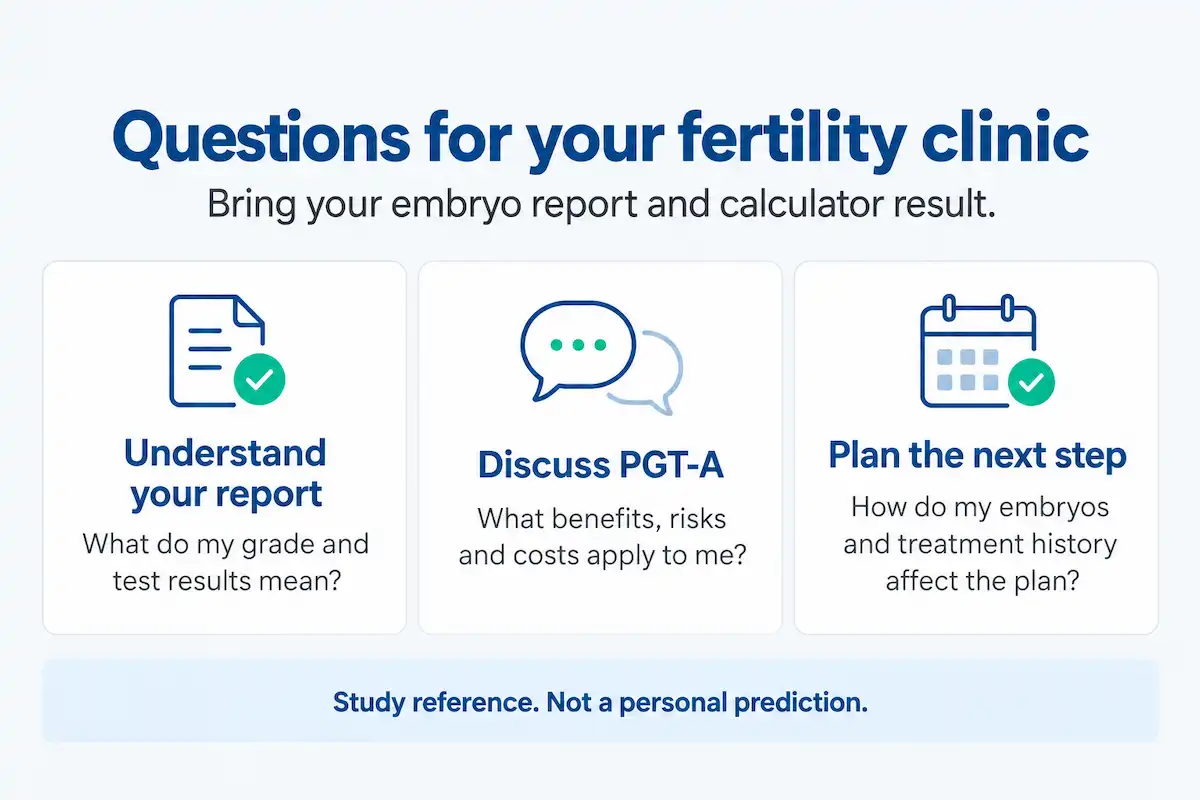
Use your result to prepare for a conversation with your fertility clinic. Bring your embryo report and ask how the study reference relates to your treatment history. The questions below can help you discuss testing and transfer options without relying on a percentage alone.
If You Are Considering PGT-A
PGT-A checks cells sampled from an embryo for missing or extra chromosomes. It helps with embryo selection; it does not repair an embryo or improve its grade.
The UK’s Human Fertilisation and Embryology Authority (HFEA) states that PGT-A has not been shown to improve the chance of having a baby for most IVF patients. It may reduce miscarriage risk, but that does not necessarily mean a higher chance of live birth.
Ask your clinic what benefit testing might offer in your circumstances, what risks and costs it adds, and how the possible results would affect your options.
If You Already Have a PGT-A Result
Enter the result exactly as your laboratory reported it. If it says mosaic, aneuploid or inconclusive, ask your clinic or a genetic counsellor to explain what it means for your treatment options. The calculator does not assign these results a universal success percentage.
If You Are Planning Transfers or More Egg Retrievals
Ask your clinic how your available embryos, previous treatment and family plans affect the next step. This calculator cannot decide which embryo to transfer, how many embryos to transfer at once or whether another retrieval is worthwhile.
You Might Also Find These Helpful
Pregnancy & Fertility 47
Enter gestational sac measurements in mm or cm to calculate mean sac diameter, estimate early gestational age, compare week-by-week milestones, and see when follow-up…
Try calculatorEstimate your ovulation date, fertile window, next period, pregnancy test date and due date from your LMP. Works for regular and irregular cycles.
Try calculatorUse our Pregnancy Chance Calculator to estimate your odds. Enter your cycle day, age, and method. Find out if you are in the high-risk…
Try calculatorUse our pregnancy due date calculator to find your exact Baby Due date. IVF, conception, ovulation, and ultrasound methods with weeks and timeline.
Try calculatorUse this Pregnancy Risk Calculator to check age, BMI, health history, bleeding, and twins. See if closer prenatal monitoring may be worth asking about.
Try calculatorStaring at a blank result? Use our pregnancy test accuracy calculator to find your exact false negative risk based on your cycle track instantly.
Try calculatorOne Time Pregnancy Calculator estimates pregnancy odds from one encounter, plus fertile window timing, test date, due date, and 21-day testing guidance.
Try calculatorUse the AMH Calculator to convert ng/mL or pmol/L, compare your result with age-based data, and see what it may mean for IVF, fertility,…
Try calculatorUse the Baby Eye Color Calculator with parents, grandparents, or sibling context to compare Brown, Green/Hazel, and Blue/Grey model estimates instantly.
Try calculatorBasal Body Temperature Calculator checks reading conditions and analyzes your temperature pattern for a sustained shift that may be consistent with ovulation.
Try calculatorBPD gestational age calculator: estimate fetal age from BPD, compare your week, check normal BPD ranges, and understand ahead or behind results.
Try calculatorCalculate odds with the Chance of Twins Calculator. Enter maternal age and history. Find your probability instantly. See if you will conceive multiples now.
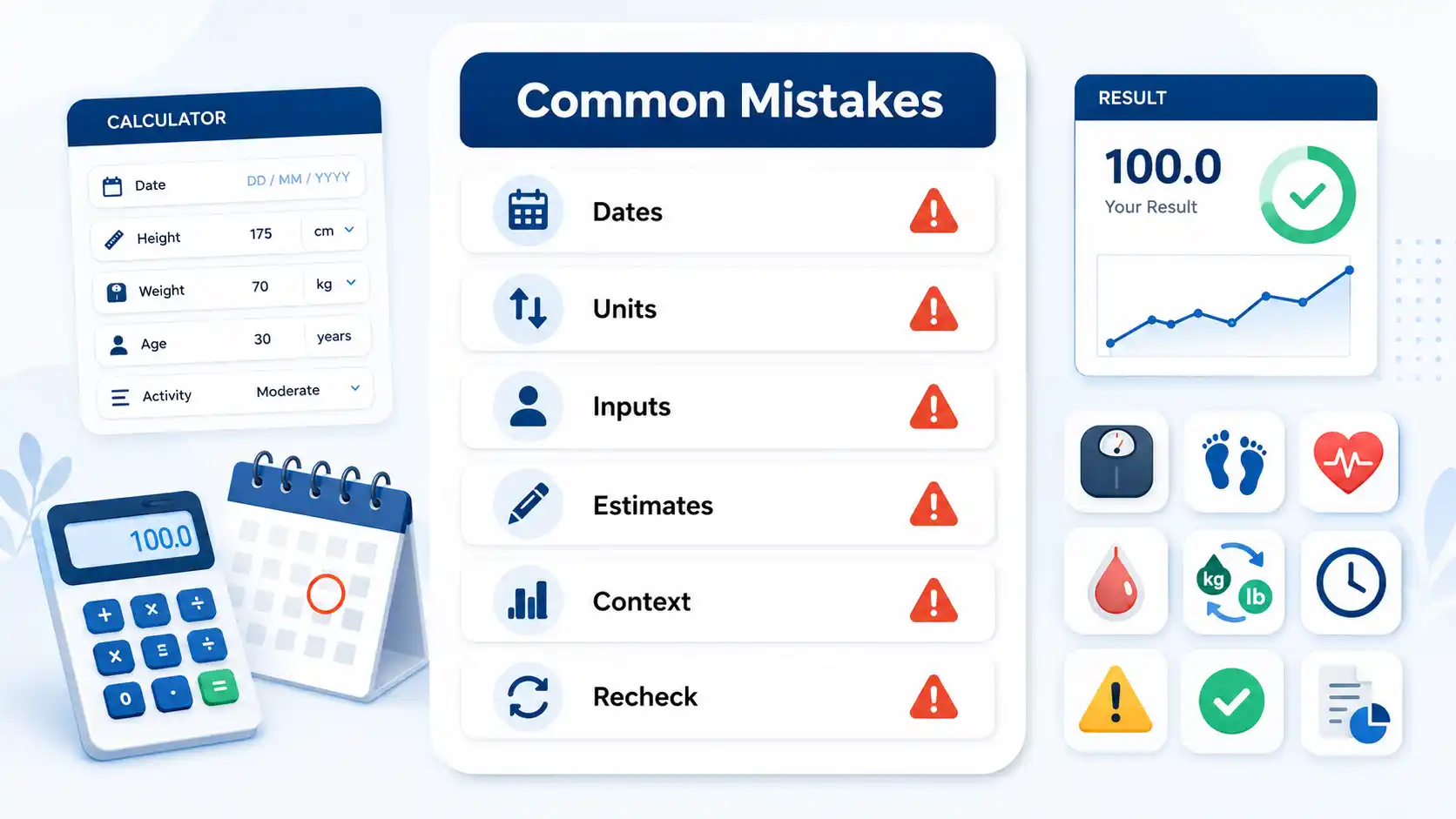
Try calculatorCommon Mistakes When Using the Embryo Grade Calculator
Check your entries against your embryology report before reading the result. Correct inputs help you find the relevant reference, but they cannot turn a study-derived percentage into a personal prediction. Avoid these common mistakes.
- Entering current age instead of retrieval age. Use the age of the person whose eggs were collected at the time of retrieval. For donor eggs, use the donor’s retrieval age.
- Swapping the two letters. In a Gardner blastocyst grade, the first letter describes the inner cell mass and the second describes the trophectoderm. AB and BA are different inputs.
- Confusing development day with expansion stage. The 5 in 5AA means expansion stage 5, not Day 5. Select the development day separately using your report.
- Applying blastocyst grades to Day-3 embryos. Choose Day 3 Cleavage and enter cell count, fragmentation and symmetry. Don’t convert a clinic’s Day-3 “Grade 1” into Gardner expansion stage 1.
- Guessing the PGT-A category. Copy the reported result. A visually strong embryo is not automatically euploid, and an inconclusive result should not be entered as “Not Tested.”
- Reading the percentage as a guarantee. The displayed figure is a research reference for a group. It does not predict your individual outcome or guarantee a healthy baby.
- Treating a missing percentage as 0%. Read the explanation beneath the result. Some inputs fall outside the calculator’s supported reference tables.
- Assuming a higher number after changing PGT-A status proves a benefit from testing. The calculator switches between separate study populations. Comparing those figures does not measure what testing would do for your embryo.
- Using the result to choose, discard or bank embryos. Bring questions to your fertility team. The calculator does not assess your full treatment history or recommend how many embryos to transfer.
Frequently Asked Questions (FAQs)
Is a 4AA or 5AA Embryo Better?
What Is the Success Rate of Graded Embryos?
There is no fixed success rate for each embryo grade. Published live-birth rates vary with retrieval age, chromosome-testing status, patient selection and treatment setting. Use the reference tables above to find the relevant study group, and ask your clinic how its own outcomes compare.
What Grade Embryo Is Most Likely to Split Into Identical Twins?
An embryo grade cannot reliably tell you whether it will split into identical twins. Expansion stages 5 and 6 describe hatching, not a twin-risk score. Research has examined links with blastocyst transfer and assisted hatching, but those findings do not establish a dependable prediction for an individual grade.
Which Embryo Has the Highest Success Rate?
There is no universal winning grade across every study and patient group. AA describes favourable visual features, but appearance alone cannot confirm chromosome status or guarantee a live birth. Clinics consider morphology alongside development day, testing results when available, and the patient’s treatment history.
What Does "Early Blastocyst Grade 2" Mean?
If your clinic uses the Gardner system, expansion stage 2 means the fluid-filled cavity occupies at least half the embryo’s volume but has not completely filled it. Separate ICM and trophectoderm letters may not yet be reported. Confirm the grading system with your clinic, because “Grade 2” can mean something different on another scale.
Does Embryo Grade Predict the Baby's Health?
No. Embryo grading describes visible development and appearance; it cannot determine a future child’s health. PGT-A provides separate information about chromosome numbers in sampled cells, but it does not test for every genetic condition or guarantee a healthy baby.
Should I Transfer an Untested Embryo or Wait for PGT-A Results?
If testing is already underway, discuss the expected result date and transfer timing with your clinic. If the embryo has not been tested, deciding whether to test is a separate discussion. PGT-A has not been shown to improve the overall chance of having a baby for most IVF patients, so a calculator result alone should not determine that choice.
Can a Low-Grade Embryo Still Result in a Healthy Pregnancy?
Yes. Lower-grade embryos can lead to live births and healthy babies. A lower visual grade does not establish that an embryo is chromosomally abnormal or that a future child will be unhealthy. Your clinic should interpret the grade alongside development, testing information and your clinical circumstances.
What Percentage of Embryos Reach the Blastocyst Stage?
There is no single percentage that applies to every IVF cycle. Blastocyst development varies with egg and sperm factors and laboratory conditions. Ask your clinic what proportion of normally fertilised eggs typically reaches the blastocyst stage in comparable patients, and whether its figure includes Day 5, Day 6 and Day 7.
Is a Mosaic Embryo the Same as an Aneuploid Embryo?
No. A mosaic PGT-A result reports an intermediate chromosome-copy-number signal in the sampled cells, suggesting possible mosaicism. An aneuploid result reports a chromosome-copy-number abnormality. Neither result maps every cell in the embryo. The categories require different interpretation, and a mosaic result should be discussed with a genetic counselor experienced in PGT-A.
Questions?
We had love to hear from you! Whether you are reporting an issue, suggesting a new calculator, or exploring collaboration opportunities — we are here to help. Every message helps us make 100calc smarter, faster, and more helpful for everyone.
Why People Trust 100calc
At 100calc.com, we focus on accuracy, speed, and trust. Every calculator we create is designed to give reliable, instant, and easy-to-understand results you can truly depend on.