No. Twelve weeks equals 84 days, while three calendar months usually span 89 to 92 days. This means a baby who is 12 weeks old is normally about 5 to 8 days short of reaching 3 calendar months. Use the birth date when you need the exact age in months.

Baby Age Calculator: How Old Is Your Baby Exactly?
A Baby Age Calculator shows how old your baby is from the date of birth. Enter the birth date to get the exact age in years, months, and days. The calculator also shows total days, weeks and days, and completed calendar months. For premature babies, corrected age adjusts the result based on weeks born early.
Weeks and months do not always match. Four weeks is not the same as one calendar month. Check your baby’s exact age, compare chronological and corrected age, or find the age on a specific date. The result also gives the baby’s age stage and upcoming milestone context.
Quick Facts
- Weeks: Exact 7-day periods since birth.
- Months: Completed calendar months, not four-week blocks.
- Corrected age: Adjusts age for babies born early.
- Specific date: Check your baby's age on any valid date.
- Milestones: Shows the next age-based milestone in the calculator.
- Updated Nov 5, 2026
- Reviewed by 100Calc Research Team
Calendar Age & Prematurity Reference
Baby Age Calculator
See your baby's age in calendar months and days, complete weeks, and total days. Check another date or compare chronological and corrected age. Age references do not assess development or set vaccine due dates.
Choose calculation mode
Exact Age
Birthday year elapsed
(chronological age)
Chronological age breakdown
Days Since Birth
Complete Weeks Since Birth
Complete Calendar Months
Next Monthly Age Date
Next Developmental Age Reference
Open the 1–24 Month Age Calendar
Development examples summarize CDC milestone checklists at selected ages. They are not a developmental test or a prediction for your child. Earlier age dates do not mean a skill has been achieved. Share concerns or loss of skills with your care team.
| Age | Date Reached | General Reference |
|---|
Vaccination Timing and Local Schedules
Vaccinations generally use chronological age, not corrected age. Your baby's previous doses, health and local schedule also matter. These links provide guidance; this calculator does not decide which vaccine is due.
- United States: AAP childhood immunization guidance
- United Kingdom: UKHSA routine schedule
- Australia: National Immunisation Program
- India: Ministry of Health immunization schedule (PDF)
For preterm babies and exceptions, see CDC preterm-vaccination guidance. Confirm your child's plan with a healthcare professional.
Traditional Korean Age (Cultural Reference)
Age:
Explore More Calculators
Birthday Calculator Featured
Use our Birthday Calculator. Enter your date of birth to find your current age, next birthday date, days until your birthday, weekday, and days…
Try calculatorAge Difference Calculator Featured
Use this age difference calculator to compare birthdays, ages, or birth years. See who is older and get the exact gap in years, months,…
Try calculatorCorrected Age Calculator Featured
Use our Corrected Age Calculator to find your premature baby's age in weeks, months, and days. Compare ages and understand what your result means.
Try calculatorDays Old Calculator Featured
Think you know your age? The Days Old Calculator counts calendar days from birth to today or any date, plus weeks, months, leap days,…
Try calculatorDiamond Birthday Calculator Featured
When is your diamond birthday? Use our Diamond Birthday Calculator to find the exact date when your age matches the last two digits of…
Try calculator1 Billion Seconds Calculator
1 billion seconds calculator shows your exact milestone date and age in seconds. See if you’ve reached it or how close you are now.
Try calculator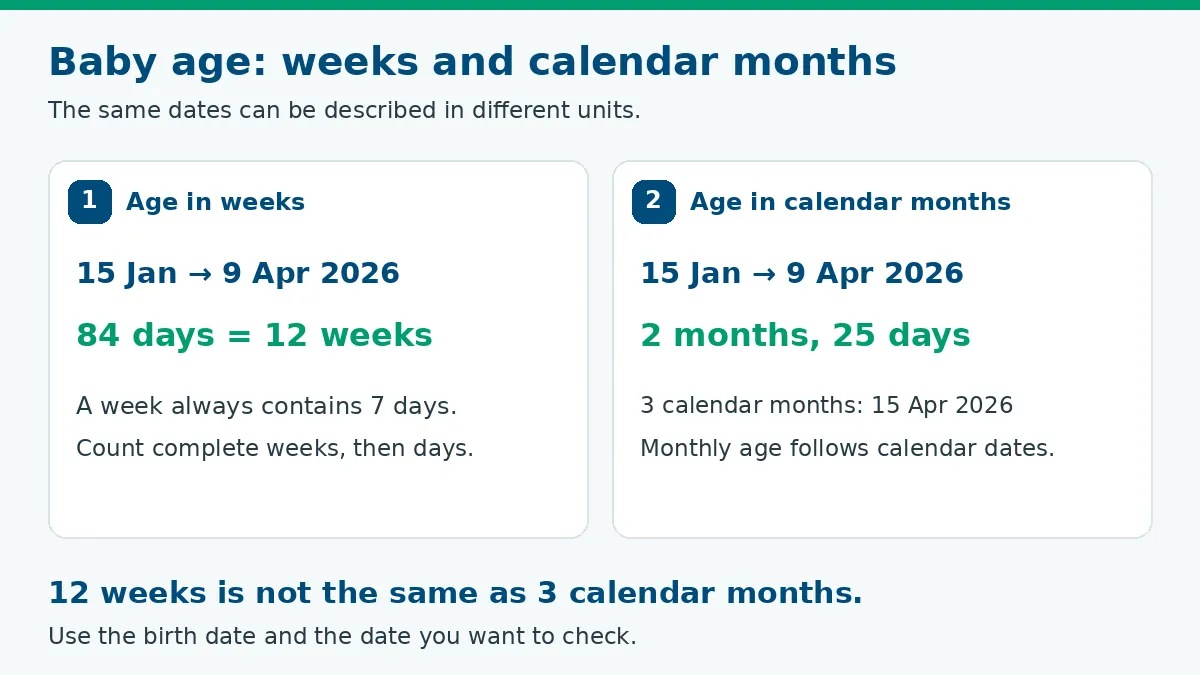
Micro Insight
The unit matters when comparing your baby’s age with guidance. Weeks help with early infancy, while calendar months are useful for age-based milestones. Corrected age can give a fairer developmental reference for babies born early.
What Is Baby Age?
Baby age is the time a baby has lived since birth, measured in days, weeks, or calendar months. These units do not always match. A week always has 7 days, while calendar months have 28 to 31 days. For babies born early, corrected age adjusts their age to account for prematurity.
A baby’s age can look different depending on the unit used. A baby born on January 31 reaches one calendar month on February 28 in a non-leap year, not simply after four weeks. This is why weeks and months can give different-looking answers for the same baby.
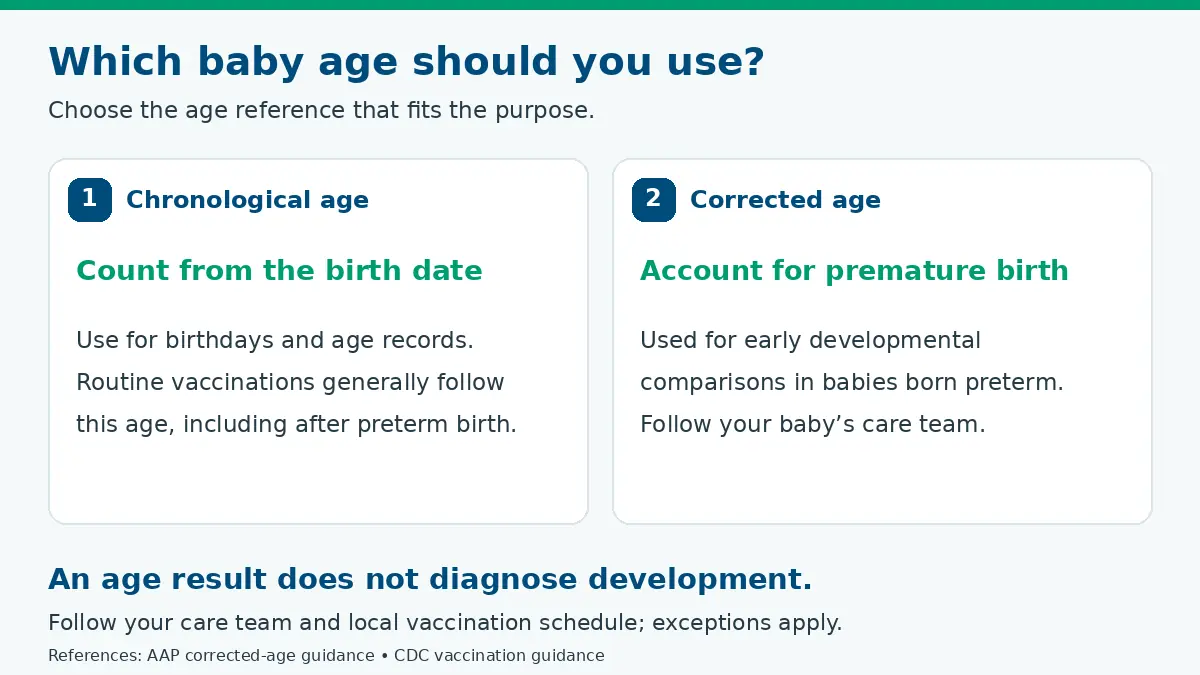
For a baby born early, chronological age counts from the actual birth date. Corrected age accounts for the time between birth and the expected due date. The American Academy of Pediatrics recommends using corrected age as a guide to developmental milestones during the first two years. Your baby’s care team can advise how to use it for your child.
If your baby was born early, use the Corrected Age Calculator for a fuller prematurity timeline that includes corrected age, chronological age, and postmenstrual age.
What Does Your Baby's Age Mean?
Your result shows your baby’s age in calendar months and days, alongside complete weeks and total days. In corrected-age mode, it also shows age counted from the expected due date while keeping chronological age visible.
Understanding Your Result
A baby born on January 1, 2026 is 3 months, 22 days old on April 23, 2026. That is also 112 days, or exactly 16 weeks. The calendar-month result and week result describe the same span in different units. Four weeks, however, is not automatically one calendar month.
Is Your Result Good or Bad?
There is no good or bad baby age result. Age tells you how much time has passed; it does not score your baby’s health or development. The CDC defines a developmental milestone as something at least 75% of children can do by a given age. A milestone checklist is a guide, not a diagnosis.
For a baby born early, chronological age counts from birth and corrected age counts from the expected due date. The CDC’s milestone checklists say to use corrected age when a child was born more than three weeks prematurely. If you’re concerned about a skill or your baby loses a skill, speak with your baby’s care team.

What You Should Do Next
- – Birthday or records: Use chronological age.
- – General age tracking: Use chronological age.
- – Prematurity and development: Check corrected age when appropriate.
- – Medical decisions-: Follow your baby’s care team and current local guidance.
Corrected age helps put a premature baby’s development in context. It does not replace age counted from birth for every purpose. The American Academy of Pediatrics explains how to use both ages when looking at development during the first two years.
Quick Example to Test
- Birth date: May 12, 2026
- Age on: September 25, 2026
The result is 4 months, 13 days.
That means four calendar months have passed since May 12, with 13 additional days. The same age is 19 weeks, 3 days, showing why calendar months and weeks do not line up exactly.
How to Use the Baby Age Calculator
Enter your baby’s birth date and choose the age method that fits your needs. The calculator compares the relevant dates, adjusts for prematurity when selected, and builds the age details from that result.
Enter Your Baby’s Date of Birth
Use your baby's actual date of birth. This date remains the starting point for chronological age. It also anchors the other calculations, including total days, weeks, calendar months, birthday timing, and milestone dates.
Choose the Age Method
Choose Current Age to count from your baby’s birth date to today. Choose Age on Specific Date to check chronological age on another date. Choose Corrected Age (Born Early) to compare chronological and corrected age using pregnancy weeks at birth or the original due date. In corrected-age mode, you can also change the age-check date.
Add Early-Birth Details
In corrected-age mode, choose which birth detail you know: weeks of pregnancy at birth or the original due date. For pregnancy weeks, enter completed weeks and any additional days. For example, 34 weeks and 3 days means entering 34 for weeks and 3 for days. Use the details from your baby’s birth record.
Calculate the Age
The calculator compares the selected dates and creates several age views. The result includes calendar years, months and days, total days, and complete weeks with remaining days. Other details are generated from the same date result.
Read the Age Context
Read the main age result, then check the chronological breakdown in days, weeks and calendar months. Corrected-age mode keeps both ages visible. The next developmental reference marks an age used in a milestone checklist; it does not predict when your baby will learn a skill.
Quick Example to Test
Choose Corrected Age (Born Early). Enter February 7, 2026 as the birth date and July 10, 2026 as the age-check date. Select Weeks of pregnancy at birth, then enter 34 completed weeks and 0 additional days.
The calculator shows an expected due date of March 21, 2026 and a corrected age of 3 months, 19 days. Chronological age remains 5 months, 3 days: 153 days, or 21 weeks, 6 days.
Advertisement
How the Baby Age Calculator System Works
The Baby Age Calculator counts from your baby’s actual birth date to today or another date you choose. It shows total calendar days, complete weeks with extra days, and completed calendar months with extra days. For a baby born early, it also counts corrected age from the original expected due date. You can enter that due date or provide the weeks and additional days of pregnancy at birth so the calculator can work it out.
Key Features & Benefits
- Calendar-based age: Counts completed months and days from the actual birth date.
- Week-based age: Shows complete seven-day weeks with remaining days.
- Corrected age: Counts from the original expected due date, entered directly or calculated from pregnancy weeks and days at birth.
- Specific-date mode: Checks chronological age on a chosen past or future date.
- Age context: Shows the age stage, next birthday timing, and developmental age-reference dates.
Technical Process
Date Capture
Records the birth date and selected comparison date for the age calculation.
Date Processing
Applies calendar-date rules and separates months, weeks, and total days.
Result Display
Shows age details with birthday and milestone context from the calculated dates.
How the Baby Age Calculator Formula Works (Complete Breakdown)
A Baby Age Calculator needs more than one time unit. Calendar age uses years, months, and days, while total weeks use fixed seven-day periods. This calculator keeps those calculations separate. Corrected age also uses a prematurity adjustment, giving preterm babies an adjusted age for developmental reference.
Formula:
					CHRONOLOGICAL AGE

Total Days = Calendar days between Birth Date and End Date

Complete Weeks = floor(Total Days / 7)
Remaining Week Days = Total Days mod 7

Complete Months = Whole calendar-month anniversaries reached
Years = floor(Complete Months / 12)
Remaining Months = Complete Months mod 12
Remaining Days = Calendar days since the latest month anniversary


CORRECTED AGE

Days Early = 280 - (Completed Pregnancy Weeks × 7 + Additional Days)
Expected Due Date = Birth Date + Days Early

Count corrected age from the Expected Due Date to the End Date.
If the original expected due date is entered, use that date directly.
How the Formula Works
The calculator counts completed calendar months from the original starting date, then counts the days left over. Each monthly anniversary uses the original day of the month. If that day does not exist, it uses the month’s last day. For example, January 31 reaches one month on February 28 in a non-leap year and two months on March 31.
Weeks use a separate count: divide total calendar days by seven. The whole number gives complete weeks, and the remainder gives extra days. “Floor” means round down to a whole number; “mod” means the remainder after division.
For corrected age, the starting date is the expected due date. The 280-day calculation uses the same 40-week reference described by the American Academy of Pediatrics. If the age-check date comes before the expected due date, the calculator shows the time remaining until that date instead of a negative age.
Understanding the Formula Variables
Birth Date
The birth date is the starting point for chronological age. It anchors the calendar calculation, total day count, weekly age, birthday timing, and other date-based results.
End Date
The end date is the date you want to check. Current Age uses today’s date on your device. Age on Specific Date uses your chosen target date. Corrected Age uses the Age on This Date field, which defaults to today and can be changed.
Total Days
Total days count the calendar days between the birth date and the age-check date. The birth date itself is day zero. Birth time is not entered, so this is not a count of completed 24-hour periods. Changes to the clocks for daylight saving do not add or remove a day.
Years and Months
Years and months represent completed calendar periods. A month depends on the actual calendar, so February does not have the same length as March or April.
Another Example Calculation (Step-by-Step)
Let’s run a different profile through the formula to see it move.
Given:
- Mode: Age on Specific Date
- Baby’s Date of Birth: March 8, 2026
- Target Date: July 20, 2026
Calculation:
					March 8 → July 8 = 4 complete calendar months
July 8 → July 20 = 12 remaining days

Calendar Age = 4 months, 12 days
Completed Calendar Months = 4

Total Days = 134
134 = (19 × 7) + 1
Age in Weeks = 19 weeks, 1 day
Result:
- Age = 4 months, 12 days
- Weeks = 19 weeks + 1 day
- Days = 134
Meaning:
The calendar result shows four completed months and 12 additional days. The weekly result describes those same 134 elapsed days as 19 complete weeks plus one day. Both measurements come from the same birth and calculation dates.
How do you calculate baby age?
To calculate baby age, count from the actual birth date to the date you want to check. The calculator shows completed calendar months and leftover days, plus total days and complete seven-day weeks. For a baby born early, corrected age counts from the original expected due date. You can enter that date or provide pregnancy weeks and days at birth. The tool does not calculate hours because it does not ask for a birth time.
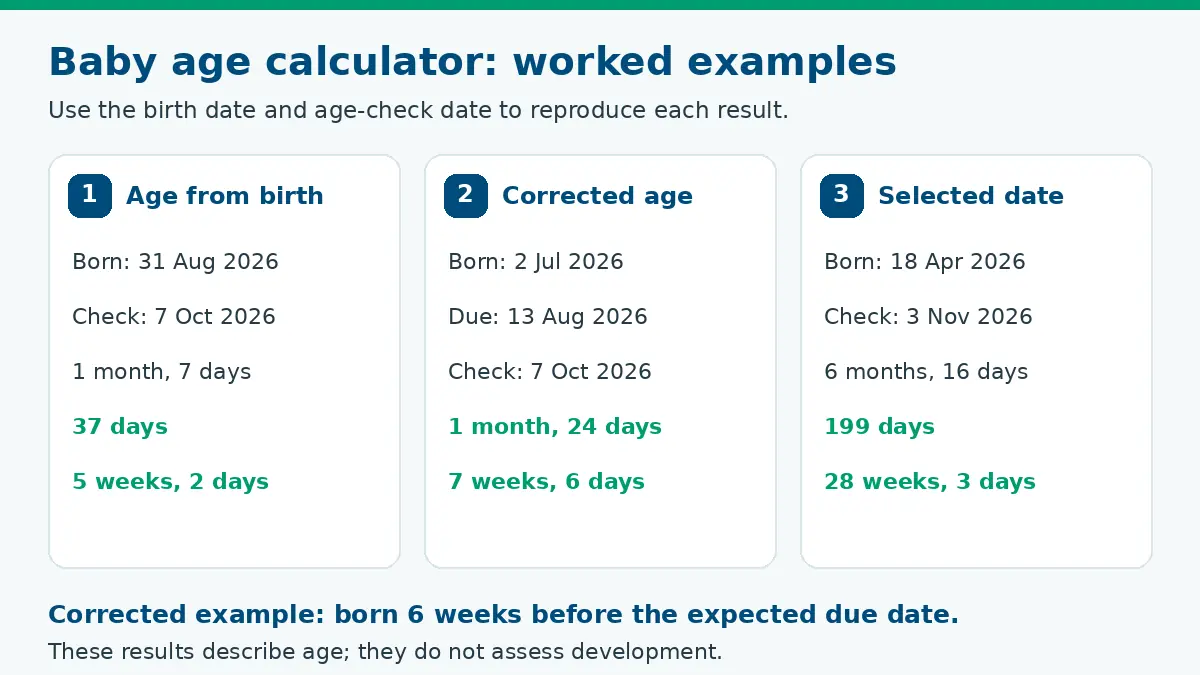
How old is a baby born on August 31, 2026, on October 7?
A late-month birth date shows why calendar months and weeks can give different-looking results.
Input
- Birth date: August 31, 2026
- Date checked: October 7, 2026
- Mode: Age on Specific Date
Process
- August 31 → September 30 = 1 completed month
- September 30 → October 7 = 7 days
- Total elapsed time = 37 days
- 37 days = 5 weeks + 2 days
Result
- Age: 1 month, 7 days
- Total days: 37 days
- Total weeks: 5 weeks, 2 days
- Completed months: 1 month
Meaning: The baby is 1 month and 7 days old. The result is not the same as simply treating four weeks as one calendar month.
What is the corrected age of a baby born 6 weeks early?
Corrected age can help parents compare a premature baby’s development with age-based guidance.
Input
- Mode: Corrected Age (Born Early)
- Baby’s Date of Birth: July 2, 2026
- Age on This Date: October 7, 2026
- Completed Weeks at Birth: 34
- Additional Days at Birth: 0
Process
- 6 weeks early = 42 days
- Expected due date: August 13, 2026
- Chronological age: July 2 → October 7
- Corrected age: August 13 → October 7
Result
- Chronological age: 3 months, 5 days
- Corrected age: 1 month, 24 days
Meaning: The two ages describe the same baby from different reference points. Corrected age gives a developmental reference that accounts for the baby being born early.
How old is a baby on an appointment date?
A specific-date calculation helps when a parent needs the baby’s exact age for a planned appointment or record.
Input
- Birth date: April 18, 2026
- Target date: November 3, 2026
- Mode: Age on Specific Date
Process
- April 18 → October 18 = 6 completed months
- October 18 → November 3 = 16 days
Result
- Age: 6 months, 16 days
- Total days: 199 days
- Total weeks: 28 weeks, 3 days
- Completed months: 6 months
Meaning: On November 3, 2026, the baby is 6 months, 16 days old. Choosing the appointment date lets you check the age for that day, even when you calculate it earlier or later.
Quick Rules to Remember
Use the actual birth date for chronological age. Choose another date when you need the baby’s age at an appointment or event. If your baby was born early, enter pregnancy weeks and additional days at birth, or enter the original expected due date, to see corrected age. Weeks contain seven days; months follow the calendar. Developmental age references are guides, not deadlines.
Advertisement
Baby Age Chart: What the Result Labels Mean
This chart explains the age-stage label shown in your calculator result. The label always uses chronological age, counted from the actual birth date. If your baby was born early, the calculator shows corrected age separately. These labels describe age groups; they do not assess development.
| Chronological Age | Calculator Label | How to Read It |
|---|---|---|
| 0–27 days | Newborn | Days and complete weeks show the age more precisely than a rounded month. |
| 28 days to before 12 calendar months | Infant | Use calendar months for month-based references and exact weeks when a source gives weeks. |
| 12 to before 36 calendar months | Toddler | The calculator still shows completed calendar months and remaining days. |
| 36 calendar months or more | Child | This is the calculator’s broad label for ages beyond the toddler range. |
How to use this chart: These are the calculator’s age labels, not health scores or developmental milestones. For a baby born early, corrected age counts from the expected due date and appears separately; see the AAP’s corrected-age explanation. Routine vaccination generally follows chronological age, with exceptions described in CDC guidance for preterm infants. Confirm doses using your local schedule and care team.
Interpretation
There is no good, bad, or failing age result. A baby who is 5 months and 12 days old simply falls into a different age reference than a baby who is 8 months old. The important point is using the right age system for the question.
For a premature baby, chronological age and corrected age can differ. Corrected age is mainly useful when looking at developmental expectations. Vaccination and medical schedules can follow different rules, so those decisions should not be based on the calculator alone.
Pro Tip
When an appointment or milestone guide gives an age in months, use the completed calendar months from the calculator. When an early-life reference gives an age in weeks, use the exact weeks and remaining days shown in the result.
What to Do After Using the Baby Age Calculator
Your Baby Age Calculator result is most useful when you match it to the reason you checked the age. Use calendar months for month-based guidance, exact weeks when a source gives weeks, and corrected age when prematurity affects developmental comparisons. The goal is to use the right age reference, not chase a particular number.
For Newborn Results: 0–27 Days
Keep the exact age in weeks and days when the baby is still very young. Small differences can matter when reading newborn guidance or preparing questions for a pediatric visit. If a source gives an age in days or weeks, use that unit rather than converting it into months.
Check the birth date carefully if you are tracking age for an appointment. For a premature baby, keep the chronological age available even when corrected age is also being used for development.
For Infant Results: 28 Days to Under 12 Months
Use completed calendar months when a milestone guide or appointment refers to a month-based age. Do not turn weeks into months by simply dividing by four. A calendar month and a four-week period are different measurements.
If two sources give different-looking ages, check the unit before assuming one result is wrong. Your calculator can show calendar age, total weeks, and total days together so you can match the result to the source you are using.
For Toddler Results: 12 to Under 36 Months
Use completed calendar months when guidance refers to ages such as 12, 15, 18, 24, or 30 months. Keep the exact date available for appointments and records. If development is the reason for checking age, look at overall progress rather than treating one milestone date as a deadline. Discuss concerns about speech, movement, social interaction, or lost skills with your child’s healthcare professional.
For Child Results: 36 Months or More
For children aged 3 years or older, the calculator reports completed years, calendar months, and days. Use Age on Specific Date when checking age for school, an appointment, an event, or a record.
Developmental concerns still require assessment by the child’s healthcare professional. The calculator measures age; it does not assess development.
You Might Also Find These Helpful
Time & Date 18
10000 Days Old Calculator
Use our 10000 Days Old Calculator to find your exact 10,000-day birthday, check days old now, and see your age in years and months.
Try calculator9 3/4 Birthday Calculator
Use our free 9 3/4 Birthday Calculator to find the exact date your child turns 9 years and 9 months. Plan the perfect wizard-themed…
Try calculatorCrown Birthday Calculator
You can use our free crown birthday calculator to find your golden date. First, enter your exact birth date. Next, discover your special celebration…
Try calculatorDiamond Jubilee Calculator
Calculate your 60-year milestone instantly. Our Diamond Jubilee Calculator provides precise dates for 60th birthdays or anniversaries with 100% accuracy.
Try calculatorEmerald Jubilee Calculator
Use our free Emerald Jubilee Calculator to find the exact date you turn 55. Discover the meaning of this green-themed milestone today.
Try calculatorGolden Birthday Calculator
Use our free Golden Birthday Calculator to find your special, once-in-a-lifetime date. Discover your Golden Age and get tips for a gold-themed party.
Try calculatorHalf Birthday Calculator
Half Birthday Calculator finds the date six months after your birthday and shows your next half birthday, countdown, and baby 6-month milestone.
Try calculatorLeap Year Age Calculator
Use our Leap Year Age Calculator to find your exact age, real leap birthdays, and whether Feb 28 or March 1 counts on common…
Try calculatorPlatinum Birthday Calculator
Use our Platinum Birthday Calculator to find your reversed-age milestone date, platinum birthday age, and whether it already passed or is still ahead.
Try calculatorQuarter Birthday Calculator
Stop guessing fractional dates. Use our exact quarter birthday calculator to instantly find your 1/4 and 3/4 milestones for infant tracking or anniversaries.
Try calculatorSilver Birthday Calculator
Turning 25? Use the Silver Birthday Calculator to track your quarter-century milestone. Get the exact countdown in days, hours, and minutes for your big…
Try calculatorTwin Flame Calculator
Twin Flame Calculator checks names and birthdays to reveal your match score, bond type, life path signs, and whether the pull feels real or…
Try calculatorCommon Baby Age Calculator Mistakes
Most Baby Age Calculator errors come from mixing calendar months, weeks, and corrected age. Parents may also enter the wrong reference date or use developmental age for a purpose that needs chronological age. Checking the input date and choosing the correct age method helps keep the result consistent.
- Treating 4 weeks as exactly 1 calendar month instead of counting completed calendar months.
- Entering the due date instead of the actual birth date for chronological age.
- Mixing chronological age with corrected age when reading a premature baby's result.
- Using corrected age for purposes that require chronological age, such as many routine medical or vaccination records.
- - Treating a developmental milestone date as a deadline instead of a general age-based reference.
Advertisement
Baby Age Calculator FAQs
How old is my baby in weeks?
Enter your baby’s birth date and the date you want to check. The calculator counts the exact number of elapsed days, divides those days into complete seven-day weeks, and shows the remaining days. This gives results such as 18 weeks, 3 days instead of a rounded week count.
How many weeks are in a month for a baby?
A calendar month is not exactly four weeks. Depending on the month, it contains 28, 29, 30, or 31 days. On average, one calendar month is about 4.35 weeks. That is why a baby can be 16 weeks old without being exactly 4 calendar months old.
How do I calculate my baby's age in months?
Count completed calendar months from the baby’s birth date to the date being checked. Any extra days remain separate. For example, a baby born April 18 and checked November 3 is 6 months, 16 days old, rather than converting the total weeks into months.
What is corrected age for a premature baby?
Corrected age adjusts a premature baby’s chronological age to account for the weeks they were born early. It gives a developmental age reference that is closer to the baby’s expected age at term. Pediatric guidance commonly uses corrected age when assessing development during early childhood.
Should I use corrected age for developmental milestones?
Corrected age is often useful when assessing developmental milestones in babies born significantly premature. It accounts for the time the baby would have spent developing before reaching term. Use the appropriate corrected-age guidance for developmental comparisons and discuss concerns with your child’s pediatrician.
Why is my baby 16 weeks but not 4 months?
Sixteen weeks equals 112 days, while four calendar months usually contain more than 112 days. A four-week period is only 28 days. The difference comes from using two different age systems. Your baby can be 16 weeks old while still being less than 4 calendar months old.
Can I calculate my baby's age on a specific date?
Yes. Select Age on Specific Date, enter the baby’s birth date, and choose the target date. The calculator compares those two dates and gives the chronological age for that day. This is useful for checking age at an appointment, planned event, record date, or milestone reference.
Should baby age be counted from the due date or birth date?
Chronological age starts from the baby’s actual birth date, not the due date. For a premature baby, corrected age accounts for the weeks born early when considering development. Keep these two age references separate because they answer different questions and may be used for different purposes.
How many days old is my baby?
A baby’s age in days is the exact number of elapsed calendar days between the birth date and the date being checked. The calculator counts those days directly rather than converting months into an estimated number of days. This makes the result useful when an exact day count matters.
Is 12 weeks the same as 3 months for a baby?
Questions?
We had love to hear from you! Whether you are reporting an issue, suggesting a new calculator, or exploring collaboration opportunities — we are here to help. Every message helps us make 100calc smarter, faster, and more helpful for everyone.
Why People Trust 100calc
At 100calc.com, we focus on accuracy, speed, and trust. Every calculator we create is designed to give reliable, instant, and easy-to-understand results you can truly depend on.