
Chinese Gender Calculator: Boy or Girl by Lunar Age
A Chinese Gender Calculator uses a traditional Chinese gender chart to make a boy-or-girl prediction from the mother’s Chinese lunar age and lunar conception month. Enter the mother’s birth date, then use a conception date, due date, or last period date. The calculator converts the dates to the Chinese lunisolar calendar and matches the lunar age and month to one square on the chart.
Your result shows the chart’s traditional prediction, plus the lunar age, lunar month, and conception date used. If the conception date was estimated from a due date or last period, the result will tell you that too.
The Chinese gender chart is a folklore method, not a medical test. Large birth-record research found that its predictions perform about the same as chance.
Quick Facts
- Uses the mother’s Chinese lunar age at conception and lunar conception month
- Uses a commonly circulated traditional Chinese boy-or-girl chart
- Research found the chart performs about the same as a 50/50 guess
- Works with a conception date, due date, or last period plus cycle length
- Made for fun and tradition, not for confirming fetal sex or making medical decisions
- Updated Oct 12, 2026
- Reviewed by 100Calc Research Team
Pregnancy & Fertility Calculator
Chinese Gender Calculator
Try the traditional Chinese gender chart for a boy-or-girl guess. The calculator converts your dates to Chinese lunar age and lunar conception month, then checks one commonly circulated chart version. For fun only. It cannot determine a baby's actual sex.
Use this if you know the conception date or best estimate.
What this calculator actually does
It converts the mother's birth date and conception date into Chinese-calendar values, then looks up the matching cell on a 28 × 12 folklore chart. The chart has no scientific ability to predict fetal sex.
Traditional Chart Prediction
Short answer
Accuracy note
Research: Villamor et al. (2010) found the Chinese lunar calendar method was no better than tossing a coin in 2,840,755 births.
Explore More Calculators
Use this fetal growth calculator to check baby weight percentile from ultrasound data in grams, kg, or cm and see what the result means…
Try calculatorEnter gestational sac measurements in mm or cm to calculate mean sac diameter, estimate early gestational age, compare week-by-week milestones, and see when follow-up…
Try calculatorMissed a birth control pill? Check pregnancy risk, protection status, backup contraception needs, and what to do next with our missed pill calculator.
Try calculatorUse our Pregnancy Chance Calculator to estimate your odds. Enter your cycle day, age, and method. Find out if you are in the high-risk…
Try calculatorUse our pregnancy due date calculator to find your exact Baby Due date. IVF, conception, ovulation, and ultrasound methods with weeks and timeline.
Try calculatorUse this Pregnancy Risk Calculator to check age, BMI, health history, bleeding, and twins. See if closer prenatal monitoring may be worth asking about.
Try calculator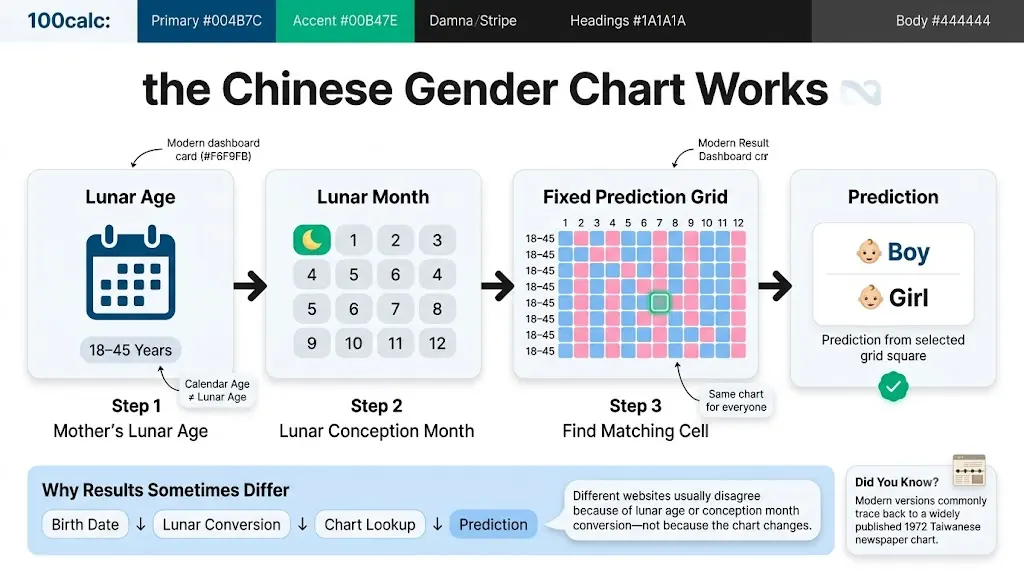
Why Can Different Sites Give Different Results?
Two websites can give different predictions even when you enter the same dates. They may use different versions of the chart, convert the Chinese lunar calendar differently, or handle leap months in different ways. This calculator shows the lunar age and lunar month it used so you can see how your result was reached.
What Is the Chinese Gender Chart?
The Chinese Gender Chart is a traditional folk chart used to make a boy-or-girl prediction. It matches the mother’s Chinese lunar age at conception with the lunar month of conception.
The chart is usually shown as a grid. Rows represent lunar ages, commonly 18 to 45. Columns represent lunar months 1 to 12. The square where the age and month meet gives a boy or girl prediction.
The chart’s exact origin is uncertain. Popular stories link it to the Qing Dynasty or a royal tomb, but no authenticated original source is widely documented. Different versions of the chart circulate online today.
The chart is part of pregnancy folklore, not a scientific method for determining fetal sex. Use it as a fun prediction while you wait for a medically reliable answer.
What Your Chinese Gender Prediction Means
Your result shows either Baby Boy or Baby Girl based on one commonly circulated version of the traditional Chinese gender chart. It is a chart lookup, not a percentage, probability score, or medical prediction.
Understanding Your Result
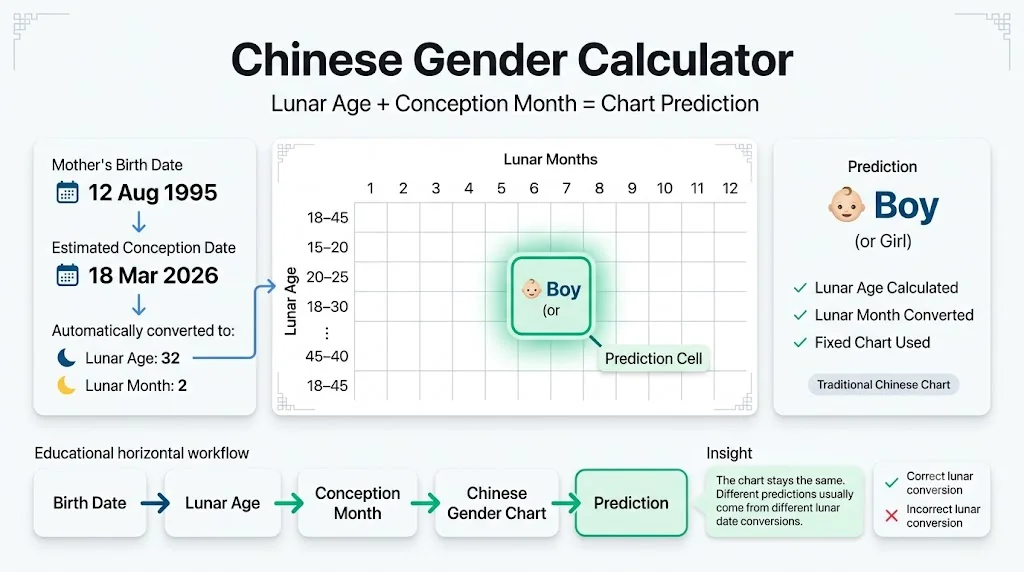
Two values determine the chart result: the mother’s Chinese lunar age at conception and the Chinese lunar month of conception.
The calculator converts your dates to those lunar values, then checks the matching square in the chart version used by this tool. That square gives a boy or girl prediction.
How Accurate Is Your Result?
The result is best treated as a traditional prediction for fun. It does not measure the actual chance that your baby is male or female. A population-based study of 2,840,755 singleton births found that the Chinese lunar-calendar method predicted fetal sex no better than chance. Use the result as a folklore guess, not as medical confirmation.
What You Should Do Next
- Save the chart result for fun or compare it later with medically obtained information where that information is legally available.
- Do not make medical decisions or important purchases based on the chart result.
- A mid-pregnancy ultrasound may show fetal sex, but it is not always possible or completely certain.
- Some cell-free DNA screening tests may report fetal sex from about 10 weeks. Availability and disclosure rules vary by country. In India, prenatal sex determination and disclosure are prohibited.
Quick Example to Test
Try this in the calculator above. Mother’s date of birth: June 12, 1998. Conception date: November 3, 2026.
That combination lands on Lunar Age 29, Lunar Month 9th. The chart’s row for age 29 shows a “B” at month 9. Result: Baby Boy.
Enter your own dates the same way. Your lunar age and lunar month will land somewhere different, and that spot decides your prediction.
How to Use the Chinese Gender Calculator
Choose the date method you know best. The calculator can use a conception date, a due date, or your last period plus cycle length. It then converts the relevant dates to the Chinese lunisolar calendar and checks the chart version used by this tool.
Enter the Mother's Birth Date
Enter the mother’s date of birth. The calculator uses this date to work out her Chinese lunar age at conception.
Choose Conception Date, Due Date, or Last Period
Choose the method that matches the dates you have. Use Conception Date if you know it, Due Date if that is easier, or Last Period if you know your LMP and average cycle length.
Add Your Date Details
Enter the date requested for your chosen method. Conception Date uses the date directly. Due Date estimates conception from the expected delivery date. Last Period uses your LMP and average cycle length to estimate conception.
Convert Your Dates to the Chinese Lunar Calendar
Tap “Predict Baby Gender.” The calculator converts the mother’s birth date and conception date into Chinese lunar calendar values, including the lunar age and lunar conception month.
Get Your Chart Match
The calculator matches the lunar age and lunar conception month to one square in the chart version used by this tool. That square gives the traditional Baby Boy or Baby Girl prediction.
Quick Example to Test
Try this: mother’s birth date of September 22, 1997, with a last period date of January 14, 2026, and a 30-day cycle length.
The calculator estimates conception on January 30, 2026. It then converts the dates to the Chinese lunisolar calendar and shows the lunar age, lunar conception month, and the matching chart prediction.
If your conception date is estimated from LMP or due date, remember that a small date difference can sometimes move the result into a different lunar month.
How the Chinese Gender Calculator System Works
The calculator converts the dates you enter to Chinese lunisolar calendar values. It uses the mother’s lunar age at conception and the lunar conception month, including leap-month information when it applies. If you use a due date or last period, the calculator estimates the conception date first. It then matches the lunar age and month to one commonly circulated 18-to-45 traditional Chinese gender chart.
Key Features & Benefits
- Converts your dates to Chinese lunisolar calendar values instead of estimating lunar months from a fixed number of days
- Supports conception date, due date, or last period plus average cycle length
- Estimates a conception date when you enter a due date or last period instead of a known conception date
- Stops the calculation when the lunar age falls outside the 18-to-45 range used by this chart version
- Shows the lunar age, lunar conception month, conception date used, and whether the date falls in a leap lunar month
Technical Process
Date Capture
Takes the mother’s birth date plus a conception date, due date, or last period and cycle length. If needed, it estimates the conception date before the lunar conversion.
Lunar Conversion
Converts the birth date and conception date to Chinese lunisolar calendar values. This provides the lunar years, conception month, and leap-month status used by the calculator.
Chart Lookup
Matches the calculated lunar age and lunar conception month to one square in the chart version used by this calculator. If conception falls in a leap lunar month, the calculator uses the same numbered month column and tells you that other traditions may handle leap months differently.
How the Chinese Gender Calculator Calculation Works (Complete Breakdown)
The Chinese Gender Calculator does not use a medical prediction formula. It converts the mother’s birth date and conception date to Chinese lunisolar calendar values, calculates her lunar age at conception, then matches that age and lunar month to the chart version used by this tool.
Calculation Method
					Birth Date → Chinese Lunar Year of Birth

Conception Date → Chinese Lunar Year + Lunar Conception Month

Lunar Age =
(Chinese Lunar Year of Conception - Chinese Lunar Year of Birth) + 1

Prediction =
Chart[Lunar Age][Lunar Conception Month]

If conception falls in a leap lunar month,
this calculator uses the same numbered month column.
How the Calculation Works
The calculator converts the dates to the Chinese lunisolar calendar first. This gives the lunar year, lunar month, and leap-month status when one applies. It then calculates the mother’s lunar age and performs a chart lookup. It does not estimate the lunar month by dividing days since Chinese New Year by 29.53.
Understanding the Calculation Values
Lunar Year of Birth
The Chinese lunisolar calendar year that contains the mother’s birth date. The calculator gets this value from the calendar conversion rather than from her regular Gregorian birth year alone.
Lunar Year of Conception
The Chinese lunisolar calendar year that contains the conception date. The calculator compares this with the lunar year of birth to calculate the mother’s lunar age at conception.
Lunar Conception Month
The Chinese lunisolar month that contains the conception date. The calculator reads the actual calendar month instead of estimating it from an average month length. If the date falls in a leap lunar month, the result shows that status and uses the same numbered month column for this chart.
Chart
The calculator uses one commonly circulated 18-to-45 traditional Chinese gender chart. Each lunar age row has 12 numbered month columns. The square where the calculated age and month meet gives the folklore Baby Boy or Baby Girl prediction.
Example: How the Chart Result Is Selected
Here is one example showing how regular calendar dates become the lunar values used for the chart lookup.
Given:
- Mother’s Date of Birth: October 2, 1991
- Conception Date: April 18, 2026
Lunar Conversion and Chart Lookup:
					Birth Date: October 2, 1991
Chinese lunar date: Lunar Year 1991, Month 8

Conception Date: April 18, 2026
Chinese lunar date: Lunar Year 2026, Month 3

Lunar Age:
(2026 - 1991) + 1 = 36

Lunar Conception Month:
3rd Month

Chart Lookup:
Chart[36][3]
Result:
- Lunar Age: 36
- Lunar Conception Month: 3rd
- Chart Prediction: Baby Boy
Meaning:
The mother’s lunar age places the result on row 36, and the 3rd lunar month selects the third column. In the chart version used by this calculator, that square gives a Baby Boy prediction. This is a traditional chart result, not a scientific prediction of fetal sex.
How Do You Calculate Your Chinese Gender Prediction?
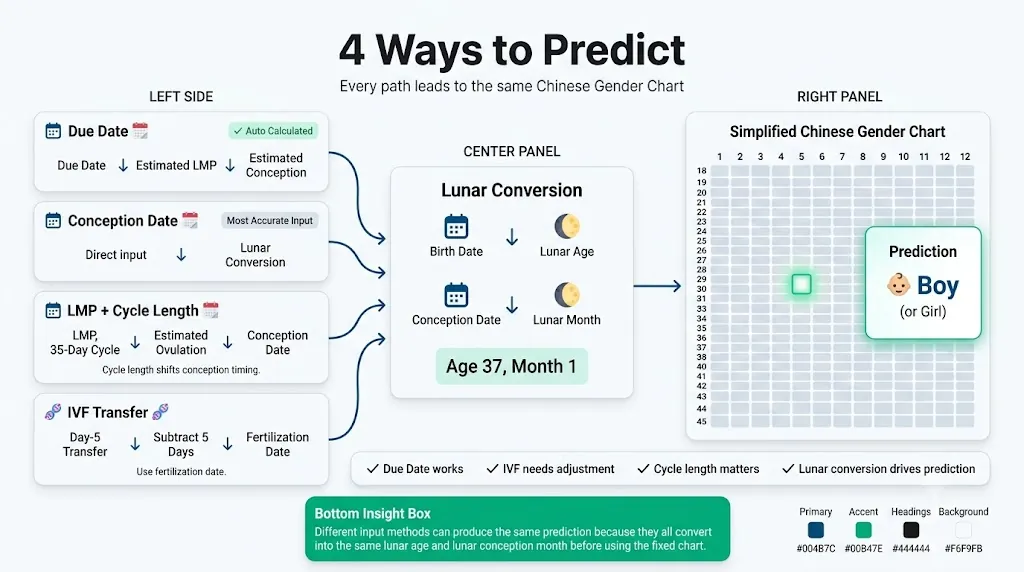
The calculator starts with the mother’s birth date and a conception date. If you only know your due date or last period, it estimates the conception date first. It then converts the dates to Chinese lunisolar values and matches the lunar age and month to the chart version used by this tool.
What If I Only Know My Due Date?
You can use the calculator even if you only know your estimated due date.
Input:
- Mother’s DOB: April 3, 1993
- Due Date: February 10, 2027
Process:
- Due Date mode estimates conception 266 days before the due date. That gives an estimated conception date of May 20, 2026.
- The Chinese calendar conversion gives Lunar Age 34 and Lunar Conception Month 4.
Result:
- Baby Girl
Meaning:
Select Due Date in the calculator and enter the expected delivery date. Because the conception date is estimated, a small date difference near a lunar-month boundary could change the chart result.
How Does an Older Maternal Age Affect the Chart Result?
The chart uses lunar age as a row number. It does not calculate different biological odds for older or younger mothers.
Input:
- Mother’s DOB: July 8, 1988
- Conception Date: December 2, 2025
Process:
- The Chinese calendar conversion gives Lunar Age 38 and Lunar Conception Month 10.
Result:
- Baby Girl
Meaning:
Lunar age only decides which chart row is used. It does not mean an older mother has a higher chance of having a boy or girl.
How Does an Irregular 35 Day Cycle Change the Result?
Cycle length matters when you use Last Period mode because it changes the estimated conception date.
Input:
- Mother’s DOB: November 11, 1985
- Last Period: June 1, 2026
- Cycle Length: 35 days
Process:
- The calculator estimates conception on June 22, 2026.
- The Chinese calendar conversion gives Lunar Age 42 and Lunar Conception Month 5.
Result:
- Baby Girl
Meaning:
A different cycle length can shift the estimated conception date. If that shift crosses a Chinese lunar-month boundary, the chart prediction can also change.
How Do IVF Transfer Dates Work With the Chart?
An embryo transfer date is not the same as the fertilization date used for this folklore chart.
Input:
- Mother’s DOB: August 25, 1990
- Day-5 Embryo Transfer Date: March 15, 2026
Process:
- For this example, a day-5 embryo places the fertilization date about five days before transfer, around March 10, 2026.
- Enter March 10, 2026 as the conception-date estimate.
- The Chinese calendar conversion gives Lunar Age 37 and Lunar Conception Month 1.
Result:
- Baby Boy
Meaning:
If your fertility clinic gave you the fertilization date, use that date. If you only know the transfer date, remember that any date you derive from it is being used only to test this traditional chart, not for medical pregnancy dating.
Quick Rules to Remember
The chart uses the mother’s lunar age and lunar conception month. Use a known conception date when available. Due Date and Last Period modes estimate conception for you. IVF users should use the fertilization date supplied by their clinic when available. Every result remains a folklore prediction, not a medical test.
Chinese Gender Calculator Result Benchmarks Explained
The chart version used by this calculator has rows for lunar ages 18 through 45 and columns for lunar months 1 through 12. If your lunar age falls outside that range, the calculator stops instead of forcing a prediction. Leap lunar months are shown separately and use the same numbered month column.
| Result Situation | Status | What You'll See | What It Means | What to Check |
|---|---|---|---|---|
| Lunar Age 18–45 | Chart Match Available | A Boy or Girl prediction, plus the lunar age, lunar conception month, and conception date used. | This chart version contains rows for lunar ages 18 through 45. | Check that your birth date and conception details were entered correctly. |
| Lunar Age Under 18 | No Chart Row | An error message instead of a prediction. | The chart version used by this calculator has no row below lunar age 18. | Recheck the mother's birth date and the conception date used. |
| Lunar Age Over 45 | No Chart Row | An error message instead of a prediction. | The chart version used by this calculator has no row above lunar age 45. | Recheck the mother's birth date and the conception date used. |
| Leap Lunar Month | Special Case | The result shows the leap lunar month and still returns a chart prediction. | This 12-column chart has no separate leap-month column, so the calculator uses the same numbered month column. | Other chart traditions may handle leap months differently, so another site may return a different result. |
| Estimated Conception Date | Date Estimated | A normal chart prediction with the conception date marked as estimated. | This happens when you use Due Date or Last Period mode instead of a known conception date. | A small date change near a lunar-month boundary can change the chart prediction. |
Heads-up: Lunar age is not the same as regular age. The calculator derives it from the Chinese calendar years of birth and conception. The result is still a folklore chart prediction, not a medical estimate of fetal sex.
Interpretation
If your lunar age is between 18 and 45, the calculator can match it to a row in this chart version. If it falls outside that range, no prediction is shown. A leap lunar month can still return a result, but the calculator uses the same numbered month column because the chart has only 12 month columns.
Pro Tip
If your conception date was estimated from a due date or last period, check the date shown in your result. A small shift can matter when the estimate falls close to a Chinese lunar-month boundary.
What to Do After Using the Chinese Gender Calculator
Your result is a fun starting point, not a plan. What you do next depends on how confident you feel in your dates and how you want to use the prediction. Here’s how to handle each situation.
If You Got a Boy or Girl Prediction
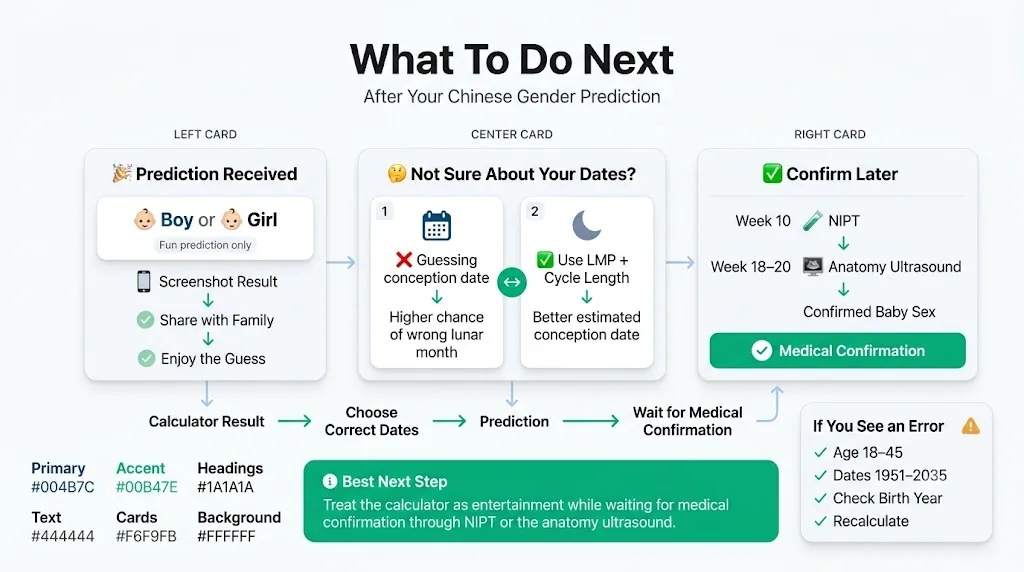
Enjoy the result as a traditional pregnancy prediction or guessing game. Do not make medical decisions or important purchases based on it. The Chinese gender chart performs about the same as chance. If fetal-sex information is available where you live, you can compare the folklore prediction with medically obtained information later in pregnancy.
If You're Not Sure of Your Conception Date
Use Due Date or Last Period mode instead of guessing a conception date. Due Date mode estimates conception from your expected delivery date. Last Period mode uses the first day of your LMP and average cycle length. Either method gives an estimated date, so a result near a lunar-month boundary may change if the conception estimate changes.
If You Got an Error Instead of a Result
Recheck the mother’s birth date and the conception details you entered. The chart version used by this calculator only contains lunar-age rows from 18 through 45. If the calculated lunar age falls outside that range, the calculator will not force a Boy or Girl prediction.
If You Want a Medically Reliable Answer
Treat the Chinese gender chart as entertainment, not as a medical test. Where fetal-sex information is legally available, cell-free DNA screening such as NIPT can be performed from about 10 weeks, and some tests may report fetal sex. A mid-pregnancy ultrasound, usually around 18 to 22 weeks, may also show fetal sex, but it is not always possible or completely certain. Availability and disclosure rules vary by country and healthcare provider.
If you are in India: prenatal testing or ultrasound must not be used to determine or disclose fetal sex. The PCPNDT Act prohibits prenatal sex determination and communicating the sex of the fetus.
You Might Also Find These Helpful
Pregnancy & Fertility 45
Find out exactly when you conceived. Our free Conception Calculator uses your Due Date, LMP, or Ultrasound to estimate your fertilization date and fertile…
Try calculatorUse our Conception Date Due Date Calculator to find your baby's arrival date. Enter your conception or intercourse date for clinical 40-week results.
Try calculatorContraceptive effectiveness calculator to compare birth control methods, typical vs perfect use, backup protection, and 5-year pregnancy risk.
Try calculatorUse this CRL calculator to estimate gestational age and due date from crown-rump length in mm or cm. Compare CRL, LMP, and IVF dating…
Try calculatorEstimate your monthly and 12-month pregnancy odds by age, partner age, and cycle dates. See your fertile window and when to seek fertility help.
Try calculatorUse this fundal height calculator to compare your cm measurement by week, check growth range, estimate baby weight, and know when to ask about…
Try calculatorUse the Gestational Age Calculator to find your pregnancy week from LMP, due date, ultrasound, or IVF. See your EDD, trimester, month, and days…
Try calculatorPanicking over your hCG levels? Use our hCG 48-Hour Calculator to compare your exact beta rise against the ACOG 35% minimum viability benchmark instantly.
Try calculatorCalculate hCG doubling time instantly. Enter two test results. See if your levels are rising normally. Check pregnancy progress now in the hCG Calculator.
Try calculatorCheck your beta hCG rise with this hCG doubling time calculator. Enter two blood tests to see doubling time, 48-hour increase, and early trend…
Try calculatorConfused by your beta hCG levels? Use our hcg gestational age calculator to estimate your pregnancy weeks, verify IVF dates, and check ultrasound milestones.
Try calculatorConfused by your early pregnancy blood test? Use our hCG range calculator to instantly check if your beta levels match standard singleton or twin…
Try calculatorUse our implantation bleeding calculator to find your implantation window, test date, and due date. See if spotting fits implantation or a period.
Try calculatorCalculate implantation window instantly. Enter last period date. Find peak probability. See when to take a pregnancy test in the Implantation Calculator.
Try calculatorUse our IUI Due Date Calculator to find your exact due date and safe pregnancy test day. Get clinical 40-week results based on your…
Try calculatorIUI Success Rate Calculator estimates pregnancy chance using age, infertility profile, pre-wash TPMSC and optional AMH, with a 1–3 cycle projection.
Try calculatorUse our IVF Due Date Calculator to find your exact twin pregnancy timeline. Enter your transfer date to get 40-week and 37-week dates instantly.
Try calculatorUse our Late Period Probability Calculator to check how many days late you are, when to test or retest, and what your result timing…
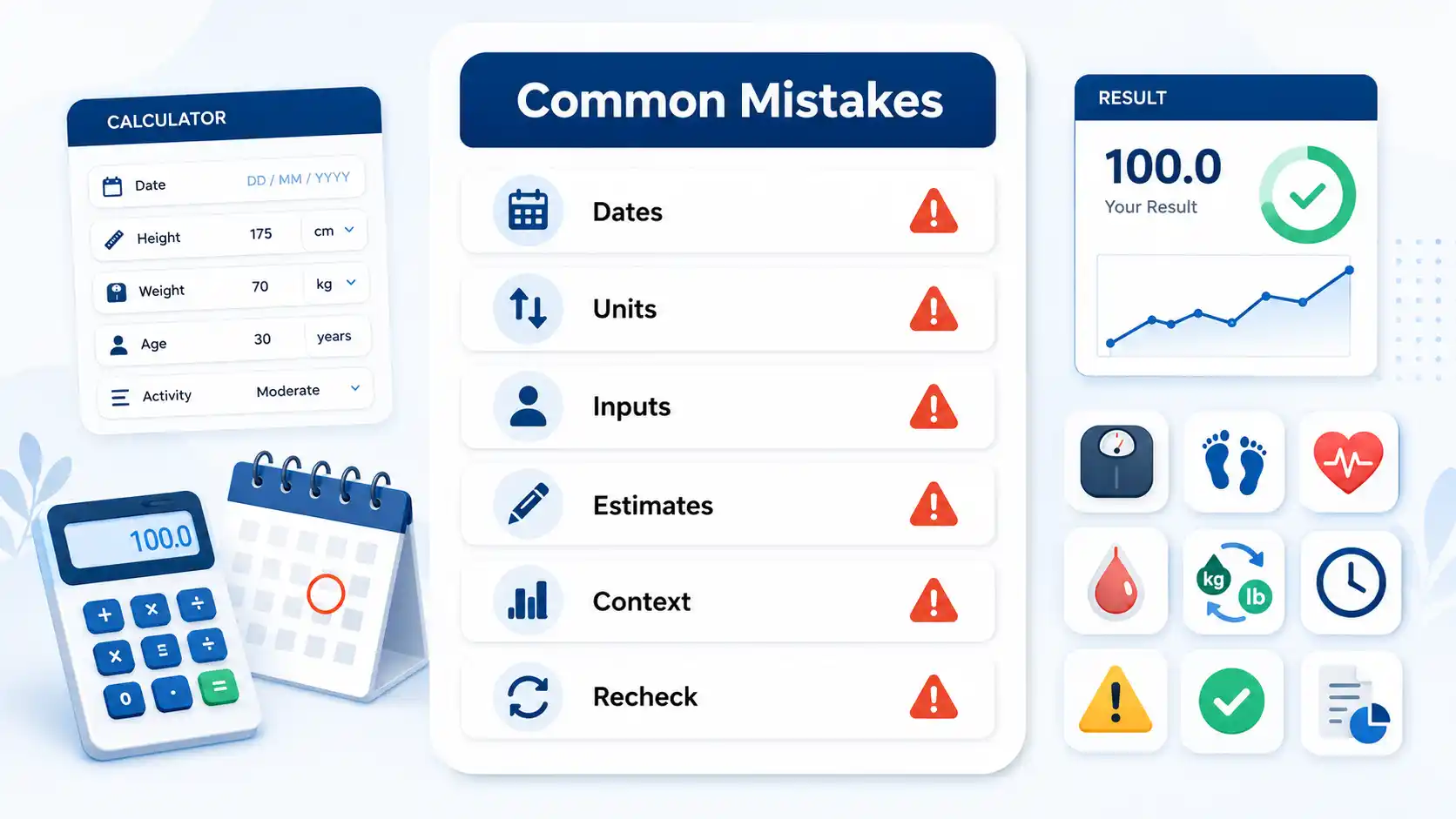
Try calculatorCommon Mistakes When Using the Chinese Gender Calculator
Different inputs, estimated dates, chart versions, and leap-month rules can all change the result. These are the main mistakes to avoid when using or comparing a Chinese gender calculator.
- Entering a due date or last period into the Conception Date field instead of choosing the correct calculation mode
- Treating a conception date estimated from a due date or LMP as exact, especially when the date is close to a lunar-month boundary
- Treating the Boy or Girl result as medically reliable when research shows the traditional method performs about the same as chance
- Ignoring a leap lunar month. This calculator shows leap-month status and uses the same numbered month column because the chart has no separate leap-month columns
- Assuming a different result on another website means one calculator is more accurate. Sites may use different chart versions, lunar-calendar conversions, or leap-month rules.
Frequently Asked Questions (FAQs)
How accurate is the Chinese gender calculator?
About 50%. A population-based study of 2,840,755 singleton births found that the Chinese lunar calendar method predicted fetal sex no better than tossing a coin. Use the result as a folklore prediction, not a medical test.
Does the Chinese gender chart change every year?
The chart version used by this calculator does not change each year. Your lunar age and lunar conception month change based on your dates. Other websites may use different chart versions or handle leap lunar months differently, so their results may not always match.
Can I use the Chinese gender calculator for twins?
You can use it as a fun prediction for the pregnancy, but the chart cannot predict the fetal sex of each twin separately. One lunar age and conception month produce one chart result.
What’s the difference between Conception Date, Due Date, and Last Period modes?
Conception Date mode uses the date you enter directly. Due Date mode estimates conception 266 days before the expected due date. Last Period mode estimates conception from your LMP and average cycle length. Because Due Date and Last Period modes use estimates, a small date change near a lunar-month boundary can change the chart result.
Why do I get different results on different Chinese gender calculator websites?
Different websites may use different chart versions, Chinese calendar conversions, conception-date estimates, or leap-month rules. This calculator shows the lunar age and lunar conception month it used so you can check how the result was reached. A different result on another site does not mean that chart is more accurate.
Is the Chinese gender predictor based on science?
No. The Chinese gender chart is a traditional folklore method, not a scientific fetal-sex test. It uses lunar age and conception month, and research has found that its predictions perform no better than chance.
Can I use this chart to try to conceive a specific gender?
No reliable evidence shows that choosing a conception month from the Chinese gender chart can increase your chance of conceiving a boy or girl. Use the chart as a tradition or guessing game, not as a method for sex selection.
When can I get a medically reliable answer instead?
Where permitted, prenatal cell-free DNA screening, often called NIPT, can be done from about 10 weeks, and some tests may report fetal sex. A mid-pregnancy ultrasound around 18 to 22 weeks may also show fetal sex, although it is not always possible or completely certain. Availability and disclosure rules vary by country and healthcare provider. In India, prenatal sex determination and disclosure are prohibited under the PCPNDT Act.
Is my Chinese lunar age always older than my actual age?
It is often higher than your regular age, but the difference is not always a simple one or two years. This calculator calculates lunar age as the Chinese lunar year of conception minus the Chinese lunar year of birth, plus one. Your exact result therefore depends on both dates.
Does timing conception around even or odd months help pick a gender?
No reliable evidence shows that conceiving in an even or odd lunar month can help you choose a boy or girl. Those patterns are part of the folklore surrounding gender charts, not a scientifically proven method.
Questions?
We had love to hear from you! Whether you are reporting an issue, suggesting a new calculator, or exploring collaboration opportunities — we are here to help. Every message helps us make 100calc smarter, faster, and more helpful for everyone.
Why People Trust 100calc
At 100calc.com, we focus on accuracy, speed, and trust. Every calculator we create is designed to give reliable, instant, and easy-to-understand results you can truly depend on.