
Vanishing Twin Calculator: Understand Your Early Twin Scan
A Vanishing Twin Calculator helps you compare an early twin ultrasound with published first-trimester twin-loss research. Enter your gestational age, what the latest scan showed, whether twins were confirmed earlier, twin type, conception method, and current symptoms.
The result gives research context for your scan, not a personalized survival percentage. It explains what your ultrasound finding may mean, how twin type affects monitoring, what to discuss with your care team, and when follow-up imaging may matter.
This calculator cannot diagnose vanishing twin syndrome or confirm a miscarriage. A single early ultrasound may also be too soon to give a final answer, so ultrasound measurements, earlier scans, and follow-up imaging can be important.
Quick Facts
- Uses published first-trimester twin-loss data as research context, not as a validated personalized prediction model.
- Covers early twin pregnancy from 5 to 13 weeks, matching the range used by this calculator.
- Distinguishes whether cardiac activity was seen in both twins, one twin only, neither twin yet, or the ultrasound report is unclear.
- Uses earlier twin confirmation, twin type, conception method, and current symptoms to tailor the explanation and follow-up context without inventing fixed percentage penalties or bonuses.
- Does not diagnose vanishing twin syndrome, confirm miscarriage, or replace review of your ultrasound by your obstetric, midwifery, early-pregnancy, or fertility team.
- Updated Oct 5, 2026
- Reviewed by 100Calc Research Team
Research-based early twin pregnancy context
Vanishing Twin Calculator
Match your early twin ultrasound findings with published twin-loss data and see what your scan can and cannot tell you. This tool does not diagnose vanishing twin syndrome or calculate a personalized survival probability.
Research context — not a diagnosis
Your scan context
Published twin-loss reference
How well does the research match?
What your ultrasound finding means
Twin type and monitoring
What to do next
NIPT / cfDNA note
Research basis and limitations
Numerical reference: Tummers et al. (2003) followed 397 IVF/ICSI twin pregnancies. In that cohort, 12.1% had partial loss (vanishing twin) and 5.0% had complete miscarriage. After fetal cardiac activity had been recorded, the remaining miscarriage risk per gestational sac was 7.3%; published milestones fell to 4.9% at 9 weeks, 2.2% at 11 weeks, and 2.0% at 13 weeks.
Important limitation: These are population-level research values, not a validated individualized vanishing-twin prediction model. The study involved IVF/ICSI pregnancies and does not provide fixed percentage adjustments for chorionicity, bleeding, maternal age, IUI, or spontaneous conception.
Explore More Calculators
Use the Chinese Gender Calculator for a traditional boy-or-girl prediction from lunar age and conception month. Enter conception date, due date, or LMP.
Try calculatorUse this fetal growth calculator to check baby weight percentile from ultrasound data in grams, kg, or cm and see what the result means…
Try calculatorEnter gestational sac measurements in mm or cm to calculate mean sac diameter, estimate early gestational age, compare week-by-week milestones, and see when follow-up…
Try calculatorMissed a birth control pill? Check pregnancy risk, protection status, backup contraception needs, and what to do next with our missed pill calculator.
Try calculatorUse our Pregnancy Chance Calculator to estimate your odds. Enter your cycle day, age, and method. Find out if you are in the high-risk…
Try calculatorUse our pregnancy due date calculator to find your exact Baby Due date. IVF, conception, ovulation, and ultrasound methods with weeks and timeline.
Try calculatorUse this Pregnancy Risk Calculator to check age, BMI, health history, bleeding, and twins. See if closer prenatal monitoring may be worth asking about.
Try calculatorOne Time Pregnancy Calculator estimates pregnancy odds from one encounter, plus fertile window timing, test date, due date, and 21-day testing guidance.
Try calculatorUse the AMH Calculator to convert ng/mL or pmol/L, compare your result with age-based data, and see what it may mean for IVF, fertility,…
Try calculatorUse the Baby Eye Color Calculator with parents, grandparents, or sibling context to compare Brown, Green/Hazel, and Blue/Grey model estimates instantly.
Try calculatorBasal Body Temperature Calculator checks reading conditions and analyzes your temperature pattern for a sustained shift that may be consistent with ovulation.
Try calculatorBPD gestational age calculator: estimate fetal age from BPD, compare your week, check normal BPD ranges, and understand ahead or behind results.
Try calculator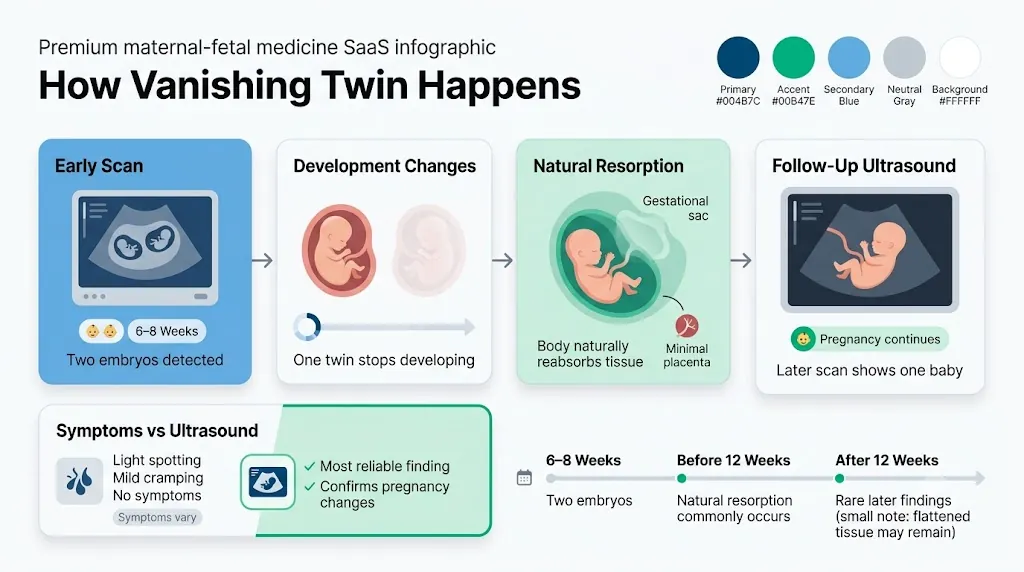
Symptoms May Be Absent
Vanishing twin syndrome may cause no noticeable symptoms. Some people have light bleeding or mild cramping, while others learn about it only through ultrasound. Symptoms alone cannot confirm or rule out a vanishing twin. Heavy bleeding, severe or one-sided pain, dizziness, fainting, or fever need prompt medical assessment.
What Is Vanishing Twin Syndrome?
Vanishing twin syndrome happens when one embryo or fetus in a multiple pregnancy stops developing, usually early in pregnancy, and its tissue is partly or fully reabsorbed. It is often found when an earlier ultrasound showed twins but a later scan shows only one continuing pregnancy.
Many people have no symptoms. Others may have light bleeding or mild cramping. When the loss happens early in the first trimester, the remaining twin usually has a good outlook. ISUOG notes that a very early loss before about 14 weeks usually carries little or no added risk to the other twin.
Timing and twin type still matter. A later loss is different from an early vanishing twin and may need closer monitoring, especially when the twins share one placenta. Ultrasound and follow-up care are used to understand what is happening in an individual pregnancy.
What Your Vanishing Twin Calculator Result Means
Your result gives research context for your early twin scan. It does not predict whether one or both twins will survive, and it does not diagnose vanishing twin syndrome.
Understanding Your Result
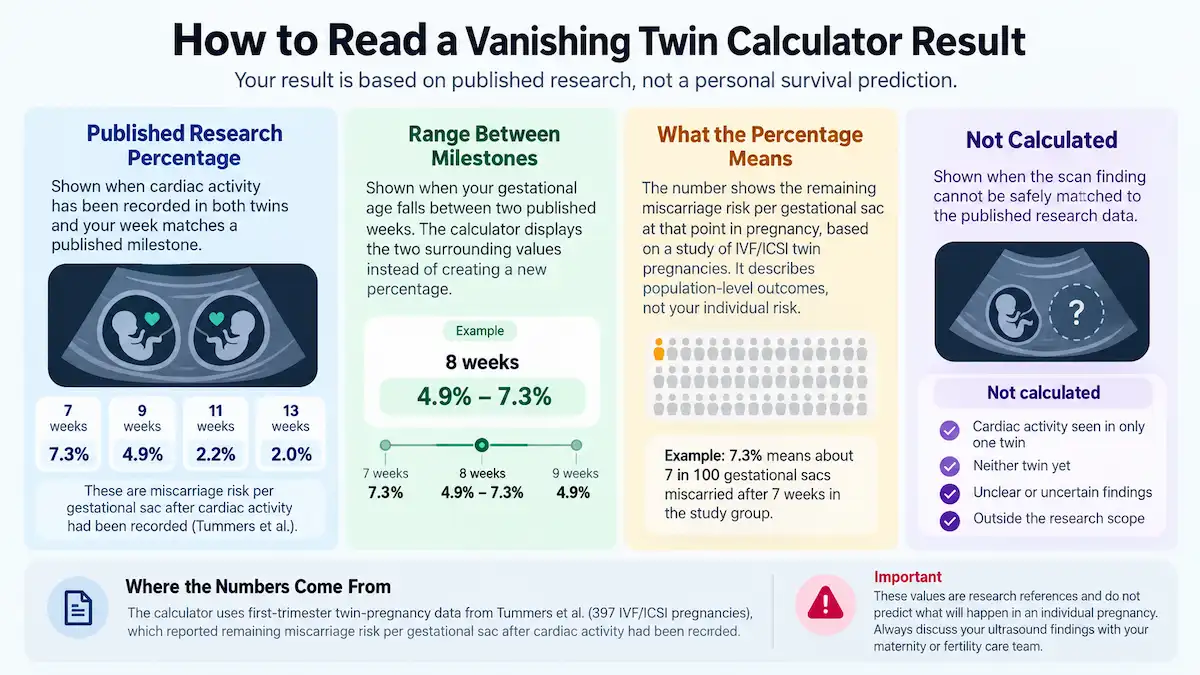
Your result depends mainly on what your latest ultrasound showed. If cardiac activity was seen in both twins, the calculator may show a published research reference for the remaining miscarriage risk per gestational sac after cardiac activity had been recorded. It also tells you how closely that research matches your pregnancy.
If cardiac activity was seen in only one twin, in neither twin yet, or the scan report is unclear, the calculator may show “Not calculated.” That means the available research cannot safely turn that finding into a personalized percentage.
The result also explains your scan finding, twin type, symptoms, and possible next questions for your maternity or fertility care team.
How Should You Read the Percentage?
Do not read the percentage as a “good,” “bad,” “safe,” or “high-risk” score. The published references used by this calculator come from an IVF/ICSI twin-pregnancy study. After cardiac activity had been recorded, the remaining miscarriage risk per gestational sac was 7.3% at 7 weeks, 4.9% at 9 weeks, 2.2% at 11 weeks, and 2.0% at 13 weeks.
These numbers describe what happened in that research group. They are not your personal chance of losing a twin, and they should not be converted into a personal survival percentage.
A result of “Not calculated” also does not mean the outlook is poor. It means your ultrasound finding needs clinical interpretation instead of a calculator-generated percentage.
What You Should Do Next
- Review the result together with your actual ultrasound report. Scan measurements, what was seen on earlier scans, and follow-up imaging can matter more than a population percentage.
- If your result shows a published percentage, treat it as research context only. If it says “Not calculated,” use the explanation shown with the result and ask your care team what follow-up is appropriate for your scan.
- Contact your maternity, early-pregnancy, or fertility team if you have new bleeding or pain. Seek prompt medical care for heavy bleeding, severe or one-sided pain, dizziness, fainting, or fever.
Quick Example to Test
Try this: 7 weeks 0 days, cardiac activity seen in both twins, twins confirmed on an earlier scan, Di/Di twins, IVF or ICSI conception, and no concerning symptoms.
Result: The calculator shows the published 7-week research reference of 7.3% remaining miscarriage risk per gestational sac after cardiac activity had been recorded.
This is a population-level research value from IVF/ICSI twin pregnancies. It is not your personal chance of losing one twin or both twins.
How to Use the Vanishing Twin Calculator
The calculator has three short steps. Use the findings from your most recent ultrasound, then add what you know about the twin pregnancy and any symptoms you have now. Your result gives research context for your scan. It does not calculate a personalized survival score.
Enter Your Gestational Age and Latest Scan Finding
Choose the week and day of your most recent ultrasound. Then select whether cardiac activity was seen in both twins, one twin only, neither twin yet, or whether the scan report is unclear.
Add Any Earlier Twin Confirmation
Select whether an earlier ultrasound confirmed two sacs, embryos, or fetuses. If you do not know, choose “Not sure.” This helps the calculator explain your current scan in the context of an earlier twin pregnancy.
Add Twin Type and Conception Method
If known, choose Di/Di, Mono/Di, or Mono/Mono twins. You can also choose “Not sure.” Then select whether the pregnancy followed IVF or ICSI, IUI, or conception without fertility treatment. These answers help explain how closely the published research fits your situation.
Add Your Current Symptoms
Choose whether you have no concerning symptoms, light spotting or mild cramping, or symptoms that need prompt medical assessment. Symptoms affect the safety guidance shown with your result. They do not add or subtract points from a risk score.
Review Your Research Context
Select “Show My Research Context.” You will see the published twin-loss reference, how closely that research matches your situation, what your ultrasound finding may mean, twin-type monitoring context, and what to discuss or do next.
Quick Example to Test
Try this: 9 weeks 0 days, cardiac activity seen in both twins, twins confirmed on an earlier scan, Di/Di twins, conception without fertility treatment, and no concerning symptoms.
Result: The calculator shows the published 4.9% remaining miscarriage risk per gestational sac at the 9-week research milestone.
Because the study used IVF/ICSI twin pregnancies, the calculator also tells you that the research is an indirect match for a pregnancy conceived without fertility treatment.
How the Vanishing Twin Calculator Gets Its Numbers
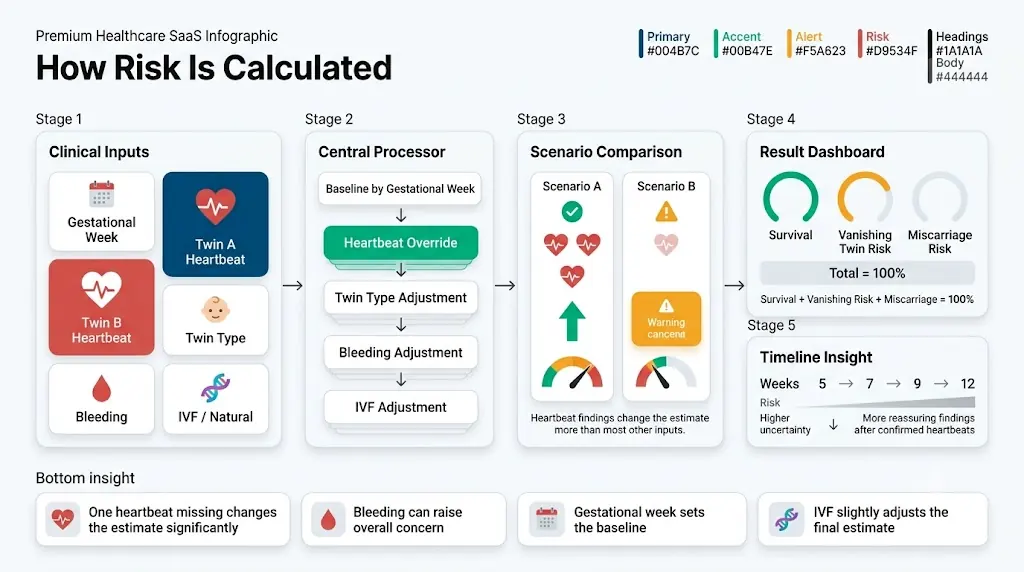
This calculator does not use a personalized clinical prediction formula. When the available research applies, it shows published first-trimester twin-loss data as a reference. Your other answers help explain how closely that research fits your pregnancy and what your scan may mean. They do not add or subtract points from the percentage.
Key Features & Benefits
- Uses published first-trimester twin-pregnancy data instead of a custom survival score.
- Shows a numerical research reference only when the calculator has suitable published data for the scan finding.
- Uses twin type to explain monitoring context, not to add a fixed risk penalty.
- Uses conception method to show how closely the research population matches your pregnancy.
- Uses current symptoms for safety guidance, not to raise or lower a calculated percentage.
Technical Process
Data Input
Collects your gestational age, latest ultrasound finding, earlier twin confirmation, twin type, conception method, and current symptoms.
Research Matching
Checks whether a published first-trimester research reference can be shown for your scan. It does not create a personal survival score or apply fixed percentage adjustments.
Output Generation
Shows the published reference when it applies, explains how well the research matches your situation, and gives plain-language scan, monitoring, safety, and next-step context.
How the Vanishing Twin Calculator Uses Published Research
This calculator does not use a formula that predicts your personal chance of vanishing twin syndrome. It uses first-trimester twin-pregnancy data published by Tummers et al. from 397 IVF/ICSI twin pregnancies. When cardiac activity has been recorded in both twins, it matches your gestational age with the published milestones. If your week falls between two milestones, it shows the range between them instead of creating a new percentage.
Published Research Milestones
					7 weeks  = 7.3%
9 weeks  = 4.9%
11 weeks = 2.2%
13 weeks = 2.0%

Measure: Remaining miscarriage risk per gestational sac
after fetal cardiac activity had been recorded.
How the Calculator Uses These Numbers
If your gestational age matches a published milestone, the calculator shows that research value. If it falls between two milestones, it shows the range between them. For example, a scan at 8 weeks falls between the published 7-week value of 7.3% and the 9-week value of 4.9%, so the calculator shows 4.9%–7.3% instead of inventing an 8-week percentage.
What Each Input Does
Gestational Age
Gestational age is used to find the nearest published research milestone or range. It does not create a starting survival score. The calculator uses first-trimester references from 7, 9, 11, and 13 weeks when the scan finding fits the research.
Latest Ultrasound Finding
The calculator first checks what the latest ultrasound showed. When cardiac activity was seen in both twins, a published research reference may apply. If cardiac activity was seen in only one twin, neither twin yet, or the report is unclear, the calculator does not create a personalized percentage.
Twin Type
Twin type helps explain the pregnancy and monitoring context. Di/Di, Mono/Di, and Mono/Mono twins can need different levels of monitoring, but this calculator does not add or subtract a fixed percentage based on twin type.
Conception Method and Symptoms
Conception method helps show how closely the published study matches your pregnancy because the research population included IVF/ICSI twin pregnancies. Symptoms are used for safety guidance. Neither conception method nor symptoms add or subtract points from the published percentage.
Example: How the Research Reference Is Selected
Here is an example of how the calculator selects a published reference without creating a custom risk score.
Given:
- Gestational Age: 8 weeks 0 days
- Latest Scan: Cardiac activity seen in both twins
- Earlier Twin Pregnancy Confirmed: Yes
- Twin Type: Di/Di
- Conception: IVF or ICSI
- Current Symptoms: No concerning symptoms
Research Match:
					Published 7-week reference: 7.3%
Published 9-week reference: 4.9%

8 weeks falls between these milestones.

Displayed research range: 4.9%–7.3%

No daily interpolation.
No twin-type penalty.
No bleeding, age, or IVF point adjustment.
Result:
- Published reference: 4.9%–7.3% remaining miscarriage risk per gestational sac
- Research match: Closer match because the published cohort included IVF/ICSI twin pregnancies
- Personal survival probability: Not calculated
Meaning:
The 4.9%–7.3% range describes outcomes in the published research group. It is not an 8-week personalized risk prediction and does not tell you whether either twin will continue. Your actual ultrasound findings and follow-up care remain more important than the research percentage.
Can You Calculate Vanishing Twin Survival Odds?
There is no validated formula in this calculator that can calculate a person’s exact vanishing twin survival odds from gestational age, heartbeat findings, twin type, symptoms, or conception method. The calculator instead shows published twin-loss references when they apply and explains when a percentage cannot safely be calculated.
What does one heartbeat at a 7-week IVF twin scan mean?
If a 7-week IVF twin scan shows cardiac activity in one twin but not the other, this calculator does not turn that finding into a personalized vanishing-twin percentage.
Input
- Gestational age: 7 weeks 0 days
- Latest scan: Cardiac activity seen in one twin only
- Earlier twin pregnancy confirmed: Yes
- Twin type: Di/Di
- Conception: IVF or ICSI
- Current symptoms: No concerning symptoms
Result: Not calculated
Meaning
A yes-or-no heartbeat finding by itself is not enough to safely calculate the outcome of the second twin. Ultrasound measurements, what was seen on the earlier scan, and follow-up imaging can all matter.
What happens when both heartbeats are confirmed at a 9-week scan?
When cardiac activity is seen in both twins at 9 weeks, the calculator can show a published research reference instead of creating a personal survival score.
Input
- Gestational age: 9 weeks 0 days
- Latest scan: Cardiac activity seen in both twins
- Earlier twin pregnancy confirmed: Yes
- Twin type: Di/Di
- Conception: IVF or ICSI
- Current symptoms: No concerning symptoms
Result: 4.9% remaining miscarriage risk per gestational sac in the published IVF/ICSI twin cohort after cardiac activity had been recorded.
Meaning
This percentage is a research reference, not a prediction that one specific twin will or will not continue.
What if there is spotting or cramping but both heartbeats are seen at 8 weeks?
The calculator does not subtract points from the research percentage because of spotting or cramping. Symptoms are used for safety guidance, not to create a new risk score.
Input
- Gestational age: 8 weeks 0 days
- Latest scan: Cardiac activity seen in both twins
- Earlier twin pregnancy confirmed: Yes
- Twin type: Mono/Di
- Conception: Without fertility treatment
- Current symptoms: Light spotting or mild cramping
Result: The calculator shows the published reference range between the 7-week and 9-week milestones: 4.9% to 7.3% remaining miscarriage risk per gestational sac.
Meaning
It also explains that this research came from IVF/ICSI pregnancies, so it is an indirect match for spontaneous conception. Your symptoms should be discussed separately with your maternity care team.
What if no heartbeats show at a very early 5-week scan?
At 5 weeks, the calculator does not assign a survival percentage when cardiac activity has not been seen yet.
Input
- Gestational age: 5 weeks 3 days
- Latest scan: No cardiac activity seen yet in either twin
- Earlier twin pregnancy confirmed: Yes
- Twin type: Di/Di
- Conception: Without fertility treatment
- Current symptoms: No concerning symptoms
Result: Not calculated
Meaning
At this early stage, a yes-or-no heartbeat finding alone is not enough to confirm pregnancy loss. Scan type, crown-rump length, sac measurements, earlier findings, and follow-up imaging may all matter.
Quick Rules to Remember
A published percentage is research context, not your personal outcome. If only one heartbeat is seen, neither is seen yet, or the scan is unclear, the calculator may show “Not calculated.” Your ultrasound measurements, earlier scans, symptoms, and follow-up imaging are what help your care team understand what is happening.
Vanishing Twin Research References by Week
The calculator uses published first-trimester twin-pregnancy data when the scan finding fits the research. These percentages are miscarriage risk per gestational sac after cardiac activity had been recorded. They are research references, not personal survival scores.
| Gestational Age | Published Reference | What It Means |
|---|---|---|
| 7 weeks | 7.3% | Remaining miscarriage risk per gestational sac after cardiac activity had been recorded in the IVF/ICSI twin cohort. |
| 9 weeks | 4.9% | Published remaining miscarriage risk per gestational sac at the 9-week milestone. |
| 11 weeks | 2.2% | Published remaining miscarriage risk per gestational sac at the 11-week milestone. |
| 13 weeks | 2.0% | Published remaining miscarriage risk per gestational sac at the 13-week milestone. |
| Between milestones | Range shown | The calculator shows the two surrounding published values instead of creating a new percentage. For example, 8 weeks displays 4.9%–7.3%. |
| Research reference does not apply | Not calculated | No personalized percentage is created when the scan finding cannot be safely matched to the published reference data. |
Important: These values come from a study of IVF/ICSI twin pregnancies. They describe population-level outcomes and do not predict what will happen in an individual pregnancy.
Interpretation
A lower published percentage at a later week does not mean the calculator has measured your personal risk. It means fewer losses remained in the study group as pregnancy progressed. If your result shows a range, your gestational age falls between two published milestones. If it shows “Not calculated,” the calculator does not have suitable evidence to turn your scan finding into a percentage.
What to Bring to Your Appointment
Bring your ultrasound report and, if available, details from earlier scans. Note your gestational age, what was seen for each twin, your twin type if known, and any bleeding, pain, dizziness, or other symptoms. Treat the calculator percentage as research context, not as a diagnosis.
What to Do After Using the Vanishing Twin Calculator
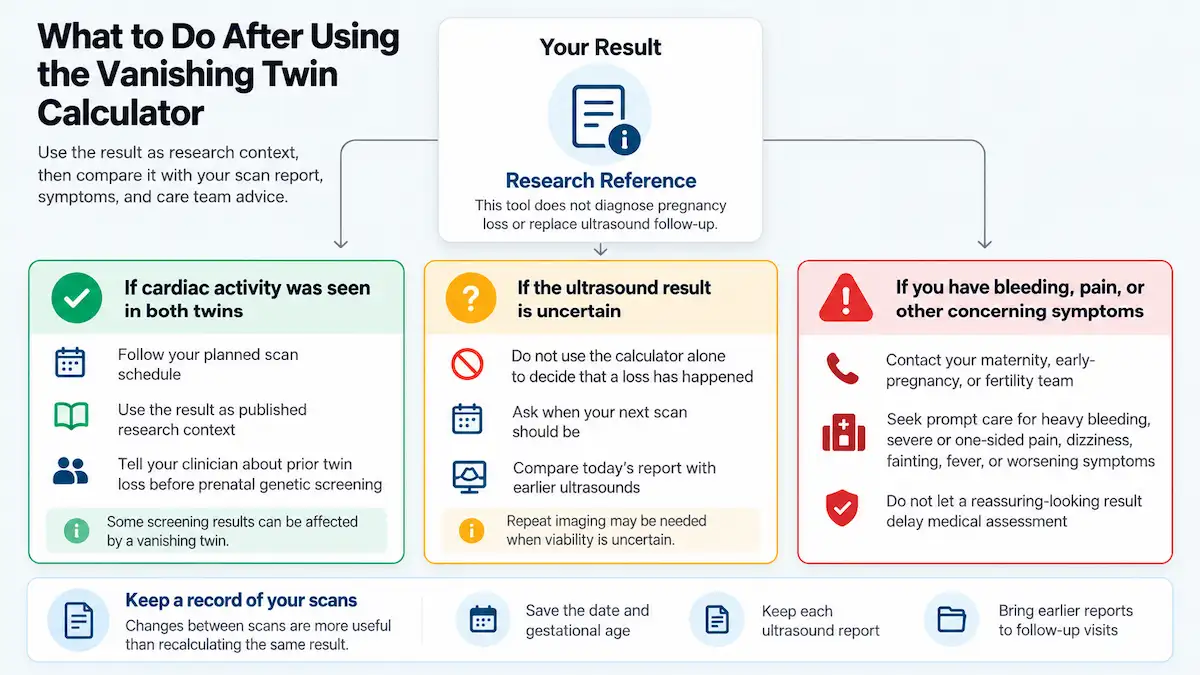
Your next step should be based on your ultrasound findings, symptoms, and care team’s advice, not on a calculator risk category. Use the result to understand the research context, then compare it with your actual scan report and any earlier ultrasounds.
If Cardiac Activity Was Seen in Both Twins
If cardiac activity was seen in both twins, the percentage shown by the calculator is still only a published research reference. Follow the scan and appointment plan given by your maternity or fertility team. If you previously had a suspected vanishing twin or fetal loss, tell your clinician before prenatal genetic screening because it can affect how some screening results are interpreted.
If the Ultrasound Result Is Uncertain
If cardiac activity was seen in only one twin, neither twin yet, or the report is unclear, do not use the calculator to decide that a pregnancy loss has happened. Your care team may use ultrasound measurements, earlier scans, and a repeat scan before making a diagnosis. Ask when your next scan should be based on your actual ultrasound findings.
If You Have Bleeding, Pain, or Other Concerning Symptoms
Contact your maternity, early-pregnancy, or fertility team if you develop new bleeding or pain. Seek prompt medical care for heavy bleeding, severe or one-sided pain, dizziness, fainting, fever, or symptoms that are getting worse. Do not let a reassuring-looking research percentage delay medical assessment.
Keep a Record of Your Scans
Keep the date and report from each ultrasound, including gestational age, what was seen for each twin, and any measurements your clinician recorded. Bring earlier reports to follow-up visits when possible. The change between scans is more useful than repeatedly recalculating the same research percentage.
You Might Also Find These Helpful
Pregnancy & Fertility 45
Calculate odds with the Chance of Twins Calculator. Enter maternal age and history. Find your probability instantly. See if you will conceive multiples now.
Try calculatorFind out exactly when you conceived. Our free Conception Calculator uses your Due Date, LMP, or Ultrasound to estimate your fertilization date and fertile…
Try calculatorUse our Conception Date Due Date Calculator to find your baby's arrival date. Enter your conception or intercourse date for clinical 40-week results.
Try calculatorContraceptive effectiveness calculator to compare birth control methods, typical vs perfect use, backup protection, and 5-year pregnancy risk.
Try calculatorUse this CRL calculator to estimate gestational age and due date from crown-rump length in mm or cm. Compare CRL, LMP, and IVF dating…
Try calculatorEstimate your monthly and 12-month pregnancy odds by age, partner age, and cycle dates. See your fertile window and when to seek fertility help.
Try calculatorUse this fundal height calculator to compare your cm measurement by week, check growth range, estimate baby weight, and know when to ask about…
Try calculatorUse the Gestational Age Calculator to find your pregnancy week from LMP, due date, ultrasound, or IVF. See your EDD, trimester, month, and days…
Try calculatorPanicking over your hCG levels? Use our hCG 48-Hour Calculator to compare your exact beta rise against the ACOG 35% minimum viability benchmark instantly.
Try calculatorCalculate hCG doubling time instantly. Enter two test results. See if your levels are rising normally. Check pregnancy progress now in the hCG Calculator.
Try calculatorCheck your beta hCG rise with this hCG doubling time calculator. Enter two blood tests to see doubling time, 48-hour increase, and early trend…
Try calculatorConfused by your beta hCG levels? Use our hcg gestational age calculator to estimate your pregnancy weeks, verify IVF dates, and check ultrasound milestones.
Try calculatorConfused by your early pregnancy blood test? Use our hCG range calculator to instantly check if your beta levels match standard singleton or twin…
Try calculatorUse our implantation bleeding calculator to find your implantation window, test date, and due date. See if spotting fits implantation or a period.
Try calculatorCalculate implantation window instantly. Enter last period date. Find peak probability. See when to take a pregnancy test in the Implantation Calculator.
Try calculatorUse our IUI Due Date Calculator to find your exact due date and safe pregnancy test day. Get clinical 40-week results based on your…
Try calculatorIUI Success Rate Calculator estimates pregnancy chance using age, infertility profile, pre-wash TPMSC and optional AMH, with a 1–3 cycle projection.
Try calculatorUse our IVF Due Date Calculator to find your exact twin pregnancy timeline. Enter your transfer date to get 40-week and 37-week dates instantly.
Try calculatorCommon Mistakes When Using the Vanishing Twin Calculator
The biggest mistakes come from treating research data like a personal diagnosis or reading more into an early ultrasound than it can show. Use the calculator for context, then compare the result with your actual scan and care-team advice.
- Assuming that no cardiac activity on one early scan confirms a loss without considering scan measurements or follow-up imaging
- Ignoring new bleeding, severe pain, dizziness, fainting, fever, or worsening symptoms because a research percentage looks reassuring
- Turning a published miscarriage percentage into your personal chance that one or both twins will survive
- Not telling your clinician about a known or suspected vanishing twin before NIPT, cfDNA, or other prenatal genetic screening
- Assuming twin type, conception method, or symptoms add or subtract fixed points from the published research percentage
Frequently Asked Questions (FAQs)
What are the symptoms of a vanishing twin?
Many people have no symptoms and learn about a vanishing twin during an ultrasound. When symptoms do occur, they may include light vaginal bleeding, mild cramping, or pelvic pain. These symptoms can also happen for other reasons in early pregnancy, so symptoms alone cannot confirm a vanishing twin.
Can an ultrasound be wrong about a vanishing twin?
An early ultrasound can sometimes be too soon to give a clear answer. If cardiac activity is not seen, the scan measurements, scan type, and earlier findings matter. A repeat ultrasound may be needed before pregnancy loss can be confirmed.
Does vanishing twin syndrome only happen with IVF or fertility treatment?
No. Vanishing twin syndrome can happen after conception without fertility treatment as well as after IVF or other assisted reproductive treatment. It is often detected more easily in fertility pregnancies because early ultrasound monitoring is more common.
Can stress or lifestyle cause a vanishing twin?
Routine stress, diet, exercise, or everyday activity are not established causes of vanishing twin syndrome. The exact cause is often unknown. Possible causes include chromosome problems in the embryo, placental problems, or problems with implantation.
Is a vanishing twin more common in older mothers?
The chance may be higher with increasing maternal age, and age 35 or older is listed as a risk factor in current medical references. However, vanishing twin syndrome can happen at any reproductive age, and age alone cannot predict whether it will occur.
Can you still feel pregnant after a vanishing twin?
Yes. Pregnancy symptoms such as nausea, breast tenderness, or fatigue may continue because the pregnancy is still producing hormones. Changes in symptoms or hCG levels cannot confirm a vanishing twin on their own. Ultrasound is the main way the condition is identified.
What causes a twin to vanish in early pregnancy?
The exact cause is often unknown. Researchers think some cases may involve chromosome problems in the embryo, problems with implantation, or placental development. In many pregnancies, there is no way to identify one definite cause.
Can a vanishing twin happen with triplets or more?
Yes. A pregnancy that begins with triplets or more can lose one embryo or fetus while the others continue. Vanishing twin syndrome is reported more often in higher-order multiple pregnancies than in twin pregnancies.
Does twin type matter after one twin stops developing?
Yes, twin type can matter for follow-up and the outlook of the remaining twin. Twins that share one placenta have connected blood vessels, so a later loss can carry more risk for the surviving twin than in twins with separate placentas. A very early vanishing twin, before about 14 weeks, usually has much less effect on the remaining twin.
Does a vanishing twin show up on your birth certificate or medical records?
If a vanishing twin is diagnosed, it may be recorded in your ultrasound reports or pregnancy medical records. An early vanishing twin usually does not receive a separate birth certificate. Legal registration rules for pregnancy loss vary by country and by how far the pregnancy had progressed.
Questions?
We had love to hear from you! Whether you are reporting an issue, suggesting a new calculator, or exploring collaboration opportunities — we are here to help. Every message helps us make 100calc smarter, faster, and more helpful for everyone.
Why People Trust 100calc
At 100calc.com, we focus on accuracy, speed, and trust. Every calculator we create is designed to give reliable, instant, and easy-to-understand results you can truly depend on.