
Pregnancy After Unprotected Intercourse Calculator: Timing & Next Steps
Use the Pregnancy After Unprotected Intercourse Calculator to understand how the timing of unprotected sex may affect pregnancy risk by comparing it with your estimated or tracked ovulation date. Check whether emergency contraception may still be an option and find out when to take a pregnancy test. The calculator provides timing-based guidance and does not diagnose pregnancy or calculate an exact personal pregnancy percentage.
Quick Facts
- Fertility timing is compared with an estimated or tracked ovulation date; the calculator does not calculate an exact personal pregnancy percentage.
- Emergency contraception is time-sensitive, so seek advice as soon as possible after unprotected sex if pregnancy prevention matters.
- Some emergency-contraception options may be used up to 5 days (120 hours) after unprotected sex.
- Pregnancy tests are most reliable from the first day of a missed period; if you do not know when your period is due, test at least 21 days after the last unprotected sex.
- Updated Sep 26, 2026
- Reviewed by 100Calc Research Team
Post-Exposure Timing & Next Steps
Pregnancy After Unprotected Intercourse Calculator
Check how the encounter lines up with your estimated or tracked ovulation date, whether the 5-day emergency contraception window may still be open, and when to take a pregnancy test. This tool does not diagnose pregnancy or calculate an exact personal pregnancy probability.
Uses your last period and average cycle length to create a calendar estimate of ovulation. Actual ovulation can shift, even in regular cycles.
If pregnancy prevention matters, timing matters
If unprotected sex happened within the last 5 days (120 hours), emergency contraception may still be available. Do not wait for a fertile-window estimate before seeking advice from a pharmacist, clinician, or sexual-health service.
Fertility Timing Context
—
Your timing context will appear here.
Timing context only — not a personal pregnancy probability.
Emergency Contraception Timing
—Your emergency-contraception timing will appear here.
When to Take a Pregnancy Test
Your testing guidance will appear here.
If Pregnancy Is Later Confirmed
A hypothetical conception and due-date reference will appear here.
Action Timeline
Quick Answer
A direct answer based on your dates will appear here.
Is it too late for emergency contraception?
Your answer will appear here.
When should I take a pregnancy test after unprotected sex?
Your answer will appear here.
Research Basis & Limits
Fertile-window timing is informed by prospective conception-timing research, but population study averages are not used as your personal pregnancy probability. Calendar ovulation estimates can miss the true ovulation day. Emergency-contraception and pregnancy-test timing are shown separately because a fertile-window estimate should not be used to rule out seeking time-sensitive care.
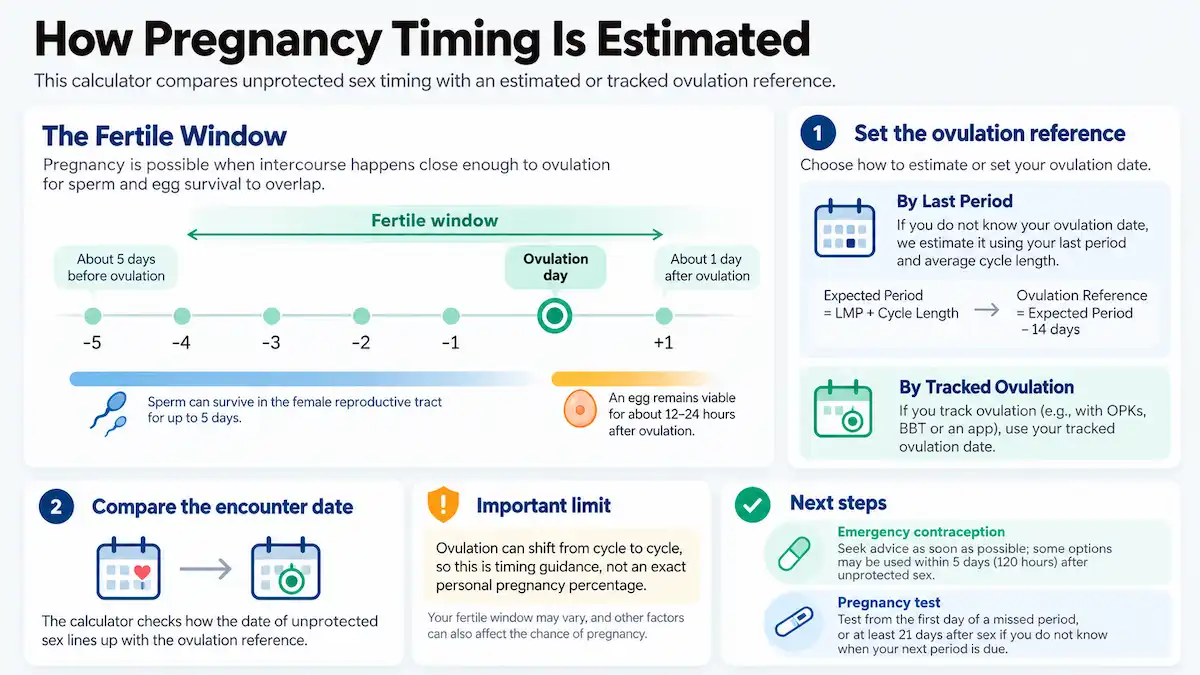
How Is Pregnancy Risk Estimated After Unprotected Intercourse?
Pregnancy is possible when unprotected intercourse happens close enough to ovulation for sperm to still be present when an egg is released. The fertile window is centered around ovulation, and sex in the days before ovulation can still lead to pregnancy because sperm may survive for several days.
This calculator compares the date of unprotected sex with an estimated or tracked ovulation date. If you do not know when you ovulated, it estimates an ovulation reference from the first day of your last period and your average cycle length. Because ovulation can shift from cycle to cycle, the result is a timing estimate rather than an exact personal pregnancy percentage.
The result also shows whether emergency contraception may still be time-sensitive and when to take a pregnancy test. If you want to prevent pregnancy and the unprotected sex happened within the last 5 days, seek emergency-contraception advice as soon as possible rather than waiting for a fertile-window estimate. Current CDC guidance says emergency-contraception pills should be taken as soon as possible within 5 days of unprotected intercourse.
Pregnancy tests are most reliable from the first day of a missed period. If you do not know when your next period is due, NHS guidance advises testing at least 21 days after the last unprotected sex.
Explore More Calculators
Use the Chinese Gender Calculator for a traditional boy-or-girl prediction from lunar age and conception month. Enter conception date, due date, or LMP.
Try calculatorUse this fetal growth calculator to check baby weight percentile from ultrasound data in grams, kg, or cm and see what the result means…
Try calculatorEnter gestational sac measurements in mm or cm to calculate mean sac diameter, estimate early gestational age, compare week-by-week milestones, and see when follow-up…
Try calculatorMissed a birth control pill? Check pregnancy risk, protection status, backup contraception needs, and what to do next with our missed pill calculator.
Try calculatorUse our Pregnancy Chance Calculator to estimate your odds. Enter your cycle day, age, and method. Find out if you are in the high-risk…
Try calculatorUse our pregnancy due date calculator to find your exact Baby Due date. IVF, conception, ovulation, and ultrasound methods with weeks and timeline.
Try calculatorUse this Pregnancy Risk Calculator to check age, BMI, health history, bleeding, and twins. See if closer prenatal monitoring may be worth asking about.
Try calculatorOne Time Pregnancy Calculator estimates pregnancy odds from one encounter, plus fertile window timing, test date, due date, and 21-day testing guidance.
Try calculatorUse the AMH Calculator to convert ng/mL or pmol/L, compare your result with age-based data, and see what it may mean for IVF, fertility,…
Try calculatorUse the Baby Eye Color Calculator with parents, grandparents, or sibling context to compare Brown, Green/Hazel, and Blue/Grey model estimates instantly.
Try calculatorBasal Body Temperature Calculator checks reading conditions and analyzes your temperature pattern for a sustained shift that may be consistent with ovulation.
Try calculatorBPD gestational age calculator: estimate fetal age from BPD, compare your week, check normal BPD ranges, and understand ahead or behind results.
Try calculator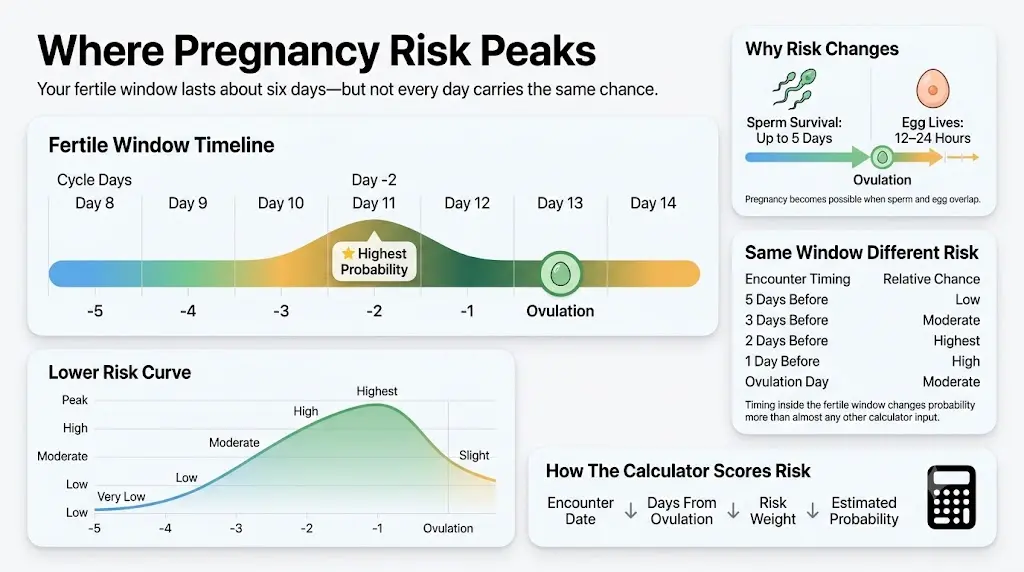
Micro Insight
Your result is based on timing, not a personal pregnancy-risk score. The calculator compares the intercourse date with an estimated or tracked ovulation reference and describes where that encounter falls relative to the fertile-window model. Timing closer to ovulation can overlap with more fertile days, but the calculator does not turn that timing into an exact personal pregnancy percentage.
What Is a Fertile Window
A fertile window is the six day span each cycle when pregnancy is possible. It covers the five days before ovulation and ovulation day itself. Sperm survive up to five days inside the body. The egg lives about a day after release. Outside this window, conception is very unlikely.
Ovulation releases one egg. That egg lasts around 24 hours before it breaks down. Sperm play a longer game. They can wait inside the body for up to five days, ready the moment the egg shows up.
Picture two friends waiting for a bus. The egg shows up once and leaves fast. Sperm can camp out for days until the bus finally arrives. That’s why sex days before ovulation can still lead to pregnancy, even though nothing happened on ovulation day itself.
Not every day around ovulation has the same chance of conception. Sex in the days before ovulation can still result in pregnancy because sperm may survive for several days, while an egg remains available for a much shorter time after ovulation. This calculator uses that timing as context. If ovulation is estimated from your last period and cycle length, the true fertile window may have occurred earlier or later.
What Your Pregnancy After Unprotected Intercourse Result Means
Your result is not a diagnosis or an exact personal pregnancy probability. It shows how the timing of unprotected intercourse compares with an estimated or tracked ovulation reference. The calculator then keeps emergency-contraception timing and pregnancy-test timing separate so you can focus on the next step that matters.
Understanding Your Result
Your V2 result has three separate parts: fertility timing context, emergency-contraception timing, and pregnancy-test timing. Each answers a different question.
The fertility timing result shows where intercourse fell relative to the ovulation reference. Depending on your dates, you may see wording such as “Closest to the estimated ovulation date,” “Closest to the tracked ovulation date,” “Within the estimated fertile-window range,” “Near the ovulation reference,” or “No fertile-window overlap detected by this estimate.” These labels describe timing only.
Emergency-contraception timing is calculated separately from the fertility result. It is based on how much time has passed since intercourse, because a fertile-window estimate should not be used to decide against seeking time-sensitive emergency contraception.
Pregnancy-test timing is also separate. If you know when your period is due, testing from the first day of a missed period is the main reference. If you are unsure when your next period is due, the calculator provides a 21-day-after-intercourse check.
How Should You Interpret the Timing Result?
A Low Risk result is reassuring. Timing worked in your favor. A High Risk result isn’t a guarantee of pregnancy. Most cycles, even peak-fertility ones, don’t end in conception on a single act.
Context matters more than the label alone. A High Risk result with the EC window still open is a very different situation than a High Risk result with that window closed. The first one is still actionable. The second one shifts straight to testing.
Medium Risk sits in between. It’s real, but it’s not the dominant outcome. Most Medium Risk encounters do not result in pregnancy.
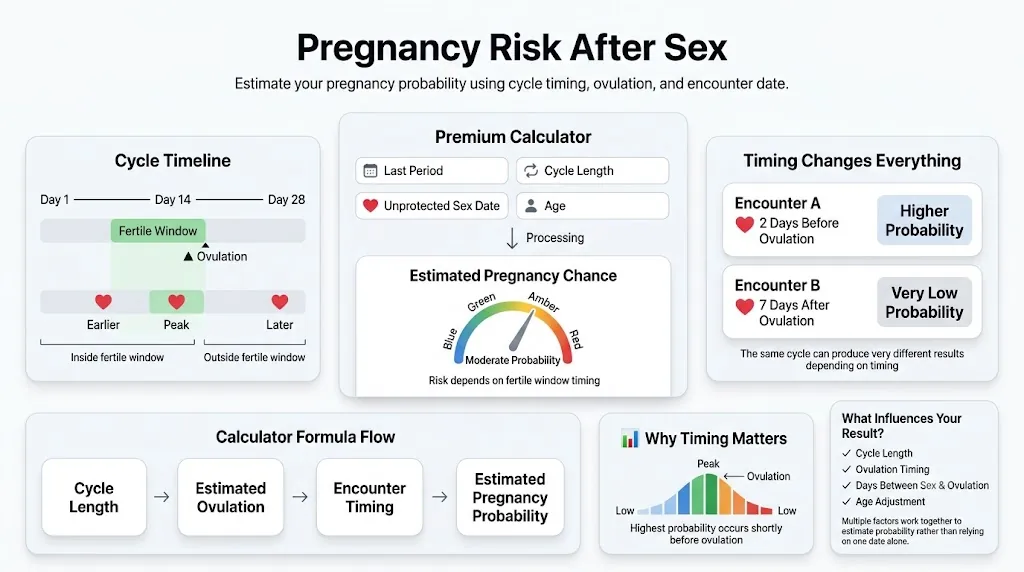
What You Should Do Next
- If preventing pregnancy is your goal and it has been less than 5 days since unprotected intercourse, seek emergency-contraception advice as soon as possible. Do not use the fertility-timing result to decide that emergency contraception is unnecessary.
- If it has been less than 72 hours, levonorgestrel emergency contraception may be one option, depending on where you live and your individual circumstances. Ulipristal acetate and a copper IUD may also be options.
- If 72 to 120 hours have passed, ask a pharmacist, clinician, or sexual-health service promptly about ulipristal acetate or a copper IUD. Ulipristal is generally more effective than levonorgestrel later in the 5-day window.
- If more than 120 hours have passed, oral emergency contraception is generally outside its usual time window. Do not assume that every emergency-contraception option is automatically closed, however. In some circumstances, a clinician may still assess whether a copper IUD can be used based on estimated ovulation timing. If pregnancy remains possible, follow the pregnancy-test timing shown by the calculator.
Quick Example to Test
Try this in the calculator: tracked ovulation date of July 20, intercourse on July 19 at 9:00 PM.
That places intercourse one calendar day before the tracked ovulation reference. V2 classifies this as “Closest to the tracked ovulation date.” This timing can overlap with a more fertile part of the cycle, but it does not provide an exact personal pregnancy percentage. The 72-hour reference is July 22 at 9:00 PM and the 120-hour reference is July 24 at 9:00 PM. Emergency-contraception options and pregnancy-test timing are evaluated separately from the fertility-timing result.
How to Use the Pregnancy After Unprotected Intercourse Calculator
This calculator compares the timing of unprotected intercourse with an estimated or tracked ovulation date, then organizes the next time-sensitive steps. Follow the steps below to check your fertility timing context, emergency-contraception window, and pregnancy-test timeline.
Choose How to Set Your Ovulation Reference
Choose By Last Period if you need the calculator to estimate ovulation from your last menstrual period and average cycle length. Choose By Tracked Ovulation if you have an ovulation date from tracking such as LH testing, BBT patterns, or ultrasound. Tracking may narrow the timing, but it may not identify the exact moment of ovulation.
Enter Your Period or Ovulation Details
In By Last Period mode, enter the first day of your last period and your usual average cycle length. The calculator uses them to create a calendar estimate of ovulation. In By Tracked Ovulation mode, enter the ovulation date you recorded instead of using the calendar estimate.
Add the Date and Time of Intercourse
Enter the date of the unprotected intercourse and the approximate time it happened. The date is compared with your ovulation reference to show where the encounter falls in the cycle. The time is used for elapsed-hour calculations and the emergency-contraception reference marks.
See How the Timing Relates to Ovulation
Select Check Timing & Next Steps and the calculator will show how many days before or after the ovulation reference the encounter occurred. It uses that timing to explain the fertility context without turning population fertility data into an exact personal pregnancy probability.
Review Your Timing and Next Steps
Review your fertility timing context, emergency-contraception timing, 72-hour and 120-hour reference marks, and 21-day pregnancy-test check. The result also explains what the dates mean and shows a hypothetical conception and due-date reference only if pregnancy is later confirmed.
Quick Example to Test
Try entering a last period date of August 3, a 30-day cycle, and unprotected intercourse on August 15 at 8:00 PM.
The calculator estimates an ovulation reference of August 19, placing the encounter 4 days before that date. Instead of assigning an exact personal pregnancy percentage, the result explains the fertility timing context. It also shows the 72-hour reference mark on August 18 at 8:00 PM, the 120-hour mark on August 20 at 8:00 PM, and the 21-day pregnancy-test check on September 5.
Accuracy and Method Behind the Pregnancy After Unprotected Intercourse Calculator
This calculator compares the timing of unprotected intercourse with an estimated or tracked ovulation reference. It then uses that timing to explain whether the encounter falls close to the fertile-window range used by the model. The result is timing context, not an exact personal pregnancy probability, because the true day of ovulation can differ from a calendar estimate or tracked date.
Key Features & Benefits
- Compares intercourse timing with either an estimated or tracked ovulation reference
- Keeps fertility timing separate from emergency-contraception timing, so a fertile-window estimate is not used to rule out seeking emergency contraception
- Calculates 72-hour and 120-hour reference marks from the date and approximate time of intercourse
- Shows pregnancy-test timing using the expected period when available and a separate 21-day-after-intercourse check when timing is uncertain
- Provides a hypothetical conception, gestational-age, and due-date reference only if pregnancy is later confirmed
Technical Process
Ovulation Reference
Uses your cycle information to estimate an ovulation reference, or uses the tracked ovulation date you enter. The calculator then compares the intercourse date with that reference.
Fertility Timing Context
Uses the day difference to describe where the encounter falls relative to the ovulation reference and fertile-window estimate. These are timing labels, not personal pregnancy-risk percentages.
Next-Step Timeline
Calculates the 72-hour and 120-hour emergency-contraception reference marks and shows when pregnancy testing is appropriate based on your expected period or the 21-day-after-intercourse check.
How the Pregnancy After Unprotected Intercourse Calculator Calculates Timing
The Pregnancy After Unprotected Intercourse Calculator uses your cycle and intercourse dates to create an ovulation reference, compare the encounter with that date, and calculate separate emergency-contraception and pregnancy-test timing. In Last Period mode, the ovulation date is a calendar estimate. In Tracked Ovulation mode, the calculator uses the date you entered. These calculations provide timing context rather than an exact personal probability of pregnancy.
Formula
					Expected Period = LMP Date + Average Cycle Length

Estimated Ovulation Reference = Expected Period - 14 days

Timing Difference = Intercourse Date - Ovulation Reference

72-Hour Reference = Intercourse Date & Time + 72 hours

120-Hour Reference = Intercourse Date & Time + 120 hours

21-Day Test Check = Intercourse Date + 21 days

Hypothetical Due-Date Reference = Ovulation Reference + 266 days
In Tracked Ovulation mode, the calculator skips the LMP-based ovulation estimate and uses the tracked ovulation date you entered as the reference.
How the Formula Works
In By Last Period mode, the calculator first estimates your next period from the LMP date and average cycle length you entered. It then counts back 14 days to create an estimated ovulation reference. This is a calendar model, so the true ovulation day may have occurred earlier or later.
In By Tracked Ovulation mode, the calculator uses the ovulation date you entered instead. Tracking can narrow the timing, but it still may not identify the exact moment an egg was released.
The calculator then measures how many calendar days separate the intercourse date from the ovulation reference. That difference is used to describe the fertility timing context. It is not converted into an exact personal pregnancy percentage.
Emergency-contraception timing is calculated separately from fertility timing. The calculator adds 72 hours and 120 hours to the intercourse date and approximate time so you can see the relevant time marks without relying on the fertile-window estimate.
Pregnancy-test timing is also handled separately. If you know when your period is due, testing from the first missed day is the main reference. If you are unsure when your period is due, the calculator shows a 21-day-after-intercourse check.
The projected conception, gestational-age, and due-date information is shown only as a hypothetical reference if pregnancy is later confirmed. It does not prove that conception occurred or replace clinical pregnancy dating.
Understanding the Formula Variables
LMP Date
The first day of your last menstrual period. In By Last Period mode, this is the starting point for estimating your next period and ovulation reference.
Cycle Length
Your usual average number of days from the first day of one period to the first day of the next. The calculator accepts 20 to 45 days as its input range and uses the value to estimate your next period and ovulation reference. This input range is a calculator limit, not a definition of a clinically normal cycle.
Timing Difference
The number of calendar days between the intercourse date and the ovulation reference. A negative value means intercourse occurred before the reference date, zero means the same date, and a positive value means afterward. The calculator uses this difference to describe fertility timing context, not to assign a personal High, Medium, or Low pregnancy-risk score.
72-Hour and 120-Hour Reference Marks
These are calculated from the date and approximate time of unprotected intercourse. They help show how much time has passed for emergency-contraception decision-making and are calculated independently of the fertile-window estimate.
21-Day Pregnancy Test Check
A date 21 days after the unprotected intercourse. If you do not know when your next period is due, this gives you a clear testing reference. If you do know when your period is due, home pregnancy tests are generally most reliable from the first day of a missed period.
Hypothetical Due-Date Reference
A projected date calculated from the ovulation reference plus 266 days. It is shown only as a what-if reference if pregnancy is later confirmed. It does not confirm that conception occurred and should not replace the due date established from your pregnancy history, ultrasound, or healthcare provider.
Another Example Calculation (Step-by-Step)
Here is the calculator method worked through with sample dates. The example shows how the ovulation reference, timing difference, emergency-contraception marks, and pregnancy-test check are calculated without assigning an exact personal pregnancy percentage.
Given:
- LMP Date: May 10, 2026
- Average Cycle Length: 26 days
- Intercourse Date and Time: May 25, 2026 at 10:00 AM
Calculation:
					Expected Period = May 10 + 26 days
Expected Period = June 5, 2026

Estimated Ovulation Reference = June 5 - 14 days
Estimated Ovulation Reference = May 22, 2026

Timing Difference = May 25 - May 22
Timing Difference = +3 days

72-Hour Reference = May 28, 2026 at 10:00 AM

120-Hour Reference = May 30, 2026 at 10:00 AM

21-Day Test Check = June 15, 2026

Hypothetical Due-Date Reference = May 22 + 266 days
Hypothetical Due-Date Reference = February 12, 2027
Result:
- Timing Context: No fertile-window overlap detected by this estimate
- Estimated Ovulation Reference: May 22, 2026
- Timing Difference: 3 days after the estimated ovulation reference
- 72-Hour Reference: May 28, 2026 at 10:00 AM
- 120-Hour Reference: May 30, 2026 at 10:00 AM
- 21-Day Test Check: June 15, 2026
- Hypothetical Due-Date Reference: February 12, 2027
Meaning:
In this example, intercourse occurred three days after the estimated ovulation reference, so the calculator does not detect overlap with the six-day fertile-window estimate used by the model. That does not mean pregnancy risk is zero, because the true ovulation day may differ from a calendar estimate. Emergency-contraception timing is evaluated separately from this fertility-timing result, and the 21-day pregnancy-test check remains June 15.
How Do You Calculate Pregnancy Risk After Unprotected Intercourse?
Pregnancy possibility after unprotected intercourse is strongly influenced by how intercourse lines up with ovulation, but dates alone cannot calculate an exact personal probability. This calculator compares the intercourse date with an estimated or tracked ovulation reference and returns fertility-timing context. Because the actual ovulation day can differ from the reference, the result cannot confirm or rule out pregnancy.
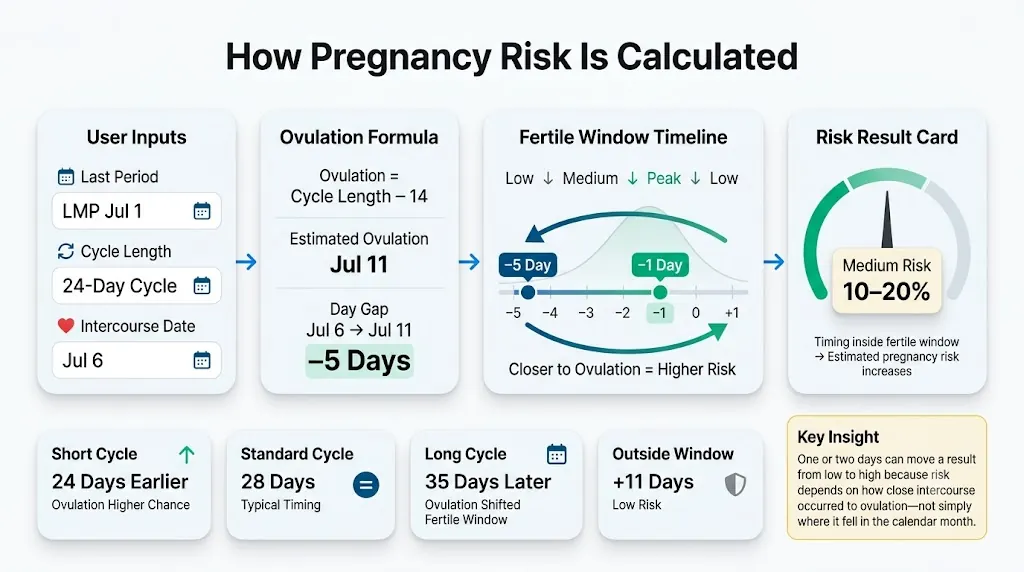
Can You Get Pregnant Right After Your Period Ends?
Yes. Sex soon after a period can still fall near fertile days, especially if ovulation happens earlier in the cycle.
Input:
- LMP July 1, average cycle length 24 days, intercourse July 6 at 10:00 AM.
Process:
- Estimated ovulation reference = July 1 + (24 − 14) = July 11.
- Timing difference = July 6 − July 11 = −5 days.
Result:
The calculator returns “Within the estimated fertile-window range.” The 72-hour reference is July 9 at 10:00 AM, and the 120-hour reference is July 11 at 10:00 AM.
Meaning:
The calendar model places the encounter five days before the estimated ovulation reference, within the pre-ovulation range used by the calculator. Because actual ovulation can shift, this is timing context rather than an exact personal pregnancy percentage.
What Are Your Chances During Ovulation Week?
Intercourse close to ovulation can occur during a more fertile part of the cycle, but this calculator cannot turn one encounter into an exact personal pregnancy percentage.
Input:
- Tracked ovulation August 10, intercourse August 9 at 9:00 PM.
Process:
- Timing difference = August 9 − August 10 = −1 day.
Result:
The calculator returns “Closest to the tracked ovulation date.” The 72-hour reference is August 12 at 9:00 PM, and the 120-hour reference is August 14 at 9:00 PM.
Meaning:
Intercourse occurred one day before the tracked ovulation reference, which can overlap with a more fertile part of the cycle. Tracking narrows the timing, but it still does not identify the exact moment the egg was released or provide a precise personal chance of pregnancy.
Is Unprotected Sex Right Before Your Period Actually Low Risk?
Sex shortly before an expected period often falls well after the estimated ovulation reference in a regular cycle, but cycle timing can shift.
Input:
- LMP September 1, average cycle length 28 days, intercourse September 26 at 7:00 PM.
Process:
- Estimated ovulation reference = September 1 + (28 − 14) = September 15.
- Timing difference = September 26 − September 15 = +11 days.
Result:
- The calculator returns “No fertile-window overlap detected by this estimate.”
Meaning:
In this calendar model, intercourse occurred 11 days after the estimated ovulation reference, so the calculator does not detect fertile-window overlap. This is not the same as zero pregnancy risk because the true ovulation date may have differed from the estimate. Follow the pregnancy-test guidance if pregnancy is still a concern.
How Accurate Is This for Irregular Cycles?
Last Period mode is less certain when cycles are irregular because an average cycle length may not predict ovulation accurately in a specific cycle.
Input:
- LMP June 1, average cycle length 35 days, intercourse June 20 at 6:00 PM.
Process:
- Estimated ovulation reference = June 1 + (35 − 14) = June 22.
- Timing difference = June 20 − June 22 = −2 days.
Result:
The calculator returns “Closest to the estimated ovulation date.”
Meaning:
Using a 35-day average, the calendar model places intercourse two days before the estimated ovulation reference. If cycles are irregular, however, actual ovulation may have occurred earlier or later, so this result should be treated as timing context rather than an exact pregnancy probability. If you have a tracked ovulation date, use the Tracked Ovulation mode instead.
Quick Rules to Remember
Timing relative to ovulation is useful context, but it cannot confirm pregnancy or calculate an exact personal probability. Sex in the days before ovulation can still lead to pregnancy, while calendar-based ovulation estimates may shift from the true date, especially when cycles are irregular. Use the calculator to understand timing and next steps, not as proof that pregnancy will or will not occur.
What Your Pregnancy Timing Result Means
The Pregnancy After Unprotected Intercourse Calculator compares when unprotected sex happened with your estimated or tracked ovulation date. It shows whether the timing overlaps the usual fertile window and gives you practical next steps, but it cannot calculate your exact personal chance of pregnancy from dates alone. If ovulation was estimated from your last period and cycle length, remember that the actual ovulation day may have been earlier or later.
| Timing Relative to Ovulation | What It May Mean | Important Limitation | What to Do Next |
|---|---|---|---|
| About 5 days before ovulation through ovulation day | The timing overlaps the usual fertile window, so pregnancy is possible. | If ovulation was estimated from your last period and cycle length, the actual ovulation day may have been earlier or later. | If pregnancy prevention matters and intercourse was within the last 5 days, seek emergency-contraception advice promptly rather than waiting for the fertility estimate. |
| About 1 day after ovulation | Pregnancy may still be possible because an egg can remain viable for roughly 12 to 24 hours after ovulation. | Even with ovulation tracking, the exact time the egg was released usually is not known. | If you are still within the emergency-contraception time window, ask a pharmacist, clinician, or sexual-health service about your options. |
| Outside the typical fertile-window timing | The timing is less consistent with conception based on the ovulation date used by the calculator. | This does not prove that pregnancy is impossible, especially when ovulation was estimated by calendar dates or cycles are irregular. | If emergency contraception is no longer relevant, follow the calculator's pregnancy-test timing instead of relying on symptoms or the timing estimate alone. |
Important: This table describes timing around ovulation, not a personal pregnancy percentage. Fertility timing can help explain whether conception is biologically plausible, but it cannot confirm or rule out pregnancy. If you do not know when your next period is due, pregnancy testing at least 21 days after the last unprotected sex provides a clearer answer.
Interpretation
Timing closer to ovulation generally means there is more biological opportunity for sperm and egg to overlap. Timing farther from the usual fertile window is less consistent with conception, but a calendar estimate cannot prove that pregnancy is impossible. The result is most useful for understanding timing and deciding what to do next, not for assigning yourself an exact pregnancy percentage.
What Matters Most
Do not use the fertile-window estimate to decide that emergency contraception is unnecessary. If pregnancy prevention matters and the unprotected intercourse happened within the last 5 days, check your emergency-contraception options promptly. If that window has passed, the pregnancy-test date provides a more useful next checkpoint than repeatedly checking symptoms.
What to Do After Unprotected Intercourse
What to do next depends mainly on how much time has passed since the unprotected intercourse, not on a High, Medium, or Low fertility label. Emergency contraception is time-sensitive, while pregnancy testing needs enough time to become reliable. Use the calculator’s timing result as context, then follow the appropriate time-based next step below.
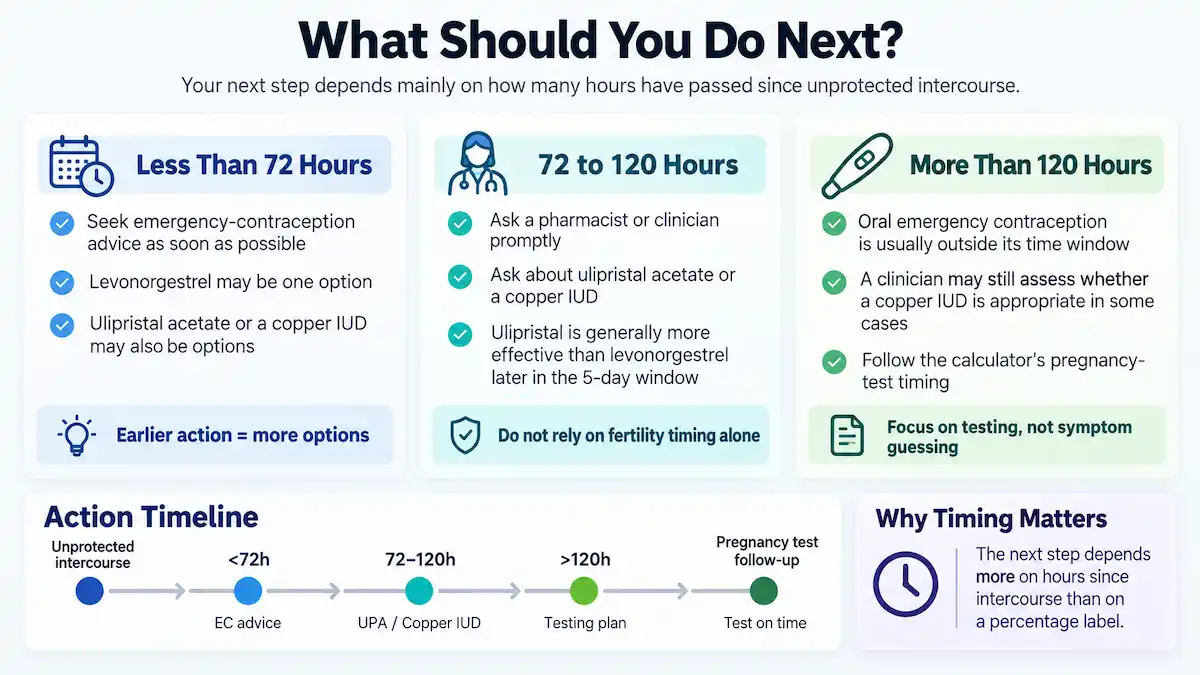
If It Has Been Less Than 72 Hours
Seek emergency-contraception advice as soon as possible if preventing pregnancy is your goal. Levonorgestrel emergency contraception is commonly used within 72 hours after unprotected intercourse, while ulipristal acetate can be used for up to 120 hours. A copper IUD is another emergency-contraception option and is the most effective method.
The best option can depend on how long it has been since intercourse, where you are in your cycle, medicines you take, body weight or BMI, the contraception you normally use, and local availability. A pharmacist, clinician, or sexual-health service can help you choose between the available options.
Emergency-contraception pills do not provide reliable protection for additional unprotected intercourse later in the cycle. If you have sex again after taking emergency contraception, ask a pharmacist or clinician what protection or additional action is needed.
If It Has Been 72 to 120 Hours
Emergency contraception may still be available during this window, so seek advice promptly rather than relying on the calculator’s fertile-window result.
Ulipristal acetate can be used up to 120 hours after unprotected intercourse. A copper IUD can also be used for emergency contraception and is the most effective option. US CDC guidance notes that ulipristal has been observed to be more effective than levonorgestrel during days 3 to 5 after intercourse.
If you use emergency contraception, follow the instructions you receive about ongoing contraception because the advice differs by method. Keep the pregnancy-test date from the calculator as a separate follow-up step.
If More Than 120 Hours Have Passed
Emergency-contraception pills are generally used within the first 120 hours after unprotected intercourse. If more than 5 days have passed, do not rely on the calculator alone to decide that no option remains. A clinician may still be able to assess copper-IUD timing in some circumstances based on when ovulation is estimated to have occurred.
If emergency contraception is no longer appropriate, the next useful step is pregnancy testing rather than repeated symptom checking. Early pregnancy symptoms overlap with normal cycle symptoms and cannot confirm whether conception occurred.
Follow the pregnancy-test timing shown by the calculator. If you know when your next period is due, test from the first day of a missed period. If you do not know when it is due, testing at least 21 days after the last unprotected intercourse provides a practical reference point.
You Might Also Find These Helpful
Pregnancy & Fertility 45
Calculate odds with the Chance of Twins Calculator. Enter maternal age and history. Find your probability instantly. See if you will conceive multiples now.
Try calculatorFind out exactly when you conceived. Our free Conception Calculator uses your Due Date, LMP, or Ultrasound to estimate your fertilization date and fertile…
Try calculatorUse our Conception Date Due Date Calculator to find your baby's arrival date. Enter your conception or intercourse date for clinical 40-week results.
Try calculatorContraceptive effectiveness calculator to compare birth control methods, typical vs perfect use, backup protection, and 5-year pregnancy risk.
Try calculatorUse this CRL calculator to estimate gestational age and due date from crown-rump length in mm or cm. Compare CRL, LMP, and IVF dating…
Try calculatorEstimate your monthly and 12-month pregnancy odds by age, partner age, and cycle dates. See your fertile window and when to seek fertility help.
Try calculatorUse this fundal height calculator to compare your cm measurement by week, check growth range, estimate baby weight, and know when to ask about…
Try calculatorUse the Gestational Age Calculator to find your pregnancy week from LMP, due date, ultrasound, or IVF. See your EDD, trimester, month, and days…
Try calculatorPanicking over your hCG levels? Use our hCG 48-Hour Calculator to compare your exact beta rise against the ACOG 35% minimum viability benchmark instantly.
Try calculatorCalculate hCG doubling time instantly. Enter two test results. See if your levels are rising normally. Check pregnancy progress now in the hCG Calculator.
Try calculatorCheck your beta hCG rise with this hCG doubling time calculator. Enter two blood tests to see doubling time, 48-hour increase, and early trend…
Try calculatorConfused by your beta hCG levels? Use our hcg gestational age calculator to estimate your pregnancy weeks, verify IVF dates, and check ultrasound milestones.
Try calculatorConfused by your early pregnancy blood test? Use our hCG range calculator to instantly check if your beta levels match standard singleton or twin…
Try calculatorUse our implantation bleeding calculator to find your implantation window, test date, and due date. See if spotting fits implantation or a period.
Try calculatorCalculate implantation window instantly. Enter last period date. Find peak probability. See when to take a pregnancy test in the Implantation Calculator.
Try calculatorUse our IUI Due Date Calculator to find your exact due date and safe pregnancy test day. Get clinical 40-week results based on your…
Try calculatorIUI Success Rate Calculator estimates pregnancy chance using age, infertility profile, pre-wash TPMSC and optional AMH, with a 1–3 cycle projection.
Try calculatorUse our IVF Due Date Calculator to find your exact twin pregnancy timeline. Enter your transfer date to get 40-week and 37-week dates instantly.
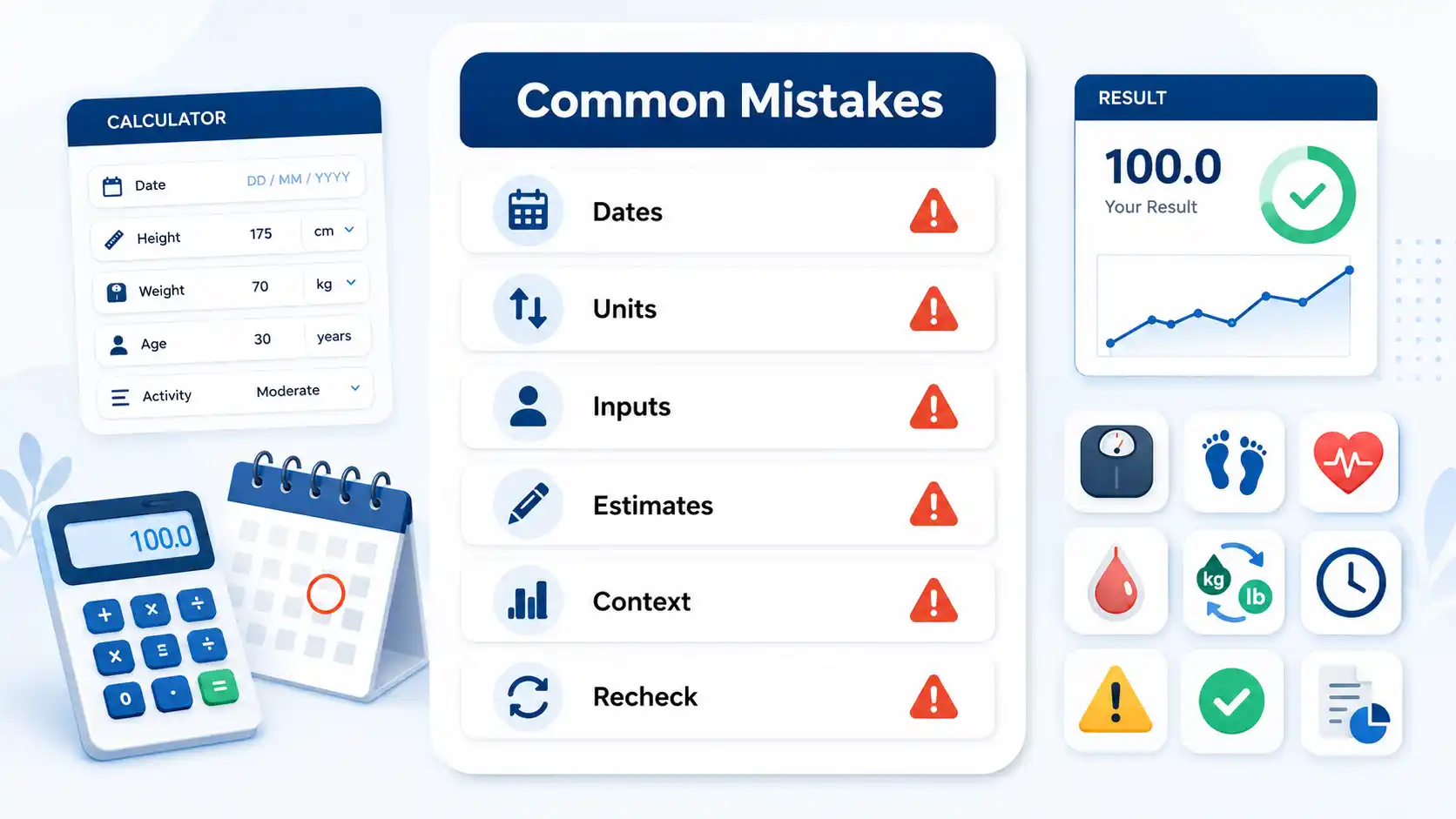
Try calculatorCommon Mistakes When Using the Pregnancy After Unprotected Intercourse Calculator
Small input errors change every date this calculator produces. Most confusion comes from mixing up emergency contraception windows, guessing dates instead of tracking them, or misreading what the risk percentage actually means.
- Treating the 72 hour and 120 hour windows as one 5 day option for the same pill, instead of two different methods
- Testing before the calculated test date and reading a negative result as final
- Assuming fertile days sit right before your period instead of mid-cycle
- Entering a rough guess for cycle length instead of your actual average
- Leaving the intercourse time at default noon when the real time falls near a deadline
Frequently Asked Questions (FAQs)
After how many days of intercourse is pregnancy confirmed?
Pregnancy cannot be confirmed from symptoms or intercourse timing alone. Home pregnancy tests are most reliable from the first day of a missed period. If you do not know when your next period is due, test at least 21 days after the last unprotected intercourse. If a test is negative but your period still does not arrive, repeat the test or contact a healthcare professional.
Am I 4 weeks pregnant if I conceived 2 weeks ago?
Often, yes. Pregnancy is usually dated from the first day of the last menstrual period rather than from conception. In a typical 28-day cycle, conception occurs about 2 weeks after the period begins, so 2 weeks after conception may correspond to about 4 weeks of gestational age. The difference can vary when ovulation happens earlier or later.
Am I fertile 2 to 3 days before my period?
Usually not, if ovulation occurred when expected, because ovulation commonly happens about 10 to 16 days before the next period. But cycle timing can vary and ovulation can occur earlier or later than predicted, so calendar dates alone cannot rule out pregnancy. If unprotected sex was recent and pregnancy prevention matters, do not use an estimated fertile window to decide whether emergency contraception is needed.
How many weeks pregnant am I really, counting from conception?
Doctors normally use gestational age, which is counted from the first day of your last menstrual period. In a typical 28-day cycle, gestational age is about 2 weeks ahead of the time since conception. It is not always exactly 2 weeks because ovulation can occur earlier or later, and ultrasound may be used to establish or confirm pregnancy dating.
Do you add 2 weeks to the conception date to get the due date?
No. If the conception or ovulation date is known, an estimated due date is about 266 days, or 38 weeks, later. The extra 2 weeks refers to how pregnancy weeks are traditionally counted from the last menstrual period: a typical pregnancy is about 280 days, or 40 weeks, from the first day of the LMP.
Is it too late to take Plan B after 3 days?
Do not assume you are out of options after 72 hours. Levonorgestrel emergency contraception such as Plan B works best as soon as possible and is commonly used within 72 hours, but evidence shows some effectiveness through 5 days. Ulipristal acetate is generally more effective than levonorgestrel during days 3 to 5, and a copper IUD is another highly effective emergency-contraception option. If it has been less than 5 days, seek advice as soon as possible because the best option can depend on timing and individual circumstances.
How accurate is a pregnancy chance calculator like this one?
This calculator provides timing context, not an exact personal pregnancy probability. It compares the intercourse date with an estimated or tracked ovulation date and shows whether the timing overlaps the usual fertile window. Its accuracy depends heavily on how accurately ovulation is known, and calendar-based estimates can be off by several days. Only pregnancy testing can tell you whether pregnancy occurred.
Can I get pregnant from unprotected sex during my period?
Yes, pregnancy during or soon after a period is possible, although the timing is often less likely to overlap with ovulation. It can happen when ovulation occurs early, especially with shorter or irregular cycles, because sperm can remain capable of fertilization for several days. A calendar date alone cannot rule pregnancy out.
Does a broken condom count the same as unprotected sex?
A broken or slipped condom can create a pregnancy risk if semen or pre-ejaculate entered the vagina, especially if ejaculation occurred. If you are not sure exactly when the condom failed, use the date and approximate time of intercourse in the calculator. If the exposure happened within the last 5 days and pregnancy prevention matters, consider emergency-contraception advice rather than relying only on the fertile-window estimate.
Can precum cause pregnancy without ejaculation happening?
Yes, pregnancy is possible without full ejaculation. Pre-ejaculate usually contains little or no sperm, but it can sometimes contain sperm, so withdrawal does not eliminate pregnancy risk. For this calculator, use the date and approximate time when unprotected vaginal intercourse occurred.
Does peeing right after sex lower pregnancy risk?
No. Urinating after sex does not prevent pregnancy or remove sperm from the vagina. Urine leaves the body through the urethra, which is separate from the vaginal opening, so peeing cannot wash sperm out of the reproductive tract. If pregnancy prevention is needed after unprotected sex, emergency contraception is the relevant time-sensitive option.
Questions?
We’d love to hear from you! Whether you are reporting an issue, suggesting a new calculator, or exploring collaboration opportunities — we are here to help. Every message helps us make 100calc smarter, faster, and more helpful for everyone.
Why People Trust 100calc
At 100calc.com, we focus on accuracy, clarity, and transparency. Our calculators are designed to make complex calculations and timing information easier to understand, while clearly explaining important assumptions and limitations.