
Luteal Phase Calculator: See What Your Dates Really Show
A luteal phase calculator finds how many calendar days fall between your ovulation date or best estimate and the first day of your following period. If both dates are known, 100Calc measures the interval. If ovulation is unknown, it does not invent a personal length. It works backward from your expected next period using an 11–17 or 12–14 day reference range to show an estimated timing window.
Here’s what many cycle apps blur. A known ovulation date can support a measured result. An unknown date can only support an estimate. That difference may explain why apps show different answers. Use the calculator to check your luteal phase length or estimated window, mid-luteal timing, and cycle split without turning an estimate into a medical claim.
Quick Facts
- Known ovulation + following period: Measures your luteal phase interval.
- Ovulation unknown: Shows an estimated timing window, not your personal length.
- 12–14 days: The calculator’s common reference range.
- 11–17 days: The broader reported variation used by the calculator.
- Previous period date: Optional. Add it to see the full cycle split.
- Updated Sep 4, 2026
- Reviewed by 100Calc Research Team
Pregnancy & Fertility Calculator
Luteal Phase Calculator
Measure a completed luteal phase from an ovulation date and the following period, or estimate a likely phase window when ovulation is unknown.
Use this mode when you have an ovulation date or best estimate and the first day of the following period.
Measured vs. estimated
A completed luteal-phase day count needs an ovulation date or best estimate plus the first day of the following period. If ovulation is unknown, this calculator can estimate timing from cycle averages, but it cannot measure your personal luteal-phase length.
Luteal Phase Length
Cycle Breakdown Map
Short answer
How this was calculated
Explore More Calculators
Use the Chinese Gender Calculator for a traditional boy-or-girl prediction from lunar age and conception month. Enter conception date, due date, or LMP.
Try calculatorUse this fetal growth calculator to check baby weight percentile from ultrasound data in grams, kg, or cm and see what the result means…
Try calculatorEnter gestational sac measurements in mm or cm to calculate mean sac diameter, estimate early gestational age, compare week-by-week milestones, and see when follow-up…
Try calculatorMissed a birth control pill? Check pregnancy risk, protection status, backup contraception needs, and what to do next with our missed pill calculator.
Try calculatorUse our Pregnancy Chance Calculator to estimate your odds. Enter your cycle day, age, and method. Find out if you are in the high-risk…
Try calculatorUse our pregnancy due date calculator to find your exact Baby Due date. IVF, conception, ovulation, and ultrasound methods with weeks and timeline.
Try calculatorUse this Pregnancy Risk Calculator to check age, BMI, health history, bleeding, and twins. See if closer prenatal monitoring may be worth asking about.
Try calculatorOne Time Pregnancy Calculator estimates pregnancy odds from one encounter, plus fertile window timing, test date, due date, and 21-day testing guidance.
Try calculatorUse the AMH Calculator to convert ng/mL or pmol/L, compare your result with age-based data, and see what it may mean for IVF, fertility,…
Try calculatorUse the Baby Eye Color Calculator with parents, grandparents, or sibling context to compare Brown, Green/Hazel, and Blue/Grey model estimates instantly.
Try calculatorBasal Body Temperature Calculator checks reading conditions and analyzes your temperature pattern for a sustained shift that may be consistent with ovulation.
Try calculatorBPD gestational age calculator: estimate fetal age from BPD, compare your week, check normal BPD ranges, and understand ahead or behind results.
Try calculatorCalculate odds with the Chance of Twins Calculator. Enter maternal age and history. Find your probability instantly. See if you will conceive multiples now.
Try calculatorFind out exactly when you conceived. Our free Conception Calculator uses your Due Date, LMP, or Ultrasound to estimate your fertilization date and fertile…
Try calculatorUse our Conception Date Due Date Calculator to find your baby's arrival date. Enter your conception or intercourse date for clinical 40-week results.
Try calculatorContraceptive effectiveness calculator to compare birth control methods, typical vs perfect use, backup protection, and 5-year pregnancy risk.
Try calculatorUse this CRL calculator to estimate gestational age and due date from crown-rump length in mm or cm. Compare CRL, LMP, and IVF dating…
Try calculatorEstimate your monthly and 12-month pregnancy odds by age, partner age, and cycle dates. See your fertile window and when to seek fertility help.
Try calculator
Micro Insight
Why this matters: A longer or shorter cycle does not automatically mean your luteal phase changed. Sometimes the timing of ovulation is what moved.
What Is the Luteal Phase?
The luteal phase is the part of your menstrual cycle after ovulation and before your next period. During this phase, the corpus luteum produces progesterone. This hormone helps prepare the uterine lining for a possible pregnancy. If pregnancy does not occur, hormone levels fall and your next period begins.
The luteal phase does not start on one fixed cycle day. Someone might ovulate on day 13 one month and day 18 another month. In both cycles, the luteal phase begins only after ovulation.
Its length also is not always exactly 14 days. A 12–14 day luteal phase is common, while 11–17 days falls within broader reported variation. Your cycle length may change because ovulation happened earlier or later.
What Does Your Luteal Phase Calculator Result Mean?
Your result shows the time between ovulation and your following period when both dates are available. This is a calendar interval, not a fertility score.
A tracked result measures the dates you entered. An estimated result works from your cycle average and a reference range. It shows likely timing, not your personal luteal phase length.
Is Your Luteal Phase Short, Typical, or Longer Than Typical?
A luteal phase result needs context. One cycle alone does not diagnose a hormone or fertility problem.
- 10 days or fewer: Shorter Than Typical. This reaches the current clinical length criterion linked with luteal phase deficiency. One result alone does not confirm that condition.
- 11 days: Within Reported Variation. It falls below the common 12–14 day range but remains within broader variation.
- 12–14 days: Common 12–14 Day Range. This is the typical reference band.
- 15–17 days: Within Reported Variation. These lengths remain within the broader reported range.
- 18 days or more: Longer Than Reported Range if your following period actually began. Without that period, the luteal phase has no completed endpoint yet.
These labels describe timing only. They do not measure progesterone, egg quality, implantation, or pregnancy chances.
If a result surprises you, check your ovulation date first. Track another completed cycle before comparing patterns. If your period is late and pregnancy is possible, consider a home pregnancy test. Repeated unusual results are worth discussing with a healthcare professional.
What Does “Measured” vs “Estimated” Mean?
A measured result needs both ends of the interval. Your entered ovulation date starts it. The following period closes it.
The number is still only as accurate as your ovulation date. A best estimate from tracking is not the same as clinically confirmed ovulation.
An estimated result works differently. When ovulation is unknown, 100Calc uses your cycle length and selected 11–17 or 12–14 day reference range. It returns a possible timing window.
A calendar estimate suggesting ovulation near cycle day 17 can help you plan tracking. It does not prove ovulation happened that day. Choosing a 14-day assumption also does not prove your luteal phase lasts 14 days.

Why Can Two Apps Give Different Luteal Phase Lengths?
Apps may use different ovulation dates or counting rules. Either difference can move your answer by a day or more.
Some systems start counting on the day after ovulation. This calculator uses the calendar difference between the ovulation date and following-period date. The following period itself does not count as a luteal day.
Ovulation predictions can create an even larger gap. One app may assume a fixed 14-day luteal phase. Another may use cycle history or tracking data.
Check both the ovulation date and counting method before deciding either result is wrong.
Quick Example to Test
Enter these dates in tracked mode:
- Previous period: August 3, 2026
- Ovulation date or best estimate: August 18, 2026
- Following period: September 2, 2026
Result: 15 days
Result type: Measured date interval
Interpretation: The result falls above the common 12–14 day range but remains within the broader 11–17 day reported variation. It should not be treated as a fertility or hormone score.
How to Use the Luteal Phase Calculator
The Luteal Phase Calculator uses two calculation paths. Choose the path that matches the cycle information you actually know. Tracked mode uses an ovulation date and following period. Estimated mode works from your last period, average cycle length, and a selected reference range.

Choose Between Tracked and Estimated Mode
Use tracked mode when you know your ovulation date or best estimate and when the following period began. Choose estimated mode when ovulation is unknown. This choice matters because tracked mode can measure a calendar interval. Estimated mode can only show where ovulation and luteal timing may fall.
Enter the Dates or Cycle Information You Know
Tracked mode needs your ovulation date and following-period start. Your previous period is optional and adds full-cycle context. Estimated mode needs the first day of your last period and an average cycle length from 15 to 60 days. You also select either the 11–17 or 12–14 day reference range.
See How Tracked Mode Measures the Interval
With tracked dates, the calculator counts the whole calendar days between your ovulation date and following-period start. Adding your previous period lets it separate the full cycle into pre-ovulation and luteal intervals. It also builds approximate mid-luteal dates and research-based implantation timing from the ovulation date you entered.
See How Estimated Mode Builds a Timing Window
When ovulation is unknown, the calculator projects your next period from your average cycle length. It then works backward using the selected luteal reference range. This creates an estimated ovulation window rather than one fixed date. Mid-luteal timing becomes broader because the actual ovulation day is unknown.
Review the Result Type and Supporting Timeline
Tracked mode returns a measured day interval with a reference label and supporting dates. Estimated mode stays marked as Estimate Only and shows a possible timing window. The cycle graphic gives visual context in both modes. It does not represent a fertility score, health percentage, or medical diagnosis.
Quick Example to Test
Try these sample values in the calculator:
- Mode: Tracked
- Previous Period: June 10, 2026
- Ovulation Date or Best Estimate: June 25, 2026
- Following Period: July 9, 2026
Result:
Your measured luteal phase interval is 14 days.
The calculator places this result in the Common 12–14 Day Range.
Because the previous period was also entered, it shows a 29-day full cycle with about 15 days before ovulation and a 14-day luteal interval.
Your approximate mid-luteal timing falls around July 1–3, 2026. The calculator may also show implantation timing as a research-based reference, not confirmation that implantation occurred.
Now enter your own tracked dates. If you do not know your ovulation date, switch to estimated mode to see a possible timing window instead of a measured luteal length.
Accuracy and Method Behind the Luteal Phase Calculator
The Luteal Phase Calculator uses calendar-date logic rather than claiming to detect ovulation or hormone levels. Tracked mode works from dates you provide. Estimated mode clearly stays an estimate when ovulation is unknown. Built-in validation, separate result types, and current reference ranges help prevent a prediction from looking like a confirmed measurement.
Key Features & Benefits
- Measured and estimated modes stay separate, so an assumed date never appears as a confirmed luteal length.
- Calendar dates are validated before processing, helping prevent invalid dates from creating misleading results.
- Two reference ranges are available, including 11–17 days and the common 12–14 day range.
- Supporting timelines add context, including mid-luteal timing and full-cycle breakdown when enough dates are available.
- Results avoid diagnostic claims, fertility scores, pregnancy predictions, and misleading health percentages.
Technical Process
Date Anchoring
The system reads your dates, cycle information, and selected mode. It checks required fields and calendar validity before processing the result.
Phase Math
Calendar dates are normalized to the same time standard before day differences are calculated. Tracked and estimated data follow separate logic paths.
Window Mapping
The system labels the result as measured or estimated, then adds the matching timeline, reference status, and supporting cycle context.
How the Luteal Phase Calculator Formula Works (Complete Breakdown)
The Luteal Phase Calculator formula depends on what cycle information is known. A completed tracked cycle uses the dates of ovulation and the following period. When ovulation is unknown, the calculator projects the next period and works backward using the selected 11–17 or 12–14 day reference range.
Luteal Phase Formula
For a tracked cycle with a known ovulation date or best estimate:
Luteal Phase Length = First Day of Next Period - Ovulation Date
This calculation finds the number of whole calendar days between the two dates. The first day of the following period closes the interval. It is not added as another luteal day.
Estimated Timing Formula
Estimated mode cannot measure a personal luteal phase because the ovulation date is unknown. It starts by projecting the following period:
					Expected Next Period = Last Period Start + Average Cycle Length

The calculator then applies the selected luteal reference range:

Earliest Estimated Ovulation = Expected Next Period - Reference Maximum

Latest Estimated Ovulation = Expected Next Period - Reference Minimum
Using the 11–17 day option, the calculator subtracts 17 days for the earliest date and 11 days for the latest date.
Using the 12–14 day option, it subtracts 14 days and 12 days.
The result is an estimated ovulation window. It is not a measured luteal-phase length.
What Each Formula Variable Means
Ovulation Date
The ovulation date is when ovulation is thought to have occurred. This may come from cycle tracking or another ovulation estimate. Different tracking methods have different levels of certainty. The calculator treats the date you enter as the starting point for its calendar calculation, not proof that ovulation happened on that exact day.
Next Period Start
The next period start is the first day of the menstrual period following ovulation. It closes the tracked luteal interval. The calculator needs this endpoint before it can measure the date difference. Spotting or another date should not replace the true start date if you want a useful cycle comparison.
Last Period Start
The last period start is cycle day 1 of the cycle used for estimated mode. This date anchors the calendar projection. The calculator adds your average cycle length to it to estimate when the following period may begin. It does not use this date to measure your personal luteal length.
Cycle Length
Cycle length is the number of days from the first day of one period to the first day of the next. Estimated mode uses your average cycle length to project the following period. The current calculator accepts whole-number cycle lengths from 15 to 60 days.
Luteal Length
Luteal length is the calendar interval between the entered ovulation date and the first day of the following period. Under 100Calc’s counting method, the following-period date closes the interval rather than becoming another luteal day. This value is measured only when both required tracked dates are available.
Mid-Luteal Point
The mid-luteal point gives timing context after ovulation. This calculator places the approximate mid-luteal range about 6–8 days after the entered ovulation date. It may help place cycle events on a calendar, but it does not measure progesterone levels or confirm whether luteal hormone production is adequate.
How Do You Calculate Your Luteal Phase?
To calculate your luteal phase, compare your ovulation date or best estimate with the first day of your next period. 100Calc uses the date difference between them. If ovulation is unknown, it works backward from your expected next period and shows an estimated timing window instead.

What Does a 10-Day Luteal Phase Look Like?
This case shows how a shorter tracked interval appears.
Input
- Previous Period: August 1, 2026
- Ovulation Date or Best Estimate: August 19, 2026
- Following Period: August 29, 2026
Process
August 29 minus August 19 gives a 10-day luteal interval. The full cycle spans 28 days, with 18 days before ovulation and 10 days after it.
Result
- Luteal Phase: 10 days
- Result Type: Measured
- Status: Shorter Than Typical
- Full Cycle: 28 days
Meaning
A 10-day result reaches the calculator’s shorter-phase threshold. It describes the tracked date interval only. One cycle cannot diagnose a luteal phase problem.
Is an 11-Day Luteal Phase Within the Reported Range?
This example shows a result just below the common 12–14 day band.
Input
- Previous Period: July 1, 2026
- Ovulation Date or Best Estimate: July 20, 2026
- Following Period: July 31, 2026
Process
The following period begins 11 calendar days after the entered ovulation date. The complete cycle measures 30 days, including a 19-day pre-ovulation interval.
Result
- Luteal Phase: 11 days
- Result Type: Measured
- Status: Within Reported Variation
- Full Cycle: 30 days
Meaning
An 11-day result falls below the common 12–14 day range. It still sits inside the calculator’s broader 11–17 day reported variation.
Can a 35-Day Cycle Still Have a 14-Day Luteal Phase?
Yes. A longer menstrual cycle does not automatically mean a longer luteal phase.
Input
- Previous Period: April 2, 2026
- Ovulation Date or Best Estimate: April 23, 2026
- Following Period: May 7, 2026
Process
May 7 minus April 23 gives a 14-day luteal interval. The full cycle lasts 35 days. In this case, 21 days occur before ovulation.
Result
- Luteal Phase: 14 days
- Result Type: Measured
- Status: Common 12–14 Day Range
- Full Cycle: 35 days
Meaning
The longer cycle comes from later ovulation in this example. The luteal interval itself still falls inside the common 12–14 day range.
How to Calculate Luteal Phase Without Knowing Ovulation
You cannot calculate your exact personal luteal phase length without an ovulation date or best estimate. If ovulation is unknown, you can only estimate luteal-phase timing.
100Calc does this by using the first day of your last period, your average cycle length, and a selected 11–17 or 12–14 day reference range. It first estimates your next period, then counts backward to create a possible ovulation window.
Input
- Last Period: May 7, 2026
- Average Cycle Length: 32 days
- Reference Range: 12–14 days
Process
A 32-day cycle projects the next period around June 8, 2026. Counting backward 14 to 12 days creates an estimated ovulation window of May 25–27, 2026.
Result
- Reference Range: 12–14 days
- Result Type: Estimate Only
- Estimated Ovulation: May 25–27, 2026
- Estimated Next Period: June 8, 2026
Meaning
This result helps place likely cycle timing on a calendar. It does not prove that ovulation happened between May 25 and May 27 or that your personal luteal phase lasts 12–14 days.
Quick Rules to Remember
Use tracked dates when you want a measured calendar interval. Use estimated mode when ovulation is unknown. Enter your own cycle details once you have them, then compare the result type and timing with the information you actually tracked.
Luteal Phase Calculator Result Benchmarks Explained
Your Luteal Phase Calculator result is most useful when compared with current clinical ranges. For a completed tracked cycle, the number shows the calendar interval from ovulation to the next period. This table helps you see whether that measured interval is shorter, within reported variation, or longer than expected.
| Range | Label | U.S. Clinical Context | General Clinical Context | Notes |
|---|---|---|---|---|
| 10 days or fewer | Shorter Than Typical | Reaches the current ASRM length criterion linked with luteal phase deficiency. | A short result alone does not confirm a hormone or fertility problem. | Recheck your dates and compare completed cycles before judging a pattern. |
| 11–17 days | Reported Variation | 12–14 days is typical, while 11–17 days falls within reported variation. | 11 and 15–17 days remain within variation; 12–14 is the common range. | Use your exact subrange when comparing results across cycles. |
| 18 days or more | Longer Than Reported Range | Falls above the commonly reported 11–17 day luteal range. | Only treat this as measured if the following period actually started. | Check entered dates. If your period has not started, the interval is not complete. |
Heads-up: These benchmarks apply to completed tracked cycles. Estimated mode shows a timing window and should not be compared as a personal luteal-phase length.
Interpretation
A measured 12–14 day luteal phase sits in the calculator’s common range. Results of 11 days or 15–17 days remain within broader reported variation.
A result of 10 days or fewer deserves more context, not an instant diagnosis. One tracked cycle cannot confirm luteal phase deficiency. An 18-day or longer result should only be interpreted after the following period has actually begun.
Pro Tip
Compare several completed cycles instead of focusing on one number. If a result suddenly looks much shorter or longer, check the ovulation and period dates before assuming your cycle changed.
What Should You Do With Your Luteal Phase Result?
Your Luteal Phase Calculator result is most useful as part of a pattern, not as a one-cycle verdict. Check how you identified ovulation, compare completed cycles using the same method, and pay attention to repeated changes. A result that keeps looking unusual may deserve medical review rather than more calendar guessing.

If Your Luteal Phase Is 10 Days or Fewer
Check the ovulation date before assuming your luteal phase is truly short. An app prediction has less certainty than cycle tracking. An ovulation predictor kit detects an LH surge, while a basal body temperature rise can support that ovulation already occurred.
Record another few completed cycles using the same tracking method and counting rule. A single short result does not diagnose luteal phase deficiency. If short intervals keep appearing, especially with irregular bleeding or trouble conceiving, discuss the pattern with an OB-GYN or fertility clinician.
If Your Luteal Phase Is 11 to 17 Days
Results in this range fall within reported variation. The common range is 12–14 days, so an 11-day or 15–17-day result does not automatically mean something is wrong.
Keep tracking with the same ovulation method each cycle. Comparing like with like matters more than chasing a perfect number. If an app changes your predicted ovulation day, check what data caused the change before comparing that cycle with earlier results.
If Your Luteal Phase Is 18 Days or Longer
Make sure the following period actually started before treating the result as a completed luteal phase. Without that endpoint, you do not yet have a finished interval to compare.
Recheck the ovulation and period dates if the number looks unexpected. If your period is late and pregnancy is possible, a pregnancy test may be more useful than extending the luteal count. Persistent irregular cycles, unexpected bleeding, or fertility concerns are good reasons to speak with a healthcare professional.
You Might Also Find These Helpful
Pregnancy & Fertility 45
Use this Pregnancy Risk Calculator to check age, BMI, health history, bleeding, and twins. See if closer prenatal monitoring may be worth asking about.
Try calculatorOne Time Pregnancy Calculator estimates pregnancy odds from one encounter, plus fertile window timing, test date, due date, and 21-day testing guidance.
Try calculatorUse the AMH Calculator to convert ng/mL or pmol/L, compare your result with age-based data, and see what it may mean for IVF, fertility,…
Try calculatorUse the Baby Eye Color Calculator with parents, grandparents, or sibling context to compare Brown, Green/Hazel, and Blue/Grey model estimates instantly.
Try calculatorBasal Body Temperature Calculator checks reading conditions and analyzes your temperature pattern for a sustained shift that may be consistent with ovulation.
Try calculatorBPD gestational age calculator: estimate fetal age from BPD, compare your week, check normal BPD ranges, and understand ahead or behind results.
Try calculatorCalculate odds with the Chance of Twins Calculator. Enter maternal age and history. Find your probability instantly. See if you will conceive multiples now.
Try calculatorFind out exactly when you conceived. Our free Conception Calculator uses your Due Date, LMP, or Ultrasound to estimate your fertilization date and fertile…
Try calculatorUse our Conception Date Due Date Calculator to find your baby's arrival date. Enter your conception or intercourse date for clinical 40-week results.
Try calculatorContraceptive effectiveness calculator to compare birth control methods, typical vs perfect use, backup protection, and 5-year pregnancy risk.
Try calculatorUse this CRL calculator to estimate gestational age and due date from crown-rump length in mm or cm. Compare CRL, LMP, and IVF dating…
Try calculatorEstimate your monthly and 12-month pregnancy odds by age, partner age, and cycle dates. See your fertile window and when to seek fertility help.
Try calculatorUse this fundal height calculator to compare your cm measurement by week, check growth range, estimate baby weight, and know when to ask about…
Try calculatorUse the Gestational Age Calculator to find your pregnancy week from LMP, due date, ultrasound, or IVF. See your EDD, trimester, month, and days…
Try calculatorPanicking over your hCG levels? Use our hCG 48-Hour Calculator to compare your exact beta rise against the ACOG 35% minimum viability benchmark instantly.
Try calculatorCalculate hCG doubling time instantly. Enter two test results. See if your levels are rising normally. Check pregnancy progress now in the hCG Calculator.
Try calculatorCheck your beta hCG rise with this hCG doubling time calculator. Enter two blood tests to see doubling time, 48-hour increase, and early trend…
Try calculatorConfused by your beta hCG levels? Use our hcg gestational age calculator to estimate your pregnancy weeks, verify IVF dates, and check ultrasound milestones.
Try calculatorConfused by your early pregnancy blood test? Use our hCG range calculator to instantly check if your beta levels match standard singleton or twin…
Try calculatorUse our implantation bleeding calculator to find your implantation window, test date, and due date. See if spotting fits implantation or a period.
Try calculatorCalculate implantation window instantly. Enter last period date. Find peak probability. See when to take a pregnancy test in the Implantation Calculator.
Try calculatorUse our IUI Due Date Calculator to find your exact due date and safe pregnancy test day. Get clinical 40-week results based on your…
Try calculatorIUI Success Rate Calculator estimates pregnancy chance using age, infertility profile, pre-wash TPMSC and optional AMH, with a 1–3 cycle projection.
Try calculatorUse our IVF Due Date Calculator to find your exact twin pregnancy timeline. Enter your transfer date to get 40-week and 37-week dates instantly.
Try calculatorUse our Late Period Probability Calculator to check how many days late you are, when to test or retest, and what your result timing…
Try calculatorUse the Miscarriage Risk Calculator to estimate risk by week, day, age and heartbeat status. See week-by-week data, reassurance, odds and study sources.
Try calculatorUse our nuchal translucency calculator to check NT percentile, MoM score, and risk level. Find out if your NT result is within the normal…
Try calculatorEstimate your ovulation date, fertile window, next period, pregnancy test date and due date from your LMP. Works for regular and irregular cycles.
Try calculatorPregnancy After Unprotected Intercourse Calculator: check fertile-window timing, emergency contraception options, and when to take a pregnancy test.
Try calculatorStaring at a blank result? Use our pregnancy test accuracy calculator to find your exact false negative risk based on your cycle track instantly.
Try calculatorObsessing over faint lines? Use our pregnancy test line calculator to match your test darkness, estimate your hCG, and check if progression is normal.
Try calculatorUse this Progesterone Calculator to convert ng/mL and nmol/L, compare levels by cycle phase or pregnancy stage, and calculate a Pg:E2 ratio.
Try calculatorFind your conception date with our Reverse Due Date Calculator. Enter your due date to reconstruct your pregnancy timeline and fertile window instantly.
Try calculatorSemen Analysis Calculator interprets volume, concentration, motility and morphology, calculates TMSC, and compares results with WHO 2021 reference values.
Try calculatorUse our stillbirth risk calculator to assess pregnancy risk factors by week, age, BMI, and history. See what your result means and when to…
Try calculatorTwin Due Date Calculator estimates a delivery-planning window for Di/Di, Mono/Di, and Mono/Mono twins using your pregnancy dates and twin type.
Try calculatorCalculate twin growth discordance from fetal or birth weights. See the formula, normal range, 20% and 25% meanings, and when closer monitoring may be…
Try calculatorUse the Vanishing Twin Calculator to compare an early twin scan with published twin-loss data by week, understand the result, and know what to…
Try calculatorUse the 2021 MFMU race-neutral VBAC Calculator to estimate your chance of successful vaginal birth after C-section if TOLAC is attempted.
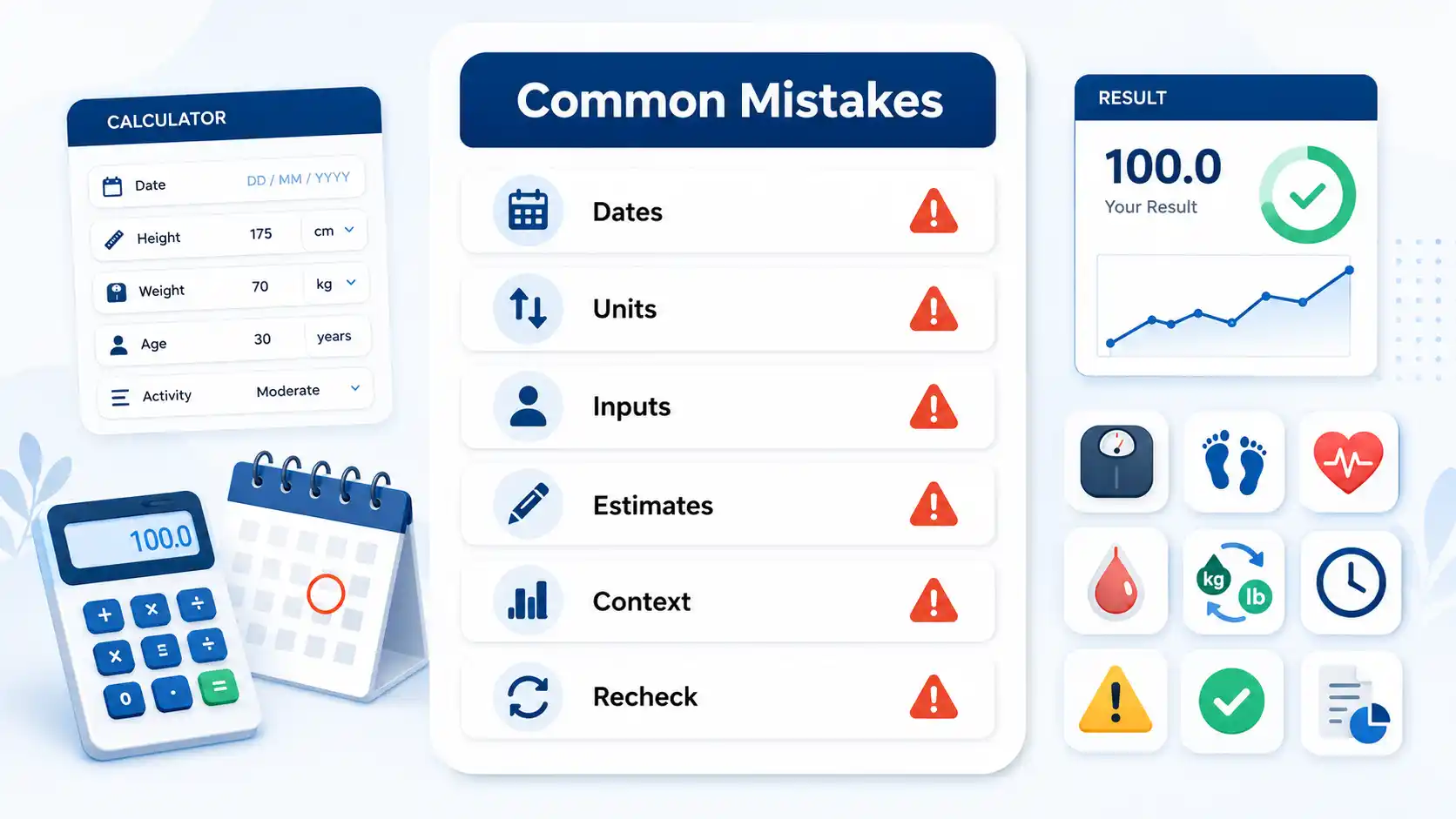
Try calculatorCommon Mistakes When Using the Luteal Phase Calculator
A Luteal Phase Calculator result can look wrong when cycle dates come from predictions, spotting, or mixed counting methods. Small input differences may shift the result by a day or change a measured result into an estimate. Watch for these common errors before interpreting your luteal phase length.
- Using an app-predicted ovulation date as confirmed ovulation, which can make a calendar estimate look like a measured result.
- Entering spotting instead of the first day of your following period, which may close the luteal interval too early.
- Counting the following-period day as another luteal day, which can make your manual count one day longer than 100Calc.
- Entering a future predicted period in tracked mode, which can make an unfinished cycle appear to have a completed luteal interval.
- Treating an estimated 11–17 or 12–14 day window as your personal luteal length, even though ovulation was never known.
Frequently Asked Questions (FAQs)
Can I Calculate My Luteal Phase Before My Next Period Starts?
No. A measured luteal phase needs a known ovulation date or best estimate and the first day of the following period. If that period has not started, the interval is not complete. You can still use estimated mode to see a likely timing window based on your cycle average.
What Date Should I Enter After a Positive Ovulation Test?
A positive ovulation test detects an LH surge, not the exact moment ovulation happens. Do not automatically enter the positive-test date as confirmed ovulation. Use your best-supported ovulation estimate from tracking. If the date is too uncertain, estimated mode gives a more honest result.
Can I Use a Luteal Phase Calculator With Irregular Cycles?
Yes, tracked mode can still be useful with irregular cycles because it uses the dates from one completed cycle. Estimated mode carries more uncertainty when cycle length changes often. A changing average cycle length can shift the predicted next period and estimated ovulation window.
Is Cycle Day 21 Always the Mid-Luteal Phase?
No. Mid-luteal timing depends on when ovulation happened, not a fixed cycle day. This calculator places the approximate mid-luteal period about 6–8 days after ovulation. Someone who ovulates later may reach the same point well after cycle day 21.
Can I Use the Calculator Without Knowing My Average Cycle Length?
Yes, if you use tracked mode and know your ovulation date or best estimate and following-period date. Average cycle length is not required for that measurement. If ovulation is unknown, estimated mode needs an average cycle length to project the next period and build the timing window.
Questions?
We had love to hear from you! Whether you are reporting an issue, suggesting a new calculator, or exploring collaboration opportunities — we are here to help. Every message helps us make 100calc smarter, faster, and more helpful for everyone.
Why People Trust 100calc
At 100calc.com, we focus on accuracy, speed, and trust. Every calculator we create is designed to give reliable, instant, and easy-to-understand results you can truly depend on.